
Choosing the wrong capstone project is the single biggest mistake BSIT students make, and most don’t realize it until 3 months in, when changing direction is too painful. The wrong project means 6 months of suffering, a weak defense, and possibly delayed graduation. The right project means clean execution, confident defense, and a portfolio piece that opens job interviews.
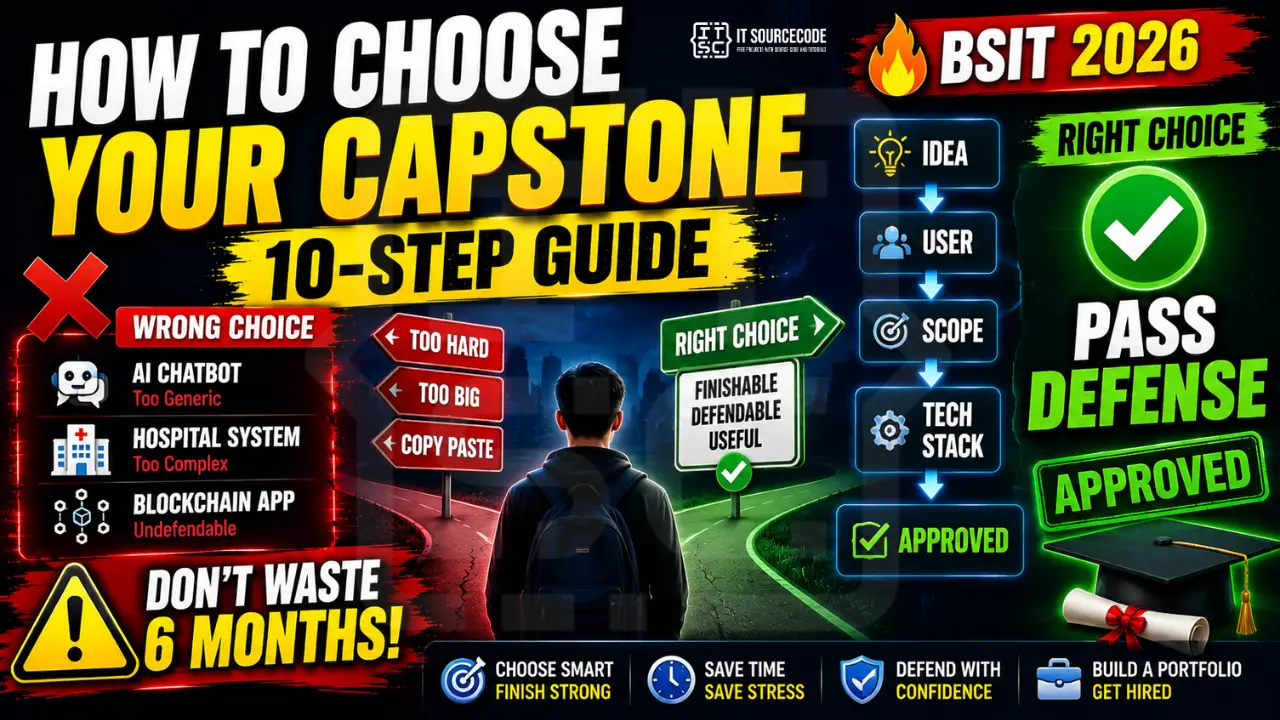
This 10-step decision guide walks you through choosing a capstone you can actually finish, defend, and be proud of. Based on observing 300+ BSIT capstones at PIES Information Technology Solutions over the past 5 years.
Step 1: Define your constraints first (not your ideas)
Before brainstorming exciting topics, write down what’s NOT negotiable:
- Team size: Solo, pair, or 3-5 members? Larger teams need bigger projects but coordination overhead drowns them.
- Time available: 6 months? 9? Including thesis writing AND development?
- Required tech stack: Did your school mandate PHP/MySQL? Or are you free to use any stack?
- Hardware constraints: Can your laptop run the project? AI/ML capstones need 16GB RAM minimum (see our laptop guide).
- Adviser availability: Some advisers won’t accept certain domains. Ask BEFORE you commit.
- Budget: If your project needs paid APIs (OpenAI, SMS gateways), where’s the budget?
Constraints kill 60% of bad capstone ideas immediately. Skipping this step is why students waste weeks brainstorming projects they can never execute.
Step 2: Choose a domain you actually understand
Build for a domain you’ve actually worked in or experienced. If you’ve never set foot in a clinic, building a “Clinic Management System” means inventing fake requirements. Defense panels detect this immediately and ask hard questions you can’t answer.
Domains BSIT students naturally know:
- Your school’s enrollment, library, or grading system
- Your barangay or LGU’s services (citizen requests, permits)
- Your family business (sari-sari store, eatery, parlor, transport)
- Your part-time job’s processes (BPO, retail, food service)
- A student club or organization you’ve been part of
Domains BSIT students fake (avoid):
- Hospital management (unless someone in the team has medical background)
- Bank/financial systems (heavy compliance requirements)
- Hotel chain management (most students never worked in hospitality)
- Industrial manufacturing (operations you’ve never observed)
Step 3: Find one specific real user who’d benefit
Your panel will ask: “Who is this for?” If your answer is “schools in general” or “small businesses everywhere,” you’ll get grilled. Specific is defensible.
Weak: “An attendance management system for small businesses.”
Strong: “An attendance management system for Aling Marie’s Eatery in Quezon City, replacing her current paper-based time-in/time-out logbook tracking 8 employees.”
Even better: get a written endorsement letter from that real user agreeing to be your case study subject. Defense panels respect this immensely.
Step 4: Verify the problem is real (not assumed)
Interview your target user BEFORE coding. Ask:
- “Walk me through how you currently do [process X]”
- “What’s the most frustrating part?”
- “How much time does it take per day/week?”
- “Have you tried solving this before? What happened?”
- “If I built a system to fix this, would you actually use it?”
Document this conversation in your Chapter 1 (Problem Statement). Quotes from real users are gold during defense.
If the user says “I don’t have that problem” or “the current process works fine,” that’s a STOP sign. Find a different problem or a different user.
Step 5: Right-size the scope
The #1 capstone failure mode is over-scoping. Aim for a system you can complete in 60% of the available time: leaving buffer for testing, defense prep, and unexpected delays.
Right-sized capstone has:
- 3-6 main modules (e.g., User Mgmt, Inventory, Sales, Reports, Notifications)
- 5-10 database tables
- 3-4 user roles (admin, manager, employee, customer)
- Web-based with one bonus integration (SMS, email, or basic AI)
Over-scoped capstone has:
- 10+ modules, “complete ERP”, “full marketplace”
- Mobile app + web app + admin dashboard (3 codebases)
- Multi-tenant SaaS with billing, subscriptions, multiple workspaces
- Custom AI training (vs using APIs)
Step 6: Pick a tech stack you can ALREADY use
Capstone is NOT the time to learn a new framework from scratch. You’ll spend 3 months learning + 3 months building badly. Instead: build on what you already know.
Recommended stacks by familiarity:
- Comfortable with PHP? → PHP + MySQL or Laravel + MySQL
- Comfortable with Python? → Python + Django + MySQL/PostgreSQL
- Comfortable with Java? → Java + NetBeans + JDBC + MySQL
- Comfortable with JavaScript? → React + Node.js + MongoDB (MERN)
- Comfortable with VB.NET? → VB.NET + SQL Server (desktop apps only)
Browse our Free Projects hub for 500+ working examples in each stack. Clone, study, then build your own.
Step 7: Validate uniqueness (avoid plagiarism flags)
Search for “[your project name] capstone” + “[your project name] thesis pdf” on Google + Scribd + Academia.edu. If 5+ similar projects exist verbatim, change your angle:
- Add a unique twist (SMS reminders, AI-powered recommendation, specific Philippine context)
- Combine 2 systems (Inventory + Loyalty Rewards, not just Inventory)
- Apply to underserved sector (sari-sari stores have fewer capstones than restaurants)
Step 8: Verify defendability
Imagine your panel asking: “Why this technology? Why this approach? Why these features?” If you can’t answer with confidence, your project has a defendability problem.
Defendable choices have clear reasoning:
- “We chose PHP because the client uses standard shared hosting”
- “We built mobile-first because 80% of target users access via phone”
- “We integrated SMS because email penetration in our barangay is <30%”
Step 9: Build a 1-page proposal first
Before writing your full Chapter 1, write a 1-page proposal:
- Title: Specific, includes target user
- Problem: 2-3 sentences with quote from real user interview
- Solution: 5-7 bulleted features
- Tech stack: Concrete (PHP 8.2, Laravel 11, MySQL 8, Bootstrap 5)
- Timeline: Month-by-month deliverables
- Defense risks: What questions you anticipate + how you’ll answer
Share with your potential adviser. If they reject the proposal, you’ve saved 6 months. If they accept, expand it into your full Chapter 1 using our writing guide.
Step 10: Lock in, then EXECUTE
Once your adviser approves, stop second-guessing. The best capstone is one you actually finish. Constant pivoting kills 30% of capstones that started with good ideas.
When new ideas surface mid-project, write them down in a “future enhancements” doc, and discuss them in Chapter 5 (Recommendations) instead of pivoting.
Common Capstone Mistakes to Avoid
- Choosing a topic just because it sounds impressive: “Blockchain Voting System” sounds cool but is undefendable without cryptography knowledge
- Cloning a popular capstone verbatim: panels Google check; plagiarism = failure
- Starting without a written proposal: fuzzy starts = fuzzy ends
- Solo developers picking 5-person scope: match scope to team size
- Choosing tech stack to “learn it for resume”: capstone isn’t a tutorial
- Ignoring adviser feedback in Week 1: they’ve seen 100 capstones; you haven’t
Frequently Asked Questions
Looking for your capstone project idea?
Browse our complete list of 150 Best Capstone Project Ideas for IT Students (2026 Edition), covering Web, Mobile, AI, Database, and Game Development topics with full descriptions and defense scope.
How long before defense should I start choosing my capstone?
Can my capstone be a clone of an existing system?
What if my adviser rejects my proposal?
Should I use AI/ML in my capstone to impress the panel?
What’s the difference between BSIT and BSCS capstone topics?
Where can I find capstone project ideas?
Final Thoughts
The students whose capstones succeed don’t start with “what should I build?” They start with “what’s broken in a world I understand, who’s affected, and how can I fix it with my current skills?” That question filters out 80% of bad ideas before you waste time on them.
🎯 Your next steps:
- Write down 3 problems in domains YOU understand (Step 2-4)
- Pick ONE, interview the real user (Step 4)
- Browse our 50+ Capstone Ideas for stack-specific suggestions
- Draft your 1-page proposal (Step 9)
- Review our guide to finding the right thesis adviser

Adrian Mercurio
Full-Stack Developer at PIES IT Solution
Specializes in building complete capstone projects with full documentation. Strong background in PHP/MySQL development and database design. Has personally built and tested over 30 capstone-ready projects with ER diagrams, DFDs, and chapter-by-chapter thesis documentation.
Expertise: PHP · Laravel · Database Design · Capstone Projects · C# · C · C++ · Python · AI Projects · View all posts by Adrian Mercurio →