
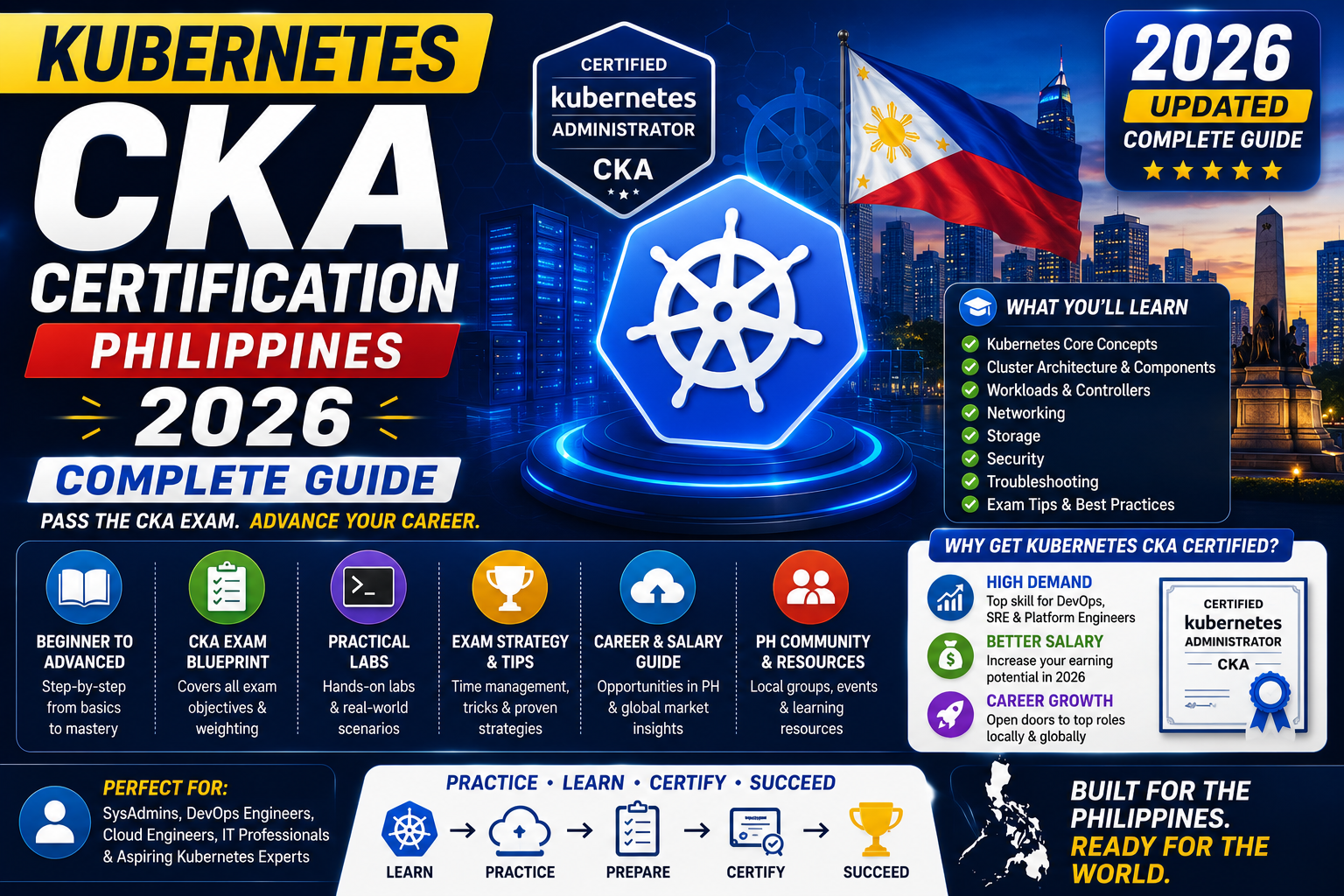
The Certified Kubernetes Administrator (CKA) is the most respected Kubernetes credential in the world. Unlike AWS, Azure, or GCP certifications, CKA is 100% hands-on: no multiple choice, no case studies, just a live terminal in front of a real Kubernetes cluster where you solve problems against the clock. For Filipino engineers moving into DevOps or Site Reliability Engineering (SRE), CKA is the gold standard. Here is what you need to know as a Filipino candidate in 2026.
What CKA tests you on
The exam gives you 2 hours in a live terminal environment. You get 15 to 20 tasks to complete on real Kubernetes clusters. Domains and weights:
- Storage (10%): Persistent volumes, storage classes, dynamic provisioning
- Troubleshooting (30%): Debugging pods, nodes, networking, DNS, cluster components
- Workloads and scheduling (15%): Deployments, ConfigMaps, Secrets, taints, tolerations, affinity
- Cluster architecture, installation, configuration (25%): RBAC, kubeadm, cluster upgrades, etcd backup and restore
- Services and networking (20%): Services, ingress, CoreDNS, network policies, CNI basics
The pass score is 66% (yes, only 66%). Kubernetes is deep and the Linux Foundation intentionally sets a lower bar because the exam is harder than any multiple-choice test.
Exam cost for Filipinos in 2026
The CKA exam costs USD 395, roughly PHP 22,200 to 22,700. This is the highest cost among the certs in this batch, but it also includes one free retake if you fail. The Linux Foundation runs frequent discounts of 30-40%, so watch their site for the current promo code before you buy.
With a typical Linux Foundation discount (usually 30%), the exam drops to about PHP 15,500 to 16,000.
Additional realistic budget:
- Practice test lab from Killer.sh (2 sessions included free with the exam purchase)
- Course (Mumshad Mannambeth’s Udemy CKA course): PHP 500 to 1,000
- Practice cluster on a spare VM or KIND locally: free
- Free retake: included if you fail once
Realistic total: PHP 17,000 to 24,000 for a first-time pass with the Linux Foundation discount.
Study path for Filipino candidates
A 10-to-12-week plan (CKA takes longer than multiple-choice certs because everything is hands-on):
Week 1-2: Kubernetes fundamentals. If Kubernetes is new to you, work through Mumshad Mannambeth’s course from Udemy. Understand pods, deployments, services, and namespaces.
Week 3-5: Networking and services. Deep dive on services (ClusterIP, NodePort, LoadBalancer, ExternalName), ingress, CoreDNS, and network policies. Set up a Calico or Cilium CNI plugin locally.
Week 6-7: Storage and workloads. Persistent volumes, storage classes, StatefulSets. ConfigMaps and Secrets deep dive. Deployments vs DaemonSets vs Jobs.
Week 8-9: Cluster admin. Install a cluster with kubeadm. Practice upgrading it. Back up and restore etcd. RBAC setup. This is a big chunk of the exam.
Week 10: Troubleshooting. Practice diagnosing broken pods, unreachable services, DNS issues, and node failures. Speed matters here because 30% of the exam is troubleshooting.
Week 11-12: Practice exams on Killer.sh. Killer.sh gives you two 6-hour sessions of practice problems that are HARDER than the real exam. If you can score 60%+ on Killer.sh, you will pass CKA.
Study materials Filipino candidates rely on
- Mumshad Mannambeth’s CKA course (Udemy). The most-used single resource. Comes with a KodeKloud lab environment.
- KodeKloud CKA labs. Interactive labs matched to Mumshad’s course.
- Killer.sh (free with exam purchase). Best exam simulator. Harder than the real exam. Non-negotiable prep.
- Kubernetes.io documentation. Bookmarks allowed during the exam so know it well.
- CKA Simulator on GitHub (community-run). Additional practice tasks with solutions.
Salary impact after passing in the Philippines
CKA has the highest salary impact of any cert in this batch because DevOps and SRE roles pay a premium and Kubernetes talent is scarce in the Philippines:
- Junior DevOps engineer with CKA: PHP 70,000 to 100,000 starting
- Mid-level DevOps or SRE, 3-5 years: PHP 120,000 to 180,000
- Senior DevOps or SRE: PHP 200,000 to 320,000
- Remote roles for US/EU companies: USD 6,000 to 12,000 monthly (PHP 340,000 to 680,000)
Filipino DevOps engineers with CKA who work remotely for US companies often earn more than a mid-level Silicon Valley engineer’s equivalent Philippine peso value, because Kubernetes skill is portable across all cloud providers and every serious tech company runs on it.
Should you take CKA or CKAD?
- You want to be a DevOps engineer, SRE, or cluster administrator: CKA. It is the deeper cert and covers cluster ops.
- You are a developer who deploys apps to existing Kubernetes clusters: CKAD (Certified Kubernetes Application Developer). It focuses on the developer side and skips cluster admin.
- You want the most marketable single cert: CKA. It signals both admin and developer skills, so it opens more doors.
- You have time and budget: Do CKAD first (easier, cheaper), then CKA. The overlap is substantial.
Common mistakes Filipino candidates make
- Not practicing on the terminal. The exam is a live terminal. Speed with kubectl matters. Learn the aliases (k for kubectl), bash completion, and vim basics.
- Skipping Killer.sh. The two free sessions are the best prep. Do the first one at 60% ready and the second right before the exam.
- Underestimating troubleshooting. 30% of the exam. Practice broken clusters, not just working ones.
- Not knowing kubectl documentation search. During the exam you can browse kubernetes.io. Practice finding what you need quickly (use Ctrl+F on the docs page).
- Ignoring etcd backup. Small topic but classic exam question. Know the exact commands.
- Panicking on the first hard task. Flag it and move on. Come back if you have time. Do not sink 30 minutes into one task.
Booking your CKA exam
Book through the Linux Foundation training portal. CKA is online proctored only (no test center option). Requirements:
- Stable internet (10 Mbps or faster)
- Webcam and microphone
- Clean private room (proctor will scan it via webcam)
- Government-issued photo ID
- Chromium-based browser (Chrome or Edge, not Firefox or Safari)
The exam runs on a Linux Foundation VM in your browser. Your local internet needs to be stable for the full 2 hours. Filipino candidates with occasional PLDT or Converge dropouts should schedule for very early morning (5-7 AM PH) when internet is most reliable.
Official documentation
Frequently asked questions
Is CKA harder than AWS SAA-C03?
Significantly harder. SAA-C03 is multiple choice. CKA is a live terminal exam that tests speed and accuracy under time pressure. Most Filipino candidates who have taken both say CKA takes 2-3x longer to prepare for.
How long is CKA valid?
Two years. Renewal requires retaking the current CKA exam. There is no shortcut through other certs. Set a reminder 90 days before expiration to plan your review.
Can I use kubectl aliases during the exam?
Yes and you should. The most common alias is “alias k=kubectl”. Set this at the start of the exam and use k everywhere to save typing. Also enable bash completion for kubectl subcommand hints.
Which cloud provider should I practice Kubernetes on?
For CKA prep, use kubeadm on local VMs (free) or KIND (Kubernetes in Docker, also free). Cloud-managed Kubernetes (EKS, GKE, AKS) hides the cluster admin details that CKA tests. Practice on raw kubeadm clusters.
Is CKA worth USD 395 for a Filipino candidate?
Yes if you are targeting DevOps, SRE, or platform engineering roles. The salary bump easily pays back the exam cost in the first month of your new role. If DevOps is not your career direction, take AWS SAA-C03 or AZ-104 instead for broader value.
What happens if my internet drops during the exam?
Short drops (under 5 minutes) usually resume automatically. Longer drops require contacting Linux Foundation support afterward. They typically grant a free retake. Do not switch to mobile hotspot mid-exam because IP changes trigger a proctor security review.