
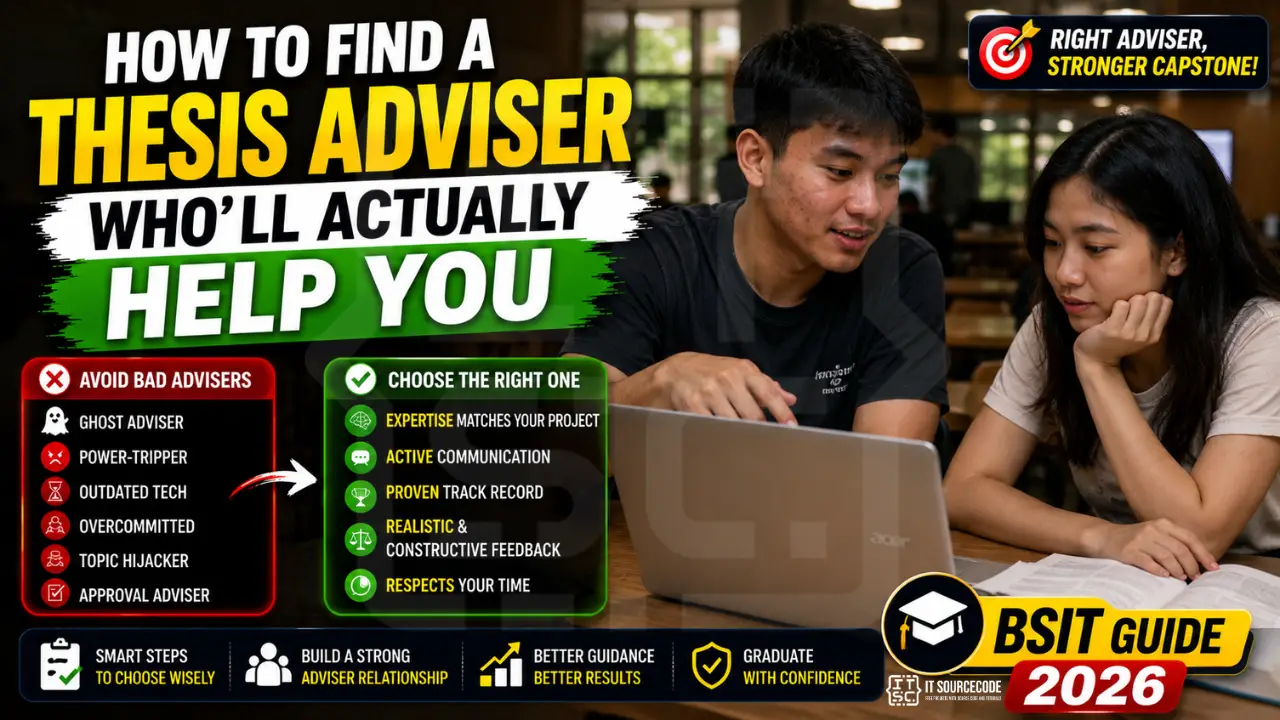
Your thesis adviser shapes the quality of your capstone almost as much as your own effort. The right adviser gives sharp feedback that strengthens your work; the wrong one is either absent (no help when you need it) or hostile (rejecting your ideas without explanation). This guide helps you find a thesis adviser who’ll genuinely help you graduate.
Why Your Adviser Choice Matters MORE Than You Think
Your adviser will:
- Approve or reject your proposal: wrong adviser kills your topic before you start
- Sign off on your chapters: without their signature, no defense
- Prep you for defense questions: they often KNOW which panelists ask what
- Influence your final grade: adviser’s grade is usually 40-60% of capstone score
- Write recommendation letters: for jobs, scholarships, internships
Most students treat adviser selection as random (“whoever’s available”). That’s a mistake. Treat it like job interviews, both sides should choose carefully.
What Makes a Great Thesis Adviser
1. Domain expertise that matches your project
If you’re building an AI capstone, your adviser should know AI. If you’re building a web system, they should know modern web development. An adviser whose expertise is “general IT” but who hasn’t coded in 5 years cannot give you sharp technical feedback.
2. Active communication style
Look for advisers who: respond to emails within 24-48 hours, schedule regular meetings (not just defense week), and give written feedback (not just verbal). Async-friendly advisers in 2026 are the strongest, they review your code/chapter changes in Google Docs or GitHub and leave specific comments.
3. Track record with capstones
Ask senior students who their advisers were and how those went. Advisers who consistently produce strong defenders + on-time submissions are gold. Avoid advisers whose past students perpetually delay defense.
4. Realistic feedback (not just praise OR just criticism)
Best advisers tell you: “These 3 sections are strong. Section 4 has a flaw, here’s why. Your panel will ask X, prepare for it.” Worst advisers either: only praise (you’ll get destroyed at defense), or only criticize (no actionable guidance).
5. They respect your time
Great advisers honor scheduled meetings, give clear deadlines, and don’t randomly ask for major rewrites the day before submission. They treat you as a junior colleague, not a subordinate.
Red Flags to AVOID
- The Ghost Adviser: assigned by department, never replies, signs only at deadline. Your defense will be brutal because you’ve had no prep.
- The Power-Tripper: uses adviser role to humiliate students, demands excessive revisions to prove dominance. Often has 0-5 successful capstone graduates in their history.
- The Outdated Tech Adviser: insists on PHP 5.6 in 2026, can’t help with modern frameworks. Your project becomes dated before defense.
- The Overcommitted Adviser: advising 10+ students simultaneously, plus teaching 5 classes. You’ll be ignored.
- The Topic Hijacker: wants you to build THEIR research idea, not yours. Your defense feels like an exam on their thinking.
- The Approval Adviser: signs anything without real review. Feels nice until your defense panel destroys you because issues weren’t caught.
How to Find Your Best-Fit Adviser
Step 1: List your top 5-7 candidate professors
Walk through your department directory. Identify professors whose:
- Specialization aligns with your project domain (web dev, AI, mobile, etc.)
- You’ve taken at least one class with (you know their style)
- Are full-time faculty (not visiting/adjunct who may leave)
- Have recent papers/projects (signal of active engagement)
Step 2: Research their track record
Ask 4th-year students or recent graduates: “Did you have [Prof X] as adviser? How was it?” Patterns matter, 2-3 negative responses about the same adviser = red flag. Check the department’s archive of past capstones, who advised the ones you respect?
Step 3: Set up an informal pre-commit meeting
Don’t formally request advising until you’ve talked. Email or message:
“Good day Sir/Ma’am, I’m exploring capstone topics in [domain]. Would you be open to a 20-minute meeting to discuss whether my topic fits your expertise? I’d value your input before I commit to a direction.”
In the meeting, bring your 1-page proposal (from Step 9 of our capstone decision guide). Their first reaction tells you everything:
- Engaged, asks deep questions: Strong candidate.
- Vague approval, no real engagement: Will be a Ghost Adviser.
- Wants to redirect to THEIR research: Topic Hijacker risk.
- Specific critique with reasoning: Best candidate.
Step 4: Ask logistics questions
Before formal commitment, ask:
- “How many students are you currently advising?” (more than 5 = likely overcommitted)
- “How do you prefer to communicate, email, chat, in-person?”
- “How often do you typically meet with advisees?”
- “What’s your expected turnaround time for chapter feedback?”
- “What does success look like, what makes a strong capstone in your view?”
Watch their answers. If they hedge, are unclear, or visibly annoyed at logistics questions, that’s the relationship you’d have for 6 months.
Step 5: Get formal approval
Once you’ve found your match, follow your department’s formal request process. Send a written commitment + your latest proposal + your team’s contact info. Keep the email chain, proof of timely commitment matters during disputes.
How to Be a Great Advisee (Your Half of the Relationship)
Even the best adviser fails when paired with a bad advisee. Your job:
- Come prepared. Before every meeting, send an agenda (3-5 bullet points) and your latest progress.
- Make decisions, then ask for review. Don’t ask “what should I do?” Say “I plan to do X because of Y. Any objections?”
- Respect their time. Don’t message at 11pm expecting immediate reply. Don’t request emergency meetings the day before deadlines you knew about.
- Take notes during meetings. Send a summary email after: “To confirm, you advised X, I’ll do Y by [date].” Creates a paper trail.
- Act on feedback within 1 week. Ignoring their feedback for a month then submitting unchanged work is the fastest way to lose their trust.
- Acknowledge effort. A simple “thank you for the detailed feedback” goes far. They’re human.
When the Relationship Breaks Down
Sometimes the partnership doesn’t work despite good intentions. Signs it’s failing:
- 3+ weeks of zero communication despite your follow-ups
- Demands for major rewrites without explaining reasoning
- Inconsistent feedback (says X this week, then opposite next week)
- Personal attacks or humiliating language
- Demanding work outside academic scope (running their personal errands)
What to do:
- Document everything (screenshots, dates).
- Talk privately to your department chair or capstone coordinator.
- Request adviser reassignment with documented evidence.
- If reassignment denied, escalate to dean’s office.
Reassignment usually delays your timeline by 1-2 months but is worth it. Suffering with a destructive adviser for 6 months wastes more time than the reassignment delay.
Frequently Asked Questions
Plan your BSIT capstone end-to-end
Can I choose my own adviser or does the department assign one?
What if multiple groups want the same popular adviser?
How often should I meet with my thesis adviser?
What if my adviser disagrees with my chosen tech stack?
Should I switch advisers if it’s not working out?
Can my adviser be from outside my department or school?
Final Thoughts
Your thesis adviser relationship is the single most important relationship of your capstone year. Choose them as carefully as you’d choose a co-founder, because for 6-9 months, they ARE your co-founder. Time spent on adviser selection pays back 10x in smoother development, sharper defense prep, and stronger recommendations.
🎯 Your action plan:
- List 5-7 candidate advisers from your department
- Ask 2-3 senior students about each (track record)
- Schedule 20-min informal meetings with your top 2-3
- Bring our 1-page proposal template to each meeting
- Once committed, set bi-weekly meeting cadence + send post-meeting summaries

Adrian Mercurio
Full-Stack Developer at PIES IT Solution
Specializes in building complete capstone projects with full documentation. Strong background in PHP/MySQL development and database design. Has personally built and tested over 30 capstone-ready projects with ER diagrams, DFDs, and chapter-by-chapter thesis documentation.
Expertise: PHP · Laravel · Database Design · Capstone Projects · C# · C · C++ · Python · AI Projects · View all posts by Adrian Mercurio →