
Title defense is the first hurdle in capstone. It’s also the one most groups underestimate.
By the time you reach title defense day, your panel hasn’t seen your code, hasn’t read your RRL, hasn’t met your respondents.
They are judging an idea (your idea) based on a 7-slide presentation and 15 minutes of Q&A. If it fails, you start over from topic selection. A bad title defense can set your project back six weeks.
The students who breeze through title defense aren’t smarter. They prepared specifically for it. And, they wrote a tight problem statement.
They drafted a clear title. They knew which questions the panel would ask and had answers ready.
This guide walks through the title defense format, the slides you need, the questions panels ask, and the five reasons most titles get rejected.
By the end, you should be able to walk into your title defense ready to come out approved on the first try.
What title defense actually evaluates
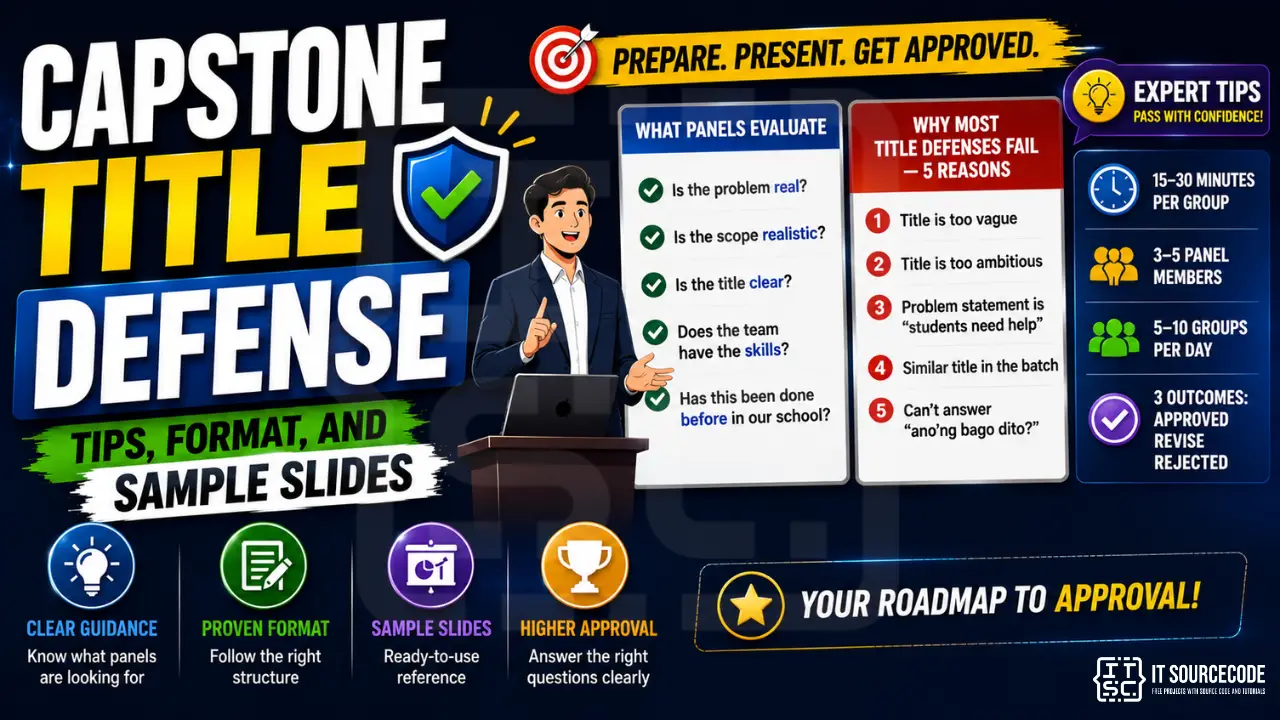
Title defense is short: typically 15 to 30 minutes per group. Panels are evaluating five things during that window:
Is the problem real? Can you point to a specific user group with a specific pain point? Vague problems like “students need help” don’t pass.
Is the scope realistic for 4-6 months? Most BSIT capstones run 12-16 weeks. If your proposal would take a 5-person engineering team a year to build, the scope is wrong.
Is the title clear? When a panel member reads your title, can they immediately understand what you’re building? If they have to ask “what does this mean?”, the title is too vague.
Does the team have the skills? Have you built anything similar before? Do at least one or two team members know the tech stack you proposed?
Has this exact thing been done before in your school? Panels reject duplicate titles. If three other groups in your batch proposed “Online Ordering System for Cafeteria,” at most one gets approved.
If you can answer all five questions clearly in your title defense, approval is likely.
Why most title defenses fail: 5 reasons
We’ve watched hundreds of title defenses across BSIT programs in the Philippines and India. The same five patterns kill proposals over and over.
1. Title is too vague. “AI System for Students” tells the panel nothing. Who are the students? What does the AI do? AI in what sense? Vague titles signal vague thinking.
2. Title is too ambitious. “AI-Powered Multilingual Educational Platform with VR Integration for K-12, College, and Corporate Training” cannot be finished in 4 months by anyone, let alone a 4-person BSIT team. Panels know this.
3. Problem statement is “students need help” with no specifics. A real problem statement names a specific user group, a specific pain, a specific impact, and a specific gap. Anything less is a wish list.
4. Another group in the batch has a similar title. Panels track this across the day. If your title overlaps with another group’s, one of you will be asked to change.
5. The team can’t answer “ano’ng bago dito?” This question gets asked at almost every Filipino BSIT title defense. If your three-word answer is “ours is for our school,” your project is going to feel small. Have a sharper differentiator.
The standard title defense format
What to expect on the actual day:
- 5 to 10 minute presentation. Walk through your 5-7 slide deck. Don’t go over time.
- 10 to 20 minute Q&A. The panel asks questions. Each member usually gets 2-4 questions.
- 3 to 5 panel members. Typically your adviser, the program chair, and 1-3 senior faculty.
- 5 to 10 groups defending the same day. You may wait an hour for your turn, or you may be first.
- Decision delivered at the end. Three possible outcomes: Approved, Approved with Revisions (most common), or Rejected.
- If you’re rejected, you’ll typically have 1-2 weeks to revise and re-defend.
- If you’re approved with revisions, you submit a written revision within the deadline.
- If you’re approved outright, you can immediately start Chapter 1.
Title defense slide template
Five to seven slides. No more. Panels punish bloat.
Slide 1: Title Slide
- Project title (large, centered)
- Team member names
- Adviser name
- School name and year
Slide 2: Problem Statement (one sentence + supporting context)
- One bold sentence stating the problem
- 2-3 bullet points of supporting context
- Source citation if you have one
Example:
“Rice farmers in Negros Occidental lose an average of 15% of their harvest each season because they cannot identify common diseases like Rice Blast and Brown Spot until visible damage is widespread.”
Slide 3: Beneficiaries
- Primary beneficiaries (named specifically)
- Secondary beneficiaries
- Institutional benefit
Example:
Primary: Rice farmers in Negros Occidental (estimated 12,000 households)
Secondary: Agricultural extension officers, DA-PhilRice
Institutional: Demonstrates university’s contribution to local agriculture
Slide 4: Proposed Solution
- One-paragraph description of what you’ll build
- Key features in bullets (3-5 max)
- Visual mockup or sketch (optional but impressive)
Example:
We propose the development of a mobile application that uses image processing and machine learning to identify common rice diseases from photos of rice leaves. Farmers can capture or upload an image, and the system will analyze it to detect diseases such as Rice Blast, Brown Spot, and Bacterial Leaf Blight. The application will also provide disease information and recommended management practices.
Key Features:
Image-based disease detection
Disease information and symptoms guide
Treatment and prevention recommendations
Disease history and reporting
User-friendly mobile interfaceVisual (Optional):
Camera → Disease Detection → Results → Recommendations
Slide 5: Scope and Delimitations
- 3 bullets: what we WILL cover
- 3 bullets: what we WON’T cover and why
Example:
Scope (What We Will Cover)
- Detection of selected rice diseases (Rice Blast, Brown Spot, Bacterial Leaf Blight)
- Mobile application development for Android devices
- Machine learning model trained using collected rice leaf images
Delimitations (What We Will NOT Cover)
- Detection of all rice diseases (limited to selected diseases only)
- Real-time drone or satellite monitoring
- Treatment effectiveness monitoring after recommendation
Slide 6: Tech Stack and Team Skills
- Technologies you’ll use
- Why each was chosen (one phrase per tech)
- Team member experience with each stack
Example:
| Technology | Purpose | Team Experience |
|---|---|---|
| Python | Machine learning model development | Intermediate |
| TensorFlow | Image classification | Beginner-Intermediate |
| Android Studio | Mobile app development | Intermediate |
| Firebase | Cloud database and authentication | Beginner |
| Git/GitHub | Version control and collaboration | Intermediate |
Why These Technologies?
- Python – Industry standard for AI development
- TensorFlow – Reliable image recognition framework
- Android Studio – Native Android application support
- Firebase – Easy backend integration
- GitHub – Efficient team collaboration
Slide 7: Timeline (mini-Gantt)
- Simple 12 or 16-week phase view
- Key milestones marked
- Reference to detailed Gantt chart in your proposal document
Example:
| Phase | Weeks |
|---|---|
| Requirements Gathering | 1-2 |
| System Design | 3-4 |
| Dataset Collection & Preparation | 5-6 |
| Model Development & Training | 7-9 |
| Mobile App Development | 10-12 |
| System Integration | 13 |
| Testing & Evaluation | 14-15 |
| Documentation & Final Revision | 16 |
Key Milestones
✓ Approved Proposal (Week 2)
✓ Trained AI Model (Week 9)
✓ Functional Mobile Application (Week 12)
✓ System Testing Complete (Week 15)
✓ Final Defense Ready (Week 16)
How to write a strong title
The 4-part formula:
[What it is] + [For Whom] + [Doing What] + [Using How]
Three examples this formula produces:
- “AI-Powered Capstone Mentor for BSIT Students Using LangChain RAG”
- “Mobile Crop Disease Detection App for Rice Farmers in Negros Occidental Using CNN”
- “Barangay Records Management System for Local Government Units Using PHP and MySQL”
Three titles this formula prevents:
- “AI Application for Students” (no What, no For Whom, no How)
- “Educational System” (no everything)
- “Smart Solution for Local Industry” (no specifics)
If your draft title fits the bad-example pattern, rewrite it. Apply the 4-part formula. The panel notices.
How to write a strong problem statement (60-second version)
One paragraph with four elements:
- Who has the problem
- What the problem is, specifically
- Why it matters now
- What happens if no one solves it
Template:
[WHO] face [WHAT SPECIFIC PROBLEM] because [SPECIFIC CAUSE]. This results in [SPECIFIC NEGATIVE OUTCOME] affecting [HOW MANY PEOPLE] in [SPECIFIC CONTEXT]. Without a solution, [LONG-TERM CONSEQUENCE].
Example for the crop disease project:
Rice farmers in Negros Occidental face delayed detection of common diseases like Rice Blast and Brown Spot because traditional visual inspection misses early-stage symptoms. This results in an average 15% harvest loss per affected household, impacting an estimated 12,000 farming families in the province. Without timely detection, farmers continue to lose income and food security at the community level deteriorates.
Memorize a version like this for your own project. Practice saying it in under 60 seconds. This is the most important paragraph you’ll ever write for your capstone.
20 questions panels ask at title defense
The most common questions, ranked by frequency.
- “Who specifically are your users?”
- “How is this different from [existing system]?”
- “What’s NEW about this?”
- “Can you finish this in 4 months?”
- “What if you can’t get respondents?”
- “Why this topic and not [related topic]?”
- “What’s your team’s technical background?”
- “Who’s the team leader?”
- “Will you partner with [external org]?”
- “What’s your scope NOT covering?”
- “Why this title and not a simpler version?”
- “Have you read related capstones in our library?”
- “What’s your adviser’s input on this?”
- “How will you evaluate success?”
- “What’s your dataset or data source?”
- “What’s your fallback if [key dependency] fails?”
- “Is this an IT problem or a [different field] problem?”
- “What’s your unique contribution?”
- “What’s the budget?”
- “When do you start development?”
Sample defensible answers for the top 5
Q1: “Who specifically are your users?”
Our primary users are [SPECIFIC GROUP]. For example: “120 senior high school students in Grade 12 STEM at our university.” Our secondary users are [SECONDARY GROUP]. We identified this user group through [METHOD: interviews, surveys, observation].
Q2: “How is this different from [existing system]?”
Compared to [EXISTING SYSTEM], our project differs in three ways. First, [DIFFERENTIATOR 1]. Second, [DIFFERENTIATOR 2]. Third, our specific context is [LOCAL OR DOMAIN CONTEXT] which existing systems do not address.
Q3: “What’s NEW about this?”
Three things distinguish our project. First, [NOVELTY 1: usually the combination of features]. Second, [NOVELTY 2: usually the local context or dataset]. Third, [NOVELTY 3: usually the evaluation approach or deployment method].
Q4: “Can you finish this in 4 months?”
Yes. We’ve broken the project into 6 sprints of 2 weeks each. The first 2 sprints cover the foundation (database, authentication, base UI). The middle 2 sprints cover core features. The last 2 cover polishing and UAT. Our scope is intentionally narrow to fit this timeline.
Q5: “What if you can’t get respondents?”
Our primary plan is to recruit through [SPECIFIC CHANNEL]. If that fails, we have two fallbacks: [FALLBACK 1] and [FALLBACK 2]. We’ve already had preliminary conversations with [SPECIFIC PERSON] who confirmed they can help us reach the user group.
Prepare similar specific answers for all 20 questions before your defense.
Common revisions panels request
When your title is “Approved with Revisions,” it’s usually one of these five:
1. Narrow the scope. Your proposal is too ambitious. Cut 1-2 features. Resubmit.
2. Specify the beneficiaries. “Students” became “Grade 12 STEM students at NOSU Binalbagan.” Get specific.
3. Pick a different name. Too similar to another group’s title. Reword to highlight your unique angle.
4. Strengthen the problem statement. Your problem is vague or unsupported. Add a statistic, a citation, or a real interview quote.
5. Change the technical approach. Your proposed tech stack doesn’t match your team’s skills or the problem. Switch to something more appropriate.
Each of these can be resolved in 1-2 days if you respond quickly. Do not sit on revisions. Turnaround time signals seriousness.
After title defense: next 3 steps
Don’t wait for full approval before starting work. Three things to do immediately after a successful title defense (or a “with revisions” outcome):
1. Submit the revised title within the deadline. Usually 1-2 weeks. Don’t wait until the last day.
2. Start Chapter 1 immediately. Use our Capstone Chapter 1-5 Template and fill in the sections you can write now: introduction, background, problem statement, beneficiaries, scope, definition of terms.
3. Begin literature review for Chapter 2 in parallel. Open Google Scholar. Find 5 papers per week. Build your sources gradually instead of cramming. Our Chapter 2 RRL guide walks through how to write defensible RRL paragraphs.
The 6 weeks between title defense and proposal defense (sometimes called preliminary defense) are when most groups fall behind. Use them.
What NOT to do at title defense
Eight mistakes to avoid:
- Reading slides verbatim. Panels can read. Talk through your slides, don’t recite them.
- Bringing only one team member who knows the project. Everyone in the group must understand the proposal.
- Saying “our adviser said this is fine.” Adviser endorsement is not the panel’s concern. Defend the choice yourself.
- Promising features you can’t actually build. Avoid scope inflation during Q&A. Stick to your slides.
- Not knowing why you chose your tech stack. “We chose Python because we know Python” is acceptable. “We chose it because the AI libraries are best for our use case” is better.
- Pitching multiple titles. “If this doesn’t pass, we have backup ideas.” Never. You’re defending ONE title.
- Disagreeing with the panel publicly. If they’re wrong, acknowledge politely and move on. Arguing is fatal.
- No printed copy of slides. Projectors fail. Always have hard copies.
Title defense day mindset: 5 quick tips
- Dress one level above your school’s usual. Smart casual, minimum. Some schools require business attire.
- Be early. Earlier than your defense slot. If something goes wrong (transit, printing, projector), you have buffer.
- Bring water. Title defense Q&A makes throats dry.
- Eat before defense. Not heavy, but enough that you’re not hungry.
- Sleep the night before. Cramming until 3 AM is the most common defense-day mistake. Your brain needs sleep more than it needs five extra facts.
Frequently Asked Questions
How long does a capstone title defense take?
What should I wear to capstone title defense?
What happens if my title gets rejected?
How do I prepare for capstone title defense?
Can I change my title after title defense?
Official references
Frequently Asked Questions
How long does a capstone title defense take?
A capstone title defense typically lasts 15 to 30 minutes per group, consisting of a 5 to 10 minute presentation and a 10 to 20 minute question and answer session. The total time block can extend if the panel requires extended Q&A or if multiple revisions need to be discussed. Most schools schedule 5 to 10 group defenses per day, so expect to wait for your turn. Decisions are usually delivered at the end of each defense or at the end of the day.
What should I wear to capstone title defense?
For capstone title defense, dress one level above your school usual attire. Smart casual at minimum: collared shirts, slacks or modest skirts, closed shoes. Some schools require business attire including blazers or sport coats. Avoid jeans, shorts, t-shirts with prints, sandals, or rubber slippers. Check your school capstone manual for specific dress code requirements. The defense is a formal academic event and dress signals seriousness.
What happens if my title gets rejected?
If your capstone title is rejected, you typically have 1 to 2 weeks to revise and re-defend. Rejection usually means one or more of: the scope is too ambitious or too narrow, the problem statement is unclear, the title overlaps with another group title, or the technical approach does not match your team skills. After rejection, meet with your adviser within 48 hours, identify the specific issues raised by the panel, draft a revised proposal, and schedule the re-defense within the school timeline. Most rejected groups pass on the second attempt.
How do I prepare for capstone title defense?
Prepare for capstone title defense through five activities. First, write your problem statement in one paragraph with four elements: who, what, why, and consequence. Second, draft your title using the 4-part formula: what it is, for whom, doing what, using how. Third, prepare 5 to 7 slides covering title, problem, beneficiaries, solution, scope, tech stack, and timeline. Fourth, anticipate at least 20 common panel questions and write specific answers using your project details. Fifth, do at least 2 dress rehearsals with your full team, once with your adviser if possible.
Can I change my title after title defense?
Yes, you can change your capstone title after title defense, but the rules vary by school. Minor wording changes such as renaming or clarifying scope are usually allowed without re-defending. Major changes such as switching the technical approach, changing the target user group, or shifting the problem area typically require either a written revision approval from your adviser and panel chair, or a new title defense. Always consult your adviser before making any change, and document the revision in your Chapter 1 background section.
Walk in with a tight title. Walk out approved.
Title defense doesn’t reward fancy. It rewards clear.
- Clear problem statement
- Clear beneficiaries.
- Clear scope
- Clear timeline
- Clear team capability.
If you have those five clarities, you’ll defend successfully. If you don’t, no amount of slide animation will save the proposal.
For the full Chapter 1-5 documentation that follows title defense, see our Capstone Chapter 1-5 Template. For Chapter 2 RRL paragraph examples, see our Chapter 2 RRL guide.
And,for Chapter 3 methodology with UML integration, see our Chapter 3 Methodology guide. For the questions panels ask at FINAL defense (after Chapter 4 and 5 are done), see our 50 Common Capstone Defense Questions.
For the Gantt chart that goes in your title defense Slide 7, see our Capstone Gantt Chart Template. If you haven’t picked a topic yet, browse 150 Best Capstone Project Ideas for IT Students 2026. For working source code to study before proposing technical features, see our Python projects library and free projects library.
Now print your slides. Practice your problem statement. Walk in tomorrow with confidence.
Title defense passed. Capstone begins.

Caren Bautista
Technical Writer at PIES IT Solution
Responsible for crafting clear, well-structured, and beginner-friendly content across the platform. Handles the writing, proofreading, and editorial review of tutorials, guides, and documentation to ensure every article is accurate, readable, and easy to follow.
Expertise: Technical Writing · Content Creation · Documentation · Editorial Writing · JavaScript · TypeScript · Python · Python Errors · HTTP Errors · MS Excel · View all posts by Caren Bautista →