Free Source Code, Capstone Projects & Programming Tutorials

Your trusted resource for downloadable source code, complete capstone projects with ER diagrams and Chapter 1-5 documentation, AI-ready capstones (RAG, ChatGPT, computer vision), and step-by-step tutorials in PHP, Python, Java, JavaScript, and more. Built by working developers, tested before publishing, and updated for 2026.

📅 Updated weekly | ✅ Code tested before publishing | 👨‍💻 Built by PIES IT Solutions developers

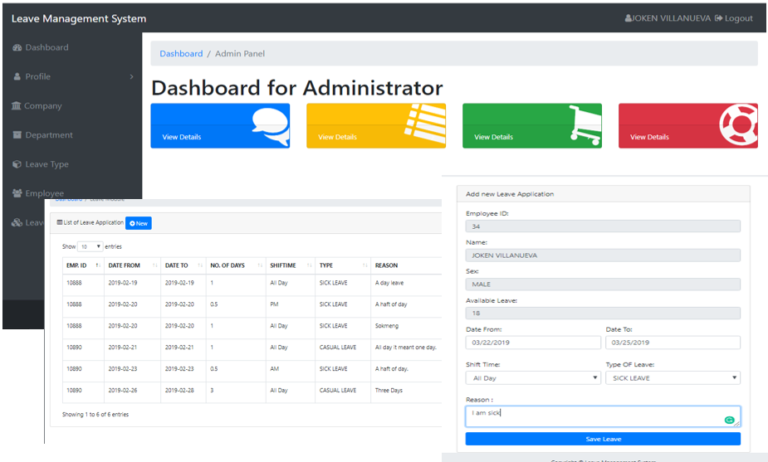
Leave Management System in PHP with Free Source Code
Leave Management System Source Code

Leave Management System in PHP is a PHP Project that allows you to manage multiple Companies with different departments such as administration, Human Resources, Information Technology, and many more. Using this …
Read more

School Management System Project In C++ With Source Code

School Management System Project In C++ With Source Code

The C++ School Management System is developed in C++ programming language, this School System C++ is based on the concept of generating the school’s Information records and adding new students …

Read more

How To Set Watermark In Word

MS Word Tutorial Watermarks

This chapter describes how to set a watermark in MS Word. It also works in MS word 2013, 2016 and higher version. A watermark is a faint image that appears behind …

Read more

How To Use Graphics In Word

MS Word Tutorial Graphics

We’ll talk about how to use graphics in Word 2019 in this chapter. You can make your Microsoft Word documents look nicer by adding different kinds of graphics. This section …

Read more

How To Use Templates In MS Word

MS Word Tutorial Templates

In this chapter, we’ll talk about how to use Word 2019 templates. The Microsoft Word template is a set of styles that tell Word how to format paragraphs, titles, and …

Read more

How To Apply Quick Styles In Word

MS Word Tutorial Quick Style

In this chapter, we’ll talk about how to apply quick styles in Word. Microsoft Word has a collection of Quick Styles that you can use for headings, titles, text, and …

Read more

The Easiest Way To Learn Java Array Of Generic Classes

The Easiest Way To Learn Java Array Of Generic Classes

How can I simulate generic arrays in Java? In Java, you can’t directly define a generic array, which means you can’t assign a parameterized type to an array reference. But …

Read more

What is Collection Hierarchy in Java

What Is Collection Hierarchy In Java

What is the hierarchy of Collection in Java? The hierarchy of the complete collection framework comprises four fundamental interfaces such as Collection, List, Set, and Map, as well as two …

Read more

How To Add Formula To A Table In Word 

MS Word Tutorial Add Formula

In this chapter, we will discuss how to add formula to a table in Word. Microsoft Word allows you to use mathematical formula in table cells which can be used …

Read more

Introduction To Java Programming And Data Structures

Introduction To Java Programming And Data Structures

What is data structure in Java Programming? A data structure and object-oriented programming are methods for storing and organizing data in order to make it easier to use and completely …

Read more

Frequently Asked Questions

Are these deep learning projects free for capstone and thesis use?
Yes. All deep learning projects on this hub are free to download, modify, and submit. No attribution required for academic use. Most are MIT-licensed or include source-code packs with sample datasets and pretrained model weights.
What deep learning frameworks do I need installed?
Most projects use OpenCV (cv2) for video capture and image preprocessing, plus one of: TensorFlow / Keras (Caffe model loading via cv2.dnn, custom CNN training), PyTorch (research-style models, YOLO v5+, transformers), or MediaPipe (Google's optimized face/hand/pose detectors). Install with pip install opencv-python tensorflow keras torch torchvision mediapipe numpy. Python 3.10, 3.11, or 3.12 recommended (avoid 3.13 until all wheels catch up).
Do I need a GPU to run these deep learning projects?
For inference (running a pretrained model on your webcam): no, CPU runs at 15-30 FPS for most computer-vision tasks. For training a custom model on your own dataset: GPU strongly recommended (CPU works but is slow). Free GPU options: Google Colab Free (12-hour sessions, sufficient for most BSIT capstones), Kaggle Notebooks Free (30-hour weekly quota), Paperspace Free tier. No need to buy a $1000+ GPU just for a capstone defense.
Deep learning vs classical machine learning, which should I pick for my capstone?
Pick deep learning when your inputs are unstructured (images, audio, video, text) and you have 10,000+ training samples. Pick classical ML (random forest, SVM, logistic regression) for tabular data, small datasets (under 1,000 rows), or when you need explainable predictions for the panel. Many capstones combine both: deep learning for feature extraction (face embedding via FaceNet) plus classical ML on top (SVM classifier for identity matching).
Why is my OpenCV deep learning model running at 2 FPS?
Three usual causes: (1) Resolution too high, resize frames to 640x480 or 320x240 before inference. (2) Wrong cv2.dnn backend, set net.setPreferableBackend(cv2.dnn.DNN_BACKEND_OPENCV) and net.setPreferableTarget(cv2.dnn.DNN_TARGET_CPU). (3) Heavy model on weak hardware, swap YOLO v5 for MobileNet-SSD or use Haar cascades for simple face/eye detection. Also close other applications and disable laptop battery-save throttling.
Can I extend a single OpenCV demo into a full BSIT capstone?
Yes, and you should. A standalone webcam demo (face detection alone) is too narrow for capstone scope. Wrap it in a real system: face recognition becomes Real-Time Attendance System with PHP/MySQL dashboard, object detection becomes Smart CCTV Alert System with email notifications, drowsiness detection becomes Driver Monitoring System for fleet vehicles. Add user accounts, database logging, simple admin UI, and write Chapters 1-5 manuscript to satisfy panel requirements.
How often is this deep learning projects list updated?
New deep learning projects are added periodically as we receive student requests and new models become OpenCV-compatible. Last refreshed June 2026 with 19 vision-focused projects covering face recognition, object detection, traffic-sign classification, OCR, and more.