
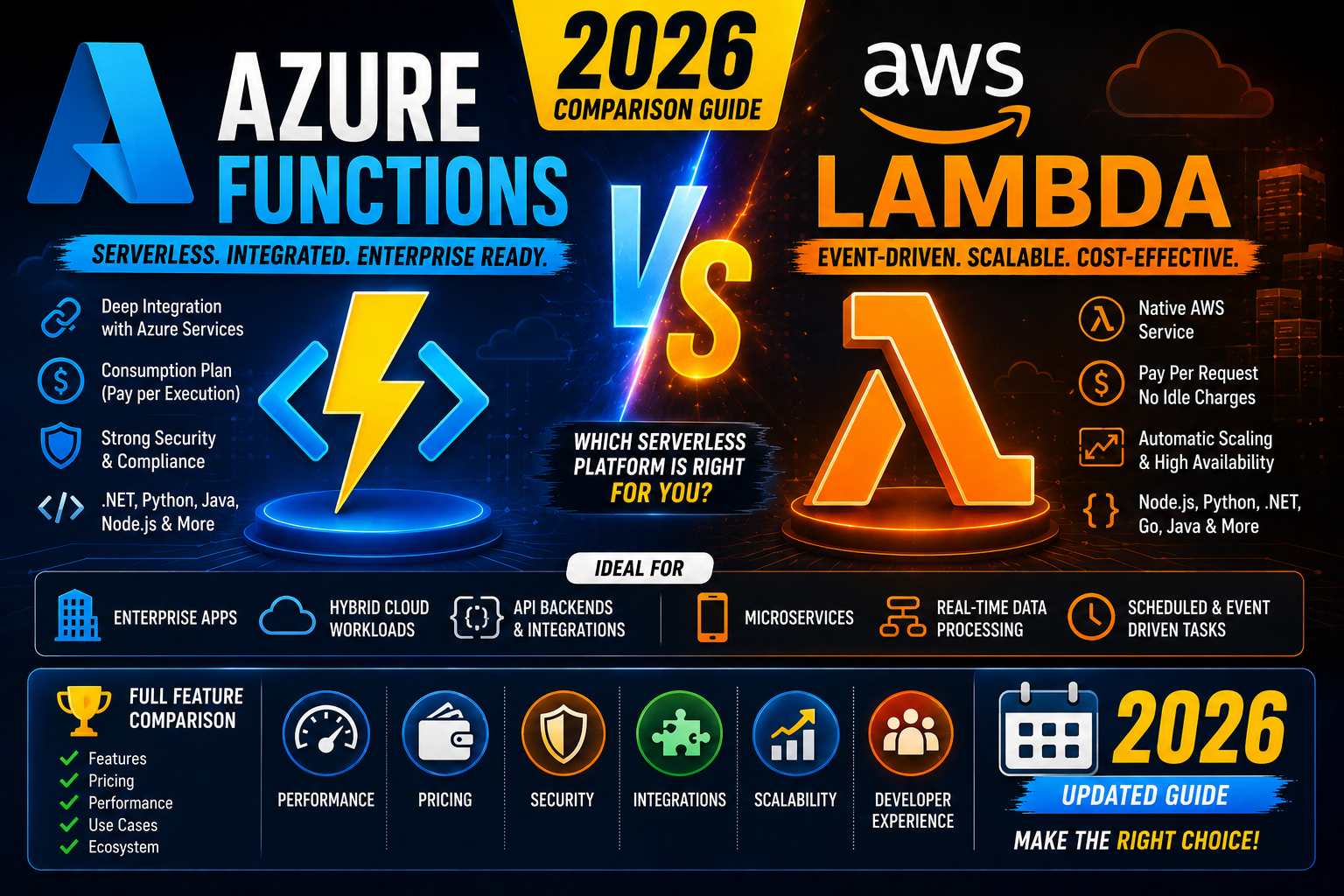
Serverless compute is a two-horse race in 2026. AWS Lambda has the ecosystem lead (launched 2014, 10+ years of integrations). Azure Functions has the enterprise .NET lead (integrated with Visual Studio, Microsoft 365, on-premises hybrid). Both run event-driven code without server management. This 2026 comparison covers cold start latency, pricing, language support, trigger ecosystem, tooling, and which one to pick based on your existing stack and audience.
Quick 2026 verdict
Pick AWS Lambda if you are building green-field on AWS, want the biggest ecosystem, or need niche languages (Rust custom runtimes, Ruby). Pick Azure Functions if your team is already on Microsoft stack (Visual Studio, C#, Azure DevOps, Active Directory, on-prem hybrid). Both work fine for typical event-driven HTTP APIs. The decision comes down to where the rest of your infrastructure already lives, not which service is technically “better.”
Side-by-side snapshot 2026
The features developers actually care about, at a glance:
| Feature | AWS Lambda | Azure Functions |
|---|---|---|
| Free tier per month | 1M requests + 400k GB-sec | 1M requests + 400k GB-sec |
| Max execution time | 15 min | 10 min (Consumption), unlimited (Premium) |
| Cold start (Python) | 200-500 ms | 400-900 ms |
| Cold start (C#) | 500-1200 ms | 100-300 ms (best-in-class for .NET) |
| Max deploy package (zip) | 250 MB unzipped | 200 MB unzipped |
| Container image support | Up to 10 GB | Up to 1.5 GB |
| Languages (first-class) | Python, Node, Java, .NET, Go, Ruby | C#, Python, Node, Java, PowerShell |
| Local dev tooling | AWS SAM CLI (Docker-based) | Azure Functions Core Tools (native) |
| Best for | General serverless, AWS-native shops | .NET shops, Microsoft ecosystem integration |
Pricing: identical on paper, subtle differences in practice
Both services price at 0.20 USD per 1 million requests plus 0.0000166 USD per GB-second. Both offer 1 million free requests per month forever. Both scale to zero when idle.
Where prices diverge in practice:
- AWS Lambda ARM64 (Graviton). Switching to arm64 architecture drops your bill by 20 percent for equivalent compute. Azure Functions has no ARM equivalent yet.
- Azure Functions Premium Plan. Fixed monthly cost around 150 USD for a always-warm instance (no cold starts). AWS Provisioned Concurrency is priced per hour and typically ends up cheaper for the same effect.
- Data transfer. AWS charges egress after the free 100 GB/month. Azure charges egress after the free 100 GB/month. Both punish you if your function returns large payloads.
For a typical webhook processor handling 5 million invocations/month at 128 MB memory and 200 ms avg duration: both cost roughly 1.50-2.00 USD/month. Real cost usually comes from adjacent services (DynamoDB reads, CloudWatch Logs, API Gateway), not the compute itself.
Cold start: the deciding factor for latency-sensitive APIs
Cold start = the delay between AWS or Azure spinning up a fresh container and your handler starting to run. Warm invocations reuse an existing container and skip the delay.
Empirically, in 2026:
- Python: AWS Lambda is faster (200-500 ms vs Azure’s 400-900 ms).
- Node.js: Roughly tied (150-400 ms both).
- C# / .NET: Azure Functions wins by a mile (100-300 ms vs AWS’s 500-1200 ms). Azure has years of .NET optimization that AWS never matched.
- Java: Both are slow (800-2500 ms). Use AWS Lambda SnapStart (Java-only, cuts cold starts to 100-300 ms) or Azure Functions Premium Plan.
For sub-100ms latency requirements, either buy always-warm instances (AWS Provisioned Concurrency or Azure Premium Plan) or move to a container platform like ECS Fargate or Azure Container Apps.
Triggers: where AWS still has the ecosystem edge
AWS Lambda triggers from 200+ AWS services out of the box (S3 upload, DynamoDB stream, SNS message, EventBridge scheduled event, API Gateway HTTP, Cognito auth event, Kinesis stream, IoT rule, and dozens more). Azure Functions triggers from 30+ Azure services (Blob Storage, Cosmos DB, Service Bus, Event Grid, HTTP, Timer, Queue Storage).
The gap matters less than the raw number suggests. Most projects use 3-5 trigger types, and both platforms cover the common cases (HTTP, storage upload, message queue, scheduled cron). AWS wins if you need something niche like MediaConvert job completion or CodeCommit push. Azure wins if you need SharePoint or Microsoft Graph webhook triggers natively.
Local development experience
AWS SAM CLI uses Docker to run your Lambda locally in a container that matches the AWS runtime bit-for-bit. Reliable, works on any OS. Downside: Docker Desktop RAM usage, slower iteration than native execution.
Azure Functions Core Tools runs your function natively (no Docker required). Faster feedback loop for pure code changes. Downside: your local runtime does not perfectly match the Azure production runtime, so you can hit “works on my machine” surprises for edge cases (memory limits, filesystem behavior).
For a mixed team where some developers use Windows and some use Mac/Linux, Azure Functions Core Tools has the smoother onboarding. For strict production parity, AWS SAM’s Docker-based approach is more reliable.
Real-world decision matrix (which to pick)
- Green-field project, no existing cloud investment: AWS Lambda. Ecosystem is bigger, community is bigger, Stack Overflow answers are more numerous.
- Team already uses Visual Studio + C# + Azure DevOps: Azure Functions. C# cold start advantage plus native tooling integration are worth ignoring the smaller ecosystem.
- Enterprise with Active Directory + on-prem hybrid: Azure Functions. Better hybrid connectivity (App Service Environments, Private Endpoints).
- Data pipelines processing S3, DynamoDB, Kinesis: AWS Lambda (native triggers, zero glue code).
- Data pipelines processing Blob Storage, Cosmos DB, Event Hubs: Azure Functions (same reason, native triggers).
- Multi-cloud strategy or trying to stay vendor-neutral: Neither. Use Cloudflare Workers, Knative on Kubernetes, or Serverless Framework with adapters.
What both services do NOT do well in 2026
Neither is a good fit for: long-running WebSocket connections (both support it but awkwardly), high-throughput streaming (Kinesis + Lambda works but backpressure is manual), GPU inference (no GPU support on either serverless platform, use SageMaker or Azure ML), or workloads with unpredictable memory spikes above 10 GB.
For those, use container platforms (AWS ECS Fargate, Azure Container Apps, or Kubernetes). Both AWS and Azure have gradually made their serverless offerings feel more like managed containers, blurring the lines. In 2026 the real choice is often “container platform vs serverless” rather than “AWS vs Azure serverless.”
Try these hosting + tool partners for your serverless work
The links below are affiliate links. We may earn a commission at no extra cost to you when you sign up through them. See our affiliate disclosure for details.
- Cloudways, managed cloud hosting for the traditional API layer that your serverless functions call into.
- Kamatera, per-hour cloud VMs for background workers, cron jobs longer than 15 minutes, and always-on services that serverless is a poor fit for.
- Ultahost, VPS hosting with predictable monthly cost for teams comparing serverless total cost of ownership vs traditional VMs.
Official documentation
Frequently Asked Questions
Which has better cold start performance in 2026?
Depends on the language. AWS Lambda wins for Python (200-500 ms vs Azure 400-900 ms). Azure Functions dominates for C# (.NET runs 100-300 ms vs AWS 500-1200 ms). Node.js and Java are roughly tied. If your team writes primarily C#, Azure has a decade of .NET tuning that AWS cannot match.
Are the free tiers really free forever?
Yes, both. 1 million requests plus 400,000 GB-seconds of compute per month, indefinitely, not just the first year. A hobby project typically stays well within free tier. Real cost usually comes from adjacent services (S3 storage, CloudWatch Logs, API Gateway), not the compute.
Can I move a function from one to the other?
The handler code is mostly portable (function signature differs but is easy to adapt). Triggers, secrets management, logging, monitoring, and IAM (AWS) vs Managed Identity (Azure) are NOT portable. Expect 40-60 percent code reuse and full re-wiring of the surrounding infrastructure. For real portability, use a serverless framework abstraction (Serverless Framework, SST, Terraform).
Which one handles VPC networking better?
Both support VPC integration. AWS Lambda VPC networking used to add cold start latency of 5-10 seconds (2018-2019) but AWS fixed that in 2019 (Hyperplane ENI). Azure Functions VPC support requires Premium Plan or App Service Plan (Consumption tier does not support VNet integration). For hybrid on-prem connectivity, Azure has slightly better patterns (App Service Environment, Private Endpoints).
What about Google Cloud Functions?
Third-place player with roughly 10 percent market share. Feature-competitive with AWS and Azure but ecosystem is smaller. Best pick if you already run GCP (BigQuery, Firestore, Cloud Storage), especially for data pipelines that stream into BigQuery. Second-generation Cloud Functions (Cloud Functions v2, launched 2022) runs on Cloud Run, which gives you container flexibility without giving up serverless pricing.
Cloudflare Workers vs Lambda vs Azure Functions?
Cloudflare Workers runs at 300+ global edge locations with sub-50 ms cold starts thanks to the V8 isolate model (not container-based). Best for latency-sensitive HTTP APIs, edge auth, and A/B testing. Downside: 30 second CPU time limit per request, no persistent filesystem, only JavaScript/TypeScript/Rust/Python (limited). Use Cloudflare Workers when latency matters more than compute time; use Lambda or Azure Functions when you need longer execution and more language options.
Related Cloud + DevOps tutorials
- AWS Lambda Complete Beginner Guide 2026 (First Function + Deploy)
- Docker Complete Beginner Guide 2026 (First Container)
- Serverless Framework Complete Guide 2026 (coming this week)
- Kubernetes for Beginners 2026 (Complete Practical Tutorial)
Official documentation
- AWS Lambda: official documentation
- Azure Functions: official documentation
- AWS Lambda pricing and Azure Functions pricing

Angel Jude Suarez
Full-Stack Developer at PIES IT Solution
Focuses on Python development, machine learning, and AI integration. Has built production AI systems including OpenAI Whisper integration for medical transcription and GPT-4o-powered diagnosis assistance. Strong background in pandas, scikit-learn, and TensorFlow.
Expertise: Python · PHP · Java · VB.NET · ASP.NET · Machine Learning · AI Integration · OpenCV · Django · CodeIgniter · View all posts by Angel Jude Suarez →