
Infrastructure as Code (IaC) tools let you define cloud resources (servers, databases, networks, Kubernetes clusters) in text files that live in version control, get code-reviewed, and deploy reproducibly. In 2026 the two dominant IaC tools are Terraform (HashiCorp) and Pulumi. Both create the same cloud resources, the difference is HOW you write the code. This guide compares them across the dimensions that actually matter when you’re choosing which to learn or migrate to.
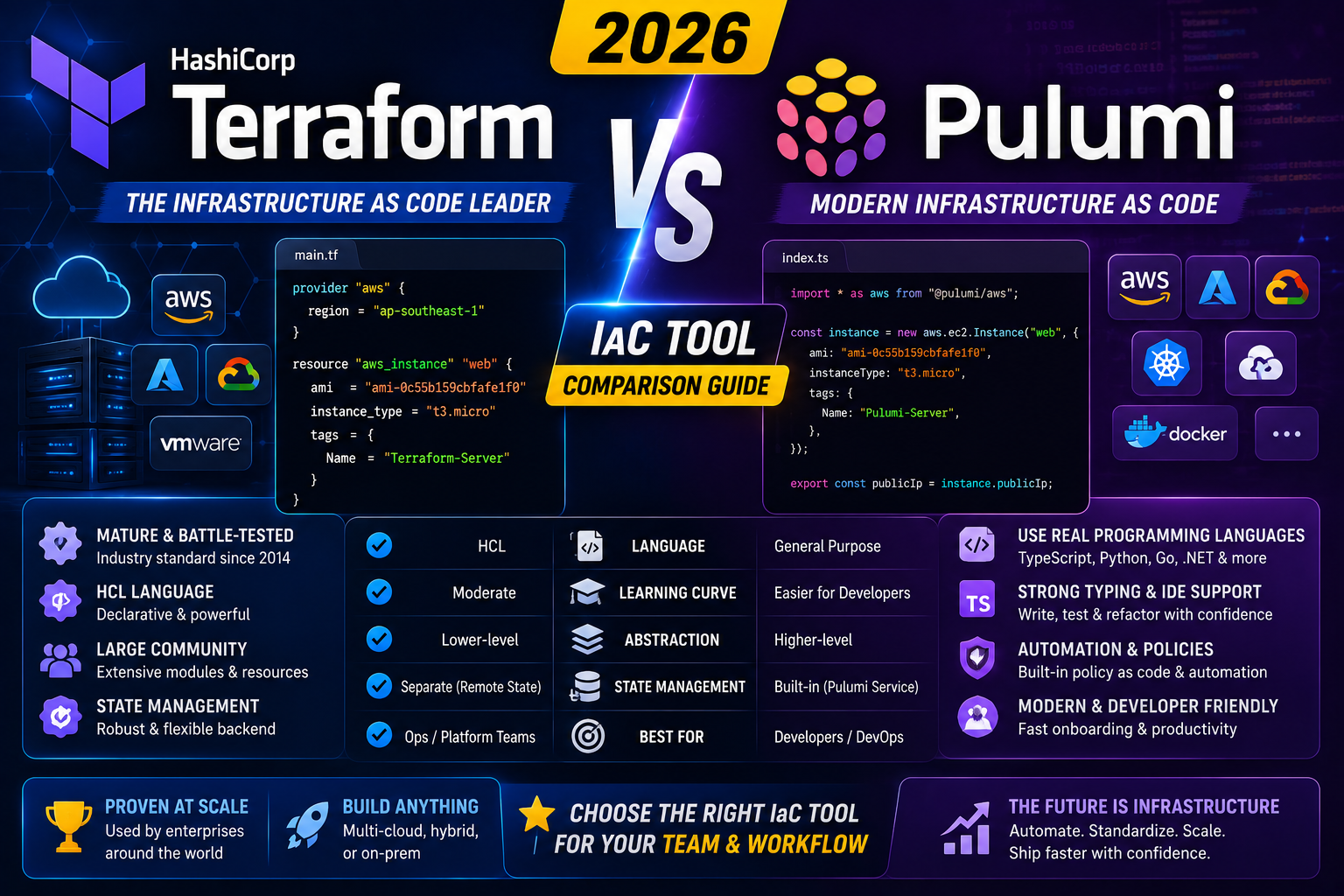
Quick 2026 verdict
Terraform if your team includes non-developers (ops, DBAs), HCL is easier to read than code. Larger ecosystem, more Stack Overflow answers, mature. Pulumi if your team is all developers, real Python/TypeScript/Go with loops, conditions, functions, unit tests. Better for complex multi-cloud logic. Both create identical cloud resources. Learning either is a strong 2026 skill.
The core difference in one sentence
Terraform uses HCL (HashiCorp Configuration Language, a domain-specific declarative language). Pulumi uses real programming languages (Python, TypeScript, JavaScript, Go, C#, Java). Everything else is downstream of that choice.
Head-to-head comparison
- Language: Terraform = HCL (learn once, use everywhere). Pulumi = your existing programming language (Python, TS, Go, C#, Java).
- Learning curve for developers: Terraform = 1-2 weeks. Pulumi = 3-5 days if you know Python or TypeScript already.
- Learning curve for ops / DBAs: Terraform = 2-4 weeks (readable). Pulumi = requires learning a real programming language first (4-8 weeks).
- Ecosystem: Terraform = 3,000+ providers on Terraform Registry, huge community. Pulumi = 150+ providers (fewer, but covers all major clouds).
- Multi-cloud: Both support AWS + Azure + GCP + Kubernetes + DigitalOcean natively.
- State management: Terraform = state file (typically in S3 with DynamoDB lock). Pulumi = Pulumi Cloud (free tier available) or self-hosted state backend.
- Testing: Terraform = Terratest (Go framework), Sentinel for policy. Pulumi = your language’s native unit test framework (pytest, jest, etc.), huge advantage.
- Enterprise adoption: Terraform = dominant (~65% market share). Pulumi = growing fast, especially among software companies.
- Free tier: Both are free open-source. Both have paid managed offerings (Terraform Cloud, Pulumi Cloud).
- License (2024+ update): Terraform moved from MPL to BSL (Business Source License, restricts competitors) in 2023. Pulumi remains Apache 2.0. If license matters (some enterprises), Pulumi has cleaner posture.
Same cloud resource in both tools (side by side)
Deploy an AWS S3 bucket + IAM policy in both tools:
Terraform (HCL):
resource "aws_s3_bucket" "my_bucket" {
  bucket = "my-app-uploads-2026"
  tags = {
    Environment = "production"
  }
}

resource "aws_s3_bucket_public_access_block" "block" {
  bucket                  = aws_s3_bucket.my_bucket.id
  block_public_acls       = true
  block_public_policy     = true
  ignore_public_acls      = true
  restrict_public_buckets = true
}
Pulumi (Python):
import pulumi
import pulumi_aws as aws

bucket = aws.s3.Bucket("my-bucket",
    bucket="my-app-uploads-2026",
    tags={"Environment": "production"})

aws.s3.BucketPublicAccessBlock("block",
    bucket=bucket.id,
    block_public_acls=True,
    block_public_policy=True,
    ignore_public_acls=True,
    restrict_public_buckets=True)
Same result: an S3 bucket with public access blocked. Terraform reads more like configuration. Pulumi reads like Python. The choice comes down to preference and team background.
Where Pulumi wins (real code advantages)
Pulumi’s use of real programming languages shines when you need logic that HCL struggles with:
- Loops with complex conditions. “Create an S3 bucket per team, but only for teams in production regions, and skip teams tagged as archived”, 5 lines of Python, 30 lines of tortured HCL.
- Reusable components. Import a Python class from a shared repo. In Terraform you use modules, which are less flexible than class inheritance.
- Real unit tests. Assert your infra code produces expected resources without deploying anything, using pytest, jest, or your language’s normal test runner.
- Data transformations. Read a CSV of team names, transform, generate resources. In HCL this requires templating tricks; in Python it is one line of pandas.
Where Terraform wins (ecosystem + simplicity)
- Provider coverage. Every niche SaaS (Datadog, PagerDuty, Auth0, Cloudflare) has a Terraform provider. Pulumi has the big ones but coverage is thinner.
- Community answers. Stack Overflow has 3-4x more Terraform Q&A than Pulumi. Faster debugging when you’re stuck.
- Enterprise mindshare. If you’re interviewing for a DevOps role, Terraform on your resume opens more doors than Pulumi.
- Readable by non-devs. Your database administrator or security officer can review Terraform HCL. Pulumi requires them to read Python or TypeScript.
- State-only workflow. Some teams prefer explicit state files over Pulumi Cloud managed state.
Decision matrix, which to pick in 2026
- Startup, small team, all developers: Pulumi. Faster to write, reuses your Python/TS skills, native unit tests.
- Enterprise, ops team mixed with devs: Terraform. Familiar to ops, larger ecosystem, more auditors know it.
- Multi-cloud with complex conditional logic: Pulumi. Real code handles the branching better.
- Simple infra (few resources, mostly Standard): Terraform. HCL is quick for simple cases.
- You are learning IaC from scratch: Terraform first (bigger community, more tutorials), Pulumi second (once you know the concepts, Pulumi is more powerful).
- Multi-team large org: Terraform with Terraform Cloud (Sentinel for policy-as-code).
- Kubernetes-heavy shop: Either works. Pulumi has slight edge with its Kubernetes package that uses real code for complex Helm-like templating.
Migration between them (both directions)
Terraform → Pulumi: Pulumi ships pulumi convert --from=terraform command that translates HCL into your target Pulumi language. Works well for straightforward configs; complex modules may need manual review.
Pulumi → Terraform: No official converter. Manual rewriting required. Bigger project. Only worth it if there’s a clear reason (team change, enterprise mandate).
In practice most teams pick one and stay. Both do the same job.
2026 update: what changed recently
Terraform: HashiCorp moved to BSL license (2023) which sparked the OpenTofu fork (Linux Foundation-backed, MPL-licensed Terraform-compatible tool). For most users, Terraform + OpenTofu are drop-in compatible. OpenTofu is worth considering if you want fully open-source.
Pulumi: Pulumi added AI-assisted resource generation in 2026, type a natural-language prompt like “create an S3 bucket with versioning and encryption” and Pulumi’s Copilot generates the code. Combined with real language testing, this narrows the productivity gap even more.
Try these hosting + tool partners for your IaC workflows
The links below are affiliate links. We may earn a commission at no extra cost to you when you sign up through them. See our affiliate disclosure for details.
- Cloudways, managed cloud hosting, ideal if you want provisioned infrastructure without writing Terraform or Pulumi yourself.
- Kamatera, cloud VMs with a Terraform provider, easy target for practicing IaC.
- Network Solutions, DNS + domain management, Terraform provider available for automating record updates.
Official documentation
Frequently Asked Questions
Can I use Terraform and Pulumi in the same project?
Technically yes, you can manage different resources with each tool. In practice this creates confusion about state ownership. Better to pick one and stay unless you have a specific migration in progress.
Is Pulumi more expensive than Terraform?
Both are free open-source. Paid managed offerings: Terraform Cloud (free for teams under 500 resources, then $20/mo per contributor). Pulumi Cloud (free for up to 500 resources, then $30/mo per contributor). Similar pricing at scale.
What is OpenTofu and should I use it instead of Terraform?
OpenTofu is a Linux Foundation fork of Terraform (created after HashiCorp changed the license to BSL in 2023). It is drop-in compatible with Terraform HCL and providers. Consider it if you want fully open-source or if your organization forbids BSL-licensed software.
Which is faster to run: Terraform or Pulumi?
Deployment speed is nearly identical because both call the same cloud provider APIs. Pulumi has slightly faster startup on small projects; Terraform has slightly better parallelism on very large projects (500+ resources). For 99% of use cases, the speed difference is negligible.
Can I unit test my Terraform code?
Yes, with Terratest (Go framework) or the newer built-in test framework (terraform test command, added 2023). Pulumi lets you use your language’s normal test runner (pytest, jest) which many find easier.
Which is better for AWS specifically?
Both cover the entire AWS API. Terraform has slightly more community modules for AWS-specific patterns (VPC baselines, EKS clusters, etc.). Pulumi Crosswalk for AWS provides high-level abstractions that are cleaner than raw Terraform. Either works; Terraform is safer default for AWS-heavy shops.
Related Docker + DevOps tutorials
- Docker Complete Beginner Guide 2026 (Mon this week)
- Kubernetes for Beginners 2026 (Mon this week)
- GitHub Actions Complete CI/CD Guide 2026 (Tue this week)
Official documentation
- Terraform: official documentation
- Pulumi: official documentation
- OpenTofu: fork of Terraform (MPL-licensed)

Joken E. Villanueva
Founder & Lead Developer at PIES IT Solution
Founder of PIES Information Technology Solutions, a software company building production-grade applications for institutions across the Philippines. Over 8 years of hands-on full-stack development experience, currently leading the development of ClinicAI, an AI-powered clinic management platform.
Expertise: PHP · MySQL · JavaScript · AI Integration · SaaS Architecture · VB.NET · Database Design · Capstone Documentation · Java · View all posts by Joken E. Villanueva →