
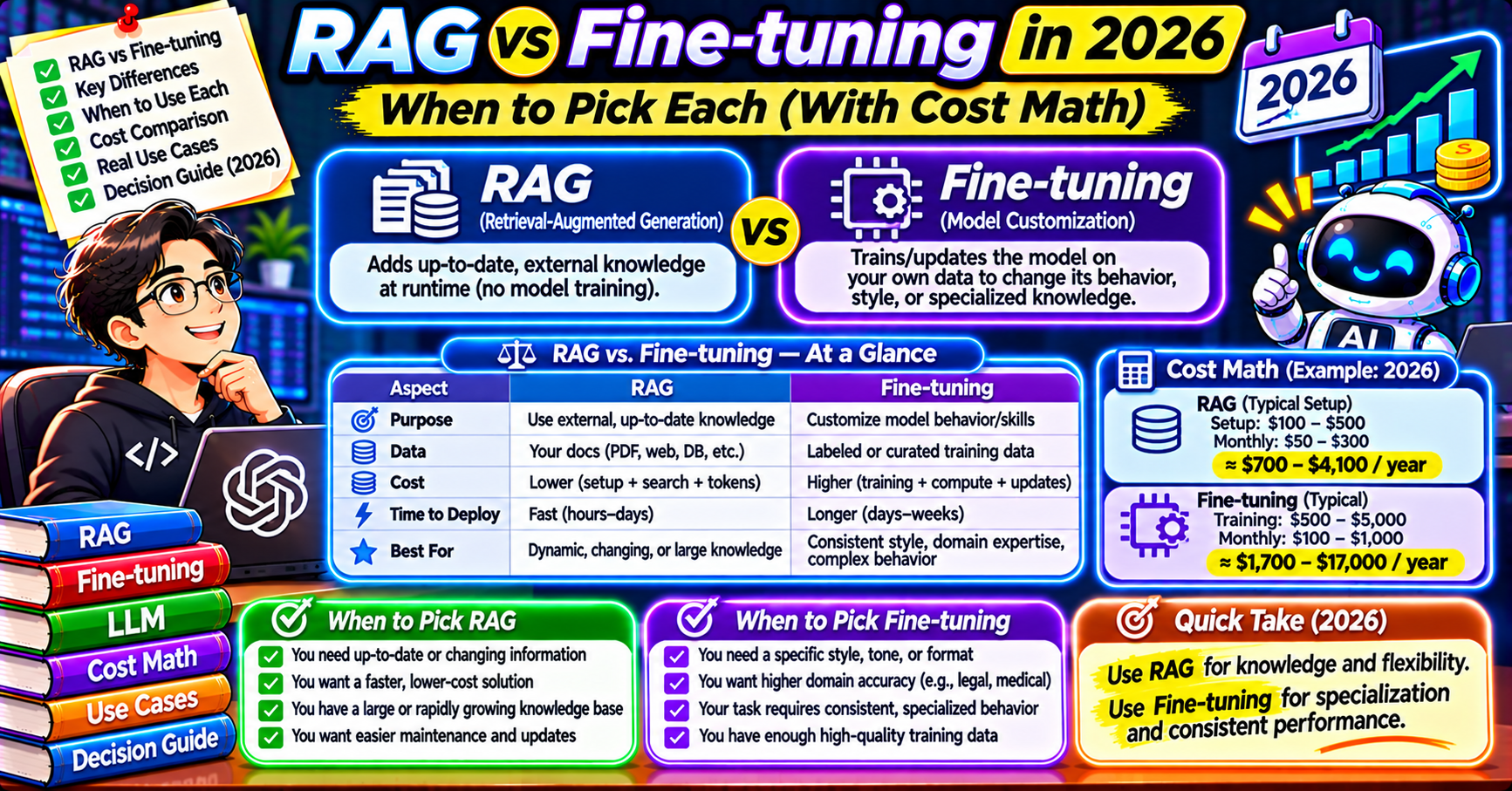
RAG vs Fine-tuning in 2026: When to Pick Each (With Cost Math)
The short answer
RAG rewrites the prompt with retrieved context; fine-tuning rewrites model weights. In 2026, RAG wins for 90% of knowledge tasks because documents swap in and out without retraining, every answer can cite sources, and cost is cents per query versus hundreds of dollars per training run. Fine-tune only when you need the model to acquire a new skill, format, or voice, not when you need it to know new facts.
Fine-tuning rewrites model weights. RAG rewrites the prompt. The two approaches solve overlapping but different problems, and the choice is almost always clear once you look at the actual constraints: freshness, cost, access control, latency, and the kind of knowledge you need the model to have.
This guide walks through the practical trade-offs with real numbers. Both techniques have gotten cheaper and better in 2026, which has shifted the breakpoints. Hybrid patterns (fine-tuning on top of RAG, or RAG with a small adapter) are also more common now.
The one-line summary
Use RAG for facts that change or that you want to attribute. Use fine-tuning for style, format, and tasks the model already roughly knows but needs to produce more reliably.
That short rule covers 80% of cases. The other 20% are hybrid patterns described below.
What RAG is really good at
- Freshness. New documents appear in retrieval the moment they are embedded. Updates propagate in minutes, not retraining cycles.
- Attribution. Every answer links to a source document. The user can verify.
- Access control. Metadata filters restrict retrieval by tenant, role, or document type. Fine-tuned models bake knowledge in and have no mechanism to restrict who sees what.
- Scale of knowledge. A RAG index routinely handles millions of documents. A fine-tuned model has a fixed capacity dictated by its parameter count.
- Factual precision on retrievable content. With grounding and citation, a RAG system can be made to never say things not in the sources.
These five properties are the reason RAG dominates knowledge-intensive production use cases: support bots, legal research, medical literature search, code repositories.
What fine-tuning is really good at
- Style transfer. Teaching a model to write in a specific voice, format, or tone the base model does not naturally produce.
- Format compliance. Making a model reliably produce structured outputs (JSON, XML, SQL, code) with the exact schema you need.
- Narrow task reliability. A model that classifies 500 types of insurance claims with 98% accuracy, where retrieval and generation prompting would be too fragile.
- Latency and cost. A fine-tuned small model (3-8B parameters) can beat a large general model on a narrow task at 1/10 the latency and 1/50 the cost.
- Specialized vocabulary. Internal jargon, chemical nomenclature, legal boilerplate that is poorly represented in the base model’s training.
These are the reasons fine-tuning survives in a RAG-dominated world. The use cases are narrower but when they fit, fine-tuning wins decisively.
Cost math: building and operating each
Approximate 2026 numbers for comparable workloads.
RAG system covering 1 million documents:
- One-time embedding of 10M chunks at voyage-3: $600
- Vector database (Pinecone or Weaviate): $70-300/mo
- Cohere Rerank at 10K queries/day: $300/mo
- Claude Opus 5.5 generation at 10K queries/day: $600-1,200/mo
- Total steady-state: $1,000-1,800/mo
Fine-tune of a 7B open-source model (e.g., Llama 3.3 7B, Qwen 2.5 7B):
- Dataset collection and labeling: $2,000-10,000 one-time (depends on complexity)
- Fine-tune compute on cloud GPUs: $200-1,500 one-time
- Inference infrastructure (one L4 GPU for low-moderate volume): $200-400/mo
- Total one-time: $2,200-11,500
- Total steady-state: $200-400/mo
Fine-tune a hosted model (Claude Haiku or GPT-5-mini custom):
- Dataset: same $2,000-10,000
- Fine-tune: $100-500 one-time
- Hosted inference: $500-1,500/mo at 10K queries/day
- Total one-time: $2,100-10,500
- Total steady-state: $500-1,500/mo
Fine-tuning has a bigger upfront investment but lower ongoing cost per query. RAG is cheaper to start, more expensive per query, and handles vastly more knowledge.
Decision framework: six questions
- Does the knowledge change daily or weekly? RAG. Fine-tuning cannot keep up with document churn.
- Do users need to see citations? RAG. Attribution is native.
- Is the task “produce output in format X” more than “know fact Y”? Fine-tuning. Format reliability is where fine-tuning dominates.
- Is there access control (tenant isolation, role-based filtering)? RAG. Fine-tuned models have no access control mechanism.
- Is per-query latency or cost dominating? Fine-tuned small model. A 7B model on your own GPU runs 5-10x faster than Claude Opus and costs almost nothing per query.
- Is the knowledge body under a few hundred examples (prompt-fits scale)? Few-shot prompting, no RAG, no fine-tuning. Smallest hammer wins.
Flow through those six questions and the right answer usually falls out in 2-3 minutes.
The hybrid pattern: RAG for knowledge, fine-tune for style
Many production systems in 2026 combine both. The architecture:
- Fine-tune a small or mid-size model on 1,000-5,000 examples of correctly-formatted responses in your voice and format.
- Build a RAG retriever that fetches relevant documents.
- Pass retrieved documents to the fine-tuned model, which composes the final answer in your style.
This gets you both: fresh knowledge from retrieval, consistent format from fine-tuning. Teams at the top of the enterprise RAG space use this pattern because it beats either alone on tasks that require specific output structure plus up-to-date information.
The anti-pattern: fine-tuning for knowledge
A common mistake: “we fine-tuned the model on our documentation so it knows our product.”
Four reasons this almost always goes wrong:
- The model learns to produce confident-sounding answers about your product that are often subtly wrong.
- No attribution. Users cannot verify where an answer came from.
- When the documentation changes, the model is stale until the next fine-tune.
- Model updates (base model version changes) require re-fine-tuning.
For “model needs to know our documentation” the right pattern is RAG. The documentation goes into a vector index; the model retrieves and cites. Fine-tuning the model on documentation gives up every property that makes documentation useful.
LoRA and PEFT: the lightweight alternative
Full fine-tuning changes every weight in a model. LoRA (Low-Rank Adaptation) and other PEFT methods freeze the base model and train only a small number of adapter weights. The adapter is tiny (10-100MB), swappable, and cheap to train.
Where LoRA shines in 2026:
- Per-customer adapters. Train a small adapter for each enterprise customer’s voice or vocabulary. Swap at inference time.
- Experiment at low cost. A LoRA adapter costs $20-200 to train. Experiment with different data mixes, keep what works.
- Easy base-model upgrade. When the base model updates, retraining a LoRA adapter is cheap.
LoRA is the sensible first fine-tune for most workloads. Full fine-tuning is for the specific cases where LoRA’s capacity ceiling is actually a problem.
When neither pattern fits
Three cases where both RAG and fine-tuning struggle:
Multi-hop reasoning across documents. “Which of our customers mentioned Postgres AND have less than 100 employees AND are in the EU?” RAG retrieves documents, but synthesizing across them is agentic work. Pattern: RAG + agent with tools for retrieval, filtering, and aggregation.
Numerical computation on retrieved data. “What is the total revenue from our top 10 customers?” The model should not do arithmetic. Pattern: RAG + a tool for executing SQL or Python on retrieved structured data.
Real-time personalization. “What should I eat for lunch given what’s in my calendar?” This blends retrieval (calendar), fine-tuning (your preferences), and current state (time of day). Pattern: multi-tool agent, not pure RAG or pure fine-tune.
In 2026, most production systems that look like “chat with my data” are actually agent systems with retrieval as one tool among several.
Migration patterns
Teams that start with the wrong choice can migrate without rebuilding from scratch:
- Fine-tuned model that is going stale: add RAG. Keep the fine-tuned model for format and style; add a retrieval layer that pulls fresh documents into the prompt. Immediate freshness without a retraining cycle.
- RAG system with inconsistent output format: fine-tune a small adapter. Train a LoRA on 500-1,000 well-formatted responses. Latency and cost drop while retrieval still handles knowledge.
- Prompt-only system that is scaling past prompt budget: move to RAG. Store the knowledge in a vector index, retrieve the top chunks per query. Prompts shrink, costs drop, knowledge body can grow.
None of these are destructive migrations. They layer new capability on top of what works and remove the piece that is holding the system back.
Frequently asked questions
Official documentation
When should I use fine-tuning instead of RAG?
Fine-tuning wins when the problem is style, format, or narrow-task reliability on a mostly-static domain. Examples: a model that classifies claims into one of 500 categories, a model that writes marketing copy in your brand voice, a model that always produces valid JSON of a specific schema. For anything knowledge-heavy or where the data changes, RAG is almost always the right pick.
Can I combine RAG and fine-tuning?
Yes, and this is the pattern many production systems use. Fine-tune a small or mid-size model on 1,000-5,000 examples of your preferred output style and format. Add a RAG retriever that pulls relevant documents. The fine-tuned model composes answers in your style using fresh knowledge from retrieval.
Is fine-tuning cheaper than RAG at scale?
Fine-tuned small models have lower per-query cost but higher upfront investment. Breakeven usually sits around 50,000-100,000 queries per month, depending on the specifics. For low volume, RAG is cheaper. For high volume on a narrow task, a fine-tuned small model pays off within a few months.
What is LoRA and should I use it?
LoRA is a lightweight fine-tuning method that trains a small adapter instead of modifying the full model. Adapters are 10-100MB, cost $20-200 to train, and are swappable at inference time. For most fine-tuning use cases in 2026, LoRA is the sensible starting point. Full fine-tuning is reserved for cases where LoRA’s capacity is genuinely insufficient.
Why is fine-tuning on documentation an anti-pattern?
The model learns to produce confident, subtly-wrong answers about your product with no citation. When docs change, the model is stale. Base-model upgrades require re-fine-tuning. Access control is impossible. For every property that makes documentation useful (freshness, attribution, access control), fine-tuning loses to RAG.
How much training data do I need to fine-tune a model?
500-2,000 well-labeled examples usually gets you most of the lift. 5,000-10,000 examples takes you close to the ceiling of what fine-tuning can do on that task. Past that, more data mostly helps on long-tail cases. Quality of labels matters far more than quantity; 500 excellent examples beat 10,000 noisy ones.
Pick based on the question type. Knowledge that changes, with attribution, with access control: RAG. Style, format, and narrow-task reliability: fine-tuning. Both together on hard problems. Prompt-only on simple ones. The honest first move is always to try the smallest hammer that could work and measure before stepping up.

Angel Jude Suarez
Full-Stack Developer at PIES IT Solution
Focuses on Python development, machine learning, and AI integration. Has built production AI systems including OpenAI Whisper integration for medical transcription and GPT-4o-powered diagnosis assistance. Strong background in pandas, scikit-learn, and TensorFlow.
Expertise: Python · PHP · Java · VB.NET · ASP.NET · Machine Learning · AI Integration · OpenCV · Django · CodeIgniter · View all posts by Angel Jude Suarez →