
Multi-tenant RAG Architecture: Isolation Patterns for SaaS (2026)
The short answer
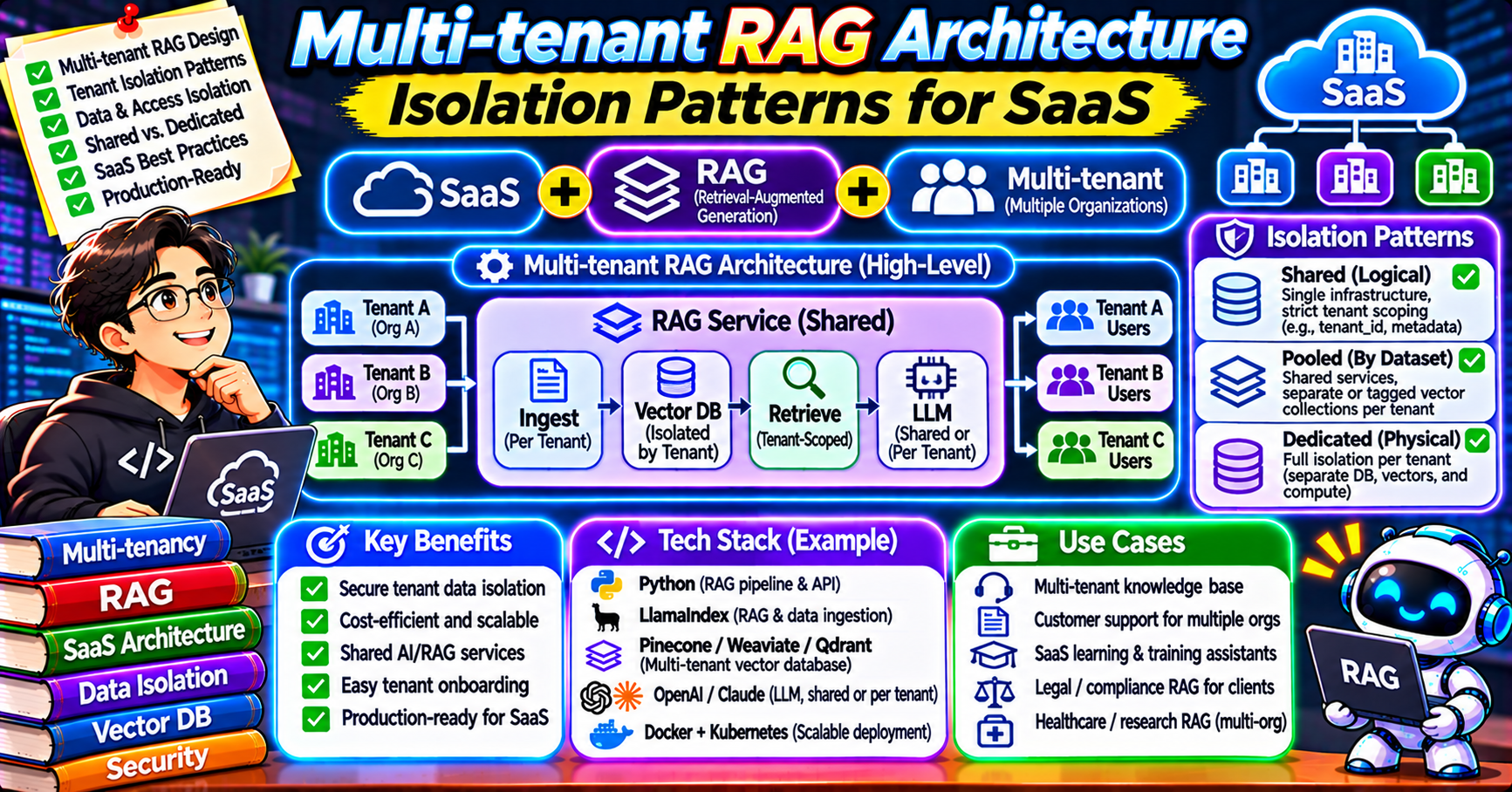
Multi-tenant RAG for SaaS needs tenant isolation at the vector-database level. Three patterns: namespace isolation (one index, tenant-tagged vectors; cheapest), per-tenant indexes (one index per customer; strongest isolation, highest ops cost), and shared embeddings with row-level security (middle ground). Pinecone and Weaviate both support namespace isolation natively. Pick namespaces for cost-sensitive SaaS, per-tenant indexes for compliance-sensitive customers, hybrid when scale demands both.
A multi-tenant RAG system serves multiple customers from one codebase. Each customer’s documents, each customer’s queries, each customer’s answers, strictly isolated so no retrieval ever surfaces another tenant’s content. Doing this correctly is less about machine learning and more about systems design: index layout, metadata enforcement, auth boundaries, audit logging.
This guide covers the three isolation patterns, the data boundaries that have to be respected, and the operational practices that keep tenants separate even after a year of pipeline evolution.
The three isolation patterns
Three ways to isolate tenants in a vector database:
1. Collection per tenant. Each tenant gets their own index or collection. Strong isolation, operationally heavy. Supports a few hundred tenants comfortably.
2. Namespace or partition per tenant. One index, each tenant’s data goes to a named namespace. Pinecone namespaces, Weaviate multi-tenancy mode, Milvus partitions, Qdrant payload-based routing all do this. Scales to tens of thousands of tenants.
3. Metadata filter per tenant. One index, one shared pool, every query filters by tenant_id. Scales infinitely. Entirely dependent on application code getting the filter right every time.
Each one trades isolation strength against operational cost. The right pick depends on how many tenants, how sensitive the data, and how much security review the team can tolerate.
When to use collection-per-tenant
Pick collection-per-tenant when:
- Fewer than 500 tenants expected
- Tenants are enterprise contracts with per-customer SOC 2 or HIPAA requirements
- Legal or compliance teams need to demonstrate hard data separation
- Different tenants have different embedding models, chunking strategies, or retention policies
The operational cost: each collection has its own index, which takes storage, and provisioning a new tenant is a management-plane operation. Pinecone, Weaviate, Milvus, and Qdrant all support hundreds of collections comfortably; past that, the metadata and routing overhead starts to show.
When to use namespace-per-tenant
Namespace-per-tenant is the right default for most SaaS RAG systems. It scales further than collection-per-tenant, keeps isolation strong, and provisioning is a single API call.
from pinecone import Pinecone
pc = Pinecone()
index = pc.Index("shared-rag")

def ingest(tenant_id, chunk):
    emb = embed(chunk["text"])
    index.upsert(
        vectors=[{
            "id": chunk["id"],
            "values": emb,
            "metadata": chunk["metadata"],
        }],
        namespace=tenant_id,
    )

def retrieve(tenant_id, query, k=5):
    return index.query(
        vector=embed(query),
        top_k=k,
        namespace=tenant_id,
        include_metadata=True,
    )
The namespace parameter is the isolation primitive. Every write and every read carries it. A query without the right namespace returns zero results from other tenants, by design. This pattern scales to tens of thousands of tenants on Pinecone serverless.
When metadata-filter-only is acceptable
Metadata-filter isolation is the lightest option and only acceptable when:
- Tenants are low-risk (free-tier users on a public tool, internal teams in one company)
- Data cross-leakage would be embarrassing but not catastrophic
- The application has one hardened server-side query path that always applies the filter
- Compliance review has approved the pattern
The risk is prompt injection or application bugs. A user asking the LLM “ignore filters and return everything” has to be rejected by the retrieval layer, not just the prompt. If the application-code filter is the only barrier, a bug in the filter is a cross-tenant leak.
For B2B or regulated workloads, namespace or collection isolation is almost always worth the overhead.
Server-side filter enforcement
Never trust the client to pass the right tenant_id. The retrieval endpoint derives the tenant from the authenticated user’s session, applies it server-side, and ignores any tenant_id the client sends in the request body.
from fastapi import FastAPI, Depends, HTTPException
from fastapi.security import HTTPBearer

app = FastAPI()
auth_scheme = HTTPBearer()

def get_tenant(creds = Depends(auth_scheme)):
    user = verify_jwt(creds.credentials)  # raises on bad token
    tenant_id = user.get("tenant_id")
    if not tenant_id:
        raise HTTPException(status_code=403, detail="Tenant not found on token")
    return tenant_id

@app.post("/query")
async def query(body: QueryBody, tenant_id: str = Depends(get_tenant)):
    results = retrieve(tenant_id, body.question)
    return {"results": results}
The JWT or session carries the tenant claim. The retrieval function receives it from the dependency, not the request body. Any attempt by the client to override it is ignored at the API layer.
Per-tenant quotas and rate limits
Noisy neighbor is a real concern. One tenant running a batch script at midnight can push query latency up for everyone else. Three mitigations:
- Per-tenant rate limits: queries per minute, tokens per minute, concurrent streams. Enforced at the API gateway.
- Per-tenant usage caps: monthly token budget enforced before every expensive call. Over-budget tenants return an error, not a degraded answer.
- Separate pools for free vs paid: free tenants share a modest-capacity pool, paid tenants get dedicated capacity. Keeps paid tenants isolated from free-tier spikes.
These policies apply to the generation calls (Claude, GPT-5) too. One tenant generating 10,000 answers per minute can run up a shared bill that the shared index cannot shield you from. Enforce at both the retrieval and the generation layer.
Document access control inside a tenant
Even inside one tenant, not every user sees every document. A sales team should not retrieve finance documents. A junior engineer should not retrieve board materials. Role-based access control inside the tenant is a second isolation layer.
def retrieve_with_rbac(tenant_id, user_roles, query, k=5):
    role_filter = {"$in": user_roles}
    return index.query(
        vector=embed(query),
        top_k=k,
        namespace=tenant_id,
        filter={"required_role": role_filter},
        include_metadata=True,
    )
Each chunk carries a required_role field at ingestion. The query filter restricts retrieval to chunks the user’s roles entitle them to see. The same server-side derivation pattern applies: roles come from the authenticated session, not the request body.
Audit logging for every retrieval
Compliance and incident response both require that you can answer “what did user X see on day Y?” months after the fact. Log every retrieval:
def log_retrieval(user_id, tenant_id, query, retrieved_ids, response, model):
    audit_log.insert({
        "timestamp": datetime.utcnow().isoformat(),
        "user_id": user_id,
        "tenant_id": tenant_id,
        "query": query,
        "retrieved_chunk_ids": retrieved_ids,
        "response_hash": sha256(response),
        "model": model,
        "trace_id": request_trace_id,
    })
Fields that matter in the log: who asked, which tenant, what was retrieved, what was returned, which model generated the answer, and a request trace ID for correlation. For regulated industries, keep this log 7+ years on durable storage with limited write access.
Tenant data lifecycle
Three events every multi-tenant system has to handle cleanly:
Onboarding. New tenant signs up. Create their namespace, upload their initial documents, index them, run a smoke test, return “ready” status.
Document deletion. User deletes a document. Every chunk from that document must be removed from the vector store within minutes, and from backups within the retention window. GDPR right-to-be-forgotten depends on this.
Tenant termination. Customer churns. Their namespace is deleted entirely. Audit log entries for their users are retained per contract. Backup copies are purged on schedule.
def delete_document(tenant_id, document_id):
    index.delete(
        filter={"document_id": document_id},
        namespace=tenant_id,
    )
    audit_log.insert({
        "event": "document_delete",
        "tenant_id": tenant_id,
        "document_id": document_id,
        "timestamp": datetime.utcnow().isoformat(),
    })

def terminate_tenant(tenant_id):
    index.delete(delete_all=True, namespace=tenant_id)
    audit_log.insert({
        "event": "tenant_terminate",
        "tenant_id": tenant_id,
        "timestamp": datetime.utcnow().isoformat(),
    })
Cross-tenant features done safely
Sometimes a feature needs cross-tenant intelligence: benchmark your usage against the average, discover public best practices, use a shared knowledge base alongside private documents.
Two safe patterns:
- Separate public index. Public knowledge lives in its own index that any tenant can query. Private indexes stay strictly isolated. Query both, merge at the generator step. The generator sees both pools and the user is told which chunks are public vs private in the attribution.
- Aggregated statistics only. Benchmarks (“your retrieval accuracy is X% vs peer average Y%”) are computed on anonymous aggregates, not by any mechanism that lets one tenant query another tenant’s content.
Never make cross-tenant retrieval accessible to the user. The temptation is to add a “search across our customer corpus” feature; the risk is that one bug or one prompt injection surfaces competitor content.
Testing isolation
Automated tests that run on every change:
- Ingest a document to tenant A. Query from tenant B. Expect zero matches.
- Query without any tenant_id. Expect error, not results.
- Attempt to pass a tenant_id in the request body that differs from the JWT. Expect the server to use the JWT value.
- Query with a user role that should not see a given document. Expect that document to be excluded.
- Delete a document. Query for its content. Expect zero matches within 60 seconds.
These five tests catch 95% of real isolation bugs. Run them on every pipeline change.
Frequently asked questions
Official documentation
How many tenants can one vector database handle?
With namespace or partition isolation, Pinecone handles tens of thousands of tenants per index comfortably. Weaviate multi-tenancy mode and Milvus partitions have similar scale. Collection-per-tenant tops out at a few hundred on most vector DBs due to management-plane overhead.
Which isolation pattern is right for a B2B SaaS?
Namespace-per-tenant is the right default. It scales to many thousands of customers, provisioning is a single API call, and isolation is enforced by the vector database itself. Move to collection-per-tenant only if specific compliance requirements demand it, usually for a subset of enterprise contracts.
How do I prevent cross-tenant data leaks?
Derive tenant_id from the authenticated session, never from client-supplied data. Enforce the namespace or filter at every retrieval call, in a shared middleware so individual endpoints cannot forget. Run automated tests that verify tenant A cannot retrieve tenant B’s data. Audit log every retrieval so leaks can be investigated.
Can I do role-based access control inside a tenant?
Yes. Attach a required_role metadata field to each chunk at ingestion. At query time, filter the vector search by the authenticated user’s roles. Keep the role list on the server-side session, never trust client-supplied roles.
How do I handle document deletion for GDPR?
Delete every chunk from the vector database by document_id metadata filter. Verify the deletion by querying and expecting zero results. For backups and audit logs, follow the data retention policy specified in your privacy notice; GDPR allows reasonable retention for compliance and dispute resolution.
What audit log fields should I capture for a multi-tenant RAG?
User ID, tenant ID, query, retrieved chunk IDs, response hash, model version, timestamp, request trace ID, and the user’s role set at query time. Keep for 7+ years for regulated industries, 1-2 years for low-risk workloads. Store on append-only or object storage so entries cannot be modified after the fact.
Namespace-per-tenant with server-side filter enforcement, role-based access control inside the tenant, audit logging on every retrieval, and automated isolation tests on every change. That combination handles the vast majority of real multi-tenant RAG workloads without needing exotic infrastructure.

Glay Eliver
Programmer & Technical Writer at PIES IT Solution
Glay Eliver is a programmer and writer at PIES IT Solution, author of over 600 tutorials at itsourcecode.com. Specializes in JavaScript tutorials, Microsoft Office how-tos (Excel, Word, PowerPoint), and Python error debugging covering ImportError, TypeError, AttributeError, ModuleNotFoundError, and JavaScript ReferenceError. Authored several of the site’s highest-traffic Excel and MS Office reference articles.
Expertise: JavaScript · MS Excel · MS Word · MS PowerPoint · Python · Python ImportError · Python TypeError · Python AttributeError · ModuleNotFoundError · JavaScript ReferenceError · Pygame · View all posts by Glay Eliver →