
Becoming a software engineer is one of the most rewarding career paths a Filipino student can take in 2026. Local entry-level salaries start around ₱30,000-45,000/month and rise quickly to ₱80,000-120,000/month for mid-level engineers. Remote roles for global companies pay ₱150,000+ as detailed in our Software Engineer Salary Philippines 2026 guide. But how do you actually get there from where you are today?
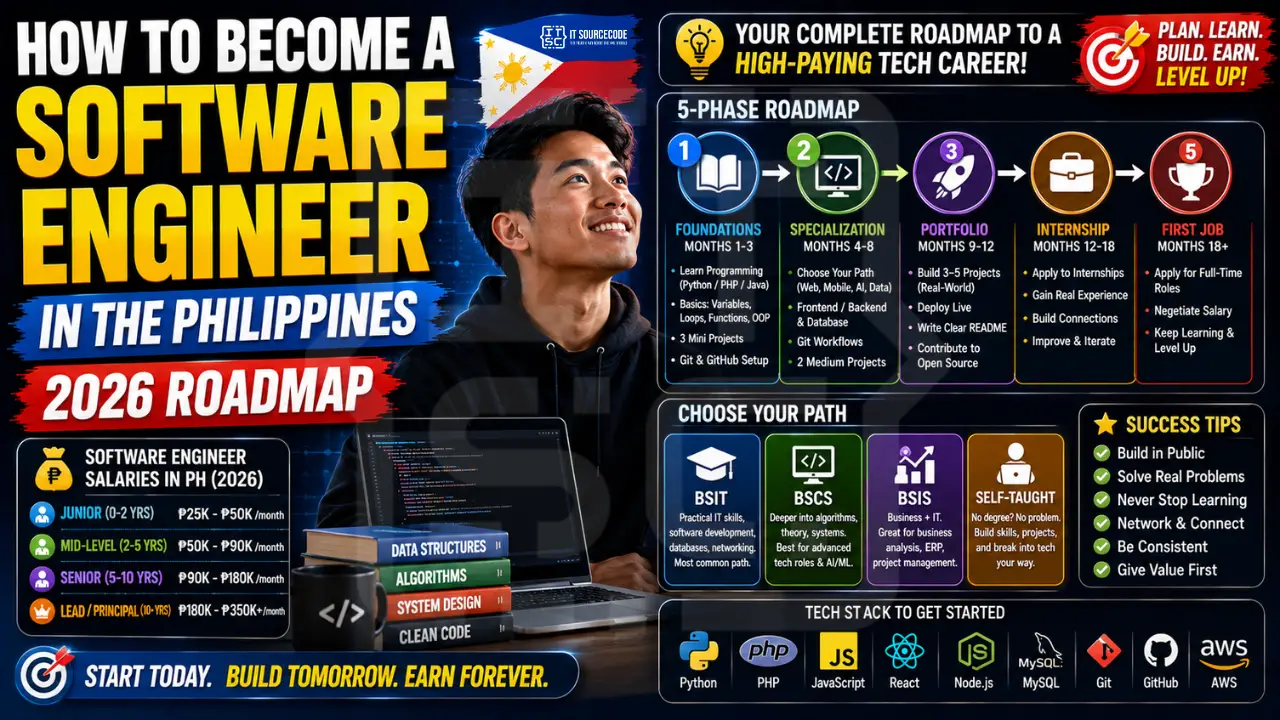
This complete roadmap walks you through every step: from choosing the right degree (or skipping it), to building your first portfolio project, to landing your first job. Whether you’re a high school graduate deciding between BSIT and BSCS, a 3rd-year student wondering if you should switch tracks, or a self-taught learner trying to break into the industry without a CS degree, this guide is for you.
Last updated: June 2026, written by PIES Information Technology Solutions for BSIT and BSCS students across the Philippines and Southeast Asia.
📌 Quick navigation: Use the section headers below to jump straight to what’s relevant. Bookmark this page, you will come back to it.
What Does a Software Engineer Actually Do?
A software engineer designs, builds, tests, and maintains software systems: apps, websites, databases, APIs, mobile applications, and increasingly, AI-powered tools. In the Philippines in 2026, the most common day-to-day work falls into these categories:
- Web development: building business websites, e-commerce platforms, admin dashboards using PHP, Python (Django), Java, JavaScript (React/Vue), or .NET
- Mobile app development: Android (Java/Kotlin), iOS (Swift), or cross-platform (Flutter, React Native)
- Backend/API development: building services that power apps and websites (Node.js, Django, Laravel, Spring Boot)
- Data engineering & AI: building data pipelines, training machine learning models, deploying AI applications (Python is dominant here)
- Quality assurance & testing: writing automated tests, manual testing, performance testing
- DevOps & cloud infrastructure: deploying and managing software on AWS, Azure, Google Cloud
Most Filipino software engineers specialize in one of these areas after gaining a year or two of generalist experience. The role you choose dramatically affects your salary, work environment, and which skills you should prioritize.
Education Paths: BSIT vs BSCS vs BSIS vs Self-Taught
Filipino students have four realistic paths to becoming a software engineer:
1. BSIT (Bachelor of Science in Information Technology)
The most common path. 4-year degree focused on practical application development, networking, databases, and IT management. Strong fit for students who want to build software professionally without going deep into theory. Most BSIT graduates become software engineers, system administrators, or web developers. Capstone defense is required.
2. BSCS (Bachelor of Science in Computer Science)
More theoretical. Covers algorithms, data structures, computational theory, operating systems, and discrete mathematics. Best for students aiming at advanced roles in AI/ML, systems engineering, or graduate school. BSCS graduates often command slightly higher starting salaries (~₱5K/month more) but the gap closes within 2-3 years on the job.
3. BSIS (Bachelor of Science in Information Systems)
Hybrid of business + IT. Less programming, more emphasis on business processes, requirements gathering, and IT project management. Many BSIS graduates become business analysts, ERP consultants, or transition into software engineering via short courses afterward.
4. Self-Taught (No CS/IT degree)
Increasingly common in 2026. Free online resources, bootcamps, and a strong portfolio can substitute for a degree at most non-government Filipino tech companies. Self-taught engineers face higher resistance from traditional firms (banks, government) but startup hiring is degree-blind. Plan for 12-18 months of focused study + a portfolio of 3-5 substantial projects.
Our recommendation: If you’re starting from zero and need affordability, BSIT is the safest bet: accessible, panel-friendly, well-recognized. If you’re self-funded and gunning for top US/SEA remote roles, BSCS or self-taught + serious portfolio both work. For cost breakdowns by path, see our guide.
The Step-by-Step Roadmap (5 Phases)
Whether you’re in a degree program or self-taught, this 5-phase roadmap works:
1: Foundations (Months 1-3)
- Pick ONE programming language and stick to it for 3 months. Python for beginners; PHP for fastest path to employability in PH; Java for OOP discipline.
- Learn variables, conditionals, loops, functions, arrays/lists, basic OOP
- Set up your dev environment: VS Code, Git, GitHub account
- Build 3 tiny projects: calculator, todo list, simple text-based game
2: Specialization (Months 4-8)
- Pick a domain: web dev, mobile, AI/ML, or data engineering
- Web dev path: HTML/CSS → JavaScript → React or Vue → Node.js/Django/Laravel
- Learn a database: MySQL or PostgreSQL (essential)
- Learn Git/GitHub workflows (branching, pull requests)
- Build 2 medium-complexity projects in your specialty
3: Portfolio (Months 9-12)
- Build 3-5 substantial projects (each takes 2-6 weeks)
- Deploy them live (Vercel, Render, Railway have free tiers)
- Document each on GitHub with a clear README
- Optional: contribute to open source (Hacktoberfest, easy-first-issue tags)
- Browse our Free Projects hub for inspiration. Clone, modify, make it your own
4: Internship/First Job (Months 12-18)
- Apply to internships even if you’re 2nd-3rd year. DSWD requires SY 3rd or 4th year internship, but private companies hire interns earlier
- Top PH internship sources: Kalibrr, Jobstreet, LinkedIn, company websites, university OJT placements
- Expect 30-50% offer rate from interviews, so apply broadly
- Salary expectation for internship: ₱5,000-12,000/month (some unpaid in start-ups)
5: First Full-Time Role (Months 18+)
- Apply 6 months before graduation for new-grad pipelines
- Salary expectation: ₱25,000-45,000/month junior; ₱150,000+/month for remote roles with US/EU companies
- Negotiate. Junior offers in PH usually have ₱3-8K wiggle room
- Continue learning: pick a senior-level skill (system design, cloud architecture, AI agents)
Essential Skills in 2026
The skill mix has evolved significantly with the rise of AI. Here’s what Philippine tech companies are hiring for in 2026:
Programming languages (in order of PH market demand)
- JavaScript/TypeScript: universal, every web role uses it
- Python: backend, AI/ML, automation, data science
- PHP: most Philippine business systems still run on it (Laravel especially in demand)
- Java: enterprise systems, Android, banking software
- C#: government, enterprise, Unity game development
Framework & tool literacy
- Frontend: React, Vue, Tailwind CSS
- Backend: Node.js (Express/NestJS), Django, Laravel, Spring Boot
- Database: MySQL, PostgreSQL, MongoDB
- Cloud basics: AWS (EC2, S3, Lambda) or DigitalOcean
- Version control: Git + GitHub workflows (mandatory)
- Container basics: Docker for development
AI literacy (NEW critical skill in 2026)
Knowing how to USE AI coding assistants (Cursor, GitHub Copilot, Claude Code) to 2-3x your productivity is now expected at most modern Filipino tech companies. Knowing how to BUILD with AI APIs (OpenAI, Anthropic Claude, Gemini) is a strong differentiator for roles paying ₱60K+/month.
Soft skills (often underrated)
- Clear written English (most senior engineers work async with global teams)
- Asking specific questions instead of “it doesn’t work”
- Reading legacy code without panic
- Documentation discipline
- Knowing when to ask for help vs spend time debugging alone
How Long Does It Take?
Realistic timelines depending on your starting point:
- From zero, self-taught, 20+ hours/week: 12-18 months to first junior role
- From zero, self-taught, 5-10 hours/week: 24-36 months
- BSIT/BSCS student, normal pace: 4 years (degree) + 0-3 months job search
- Career changer with adjacent skills (BSIS, math, electronics): 12-18 months
- Career changer from non-technical field: 18-24 months
The biggest variable is not talent. It is consistent practice. Three hours daily beats 21 hours every Saturday. Track your progress weekly; if you’re not shipping something each month, your approach needs adjustment.
Cost of Becoming a Software Engineer in the Philippines
Path costs vary wildly. We’ve broken down detailed numbers in our Cost of Being a Software Engineer guide, but the high-level breakdown:
- BSIT/BSCS at public university (UP, PUP, UPLB): ₱5,000-15,000/semester
- BSIT at top private university (Ateneo, La Salle, FEU): ₱60,000-120,000/semester
- Self-taught with free resources: ₱0-2,000 (just hosting & domain)
- Self-taught with paid courses (Udemy, Coursera Plus): ₱20,000-60,000 total
- Bootcamps (KodeGo, Avion School, FreeCodeCamp PH): ₱60,000-200,000 for 3-6 months
- Equipment: ₱30,000-60,000 for a capable programming laptop
Top Companies Hiring Software Engineers in the Philippines (2026)
Where the demand is in 2026:
Local Filipino tech companies
- GCash, Maya, Coins.ph: fintech, hiring aggressively at all levels
- Shopee, Lazada: e-commerce platforms with massive PH presence
- Grab, JoyRide: ride-hailing and delivery
- Globe Telecom, PLDT/Smart, Converge: telecom and IT infrastructure
- Voyager Innovations, Kumu, Mynt: local tech scale-ups
Outsourcing / IT services (high volume)
- Accenture, IBM, Cognizant, Wipro, Tata Consultancy (Tier 1 outsourcers)
- Pointwest, Stratpoint, Exist Software Labs (homegrown PH consultancies)
Remote roles for US/Europe (highest paying)
Once you have 2-3 years of experience, US/EU remote roles via Toptal, Arc.dev, Crossover, or direct hire pay ₱150K-400K/month. English proficiency, GitHub portfolio, and timezone flexibility are entry requirements.
How to Build a Portfolio Without Work Experience
Your portfolio is what gets you interviews. Three rules:
- Build real projects, not tutorial replicas. If you follow a tutorial, modify it significantly. Hiring managers can spot tutorial copy-paste in seconds.
- Deploy everything live. A working demo URL beats screenshots 10x. Free hosting on Vercel, Netlify, Render is enough for portfolio projects.
- Document with clear READMEs. Each project should explain: what it does, what stack, how to run locally, what you learned, what you’d improve.
Portfolio project ideas that impress:
- A real tool that solves your own problem (price tracker, study planner, expense splitter)
- An MVP clone of a popular app (Twitter feed, Spotify dashboard, Notion-lite)
- An AI-powered tool (chat with your notes, image classifier, code reviewer)
- A complete capstone-level system (Library Management, Inventory, POS). See Free Projects
How to Pass Software Engineer Interviews in 2026
PH interview structure has changed in 2026. Typical pipeline:
- Application screening (CV + GitHub): Strong portfolio gets you through automatically
- Initial screening call (15-30 min): Background, motivation, salary expectation
- Technical assessment (2-4 hrs, take-home): Build a small app or solve algorithmic problems
- Technical interview (45-90 min): Live coding, system design discussion, walking through your portfolio
- Behavioral/culture fit (30-60 min): Team dynamics, work style, conflict resolution
- Final round (sometimes with CEO/founders for startups): Closing alignment
What separates strong candidates:
- They can EXPLAIN their portfolio projects clearly, including trade-offs they made
- They ask thoughtful questions about the company, the team, the tech stack
- They admit when they don’t know something, and explain how they would find out
- They’ve done research on the company beyond just the website
Career Progression: Junior to Senior to Architect
Typical Philippine software engineer career ladder:
- Junior (0-2 years): ₱25,000-45,000/mo. Learn the codebase, ship features under guidance.
- Mid-Level (2-5 years): ₱50,000-90,000/mo. Own features end-to-end, mentor juniors.
- Senior (5-8 years): ₱100,000-180,000/mo locally; ₱150,000-300,000/mo for remote. Lead projects, design systems, set technical direction.
- Tech Lead / Engineering Manager (8+ years): ₱180,000-300,000/mo. Lead a team of 5-15 engineers.
- Principal / Staff / Architect (10+ years): ₱250,000-500,000+/mo. Cross-team technical strategy.
Full salary breakdowns by city, company type, and specialization are in our Software Engineer Salary Philippines 2026 guide.
Common Mistakes to Avoid
- Tutorial paralysis: Watching 100 hours of tutorials without ever building anything. Cap tutorials at 30% of your time; spend 70% building.
- Premature specialization: Picking “AI engineer” before you can build a basic CRUD app. Walk before you run.
- Switching languages constantly: Master ONE language before jumping to the next. Six months minimum.
- No public GitHub: Even modest projects on GitHub show employers you’re actively building.
- Hiding from interviews: Apply broadly even when you feel unready. Interview practice itself is a skill.
- Underselling your degree: “I only have BSIT” is a poor mindset. Most hiring managers want practical builders, not theorists.
- Ignoring soft skills: Your English, communication, and Git workflow discipline matter as much as your technical depth at junior/mid levels.
Frequently Asked Questions
Plan your software engineering career in the Philippines
Can I become a software engineer in the Philippines without a degree?
How much do junior software engineers earn in the Philippines (2026)?
Should I learn Python, JavaScript, or PHP first as a Filipino BSIT student?
How long does it take to become a software engineer in the Philippines?
What’s the difference between a software engineer and a software developer in the Philippines?
Do I need to know math to become a software engineer?
How do I get my first software engineering internship in the Philippines?
Can BSIT students get remote jobs with US or European companies?
Final Thoughts + Next Steps
Becoming a software engineer in the Philippines in 2026 is more accessible than ever, but also more competitive. Generic tutorial-following won’t get you hired. What works: pick one language, ship 5 real projects, document everything on GitHub, apply to 50 internships, and iterate on your interview performance until you land that first offer.
The biggest mistake we see Filipino students make is waiting until graduation to start applying for jobs. Don’t. The students who land the best entry-level offers have been writing code, contributing to GitHub, and going to tech meetups since their 1st or 2nd year. Start today.
🎯 Your next 3 actions:
- Pick ONE language and commit to 3 months of daily practice. See our free programming tutorials
- Browse our Free Projects hub for capstone-quality starter code to learn from
- Bookmark our Software Engineer Salary 2026 guide for the income reality at every career stage
We are hoping this roadmap helps you map out your path from student to working software engineer in the Philippines. Bookmark the salary and interview guides linked above and revisit this checklist after each milestone. Thank you for reading itsourcecoders.
This guide is updated annually. Found a section that needs updating? Have feedback or questions? Leave a comment below and our team responds within 24 hours.

Adrian Mercurio
Full-Stack Developer at PIES IT Solution
Specializes in building complete capstone projects with full documentation. Strong background in PHP/MySQL development and database design. Has personally built and tested over 30 capstone-ready projects with ER diagrams, DFDs, and chapter-by-chapter thesis documentation.
Expertise: PHP · Laravel · Database Design · Capstone Projects · C# · C · C++ · Python · AI Projects · View all posts by Adrian Mercurio →