
HubSpot, Zoho CRM, and Salesforce are the three CRM platforms most commonly considered by Filipino small-to-mid businesses (SMBs) planning to scale past 20 employees. Choosing one is a 3-5 year commitment because CRM migration is painful and data locked in one system does not easily move to another. Getting the decision right the first time matters.
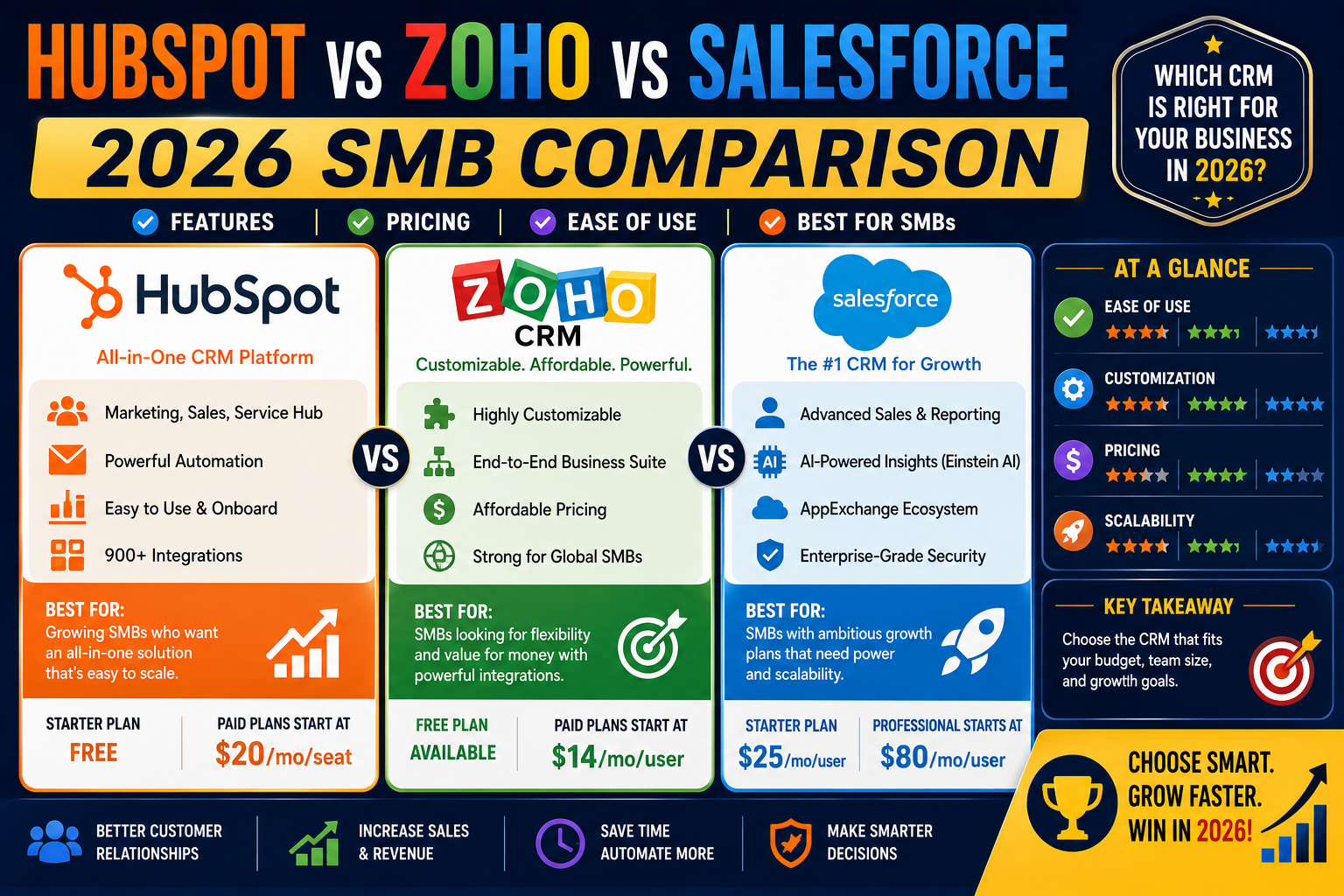
This comparison evaluates the three specifically for Filipino SMBs in 2026, focusing on the trade-offs that actually matter at growth stage: cost per user as team scales, ecosystem depth, integration coverage, and long-term flexibility. Not another feature checklist.
Quick verdict for Filipino SMBs
- Pick HubSpot if: Marketing and sales alignment is your top priority, or you value the best UX in the category and can afford it as you scale.
- Pick Zoho CRM if: You want the widest feature set at the lowest cost, and are comfortable with a less polished UI in exchange for real savings.
- Pick Salesforce if: You plan to grow to 50+ sales reps within 3 years, or your business specifically needs Salesforce integration (US enterprise clients, Salesforce-first partners).
Pricing head-to-head at multiple team sizes
All three CRMs charge per user per month. The relative economics change dramatically as your team grows.
| Team size | HubSpot Starter | Zoho Standard | Salesforce Essentials |
|---|---|---|---|
| 5 users | USD 100/mo | USD 70/mo | USD 125/mo |
| 15 users | USD 300/mo | USD 210/mo | Sales Professional USD 1,200/mo |
| 30 users | Prof USD 3,000/mo | USD 420/mo | Sales Professional USD 2,400/mo |
| 50 users | Prof USD 5,000/mo | Prof USD 1,150/mo | Sales Enterprise USD 8,250/mo |
Zoho dominates on price at every team size. HubSpot’s Starter tier is competitive at small scale but Professional pricing jump at 15+ users is severe. Salesforce Essentials caps at 10 users, forcing upgrade to Sales Professional at USD 80/user/month for teams above 10.
For a Filipino SMB planning to grow from 10 to 30 employees over 24 months:
- Zoho: USD 140 to USD 420/month range (roughly PHP 8,000 to PHP 24,000/month)
- HubSpot: USD 200 to USD 3,000/month range (roughly PHP 11,400 to PHP 171,000/month, jumping at Professional tier)
- Salesforce: USD 250 to USD 2,400/month range (roughly PHP 14,250 to PHP 137,000/month)
Ecosystem depth and integration coverage
HubSpot: Strong ecosystem around inbound marketing. HubSpot Marketing Hub, Content Hub (CMS), Sales Hub, Service Hub, Commerce Hub, Operations Hub. All integrate seamlessly. Third-party integrations 1,700+ via HubSpot App Marketplace.
Zoho: Massive ecosystem beyond CRM. Zoho One bundle (USD 45/user/month) includes 45+ apps: Books (accounting), Mail (email), Projects (project management), Desk (support ticketing), Campaigns (email marketing), Meeting (video), and dozens more. If you use even 3-4 Zoho apps, the bundle economics dominate every alternative.
Salesforce: Salesforce AppExchange has 8,000+ apps, more than HubSpot and Zoho combined. Every major B2B SaaS integrates with Salesforce first, other CRMs second. This is the ecosystem depth advantage.
For Filipino SMBs sticking with one primary vendor, Zoho’s app breadth is the strongest value. For SMBs building on best-of-breed SaaS across many vendors, HubSpot’s integration polish or Salesforce’s integration count wins depending on your specific stack.
UX and daily user experience
HubSpot: Best UX in the category. Cleanest interface, most intuitive workflows, best mobile app. Adoption rate on HubSpot is consistently higher than Zoho or Salesforce in real teams. If you struggle to get sales reps to actually use the CRM, HubSpot solves that problem faster than the alternatives.
Zoho: UI feels dated in 2026. Menu-heavy, more clicks required for common actions. Sales reps who used HubSpot or Salesforce previously often push back on Zoho’s UX. Learning curve is steeper but manageable with 1-2 weeks of team training.
Salesforce: Powerful but complex. Requires administrator with Salesforce experience to configure properly. UI has improved with Lightning Experience but still more clicks than HubSpot. Sales reps eventually adapt but adoption takes 4-8 weeks.
For Filipino SMBs prioritizing team adoption and low training overhead, HubSpot wins. For those willing to invest in training for lower long-term cost, Zoho is fine. Salesforce is highest overhead of the three.
Marketing automation capabilities
HubSpot: Best-in-class marketing automation, especially for inbound marketing (email nurture campaigns, landing pages, blog CMS, SEO tools). HubSpot Marketing Hub Starter starts at USD 20/month for basic, Professional at USD 800/month for advanced. Widely used by content-marketing-driven Filipino agencies.
Zoho: Zoho Marketing Automation (separate from CRM) at USD 19/user/month covers email campaigns, workflow automation, lead scoring. Less polished than HubSpot but 60-70% of the features at 30% of the cost.
Salesforce: Marketing Cloud is a separate product (formerly ExactTarget). Enterprise-grade marketing automation but complex to configure and expensive (USD 400+/user/month starting). Overkill for most SMBs.
For content and inbound marketing focus, HubSpot Marketing Hub Starter is the pragmatic pick even at the higher price. For basic email automation, Zoho Campaigns bundled in Zoho One saves real money.
Reporting and analytics
HubSpot: Reporting is intuitive and dashboards look great out of the box. Custom reports require Professional tier (USD 600/user/month). Enterprise-grade reporting via Operations Hub adds significant cost.
Zoho: Zoho Analytics is a separate product (USD 30/month starter) that plugs into Zoho CRM data. Deep reporting capabilities but requires learning Zoho Analytics separately.
Salesforce: Salesforce Reports and Dashboards are industry-leading. Every metric imaginable, drag-and-drop dashboard builder, real-time updates. This is where Salesforce’s price premium shows up: reporting depth is unmatched.
For SMBs that need basic sales pipeline reports, all three work. For advanced BI-style analytics, Salesforce wins meaningfully.
Growth path considerations (3-5 year horizon)
Starting with HubSpot: Smooth path from Starter (USD 20/user) to Professional (USD 100/user) to Enterprise (USD 150/user). Feature parity increases gracefully. Migration between HubSpot tiers is seamless. Growth ceiling: HubSpot Enterprise handles 1,000+ user organizations.
Starting with Zoho: Zoho Standard (USD 14) to Professional (USD 23) to Enterprise (USD 40) to Ultimate (USD 52). Solid growth path with reasonable pricing. Zoho One bundle (USD 45) unlocks 45+ Zoho apps at scale.
Starting with Salesforce: Essentials (USD 25, capped at 10 users) forces upgrade to Sales Professional (USD 80) at 11+ users. That is a big cliff. Sales Enterprise (USD 165) and Unlimited (USD 330) tiers exist for larger organizations. Salesforce is the “aim for enterprise” choice.
For Filipino SMBs uncertain about their growth trajectory, HubSpot and Zoho have smoother upgrade paths. Salesforce has the sharpest cliff at 10 users.
The realistic decision matrix
Filipino agency doing inbound marketing (content, SEO, ads) with 5-15 people: HubSpot. Marketing and sales alignment matters more than lowest cost.
Filipino BPO or SMB with 20-100 people wanting one-vendor cost efficiency: Zoho One bundle. USD 45/user/month for 45+ apps is unbeatable value.
Filipino B2B SaaS startup planning to raise VC funding and scale to enterprise: Salesforce from day one. Investors and enterprise clients expect it, and migration off Salesforce later is prohibitively expensive.
Filipino consulting firm that also uses accounting and email tools: Zoho One dominates if you can accept the older UI. Or HubSpot + separate accounting/email if UX is your top priority.
Filipino manufacturer or trader with complex sales cycles (multiple decision-makers, long lead time): Salesforce or HubSpot Professional. Zoho works but reporting depth wins for complex sales.
Bottom line
For most Filipino SMBs in 2026, Zoho CRM Standard at USD 14/user/month is the correct starting point. Best economics at every team size, widest ecosystem for one-vendor bundling, adequate feature depth for most needs.
Upgrade path from Zoho: stay on Zoho as you scale (Professional USD 23, Enterprise USD 40), or add Zoho One bundle (USD 45) when you use 3+ Zoho apps.
Pick HubSpot instead if: Team adoption is your risk (HubSpot’s UX solves adoption), or if inbound marketing is your primary sales engine (HubSpot Marketing Hub is unmatched at SMB scale).
Pick Salesforce instead if: You are specifically building for enterprise scale (50+ sales reps within 3 years) or specifically integrating with Salesforce-first partners.
Do not switch between these platforms once committed. Migration costs (retraining, data migration, integration rebuild) easily exceed 6 months of subscription savings. Pick once, commit for 3-5 years.
Official documentation
Try HubSpot, Zoho, or Salesforce (affiliate)
Some links below are affiliate links. We may earn a commission at no extra cost to you. See our affiliate disclosure.
- HubSpot CRM, best UX and inbound marketing integration
- Zoho CRM, our top pick for Filipino SMBs on cost
- Zoho One bundle, 45+ apps at USD 45/user/month
- Salesforce, aim-for-enterprise choice
Frequently asked questions
Is HubSpot really more expensive than Zoho?
Yes, meaningfully. HubSpot Starter at USD 20/user vs Zoho Standard at USD 14/user, so 40% more expensive at the entry tier. At Professional tier, HubSpot USD 100/user vs Zoho USD 23/user is a 4x price difference. The premium buys you better UX and stronger marketing tools. For pure CRM functionality, Zoho gives you 80% of HubSpot’s features at 30% of the cost.
Is Salesforce overkill for a 10-person Filipino agency?
Almost always yes. Salesforce Essentials caps at 10 users forcing you to Professional (USD 80/user) or Enterprise (USD 165/user) at 11+ users. For a 15-person team, Salesforce Professional runs USD 1,200/month versus Zoho Standard at USD 210/month. Unless your team specifically needs Salesforce for a client integration, other options are more cost-effective at SMB scale.
Can I use HubSpot Free forever?
HubSpot Free is genuinely free forever (not a trial) but capped at 1 million contacts and no removal of HubSpot branding on emails or forms. Free tier is enough for small teams under 5 people who mostly do inbound CRM without heavy marketing automation. Upgrade to Starter when you need to remove branding or add email sequences.
What is Zoho One and why does everyone recommend it?
Zoho One is Zoho’s all-in-one bundle at USD 45/user/month annual. Includes 45+ Zoho apps: CRM, Books (accounting), Projects (PM), Mail (email), Desk (support), Campaigns (marketing), Analytics (BI), Meeting (video), Sign (e-signatures), and more. If your business would separately pay for 3+ of these tools, the bundle saves significant money. For Filipino SMBs consolidating their stack, Zoho One is the highest-value CRM-adjacent deal.
Do Filipino companies use Salesforce?
Yes, but concentrated in specific segments: PH BPO industry (call centers use Salesforce Service Cloud), PH BFSI (banks and insurers use Salesforce Financial Services Cloud), and Filipino subsidiaries of US Fortune 500 companies (parent company mandates Salesforce). For pure Filipino SMBs without those specific needs, HubSpot or Zoho are more commonly used.
How hard is CRM migration between these platforms?
Hard. Contact and deal data export cleanly from all three via CSV. But custom fields, workflows, automation rules, email templates, and integrations rarely migrate without manual rebuild. Typical migration takes 3-8 weeks for a 20-person team with an experienced admin. Budget PHP 100,000-300,000 in consulting fees if you hire outside help. This is why picking the right CRM the first time matters a lot.

Leah Whynett Dela Pena
Technology Writer at PIES IT Solution
Leah Whynett Dela Pena is a technology writer at PIES IT Solution, author of 93 career and IT education guides at itsourcecode.com. Specializes in tech career paths (software engineering, web development, cybersecurity, IT analyst roles), degree and certification guidance, and IT industry how-to content for students and career changers.
Expertise: Tech Careers · IT Education · Web Development Careers · Software Engineering Careers · Cybersecurity Careers · IT Certifications · Career Guidance · View all posts by Leah Whynett Dela Pena →