
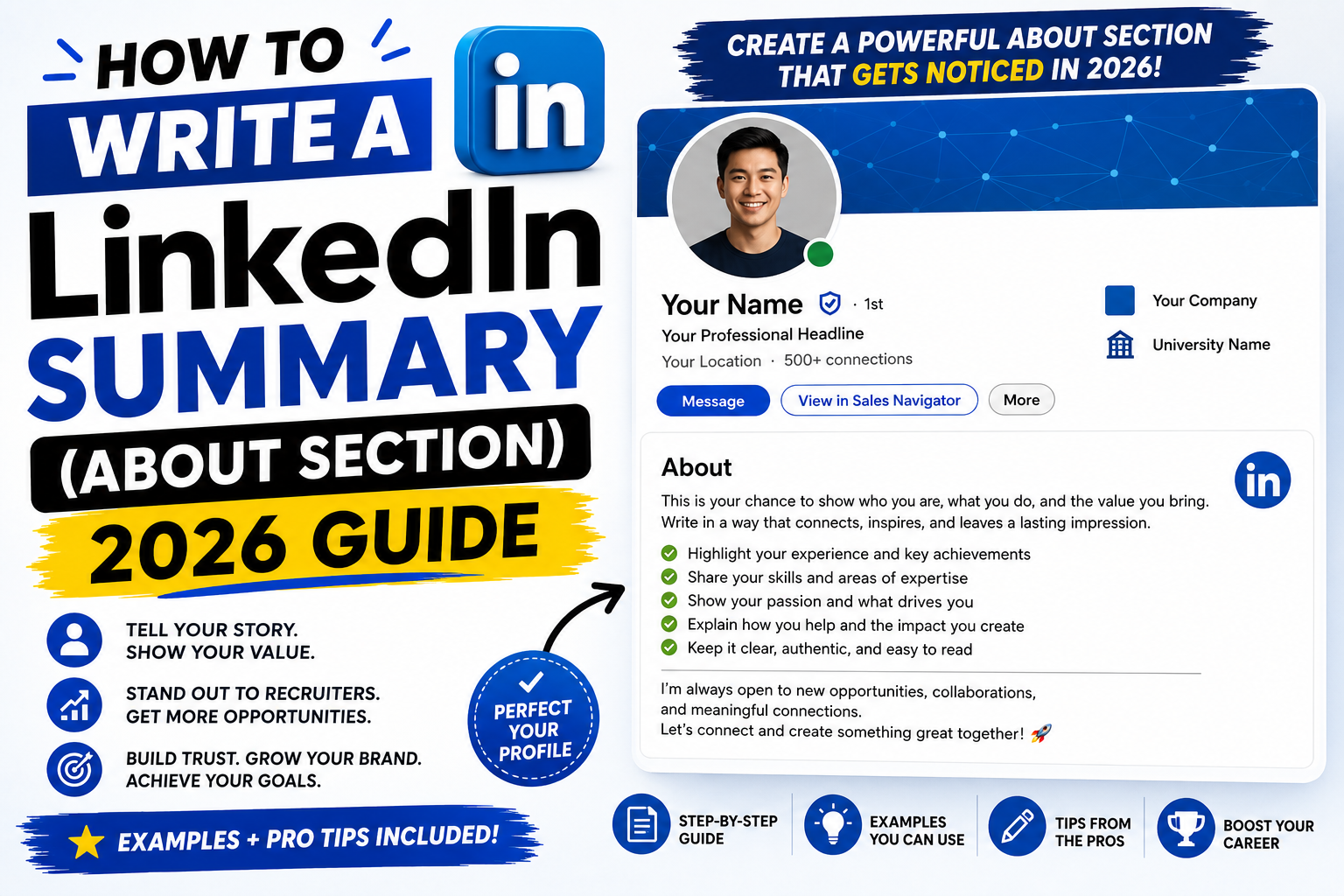
Your LinkedIn About section (Summary) is your 2,600-character pitch. Recruiters and prospects read it after your headline pulls them in. A great summary tells your story, hits keyword targets, and closes with a clear call to action. This 2026 tutorial gives you 4 proven summary formulas plus hook templates and mistakes to avoid.
Why the summary matters
- 2,600 characters (~400 words) to sell yourself in your own voice.
- LinkedIn shows first 3 lines (about 220 characters) before “see more” fold.
- Recruiters search summary text for keywords.
- Prospects/hiring managers decide whether to message you based on it.
The critical first 3 lines (above the fold)
Your first 3 lines (before “see more”) need a hook. Try:
Hook types:
- Curiosity: "3 things about being a data analyst that surprised me..."
- Result: "In 2 years, I helped 5 companies save $2M via process automation."
- Question: "What if you could scale customer support without hiring?"
- Bold statement: "The B2B marketing playbook is broken. Here's my alternative..."
- Story: "In 2019, I quit my finance job to become a UX designer..."
Formula 1: Story + Skills + Ask
Structure (4 paragraphs):

Paragraph 1 (Hook): personal story or bold statement.
Paragraph 2 (Now): what you do, your specialty, the value you create.
Paragraph 3 (Track record): concrete achievements with numbers/outcomes.
Paragraph 4 (Ask): who to contact and why (email or DM invitation).
Formula 2: Problem + Solution + Proof + CTA
Structure:

Problem: what problem your target audience faces.
Solution: your approach to solving it.
Proof: your credentials, certifications, results.
CTA: how to reach you, what you're open to.

Great for consultants, freelancers, agency owners.
Formula 3: Chronological career story
Structure:

Sentence 1: your current role.
Paragraph on how you got there (2-3 pivots, learning moments).
Paragraph on key achievements (with numbers).
Sentence: what you're doing/looking for next.
Ask: contact info.

Great for career-change or extensive experience professionals.
Formula 4: Skills-first (for job seekers)
Structure:

Line 1: role you're seeking + years of experience.
Skills list (bullet-format friendly):
• Technical: [3-5 specific tools/languages]
• Business: [3-5 business skills]
• Soft: [2-3 soft skills that matter for your target role]

Experience highlights (3-4 bullet points with results).

Availability: immediate / 2 weeks / remote / relocation OK.

Contact: email + LinkedIn message invitation.

Ideal for BSIT/CS graduates and career-changers.
Keyword strategy for the summary
- Naturally integrate 15-20 keywords across the summary.
- Include job titles you’d apply for.
- List technical skills verbatim (Python, AWS, Salesforce, SQL).
- Mention industries: SaaS, fintech, e-commerce, healthcare.
- Add certifications with acronyms: PMP, CSM, AWS SA, CISA.
- Never stuff, must sound like natural conversation.
Common summary mistakes
- Too long (2600 chars max but 1500-2000 sweet spot).
- All third-person (“Leah is…” instead of “I am…”), sounds robotic.
- Just a job description, no personality or achievements.
- Buzzword salad (“results-driven synergistic thought leader”).
- No call to action.
- No email or way to contact.
- Old dates or outdated info (says “5 years experience” but was written 5 years ago).
Add media to your summary
Scroll to bottom of About section > click Featured > add:
- PDF resume or portfolio.
- Case study links.
- Blog posts or LinkedIn articles you wrote.
- Speaking videos.
- Certifications displayed as visual cards.
Example summary (for BSIT graduate)
Hi! I'm Karen, BSIT graduate from Manila, actively looking for Full-Stack Developer roles.

For the past 3 years I've been building web applications with React, Node.js, and PostgreSQL. My capstone project (an inventory management system for a local retail chain) automated 8 hours of daily manual work, and I've been building side projects ever since.

What I do:
• React + TypeScript for frontend
• Node.js + Express + PostgreSQL for backend
• Docker + AWS for deployment
• Git + GitHub for team collaboration

Portfolio highlights:
• Inventory Management System (my capstone)
• Personal budget tracker (Vue + Firebase, 100 users)
• Real-time chat app (Socket.io, MongoDB)

I'm open to:
• Remote roles worldwide
• On-site roles in Manila
• Immediate start

Reach out at karen@email.com or send a LinkedIn DM. Happy to share code samples on request.
How to edit your summary
- Go to your LinkedIn profile.
- Scroll to the “About” section.
- Click the pencil (edit) icon.
- Type or paste your new summary.
- Character limit shows in real time.
- Click Save.
Official documentation
Recommended career resources
The links below are affiliate links. We may earn a commission at no extra cost to you when you buy or sign up. See our affiliate disclosure.
LinkedIn summary formulas by industry
The universal summary structure works for most people. But different industries reward different signals in your About section. A recruiter scanning software engineers reads for stack depth. One scanning sales leaders reads for closed-won numbers. Here are industry-specific patterns that consistently perform well in 2026.
Software developer or engineer
Open with your stack, your years of experience, and a concrete outcome. Do not list every framework you have touched. Pick the 3 or 4 that matter most for the roles you want. Then end with what kind of team or product you want to work on next. Example opener: Full-stack developer with 6 years shipping production Python and React apps. Currently building fintech APIs at a Series B startup. Looking for a senior role at a product company that ships weekly.
Marketing, content, or growth
Lead with the channel you own and a real number. Marketing recruiters need proof of impact fast. Example: SEO manager who grew organic traffic 340% at a SaaS company from 20K to 87K monthly visitors in 14 months. I focus on content operations, technical SEO, and building topic clusters that actually rank.
Sales or business development
Sales summaries live and die by numbers. Include your quota attainment, your average deal size, and your industry vertical. Example: Enterprise SaaS AE closing $2M+ ARR annually at 130% quota attainment. I specialize in helping CTOs at 500 to 5,000 employee companies cut cloud costs while scaling engineering teams.
Career changer or recent graduate
Do not hide the transition. Recruiters respect clarity about your journey more than they respect padding. Explain what you did before, what you are moving toward, and what proof of skill you have already gathered. Example: Aspiring data analyst with 4 years in accounting. Currently completing the Google Data Analytics Certificate and building portfolio projects in Python and SQL. I bring finance domain expertise plus fresh analytics skills to any team hiring for junior roles.
Common LinkedIn summary mistakes to avoid
I have reviewed hundreds of LinkedIn About sections in the past year. These are the five mistakes I see most often. Fix these and your summary will read as sharp, credible, and human instead of generic.
- Writing in third person. “Jessica is a passionate marketer who…” reads like a corporate bio, not a real person. Write in first person. It sounds warmer and more direct.
- Using buzzwords without proof. “Strategic thinker, results-driven, passionate about innovation.” These phrases are meaningless because they cannot be measured. Replace them with a specific outcome or number.
- Skipping the first line. LinkedIn cuts your summary at around 220 characters on mobile. The first line has to earn the click on “see more.” Never waste it on a generic greeting.
- Listing every skill you have ever used. A summary is not a resume. Pick the 4 to 6 skills that matter for the roles you want and leave the rest for the Skills section.
- Ending with silence. Close with a specific call to action. Tell people what to do next: “Message me if you are hiring senior React developers.” Silent summaries convert nothing.
By the way, do not treat your summary as write once and forget. Update it every 6 months or whenever you change roles, add a certification, or hit a new milestone. Fresh summaries signal to LinkedIn’s algorithm that your profile is active, which helps you show up in more searches.
Frequently Asked Questions
Should the LinkedIn summary be first person or third person?
First person (“I”). More authentic and conversational. Third person (“Leah is…”) reads as a corporate bio and feels stiff.
What length is ideal?
1,500-2,000 characters is sweet spot. Long enough to include story + skills + achievements, short enough to keep readers engaged. 2,600 max.
Should I include an email in the summary?
Yes. Recruiters and prospects want easy ways to contact you outside LinkedIn’s messaging (they may not have Premium to message you). Include an email or portfolio link.
Can I use bullet points in the summary?
Yes. Use • or, symbols. Bullet points help skimmable content (skills list, achievements). Mix with paragraphs for storytelling.
How often should I update the summary?
Every 6 months minimum. Always update when: changing roles, gaining new certifications, adding significant achievements, or shifting career goals.

Leah Whynett Dela Pena
Technology Writer at PIES IT Solution
Leah Whynett Dela Pena is a technology writer at PIES IT Solution, author of 93 career and IT education guides at itsourcecode.com. Specializes in tech career paths (software engineering, web development, cybersecurity, IT analyst roles), degree and certification guidance, and IT industry how-to content for students and career changers.
Expertise: Tech Careers, IT Education, Web Development Careers, Software Engineering Careers, Cybersecurity Careers, IT Certifications, Career Guidance · View all posts by Leah Whynett Dela Pena →