
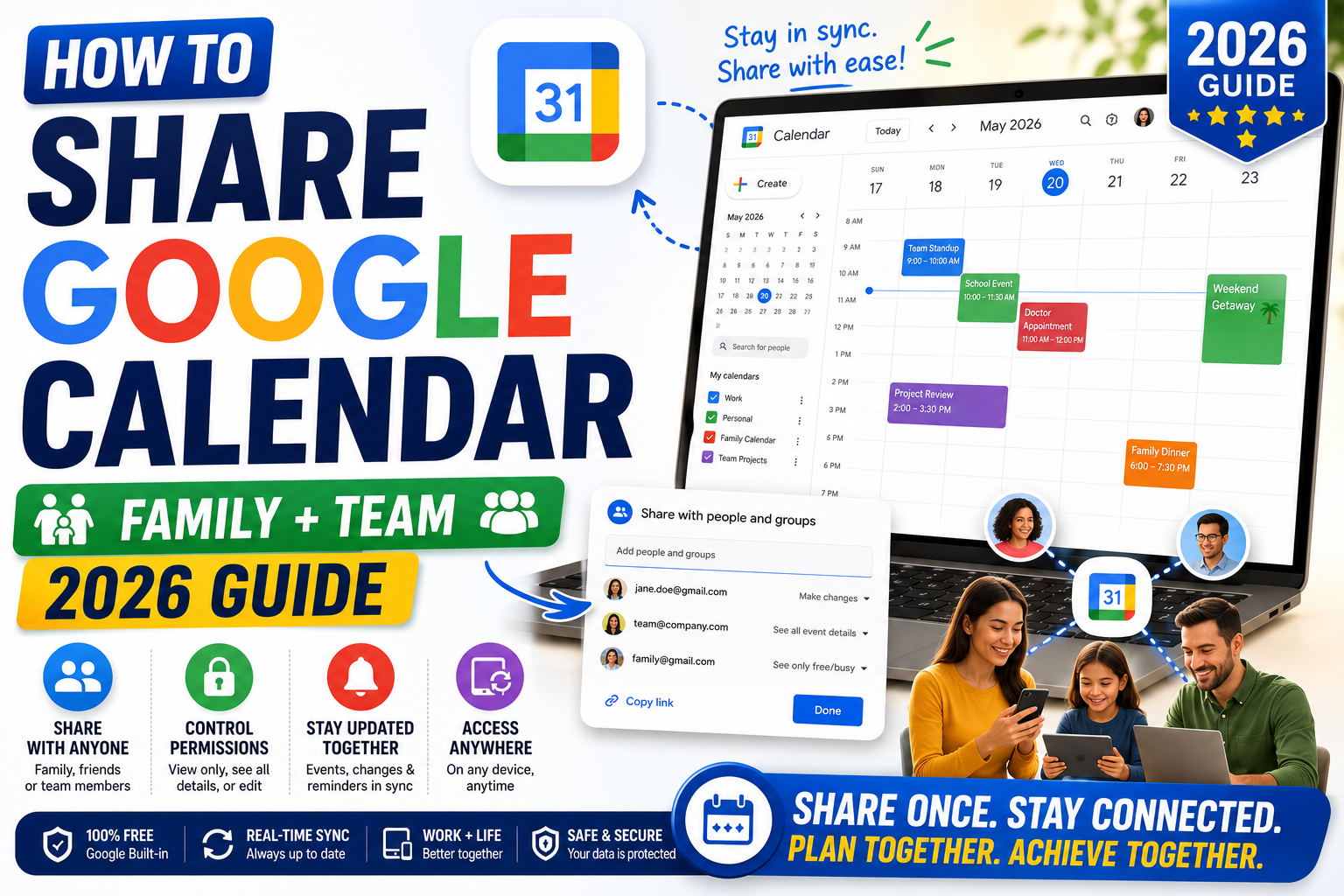
Sharing your Google Calendar lets family, coworkers, or clients see your availability without emailing back and forth. Calendar supports four permission levels, sharing with specific emails, making a calendar public, and generating a subscribe link for external calendar apps. This 2026 tutorial covers every sharing method.
Step 1: Open calendar settings
- Open Google Calendar in your browser (calendar.google.com).
- Look at the left sidebar for “My calendars”.
- Hover over the calendar you want to share.
- Click the three-dot menu that appears.
- Click Settings and sharing.
Step 2: Share with specific people
- Scroll to Share with specific people or groups.
- Click Add people and groups.
- Enter email addresses.
- Pick permission level (see next section).
- Click Send.
- Recipients get an email with a link to add your calendar.
Permission levels explained
- See only free/busy (hide details): recipients see when you’re busy but not event titles. Great for scheduling without exposing meeting content.
- See all event details: recipients see event titles, locations, times. Good for family sharing.
- Make changes to events: recipients can add, edit, delete events. Useful for assistants managing your schedule.
- Make changes and manage sharing: full ownership powers, they can also share your calendar with others. Use sparingly.
Make calendar public (Anyone with link)
- Settings and sharing > Access permissions for events.
- Check Make available to public.
- Choose “See only free/busy” or “See all event details”.
- Save.
Warning: public calendars can appear in Google Search results. Use only for public event calendars (business hours, holidays), never for personal schedules.
Share with your organization (Workspace only)
- Settings and sharing > Access permissions.
- Check Make available for [your-org.com].
- Set access level for internal viewers.
Great default for work calendars. Coworkers see availability without needing individual sharing.
Get a shareable link (subscribe URL)
For subscribing from Outlook, Apple Calendar, or other calendar apps:
- Settings and sharing > Integrate calendar.
- Copy the Public URL to this calendar (only works if calendar is public).
- Or copy Secret address in iCal format for personal use (don’t share this, it exposes all events).
- Paste the URL into Outlook / Apple Calendar / other app > Add calendar by URL.
Create a shared team calendar
Instead of sharing your personal calendar, create a dedicated team calendar:
- Left sidebar > Other calendars > click + > Create new calendar.
- Name it: “Marketing Team”, “Family Events”, “Product Launches”, etc.
- Fill description, time zone.
- Click Create.
- Go to Settings > Share with specific people, add teammates as Editors.
- Everyone can add events to this shared calendar.
Family calendar (Google Families)
- Family Manager creates a family group at families.google.com.
- Family Calendar auto-appears for all members.
- Anyone in the family can add/edit events.
- Great for kids’ school schedules, family vacations, appointments.
Un-share a calendar
- Settings and sharing.
- Under “Share with specific people or groups”, click the X next to a person.
- Or change permission to lowest level.
- To un-public a calendar: uncheck “Make available to public”.
Share on Google Calendar mobile
- Open Calendar app.
- Tap three-line menu > Settings.
- Tap the calendar you want to share.
- Mobile has limited sharing options, for adding people, use browser.
- Mobile can turn calendar visibility on/off but not manage share permissions.
Common sharing issues
- Recipient’s calendar shows nothing: they may need to check “Show calendar” checkbox in their sidebar.
- Recipient sees “free/busy” only: your sharing level is set to hide details. Change to “See all event details”.
- Cannot share due to Workspace restrictions: admin blocked external sharing. Contact admin.
- Recipient can’t add events to shared calendar: their permission is only View. Give them “Make changes to events”.
- Old shared calendar still visible: recipient must remove it themselves via Settings > Remove calendar.
Common Google Calendar mistakes to avoid
Even long-time Calendar users hit the same traps. Being aware of these saves time and prevents scheduling errors.
- Forgetting time zones when scheduling with international teams. Calendar defaults to your primary time zone. Set the event time zone explicitly when scheduling with people in different regions.
- Not checking guest RSVPs. Guests can accept, decline, or mark tentative. Check responses before assuming everyone will attend.
- Overusing “all-day” for actual scheduled events. All-day events do not block your working hours. Use specific time-slot events for anything requiring your attention.
- Ignoring calendar sharing permissions. Public calendars can be indexed by search engines. Restrict sharing to specific emails or your organization for anything containing personal or business schedules.
- Missing the automatic Google Meet link. Calendar adds a Meet link automatically when you invite others. Delete it manually if you plan to use a different video platform.
Power-user tips for Google Calendar
- Use keyboard shortcuts. Press
/to jump to search,cto create an event,dfor day view,wfor week. Full list atcalendar.google.com/calendar/keyboardshortcuts. - Set default event duration. Settings > Event settings > Default duration. Changing from 60 to 30 minutes gently pressures shorter meetings.
- Add “speedy meetings”. Settings > End 30-minute meetings 5 minutes early. Gives everyone breathing room between back-to-back calls.
- Book focus time with Focus Time events. Prevents automatic Meet links and blocks your calendar visibly.
- Use appointment slots for external bookings. Create a bookable page anyone can use to grab time on your calendar without back-and-forth email.
Real-world scenarios
For BSIT students: use Google Calendar to schedule capstone advisor consultations. Share the calendar with your team so everyone sees deadlines and defense dates.
For freelancers: block “client focus” hours and “admin” hours on your calendar. Colored labels make it easy to see time allocation at a glance.
For small teams: create a shared team calendar for meetings, deadlines, and out-of-office. Everyone subscribes; nobody has to individually track.
For remote workers across time zones: enable secondary time zone display so you always see your teammate’s local time next to yours.
Best practices summary
- Default to 30-minute meetings. Most conversations do not need a full hour.
- Include clear titles. “Q3 planning” beats “Meeting”. Titles show up in preview panels everywhere.
- Add descriptions with agenda items. Recipients arrive prepared. Meeting quality improves.
- Set reminders 10 minutes and 24 hours before important events. Prevents missed meetings.
- Archive old calendars. Old project calendars clutter your view. Hide them from sidebar when the project ends.
Official documentation
Recommended time management and calendar resources
The links below are affiliate links. We may earn a commission at no extra cost to you when you buy or sign up. See our affiliate disclosure.
Quick step-by-step summary (click to expand)
- Open Google Calendar settings. calendar.google.com then gear icon > Settings.
- Select the calendar to share. Under “Settings for my calendars” click the calendar name.
- Add specific people. Under Share with specific people, add email addresses. Set permission (view or edit).
- Public sharing. Toggle “Make available to public” if you want a public link (view-only).
- Copy shareable link. Under Integrate calendar copy the public URL.
Frequently Asked Questions
Can I share only my work hours?
Not directly. Create a separate work calendar, add only work events there, and share ONLY that calendar. Personal calendar stays private.
Does recipient need a Google account?
For direct sharing (specific email), yes. For public calendar URL, no. They can subscribe from any calendar app (Outlook, Apple Calendar, Fantastical).
How many people can I share with?
No hard limit. Practical max is around 200 individual shares before things get slow. For 200+ viewers, use public sharing or a Google Group.
Can I make an event private on a shared calendar?
Yes. When creating an event, set visibility to Private. Only YOU can see it, even on your shared calendar. Others see just “Busy”.
Is it safe to make my calendar public?
Only for calendars with genuinely public info (business hours, holiday schedule, event dates). Personal calendars should NEVER be public. Google Search may index public calendars.

Caren Bautista
Technical Writer at PIES IT Solution
Responsible for crafting clear, well-structured, and beginner-friendly content across the platform.
Expertise: Technical Writing · Content Creation · Documentation · Editorial Writing · JavaScript · TypeScript · View all posts by Caren Bautista →