
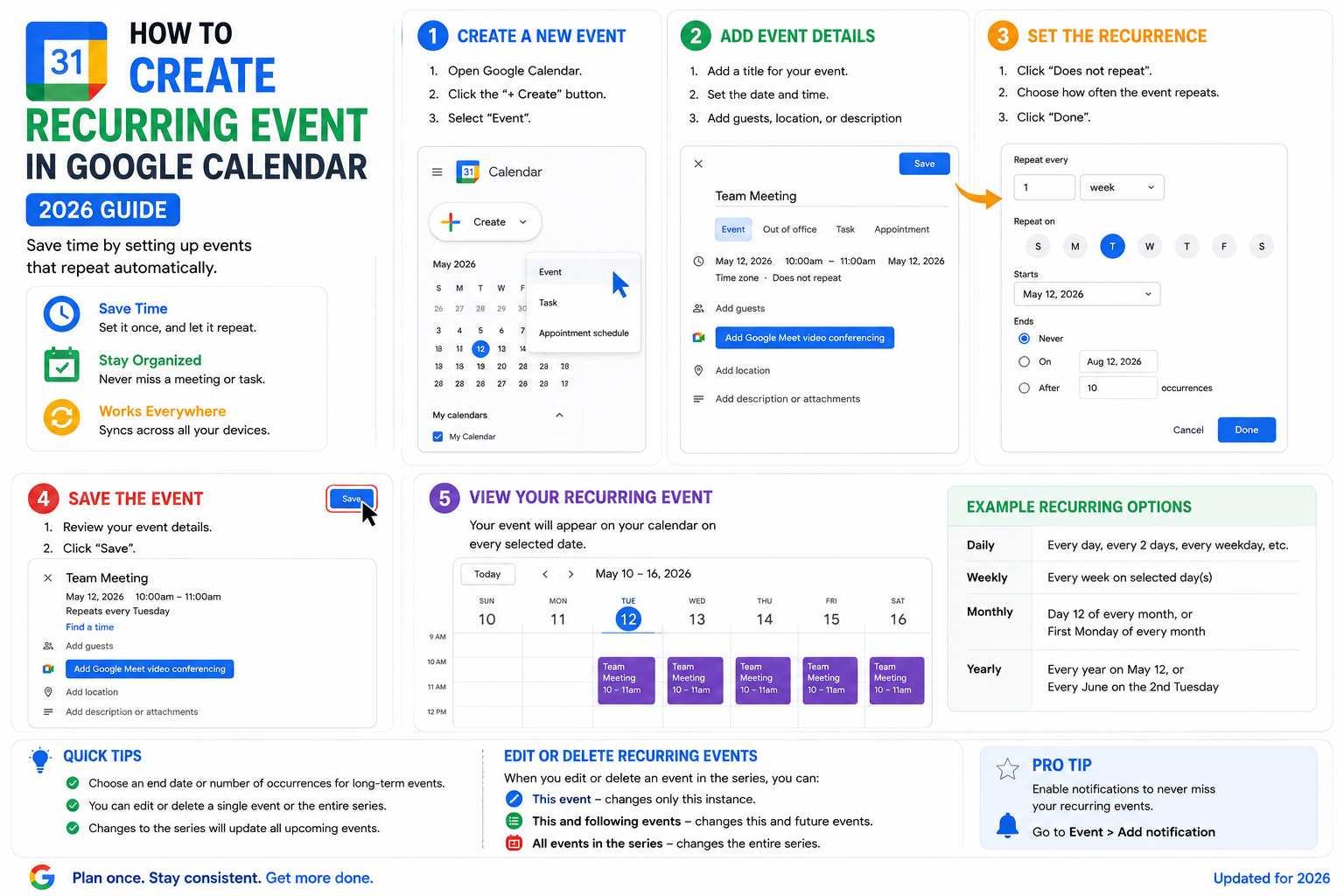
Recurring events save time when you have regular commitments, daily standups, weekly team meetings, monthly reports, or yearly birthdays. Google Calendar supports simple presets (daily, weekly, monthly) plus fully custom recurrence like “every other Thursday” or “last Friday of the month.” This 2026 tutorial covers every recurrence pattern.
How to set recurrence
- Open Google Calendar.
- Create a new event OR edit an existing one.
- Below the time selector, click the Does not repeat dropdown.
- Pick a preset OR click Custom for advanced patterns.
Recurrence preset options
| Preset | Uses |
|---|---|
| Daily | Daily standup, gym, medication |
| Weekly on [day] | Team meeting, class |
| Monthly on [date] | Rent, subscription, birthday |
| Annually on [date] | Anniversary, birthdays |
| Every weekday | Work-only routines |
Custom recurrence: biweekly (every 2 weeks)
- Click Custom in the recurrence dropdown.
- Set Repeat every = 2 weeks.
- Pick day(s) of week (e.g., Wednesday).
- Set end date or number of occurrences (optional).
- Click Done.
Common uses: biweekly team meeting, pay period, meal planning cycle.
Custom recurrence: last Friday of the month
- Custom > Repeat every 1 month.
- Pick Monthly on the last Friday from the dropdown.
- Set end date.
Common uses: monthly all-hands, last-Friday reports, monthly happy hour.
Custom recurrence: multi-day weekly
- Custom > Repeat every 1 week.
- Click multiple days: e.g., Monday + Wednesday + Friday.
- Set end date.
Common uses: MWF workout schedule, Tues/Thurs class, alternating days off.
Set end date or number of occurrences
You have three options in Custom recurrence:
- Never: repeat forever (default).
- On [date]: pick a specific end date.
- After [X] occurrences: stop after N repeats.
Set end dates for temporary commitments (class ends, project deadline). Use “Never” for ongoing habits.
Edit a single instance vs all instances
When you edit or delete a recurring event, Calendar asks which occurrences to modify:
- This event: change only the single instance you clicked.
- This and following events: change from this date forward (past instances unchanged).
- All events: change every occurrence in the series.
Careful: choosing “All events” affects past instances too, which may cause confusion.
Skip a single instance (cancel one occurrence)
- Click the instance you want to skip.
- Click the trash icon.
- Choose This event.
- Only this occurrence is deleted; series continues.
Change a single instance’s time
- Click the instance.
- Edit > adjust time.
- Save > pick This event.
- Only that instance moves; rest of series stays.
Great for “next week only” schedule changes.
Recurring event with Google Meet
All instances share the same Meet link by default:
- Add Meet to the first event in the series.
- Same URL persists for all recurrences.
- Great for weekly team standups, bookmark the Meet URL for one-click join.
Convert one-time event to recurring
- Open the event.
- Edit > click the Does not repeat dropdown.
- Pick recurrence pattern.
- Save.
Common recurring event issues
- All instances got moved when I only wanted one: you saved with “All events” instead of “This event”. Undo (Ctrl+Z) if quick, or manually restore.
- Custom recurrence not showing my option: some complex patterns (last-workday-of-quarter) need workarounds via multiple simpler events.
- Recurring event disappeared: past end date reached. Extend by editing “This and following” > adjust end date.
- Meet link changed for one instance: rare but happens if event was edited outside a Google client. Contact host for updated link.
- Guests can’t RSVP to individual instance: each instance has its own RSVP. Guests may need to re-RSVP after edits.
Common Google Calendar mistakes to avoid
Even long-time Calendar users hit the same traps. Being aware of these saves time and prevents scheduling errors.
- Forgetting time zones when scheduling with international teams. Calendar defaults to your primary time zone. Set the event time zone explicitly when scheduling with people in different regions.
- Not checking guest RSVPs. Guests can accept, decline, or mark tentative. Check responses before assuming everyone will attend.
- Overusing “all-day” for actual scheduled events. All-day events do not block your working hours. Use specific time-slot events for anything requiring your attention.
- Ignoring calendar sharing permissions. Public calendars can be indexed by search engines. Restrict sharing to specific emails or your organization for anything containing personal or business schedules.
- Missing the automatic Google Meet link. Calendar adds a Meet link automatically when you invite others. Delete it manually if you plan to use a different video platform.
Power-user tips for Google Calendar
- Use keyboard shortcuts. Press
/to jump to search,cto create an event,dfor day view,wfor week. Full list atcalendar.google.com/calendar/keyboardshortcuts. - Set default event duration. Settings > Event settings > Default duration. Changing from 60 to 30 minutes gently pressures shorter meetings.
- Add “speedy meetings”. Settings > End 30-minute meetings 5 minutes early. Gives everyone breathing room between back-to-back calls.
- Book focus time with Focus Time events. Prevents automatic Meet links and blocks your calendar visibly.
- Use appointment slots for external bookings. Create a bookable page anyone can use to grab time on your calendar without back-and-forth email.
Real-world scenarios
For BSIT students: use Google Calendar to schedule capstone advisor consultations. Share the calendar with your team so everyone sees deadlines and defense dates.
For freelancers: block “client focus” hours and “admin” hours on your calendar. Colored labels make it easy to see time allocation at a glance.
For small teams: create a shared team calendar for meetings, deadlines, and out-of-office. Everyone subscribes; nobody has to individually track.
For remote workers across time zones: enable secondary time zone display so you always see your teammate’s local time next to yours.
Best practices summary
- Default to 30-minute meetings. Most conversations do not need a full hour.
- Include clear titles. “Q3 planning” beats “Meeting”. Titles show up in preview panels everywhere.
- Add descriptions with agenda items. Recipients arrive prepared. Meeting quality improves.
- Set reminders 10 minutes and 24 hours before important events. Prevents missed meetings.
- Archive old calendars. Old project calendars clutter your view. Hide them from sidebar when the project ends.
Official documentation
Recommended habit and routine resources
The links below are affiliate links. We may earn a commission at no extra cost to you when you buy or sign up. See our affiliate disclosure.
Quick step-by-step summary (click to expand)
- Open Google Calendar. Go to calendar.google.com or open the Calendar app.
- Click Create then Event. Fill in title, date, and time as usual.
- Click the Does not repeat dropdown. Choose from Daily, Weekly, Monthly, Yearly, or select Custom for advanced patterns.
- Set the end date. Choose Never (indefinite), On date, or After N occurrences. This controls when the series stops.
- Save the event. Google Calendar creates every future occurrence at once. Edit any single occurrence later without affecting the series.
Frequently Asked Questions
How long can a recurring event last?
Indefinitely if “Never” is chosen for end date. Practical max: 100 years or so. Calendar handles thousands of instances without issues.
Can I have a “every 6 weeks” recurrence?
Yes. Custom > Repeat every 6 weeks > pick day. Great for quarterly-adjacent cycles (chiropractor, oil change, dental cleaning).
Do recurring events count against my event limit?
Google Calendar has no hard limit on events. Recurring events are stored as one master + occurrences, so they don’t bloat your account.
Can I change the recurrence pattern later?
Yes. Open event > Edit > click recurrence dropdown > pick new pattern > Save > choose scope (this event, following, all).
Are recurring events supported on all devices?
Yes. Web, Android app, iPhone app, and Outlook/Apple Calendar sync (when configured) all support recurring events. Some complex custom patterns may show as one-time in older sync clients.

Caren Bautista
Technical Writer at PIES IT Solution
Responsible for crafting clear, well-structured, and beginner-friendly content across the platform. Handles the writing, proofreading, and editorial review of tutorials, guides, and documentation to ensure every article is accurate, readable, and easy to follow.
Expertise: Technical Writing · Content Creation · Documentation · Editorial Writing · JavaScript · TypeScript · View all posts by Caren Bautista →