
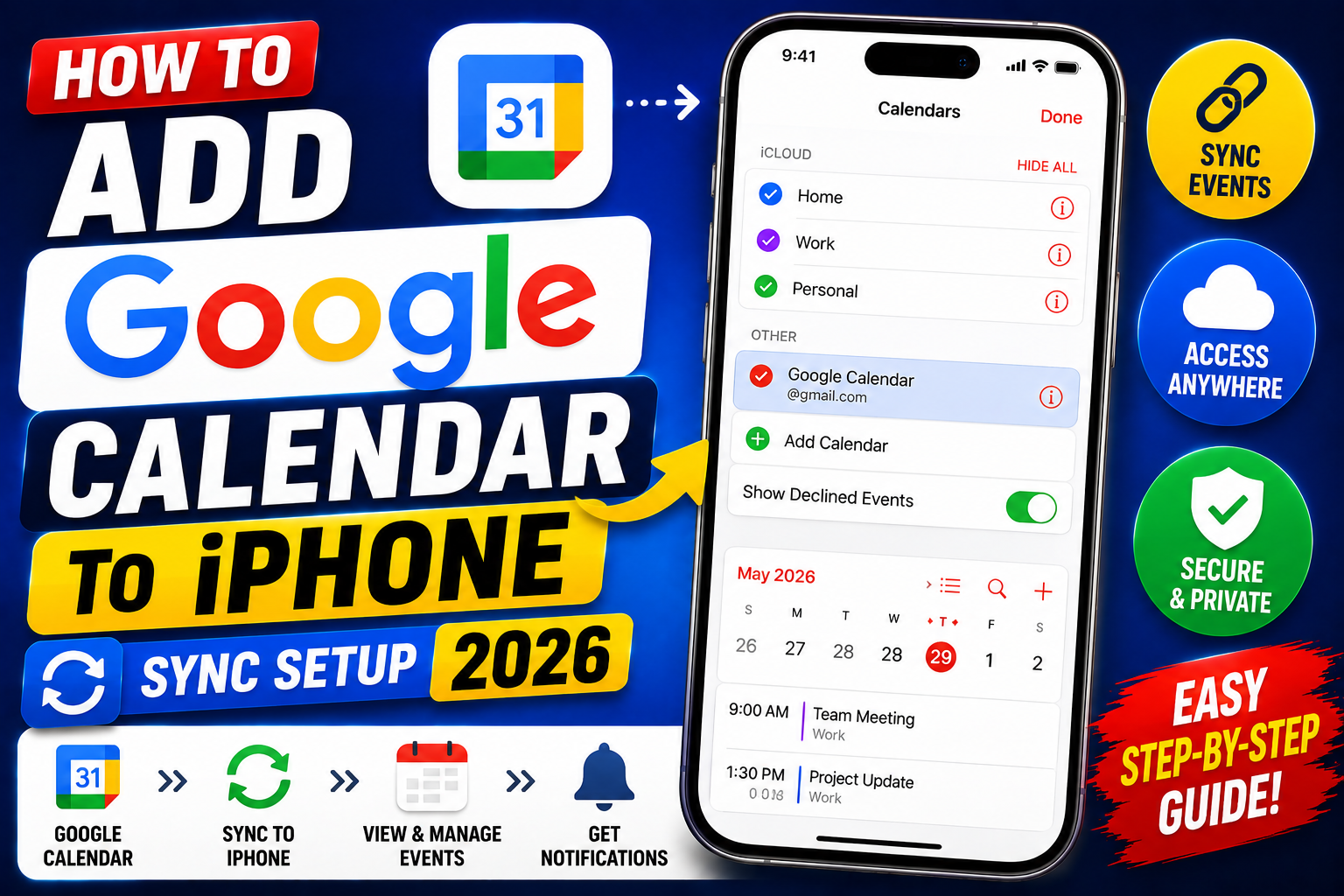
You can access Google Calendar on iPhone two ways: through the native Apple Calendar app (all your calendars in one place) or via the Google Calendar app (better UI and Meet integration). This 2026 tutorial covers both methods, plus multi-account sync and fixing common issues.
Method 1: Add Google Calendar to Apple Calendar app
- Open Settings on your iPhone.
- Scroll down to Calendar.
- Tap Accounts.
- Tap Add Account.
- Tap Google.
- Enter your Gmail email and password (may require 2FA).
- Toggle Calendars on (also toggle Mail, Contacts if desired).
- Tap Save.
Google Calendar events now appear in the Apple Calendar app alongside iCloud events.
Method 2: Install the Google Calendar app
- Open the App Store.
- Search “Google Calendar”.
- Install.
- Open the app.
- Sign in with your Google account.
- All your Google calendars appear.
Google Calendar app is more polished for Google-specific features: Meet integration, Goals, task list, Rooms (Workspace).
Choose which calendars to sync
- Settings > Calendar > Accounts > Gmail account.
- Tap Calendars.
- Toggle each calendar on/off (primary, birthdays, holidays, shared calendars).
Useful if you don’t want holiday or birthday calendars cluttering your view.
Sync additional Google accounts
- Settings > Calendar > Accounts > Add Account > Google.
- Sign in with a second Gmail (work vs personal).
- Repeat for as many accounts as needed.
- Each account’s calendars appear as separate groups.
Set Google Calendar as default
- Settings > Calendar > Default Calendar.
- Pick a Google Calendar (e.g., “Personal”).
- New events created from Siri, Mail invites, or third-party apps default to this calendar.
How often iPhone syncs Google Calendar
- Push sync (real-time): available for Google Calendar via CalDAV.
- Manual refresh: pull-down in Apple Calendar app to force sync.
- Google Calendar app: syncs automatically in background.
- Battery-saving mode may delay sync, check Low Power Mode.
Add events on iPhone (syncs to Google)
- Apple Calendar app > + icon > New Event.
- Enter title, date, time, location.
- Scroll to Calendar > pick a Google calendar.
- Add > event syncs to Google within seconds.
Now the event appears on desktop Google Calendar too.
Enable Google Calendar widget on iPhone
- Long-press an empty area of home screen.
- Tap the + icon (top-left).
- Search “Google Calendar”.
- Pick widget size and add.
- Widget shows today’s/upcoming events at a glance.
Google Calendar vs Apple Calendar: which to use?
| Feature | Apple Calendar app | Google Calendar app |
|---|---|---|
| All calendars in one place | Yes (Google + iCloud) | Google only |
| Google Meet integration | Limited | Native |
| Widgets | Native iOS widget | Google widget |
| Siri integration | Full | Partial |
| Best for | Personal + iOS integration | Work + Meet users |
Best of both: use Apple Calendar for daily view (Siri, widgets), Google Calendar app for Meet-heavy meetings.
Common sync issues
- Events not syncing: check Settings > Calendar > Accounts > Google > Calendars toggle is on.
- Events created on iPhone don’t reach Google: default calendar is set to iCloud. Change default calendar to Google.
- Duplicated events: Google Calendar added twice (once via iOS Google account, once via CalDAV manual). Remove one.
- Old events missing: Apple Calendar limits sync range. Settings > Calendar > Sync > “All Events” instead of “Events 1 month back”.
- Push not working: reset network or reboot iPhone. Also check that Fetch New Data is set to Push in Settings > Calendar > Accounts > Fetch New Data.
Common Google Calendar mistakes to avoid
Even long-time Calendar users hit the same traps. Being aware of these saves time and prevents scheduling errors.
- Forgetting time zones when scheduling with international teams. Calendar defaults to your primary time zone. Set the event time zone explicitly when scheduling with people in different regions.
- Not checking guest RSVPs. Guests can accept, decline, or mark tentative. Check responses before assuming everyone will attend.
- Overusing “all-day” for actual scheduled events. All-day events do not block your working hours. Use specific time-slot events for anything requiring your attention.
- Ignoring calendar sharing permissions. Public calendars can be indexed by search engines. Restrict sharing to specific emails or your organization for anything containing personal or business schedules.
- Missing the automatic Google Meet link. Calendar adds a Meet link automatically when you invite others. Delete it manually if you plan to use a different video platform.
Power-user tips for Google Calendar
- Use keyboard shortcuts. Press
/to jump to search,cto create an event,dfor day view,wfor week. Full list atcalendar.google.com/calendar/keyboardshortcuts. - Set default event duration. Settings > Event settings > Default duration. Changing from 60 to 30 minutes gently pressures shorter meetings.
- Add “speedy meetings”. Settings > End 30-minute meetings 5 minutes early. Gives everyone breathing room between back-to-back calls.
- Book focus time with Focus Time events. Prevents automatic Meet links and blocks your calendar visibly.
- Use appointment slots for external bookings. Create a bookable page anyone can use to grab time on your calendar without back-and-forth email.
Real-world scenarios
For BSIT students: use Google Calendar to schedule capstone advisor consultations. Share the calendar with your team so everyone sees deadlines and defense dates.
For freelancers: block “client focus” hours and “admin” hours on your calendar. Colored labels make it easy to see time allocation at a glance.
For small teams: create a shared team calendar for meetings, deadlines, and out-of-office. Everyone subscribes; nobody has to individually track.
For remote workers across time zones: enable secondary time zone display so you always see your teammate’s local time next to yours.
Best practices summary
- Default to 30-minute meetings. Most conversations do not need a full hour.
- Include clear titles. “Q3 planning” beats “Meeting”. Titles show up in preview panels everywhere.
- Add descriptions with agenda items. Recipients arrive prepared. Meeting quality improves.
- Set reminders 10 minutes and 24 hours before important events. Prevents missed meetings.
- Archive old calendars. Old project calendars clutter your view. Hide them from sidebar when the project ends.
Official documentation
Recommended productivity resources
The links below are affiliate links. We may earn a commission at no extra cost to you when you buy or sign up. See our affiliate disclosure.
Quick step-by-step summary (click to expand)
- Open iPhone Settings. Scroll to Calendar > Accounts > Add Account.
- Choose Google. Sign in with your Gmail account.
- Enable Calendar sync. Toggle Calendars ON. Optionally enable Contacts, Mail.
- Or install Google Calendar app. Download from App Store, sign in with Gmail — all calendars sync automatically.
- Verify sync. Open Calendar or Google Calendar app. Events appear within 1-2 minutes.
Frequently Asked Questions
Can I have both Apple and Google Calendar on iPhone?
Yes. Both work simultaneously. Apple Calendar shows all your calendars from all accounts; Google Calendar app shows only Google. Use both if you want.
Does iPhone show shared calendars?
Yes. Calendars shared with your Google account appear on iPhone too. Toggle them on in Settings > Calendar > Accounts > Google > Calendars.
Why are notifications not working?
Settings > Notifications > Calendar (or Google Calendar) > enable Allow Notifications. Also check Focus/DND modes aren’t blocking calendar alerts.
Can I use Siri with Google Calendar?
Only through Apple Calendar. Say “Hey Siri, add meeting to my Google calendar tomorrow at 10 AM” and it creates the event in the Google Calendar you set as default.
How do I remove Google Calendar from iPhone?
Settings > Calendar > Accounts > Gmail > Delete Account (removes all Gmail data). Or just toggle Calendars off to hide events while keeping Mail active.

Caren Bautista
Technical Writer at PIES IT Solution
Responsible for crafting clear, well-structured, and beginner-friendly content across the platform.
Expertise: Technical Writing · Content Creation · Documentation · Editorial Writing · JavaScript · TypeScript · View all posts by Caren Bautista →