
Disclosure: This article contains affiliate links. If you purchase through these links, itsourcecode.com may earn a small commission at no extra cost to you. We only recommend books we’ve personally read or seen recommended by 100+ developers.
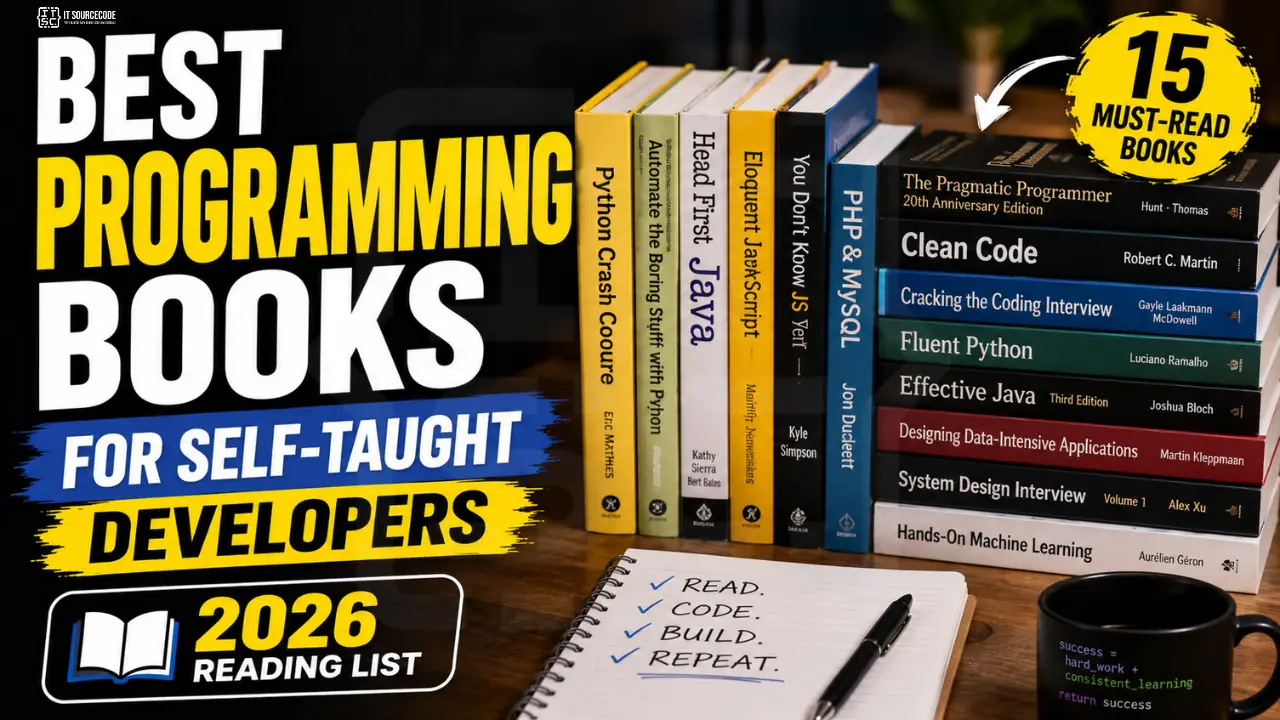
Online tutorials are great for getting started, but the developers who advance fastest read books. Why? Books force depth, they build mental models that scattered YouTube videos can’t. The 15 books below have shaped tens of thousands of careers, and most are still relevant in 2026 (some now in their 5th-10th editions).
📚 Tier 1: Absolute Must-Reads for Any Developer
1. “The Pragmatic Programmer” by David Thomas & Andrew Hunt (20th Anniversary Edition)
Why read: The single best book about how to THINK like a professional developer. Not language-specific, applies whether you write PHP, Python, Java, or anything else. Topics: code quality, debugging, learning continuously, dealing with bad managers.
Best for: Every developer at every stage.
Price PH: ₱1,200-1,500 paperback, $20-30 ebook on Amazon Kindle.
2. “Clean Code” by Robert C. Martin
Why read: Teaches you to write code that other developers can actually maintain. Examples in Java, but principles apply to any language. Read this before your 2nd year of professional work, you’ll write 10x cleaner code.
Caveat: Some advice is controversial in 2026 (over-aggressive function extraction). Read critically.
Price PH: ₱1,500-2,000 paperback.
3. “Cracking the Coding Interview” by Gayle Laakmann McDowell
Why read: THE definitive technical interview prep book. 189 problems with solutions, covering all common DS/Algo patterns. If you’re targeting big tech (GCash, Shopee, US remote roles), this is mandatory.
Best for: 3rd-4th year BSIT students preparing for interviews. Pair with our interview questions guide.
Price PH: ₱1,800-2,200 paperback.
🐍 Best Python Books
4. “Python Crash Course” by Eric Matthes (3rd Edition)
Why read: Best beginner Python book. Builds 3 projects: a game, a data viz dashboard, and a web app. Zero assumed knowledge.
Price PH: ₱1,200-1,500 paperback. Often free PDF circulates.
5. “Automate the Boring Stuff with Python” by Al Sweigart
Why read: Practical Python for real-world automation, reading Excel files, web scraping, scheduling tasks. FREE legally at automatetheboringstuff.com.
Best for: Beginners who want immediate practical results.
6. “Fluent Python” by Luciano Ramalho (2nd Edition)
Why read: Intermediate-to-advanced Python. After you can write basic Python, this teaches you to write Python LIKE A PYTHONISTA. Decorators, generators, descriptors, metaclasses.
Price PH: ₱2,000-2,500 paperback. Worth every peso.
☕ Best Java Books
7. “Effective Java” by Joshua Bloch (3rd Edition)
Why read: 90 specific items showing best practices for Java. Skip the basics, this assumes you know Java fundamentals. Required reading if you’ll work on enterprise Java.
Best for: 3rd-year BSIT students doing Java capstones; aspiring backend engineers.
Price PH: ₱1,800-2,200 paperback.
8. “Head First Java” by Kathy Sierra & Bert Bates
Why read: Best beginner Java book. Heavily illustrated, conversational tone, easy to absorb. The “Head First” series breaks down complex OOP concepts visually.
Price PH: ₱1,500-1,800 paperback.
🌐 Best Web Development Books
9. “Eloquent JavaScript” by Marijn Haverbeke (4th Edition)
Why read: Free at eloquentjavascript.net. Best free JS book online. Modern ES2020+ syntax, builds real projects.
Price PH: FREE online or ₱1,500 paperback.
10. “You Don’t Know JS Yet” (book series) by Kyle Simpson
Why read: Series of 6 short books going DEEP into JavaScript quirks (closures, prototypes, async). FREE on GitHub.
Best for: JS developers who want to actually understand the language, not just use frameworks.
11. “PHP & MySQL: Server-side Web Development” by Jon Duckett
Why read: Best illustrated PHP book. Perfect for BSIT students doing PHP + MySQL capstones. Visual learners especially benefit.
Price PH: ₱2,200-2,800 paperback.
🏗 Best System Design & Architecture Books
12. “Designing Data-Intensive Applications” by Martin Kleppmann
Why read: Modern bible for backend engineering. Databases, distributed systems, batch/stream processing. Heavy book, set aside 2-3 months to digest.
Best for: 4th-year BSIT or 1-2 year experienced developers targeting senior roles.
Price PH: ₱2,500-3,000 paperback.
13. “System Design Interview” by Alex Xu (Volume 1 & 2)
Why read: Step-by-step system design walk-throughs. URL shortener, chat app, news feed, etc. Essential for senior interview prep.
Price PH: ₱1,500-1,800 per volume, paperback.
🤖 Best AI/ML Books for Beginners
14. “Hands-On Machine Learning” by Aurélien Géron (3rd Edition)
Why read: Best practical ML book in 2026. Scikit-learn, Keras, TensorFlow. Code-heavy with real datasets.
Best for: Anyone doing AI capstone projects.
Price PH: ₱2,500-3,000 paperback.
15. “AI Engineering” by Chip Huyen (2024)
Why read: Modern AI engineering with LLMs (ChatGPT-era). How to build production AI applications, not just train models.
Price PH: ₱2,200-2,800 paperback.
📖 How to Read Programming Books (the Hack)
Programming books are different from novels. Don’t read them cover to cover:
- Skim first. Read all chapter titles + first paragraph. Understand the book’s structure before diving in.
- Pick 3 chapters that match your current need. Read those deeply. Skip the rest until later.
- Type out every code example. Don’t just read code, typing it activates muscle memory.
- Build something with each chapter’s concept. Even a 10-line script counts.
- Return to the book 6 months later. You’ll absorb 2x more on second pass.
Where to Buy in the Philippines
- National Bookstore / Fully Booked: physical books, often discounted
- Amazon Kindle (₱ to USD): instant ebook access, often cheaper than paperback
- Lazada / Shopee: imported paperbacks, watch shipping costs
- Library Genesis / Z-Library: for FREE PDFs (legal in many jurisdictions for learning purposes; check local rules)
- Author websites: many authors release older editions free (Sweigart, Haverbeke, Simpson)
Frequently Asked Questions
More BSIT gear guides
Are programming books still relevant in the YouTube/ChatGPT era?
Should I buy paperback or ebook?
How many programming books should I read per year?
Are old programming books still useful?
What’s the best book for absolute beginners with zero programming experience?
Final Thoughts
Pick 3 books from this list, read them deeply over the next 6 months, and apply the lessons in real projects from our Free Projects hub. That’s worth more than 100 YouTube tutorials. Your 4-year BSIT journey will thank you for this investment.
🎯 Quick start:
- Beginner → Buy “Python Crash Course” + read “Automate the Boring Stuff” (free)
- Intermediate → Buy “Pragmatic Programmer” + “Clean Code”
- Interview prep → Buy “Cracking the Coding Interview”
- For your laptop setup, see our Best Laptops for Programming Students guide

Adrian Mercurio
Full-Stack Developer at PIES IT Solution
Specializes in building complete capstone projects with full documentation. Strong background in PHP/MySQL development and database design. Has personally built and tested over 30 capstone-ready projects with ER diagrams, DFDs, and chapter-by-chapter thesis documentation.
Expertise: PHP · Laravel · Database Design · Capstone Projects · C# · C · C++ · Python · AI Projects · View all posts by Adrian Mercurio →