
Three open-source model families dominate the serious self-hosted LLM space in 2026: Meta’s Llama 3, Mistral’s family (Mistral, Mixtral, Codestral), and Alibaba’s Qwen 3. All three ship permissive licenses, strong instruction-following, and competitive benchmarks against hosted frontier models. The right pick for your project comes down to language mix, context length, hardware, and the specific capability you need. This article walks through all four dimensions with the September 2026 model lineup.
The three families in one minute each
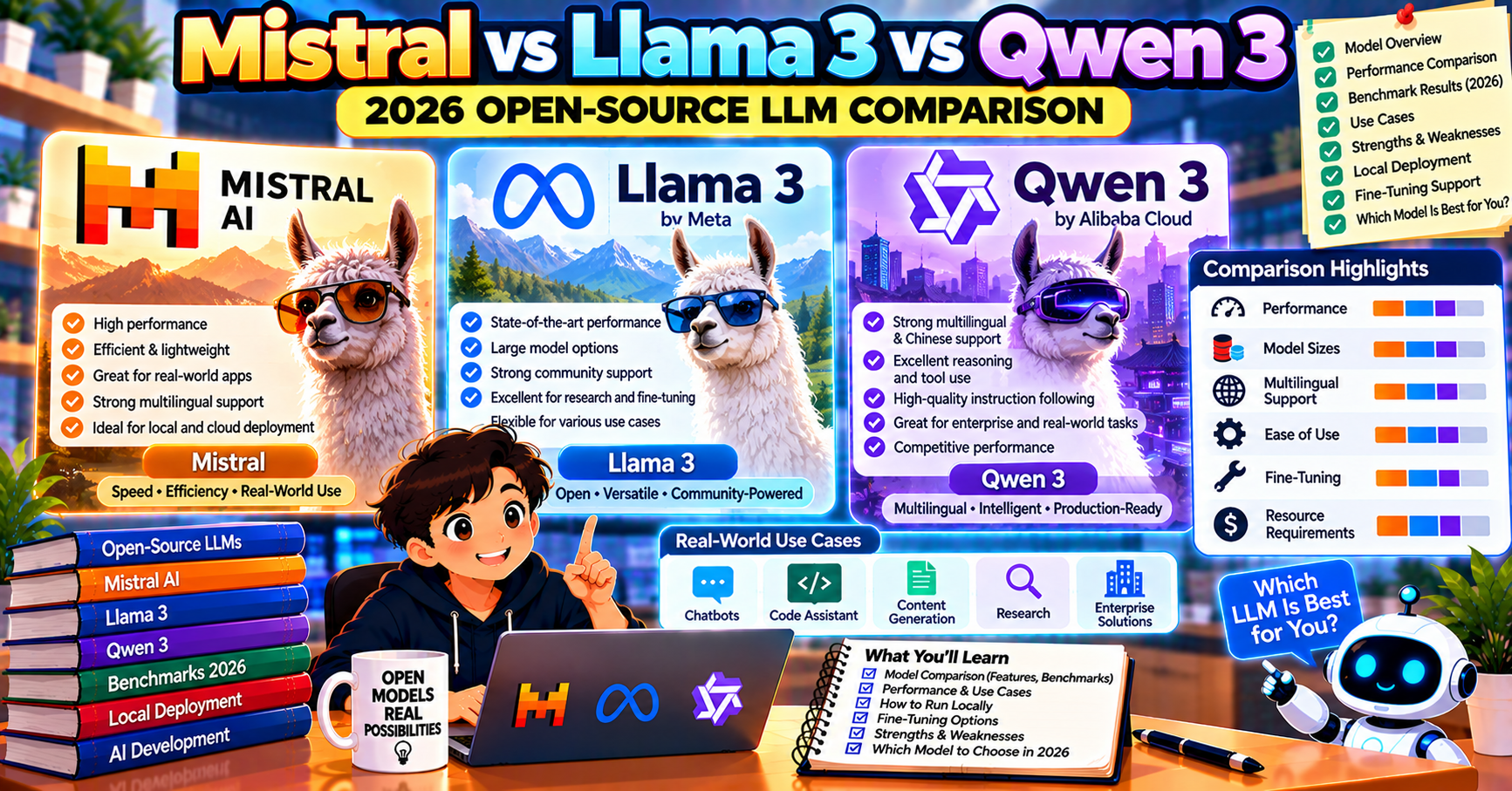
Meta Llama 3: the open-source baseline that most teams compare everything else against. Llama 3.3 (70B) and Llama 3.2 (1B, 3B, 11B, 90B vision) are the current flagship releases. Strong English, good tool-calling, massive community (every tutorial, LangChain integration, and third-party fine-tuned variant exists for Llama first). License is Meta’s custom “Llama 3 Community License” which is permissive for commercial use under 700M MAU.
Mistral AI: French team that ships lean, efficient models. Mistral Small 24B, Mistral Nemo 12B, and Mixtral 8x22B (mixture-of-experts) are the current workhorses. Codestral 22B is the dedicated code model. Mistral models consistently punch above their weight on parameter count: a Mistral 7B often matches or beats a Llama 3 8B at the same task. Apache 2.0 license, no usage restrictions.
Alibaba Qwen 3: the dark horse that has overtaken Llama on several 2026 leaderboards. Qwen 3 ships in 1.5B, 3B, 7B, 14B, 32B, 72B, and the massive 110B parameter sizes. Multilingual by design (over 29 languages with first-class quality, not just English). Strong code generation. Apache 2.0 license. The 32B parameter model fits in 24 GB of VRAM and consistently beats Llama 3.1 70B on reasoning benchmarks.
Benchmarks (September 2026)
MMLU and HumanEval scores from independent 2026 testing. Treat as directional; your actual workload will vary.
- Qwen 3 72B: MMLU 85.4, HumanEval 86.1
- Qwen 3 32B: MMLU 82.7, HumanEval 83.2
- Llama 3.3 70B: MMLU 83.6, HumanEval 81.5
- Mixtral 8x22B: MMLU 77.8, HumanEval 76.3
- Mistral Small 24B: MMLU 73.4, HumanEval 72.0
- Llama 3.1 8B: MMLU 68.4, HumanEval 65.9
- Qwen 3 7B: MMLU 70.1, HumanEval 68.3
- Mistral Nemo 12B: MMLU 71.5, HumanEval 69.7
Qwen 3 32B is the single most impressive data point. It beats Llama 3.3 70B on reasoning benchmarks at less than half the parameter count. If you can only run one open-source model and have a 24 GB VRAM GPU, Qwen 3 32B is where to start.
Context window
- Llama 3.3: 128K tokens (same across 70B)
- Qwen 3 (7B+): 128K tokens native
- Mistral Small 24B: 32K native, extensible to 128K via YaRN
- Mixtral 8x22B: 64K native
- Codestral 22B: 32K native
For long-document RAG or multi-step agent flows, Llama 3.3 and Qwen 3 are the practical choices. Mistral’s smaller context ceilings matter less for standard chat and classification work.
Multilingual capability
If your product serves non-English users, this dimension often decides the pick.
- Qwen 3: strongest multilingual quality across the three. Chinese, Spanish, French, German, Japanese, Korean, Portuguese, Arabic, Russian all at first-class quality. 29 languages trained in.
- Mistral: strong on European languages (French, German, Spanish, Italian) because the team is French. Weaker on Asian languages.
- Llama 3: English-first with second-tier support for Spanish, French, German, Hindi, Thai. Non-trained languages work but quality drops noticeably.
Hardware fit
Approximate VRAM needed to run each (Q4 quantization):
- Qwen 3 1.5B: 1.5 GB
- Qwen 3 3B / Llama 3.2 3B: 2.5 GB
- Mistral 7B / Llama 3.1 8B / Qwen 3 7B: 4.5 to 5.5 GB
- Mistral Nemo 12B: 8 GB
- Qwen 3 14B / Llama 3.2 11B vision: 10 GB
- Mistral Small 24B / Codestral 22B / Qwen 3 32B: 15 to 20 GB
- Mixtral 8x22B: 90 GB (sparse MoE, only 44B active)
- Llama 3.3 70B / Qwen 3 72B: 42 to 50 GB
- Qwen 3 110B: 65 GB
Common hardware targets: 24 GB VRAM (RTX 4090, A6000) runs the Qwen 3 32B sweet spot. 48 GB VRAM (2x RTX 4090 or H100 80GB partitioned) runs 70B models. For most self-hosters, the 24 to 32 GB tier is the pragmatic ceiling.
Code generation specifically
If your use case is primarily code (autocomplete, review, refactor), the specialized models beat the general models:
- Codestral 22B: Mistral’s dedicated code model. Strong across Python, JavaScript, Rust, Go, C++. 32K context.
- DeepSeek Coder V2 16B: not from the three families but worth mentioning as a frequent benchmark-topper for code
- Qwen 2.5 Coder 32B: Alibaba’s code variant, strong on repository-level understanding
- Code Llama: Meta discontinued dedicated updates in 2025. Use general Llama 3.3 instead.
Tool use and function calling
All three families support tool calling in 2026, but with different maturity:
- Llama 3.3 and 3.1: native tool-calling format compatible with OpenAI’s. Works well with LangChain and LangGraph.
- Mistral Nemo and Small: strong tool-calling, especially multi-tool chaining. Mistral’s function_calling parameter is first-class.
- Qwen 3: tool calling added across the family in 2026. Format is close to OpenAI but needs the model’s prompt template applied correctly (frameworks like Ollama, vLLM, and SGLang handle this).
Which to pick for your use case
- English chat on consumer hardware (16 to 24 GB): Qwen 3 14B or 32B. Best quality-per-GB in 2026.
- Multilingual production app: Qwen 3 32B or 72B. Nothing else is close on language breadth.
- Code generation: Codestral 22B or Qwen 2.5 Coder 32B.
- Edge or mobile (under 4 GB): Llama 3.2 3B or Qwen 3 3B. Both run on phones.
- Maximum quality on 48+ GB: Llama 3.3 70B or Qwen 3 72B. Benchmark both on your task.
- European languages priority: Mistral Small 24B or Mixtral 8x22B.
- You want the largest community and most tutorials: Llama 3. Second largest is Qwen; Mistral is third.
Frequently Asked Questions
Can I use these models commercially?
Yes, all three families ship permissive licenses in 2026. Mistral uses Apache 2.0 (no restrictions). Qwen uses Apache 2.0. Llama 3 uses Meta’s Llama 3 Community License, which is free for commercial use under 700 million monthly active users (effectively unlimited for every company that is not a hyperscaler).
Which is cheapest to run self-hosted?
Qwen 3 32B is the cost-performance sweet spot in 2026. On a single RTX 4090 (24 GB VRAM, around $1800), it serves roughly 20 to 50 concurrent requests at interactive latency. Electricity cost is roughly $0.50 per day. Over 12 months at full use, cost per million tokens is lower than any hosted API.
Can I fine-tune these models?
Yes. All three support LoRA, QLoRA, and full fine-tuning through libraries like Axolotl, Unsloth, and LLaMA-Factory. Qwen 3 and Llama 3 have the largest community of fine-tuned derivatives on Hugging Face. Mistral has fewer derivatives but strong first-party fine-tuning support through Mistral’s own trainer.
Are these models safe for production?
Yes, with the same safety considerations as any LLM. Output can hallucinate, leak training data in rare cases, and be jailbroken. Production deployments should add guardrails (NeMo Guardrails, LLM Guard), prompt injection defenses, and output validation. Self-hosting does not remove these risks; it just moves responsibility from the API provider to you.
How do they compare to GPT-5 or Claude Opus 5.5?
In September 2026 the frontier hosted models still lead on complex reasoning benchmarks by 5 to 10 points. For everyday chat, classification, summarization, and code generation, Qwen 3 72B and Llama 3.3 70B are within 2 to 3 points and the gap keeps narrowing. For a startup prototype, self-hosted is usually enough. For a flagship product where last-mile quality matters, hosted frontier still wins.
Which one should I try first?
Qwen 3 7B or Llama 3.2 3B through Ollama. Both download in under 2 minutes and run on any laptop with 16 GB RAM. If you like what you see and have a 24 GB GPU, scale up to Qwen 3 32B. If you need multilingual, go straight to Qwen 3. If you want the largest ecosystem of tutorials and third-party tools, go Llama.
Official documentation

Adrian Mercurio
Full-Stack Developer at PIES IT Solution
Specializes in building complete capstone projects with full documentation. Strong background in PHP/MySQL development and database design. Has personally built and tested over 30 capstone-ready projects with ER diagrams, DFDs, and chapter-by-chapter thesis documentation.
Expertise: PHP, Laravel, Database Design, Capstone Projects, C#, C, C++, Python, AI Projects · View all posts by Adrian Mercurio →