
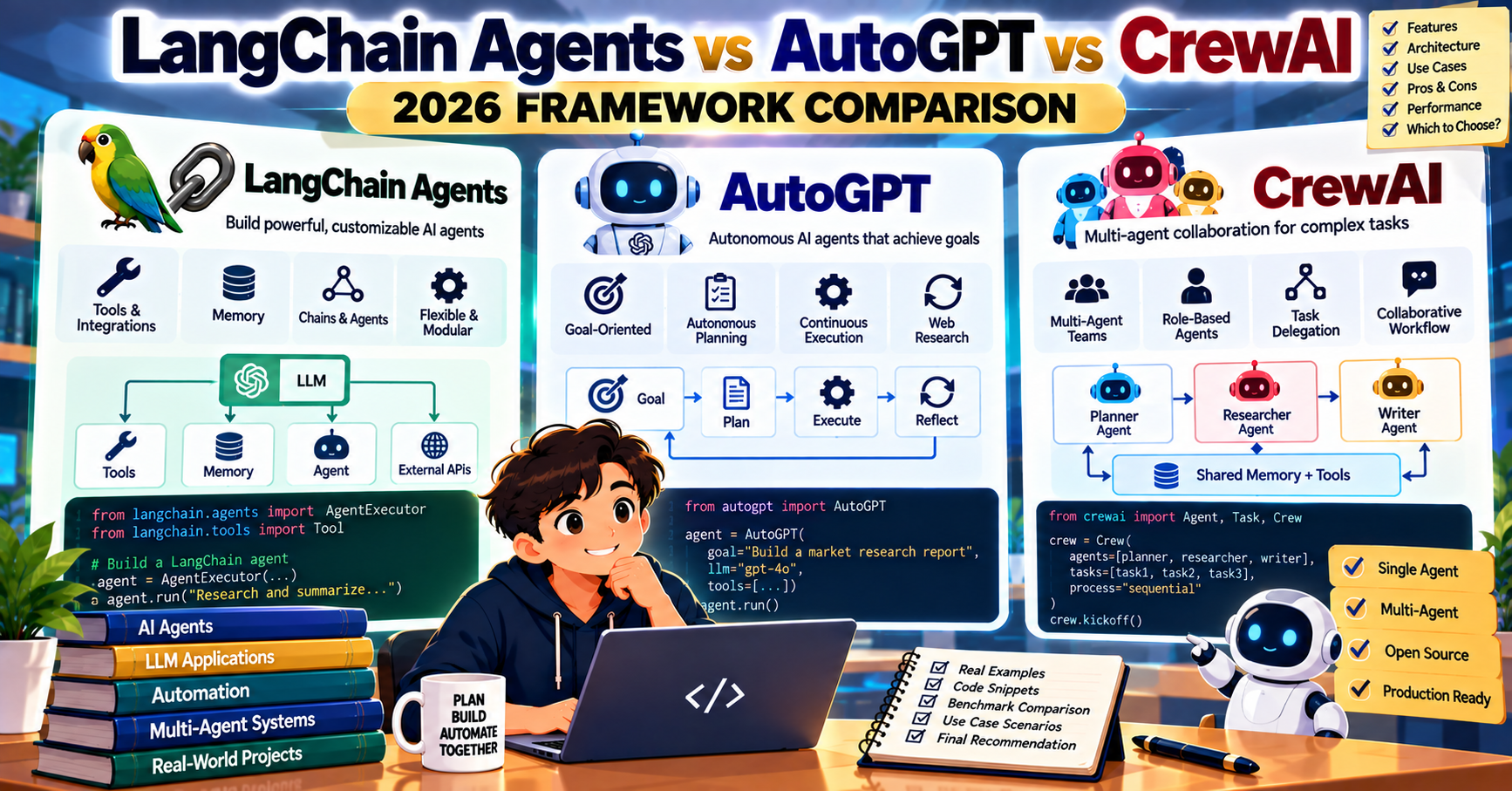
AI agents moved from research toy to production feature in 2026. Three frameworks dominate the Python agent space: LangChain (via LangGraph), AutoGPT, and CrewAI. All three let you compose multiple LLM calls into a system that reasons, uses tools, and runs multi-step workflows. The differences in design philosophy, developer experience, and production maturity are large enough that picking the wrong one costs weeks of rework. This article walks through the three on the dimensions that drive real buying decisions.
The three frameworks at a glance
LangChain + LangGraph is the most production-ready agent stack in 2026. LangGraph treats agents as state machines, where each node is an LLM call or a tool invocation and edges define the flow. The explicit graph structure means you can debug, visualize, and resume agent runs. LangChain itself provides the LLM wrappers, tool integrations, and memory abstractions underneath.
AutoGPT is the oldest and the most autonomous of the three. It gives the LLM a goal (such as “research the top 10 CRM software for small businesses”) and lets it decide its own steps, call its own tools, and continue running until it believes the goal is complete. The developer defines the goal and the tool set; AutoGPT handles the rest. The 2026 release (v0.6) introduced a cleaner developer API after years of being more of a demo than a framework.
CrewAI frames the problem as a team of specialists. You define multiple agents, each with a role (researcher, writer, editor), and CrewAI orchestrates them to collaborate on a task. The abstraction maps cleanly onto how humans think about multi-step work, which makes CrewAI the fastest to understand for teams new to AI agents.
Design philosophy in one sentence each
- LangGraph: define the graph, control every edge, debug every step.
- AutoGPT: define the goal, trust the LLM to figure out the steps.
- CrewAI: define the roles, let the roles collaborate.
The three philosophies produce different failure modes. LangGraph fails when developers write too much graph code and the agent becomes brittle. AutoGPT fails when goals are ambiguous and the agent spins in circles. CrewAI fails when agent roles overlap and the orchestrator gets confused about who should act next.
Learning curve and first-day experience
Based on common developer experience in 2026:
- CrewAI: 30 minutes to a working multi-agent prototype. The role-based abstraction maps cleanly to how you already think about dividing work.
- AutoGPT: 1 to 2 hours to a working goal-driven agent. Most of that time is understanding the tool interface and the goal-decomposition behavior.
- LangGraph: 3 to 6 hours to a working agent. More concepts to learn (state, nodes, edges, conditional routing) and more code to write, but you understand exactly what is happening.
Code example: build a simple research agent
Each framework building the same task: given a topic, search the web, read 3 pages, and summarize findings.
CrewAI
from crewai import Agent, Task, Crew
from crewai_tools import SerperDevTool, ScrapeWebsiteTool

researcher = Agent(
    role="Senior Research Analyst",
    goal="Find the most relevant information on {topic}",
    tools=[SerperDevTool(), ScrapeWebsiteTool()],
)
writer = Agent(
    role="Content Writer",
    goal="Summarize research findings into a readable brief",
)
research_task = Task(description="Research {topic}", agent=researcher)
write_task = Task(description="Write a 300-word summary", agent=writer)
crew = Crew(agents=[researcher, writer], tasks=[research_task, write_task])
result = crew.kickoff(inputs={"topic": "AI agent frameworks 2026"})
LangGraph
from typing import TypedDict
from langgraph.graph import StateGraph, END
from langchain_openai import ChatOpenAI
from langchain_community.tools import DuckDuckGoSearchRun

class State(TypedDict):
    topic: str
    search_results: list
    summary: str

llm = ChatOpenAI(model="gpt-4o")
search = DuckDuckGoSearchRun()

def research(state):
    results = search.invoke(state["topic"])
    return {"search_results": [results]}

def summarize(state):
    content = "\n".join(state["search_results"])
    summary = llm.invoke(f"Summarize: {content}").content
    return {"summary": summary}

graph = StateGraph(State)
graph.add_node("research", research)
graph.add_node("summarize", summarize)
graph.add_edge("research", "summarize")
graph.add_edge("summarize", END)
graph.set_entry_point("research")
app = graph.compile()
result = app.invoke({"topic": "AI agent frameworks 2026"})
AutoGPT
from autogpt.app.agent import Agent
from autogpt.commands.web import SearchWeb, BrowseWebsite

agent = Agent(
    name="Research Assistant",
    goal="Research AI agent frameworks in 2026 and write a 300-word summary",
    tools=[SearchWeb(), BrowseWebsite()],
    model="gpt-4o",
)
result = agent.run(max_iterations=10)
AutoGPT needs the fewest lines but gives you the least control. LangGraph needs the most lines but gives you full observability. CrewAI sits in the middle on both axes.
Production readiness
LangGraph is the clear production leader in September 2026. State persistence, resumable runs, checkpoint storage, OpenTelemetry integration, and LangSmith tracing all work out of the box. Enterprise customers from Microsoft to Elastic ship LangGraph agents in regulated environments.
CrewAI is production-viable but still maturing. CrewAI Enterprise (paid tier) provides observability and workflow management. The open-source core is stable; the hosted platform is improving.
AutoGPT has shipped autonomous agents in production for research-heavy workflows (market analysis, competitive intelligence, lead qualification) but tends to feel less controlled than the other two. Teams usually bolt their own observability on top.
Cost and latency considerations
Multi-step agents call LLMs multiple times per task. Costs add up fast. A typical “research three sources and summarize” workflow in 2026:
- CrewAI with GPT-4o: 6 to 10 LLM calls per task, roughly $0.08 per run
- LangGraph with GPT-4o: 4 to 7 LLM calls per task, roughly $0.05 per run
- AutoGPT with GPT-4o: 8 to 15 LLM calls per task, roughly $0.12 per run
LangGraph wins on cost because the graph lets you pin which steps use a cheaper model (gpt-4o-mini for routing, gpt-4o for synthesis). AutoGPT’s autonomous decisions can rack up extra calls if the goal is ambiguous.
Which to pick for your use case
- Production agent, enterprise or regulated environment: LangGraph. Observability and state persistence are first-class.
- Team of 2 to 5 agents collaborating on content, research, or analysis: CrewAI. Role-based abstraction keeps the code readable.
- Autonomous research agent given a loose goal: AutoGPT. The goal-decomposition behavior is what you want when steps are unclear in advance.
- You already use LangChain: LangGraph. Zero-friction stack extension.
- Fast prototype or demo: CrewAI. Working multi-agent system in 30 minutes.
- Cost-sensitive production workload: LangGraph with per-node model selection.
Frequently Asked Questions
Which AI agent framework is best for beginners in 2026?
CrewAI. The role-based abstraction (researcher, writer, editor) maps to how beginners already think about multi-step work. A first prototype runs in 30 minutes with three agents and a shared task list. LangGraph has more concepts to learn upfront; AutoGPT needs more careful goal design.
Can I use LangGraph and CrewAI together?
Yes. Both support the same underlying LangChain tools and LLM wrappers. A common pattern is LangGraph for the top-level workflow and CrewAI inside a single LangGraph node when that node needs multi-agent collaboration. Teams use this to combine production-grade orchestration with role-based specialization.
Is AutoGPT still maintained in 2026?
Yes, actively. The v0.6 release in May 2026 introduced a cleaner developer API and shifted the project toward being used as a library rather than a standalone demo. Community activity on GitHub is healthy, though less than LangChain’s.
Which framework has the best observability?
LangGraph plus LangSmith is the gold standard in September 2026. Every node execution, LLM call, and tool invocation shows up as a traced span. CrewAI integrates with LangSmith and AgentOps but the first-class experience is LangGraph. AutoGPT needs you to wire in your own observability stack.
Do these frameworks work with Claude or Gemini?
Yes. All three accept any provider through LangChain’s LLM wrappers. Swap OpenAI for Anthropic or Google by changing one line (ChatAnthropic or ChatGoogleGenerativeAI). The agent logic is model-agnostic.
Which framework should I use for an AI customer support agent?
LangGraph for most production customer support agents in 2026 because the state machine model handles conversation state well. CrewAI works when you want a tiered support model (tier 1 agent escalates to a tier 2 specialist agent). AutoGPT is rarely the right choice here because customer support needs predictable behavior, not autonomous goal pursuit.