
Picking an LLM API in 2026 is a different problem than it was in 2024. All three major providers now ship frontier models with similar reasoning quality on most benchmarks, so the question has shifted from “which is smartest” to “which fits my workload, my budget, and my team’s existing stack.” This article walks through OpenAI, Anthropic, and Google Gemini on the dimensions that actually affect your production application.
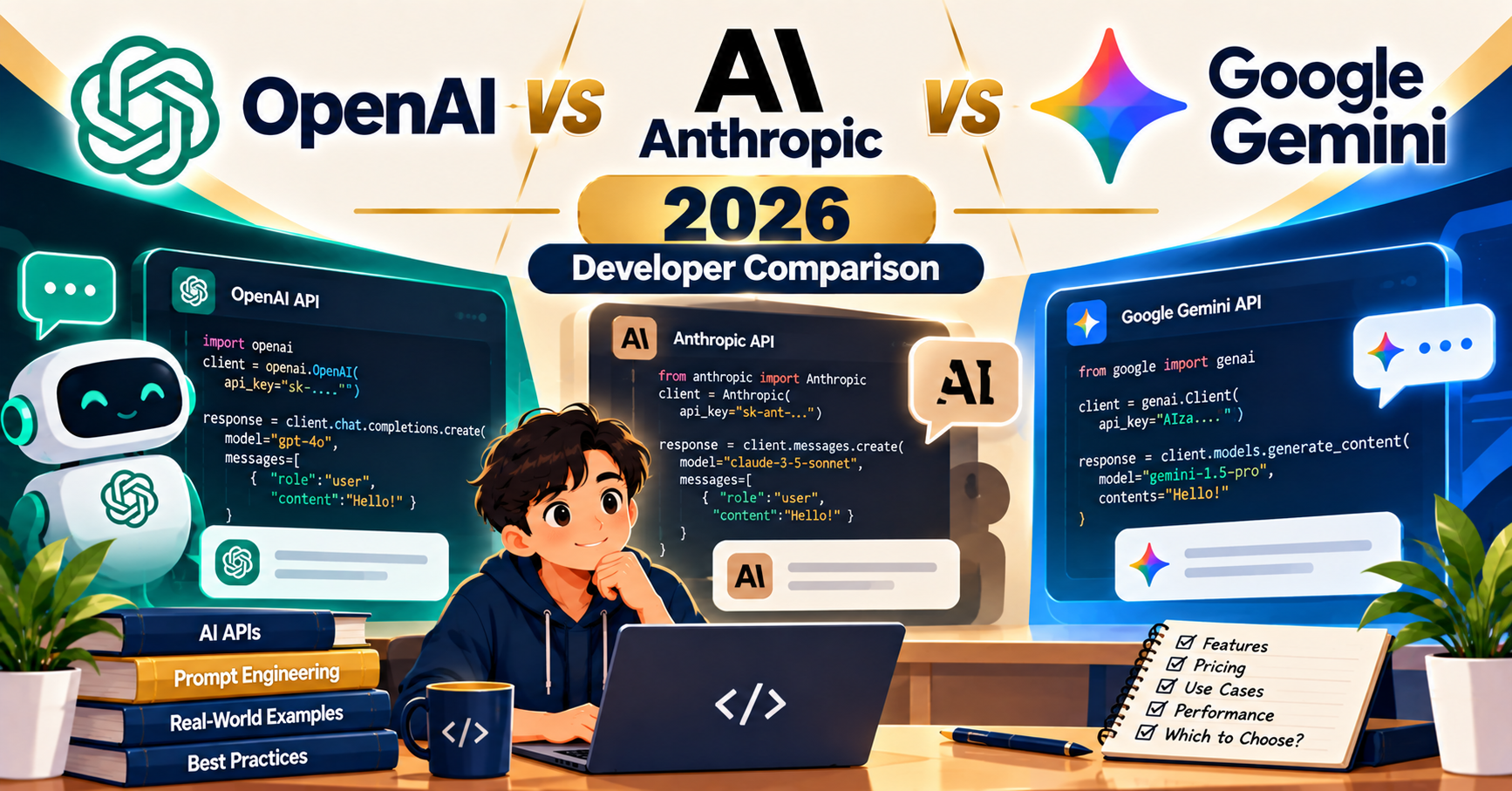
The three APIs in one minute
OpenAI gives you the broadest model lineup. GPT-5 for complex reasoning, GPT-4o for the price-performance middle, GPT-4o mini for high-volume cheap calls, and the Realtime API for voice applications. The SDK is mature in every language a web developer touches, and the ecosystem of tutorials and example repos is still the largest.
Anthropic ships Claude Opus 5.5 for the top tier, Claude Sonnet 5.5 as the workhorse, and Claude Haiku 4.5 for latency-sensitive paths. Claude’s defining trait in 2026 is behavior under long documents and multi-step agent workflows. If your product reads a 150-page PDF or runs a chain of tool calls across minutes of wall clock, Claude typically produces fewer hallucinations and better self-corrections.
Google Gemini 2.5 Pro and Gemini 2.5 Flash both landed in early 2026 with the largest context window on the market (2 million tokens for Pro) and the deepest integration with the rest of Google Cloud. If you already run on BigQuery, Vertex AI, or Firestore, Gemini removes a lot of auth and billing friction.
Pricing comparison (per million tokens)
Prices below reflect the September 2026 published rates for the standard API tier (not batch, not cached). Cached input is roughly 10% of the input price on all three providers now that prompt caching has become a baseline feature.
OpenAI
- GPT-5: $15 input / $75 output
- GPT-4o: $2.50 input / $10 output
- GPT-4o mini: $0.15 input / $0.60 output
Anthropic
- Claude Opus 5.5: $15 input / $75 output
- Claude Sonnet 5.5: $3 input / $15 output
- Claude Haiku 4.5: $1 input / $5 output
- Gemini 2.5 Pro: $1.25 input / $5 output (up to 200K context; higher above)
- Gemini 2.5 Flash: $0.075 input / $0.30 output
Gemini 2.5 Flash is the cheapest serious model in the market. If your application fits in its reasoning envelope, nothing competes on cost per call. GPT-5 and Claude Opus 5.5 are priced identically for a reason: they are directly competing at the top of the reasoning benchmark leaderboard, and both companies have no incentive to undercut.
Context window and document capacity
Context window ceilings in 2026:
- OpenAI GPT-5: 256K tokens
- Claude Opus 5.5 and Sonnet 5.5: 200K tokens
- Gemini 2.5 Pro: 2 million tokens
The raw numbers hide a quality cliff that benchmarks keep catching: Claude and GPT-5 stay sharp through roughly 180K tokens before accuracy on needle-in-haystack tasks drops meaningfully. Gemini 2.5 Pro keeps retrieval accuracy over 90% out to roughly 1 million tokens on the official benchmark, which is unique. If you process whole books, long legal documents, or multi-month customer support transcripts in one call, Gemini is the practical choice. For normal RAG with 10 to 50 chunks of relevant context, the smaller windows are plenty and the three models are indistinguishable.
Latency and streaming
Measured on identical prompts (1000 input tokens, 500 output tokens, standard streaming), September 2026 time-to-first-token numbers from the public endpoint:
- Claude Haiku 4.5: 180 to 240 ms
- Gemini 2.5 Flash: 200 to 280 ms
- GPT-4o mini: 250 to 320 ms
- Claude Sonnet 5.5: 400 to 550 ms
- GPT-4o: 450 to 600 ms
- Gemini 2.5 Pro: 500 to 700 ms
- GPT-5: 800 to 1200 ms (uses extended reasoning tokens before first visible token)
- Claude Opus 5.5: 900 to 1300 ms (same reason)
If your UI blocks until the first streamed character, Haiku 4.5 and Gemini Flash are noticeably snappier. Opus and GPT-5 are slower because they generate internal reasoning before any user-visible text.
Tool use and function calling
All three providers support structured tool calls in 2026. The differences live in the edge cases:
- OpenAI uses the function calling schema it introduced in 2023. Mature libraries exist in every language. The newer Responses API also supports parallel tool calls out of the box.
- Anthropic uses a tool_use block in the Messages API. Its tool-use error recovery is the best of the three; Claude is willing to retry a failed tool call with corrected arguments inside the same turn, which cuts latency on agent flows.
- Google supports function declarations through either the Gemini API or the Vertex AI SDK. Nice feature: automatic grounding to Google Search is a one-flag opt-in on Pro, so a tool that would otherwise require you to call a search API is just an API parameter.
Vision and multimodal input
In 2026 all three accept images in-prompt and can reason about charts, screenshots, and diagrams. Audio input is where they split: OpenAI’s Realtime API is still the production choice for low-latency speech-to-speech because it does end-to-end audio in one model. Gemini 2.5 Pro accepts audio input at the file level but not for real-time conversation. Claude 5.5 does not accept audio directly as of September 2026; you need to transcribe first with Whisper or Gemini.
SDK quality and developer ecosystem
OpenAI’s official SDK is the gold standard. Python, Node, Go, Java, Ruby, and PHP are all first-party. The CLI, type hints, and error messages are polished. Anthropic ships official Python and TypeScript SDKs, plus community-maintained libraries for Go, Ruby, and Java. Google’s SDK is strong on Python and TypeScript; other languages lean on Vertex AI’s REST endpoint.
Tutorial and Stack Overflow volume is still OpenAI-first by a wide margin. If your team is new to LLM APIs and will Google problems constantly, you will find more OpenAI answers in 2026 than Anthropic or Google combined. That gap is closing but is still real.
Which to pick for your use case
- Chatbot or conversational product with voice: OpenAI Realtime API, GPT-4o fallback.
- Document analysis of long inputs (books, legal, financial reports): Gemini 2.5 Pro for its 2M context.
- Agent system with multi-step tool use: Claude Sonnet 5.5 for cost-performance, Opus 5.5 for mission-critical paths.
- High-volume classification or extraction: Gemini 2.5 Flash for cost, Haiku 4.5 for consistency.
- Code generation and review: GPT-5 or Claude Opus 5.5. Benchmark both on your own test suite.
- Google Cloud shop: Gemini removes auth friction. Keep OpenAI or Anthropic as a fallback for benchmark-driven routing.
Code example: send the same prompt to all three
import os
from openai import OpenAI
from anthropic import Anthropic
from google import genai

PROMPT = "Summarize what makes a good software engineering interview in 2026."

openai_client = OpenAI()
openai_resp = openai_client.chat.completions.create(
    model="gpt-4o",
    messages=[{"role": "user", "content": PROMPT}],
)
print("OpenAI:", openai_resp.choices[0].message.content)

anthropic_client = Anthropic()
claude_resp = anthropic_client.messages.create(
    model="claude-sonnet-5-5",
    max_tokens=1024,
    messages=[{"role": "user", "content": PROMPT}],
)
print("Claude:", claude_resp.content[0].text)

google_client = genai.Client(api_key=os.environ["GEMINI_API_KEY"])
gemini_resp = google_client.models.generate_content(
    model="gemini-2.5-flash",
    contents=PROMPT,
)
print("Gemini:", gemini_resp.text)
Each SDK follows the same mental model: client, model id, messages or contents, response. The method names differ. You can wrap all three behind a thin provider interface and route per call if you want runtime flexibility, which is what most production shops end up doing.
Frequently Asked Questions
Which LLM API is cheapest for prototyping in 2026?
Gemini 2.5 Flash at $0.075 input / $0.30 output per million tokens, followed by GPT-4o mini and Claude Haiku 4.5. For a weekend prototype that reads short inputs and generates short outputs, all three cost less than a cup of coffee for hundreds of thousands of calls.
Can I use OpenAI and Anthropic together in the same app?
Yes, and most production teams do. The common pattern in 2026 is to route cheap, high-volume calls to a smaller model (Gemini Flash or GPT-4o mini) and reserve the top-tier model (GPT-5, Claude Opus 5.5) for the hardest 5% of requests. Latency, cost, and quality all improve.
Which API has the longest context window?
Google Gemini 2.5 Pro at 2 million tokens. In practical terms this means you can prompt it with roughly 1.5 million words of context in a single call. Claude and GPT-5 cap at 200K and 256K respectively. For most RAG applications 200K is more than enough.
Which model is best for AI agents that use tools?
Claude Sonnet 5.5 and Opus 5.5 are the strongest for multi-step agent flows in 2026 because they recover from failed tool calls inside the same turn and tend to stay on task longer. GPT-5 is close and has better parallel tool call ergonomics. Gemini 2.5 Pro trails here as of September 2026 but is improving quickly.
Do all three providers support streaming?
Yes, all three support server-sent event streaming in Python and TypeScript SDKs out of the box. If your framework is Next.js or FastAPI, every provider has a tutorial on wiring streaming to a browser.
Is there a free tier in 2026?
Google Gemini still has a free tier through Google AI Studio with usage caps. OpenAI and Anthropic do not offer free API usage for production, but both grant startup credits ($5000 and $2500 respectively) through accelerator programs.
Official documentation

Angel Jude Suarez
Full-Stack Developer at PIES IT Solution
Focuses on Python development, machine learning, and AI integration. Has built production AI systems including OpenAI Whisper integration for medical transcription and GPT-4o-powered diagnosis assistance. Strong background in pandas, scikit-learn, and TensorFlow.
Expertise: Python, PHP, Java, VB.NET, ASP.NET, Machine Learning, AI Integration, OpenCV, Django, CodeIgniter · View all posts by Angel Jude Suarez →