
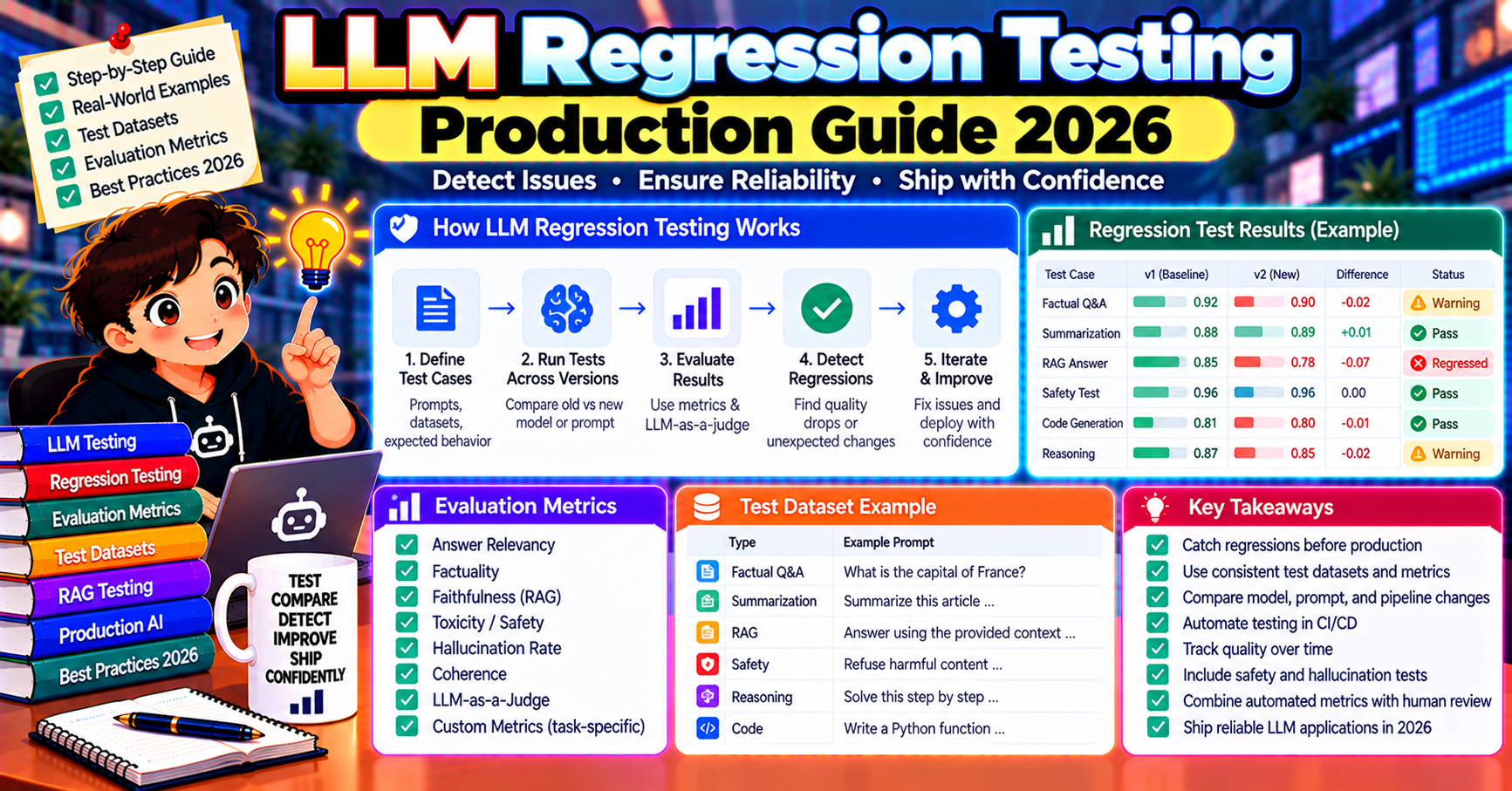
Regression testing an LLM pipeline is different from regression testing a REST API or a database query. LLM outputs are non-deterministic, judgment-sensitive, and often correct in multiple distinct ways. Yet production teams in 2026 absolutely need regression tests, because frontier models update underneath you (silent OpenAI model updates, Anthropic deprecations) and a prompt change can wreck 20% of your use cases without warning. This article walks through the regression testing patterns that actually work for LLMs, how to build a test suite that survives model updates, and the specific anti-patterns that look right but produce noisy test failures.
Why LLM regression testing is hard
Four problems traditional test frameworks do not have to solve:
- Output non-determinism: same input twice produces slightly different outputs. Direct string comparison fails even on perfectly correct responses.
- Multiple correct answers: “What is our refund policy?” has 20 reasonable phrasings. Pinning to one exact phrasing is brittle.
- Silent model updates: OpenAI and Anthropic push model improvements under the same API version. A regression test that passed yesterday fails today for reasons you did not cause.
- Judge-dependent scoring: metrics like “is this answer good” require an LLM to score, which has its own variance.
The patterns below address each of these.
Pattern 1: Semantic equivalence, not exact match
Never compare LLM output as a string. Compare semantically:
def test_refund_answer():
    response = pipeline("What is our refund policy?")
    # Bad: assert response == "You can get a refund within 30 days."
    # Good: assert the answer contains the key facts
    assert "30 days" in response.lower()
    assert "refund" in response.lower()
    assert "unopened" not in response.lower()  # we do not have this condition
Pattern: assert on facts the answer MUST include and facts it MUST NOT include. Lets the model phrase the answer naturally while catching semantic errors.
For more complex equivalence, use an LLM-as-judge with explicit criteria:
def judge_equivalent(actual, expected, criteria):
    prompt = f"""Compare the two responses on these criteria: {criteria}.
Does the actual response meet ALL criteria? Answer yes or no only.

Expected: {expected}
Actual: {actual}

Answer:"""
    result = client.chat.completions.create(
        model="gpt-4o-2024-08-06",
        messages=[{"role": "user", "content": prompt}],
        max_tokens=10,
    )
    return "yes" in result.choices[0].message.content.lower()
Pattern 2: Pin EVERY model version in tests
If your test uses an LLM-as-judge or your pipeline uses an LLM at all, pin the exact version:
# Bad - OpenAI will silently update "gpt-4o"
JUDGE_MODEL = "gpt-4o"

# Good - OpenAI versions this and keeps old snapshots available
JUDGE_MODEL = "gpt-4o-2024-08-06"
OpenAI, Anthropic, and Google all offer version-pinned model IDs. Use them in both the pipeline-under-test AND the judge. If the pipeline must use gpt-4o (unversioned) because of a product constraint, at least pin the judge to a specific snapshot so changes in the judge do not confuse your regression analysis.
Pattern 3: Record-replay for deterministic test runs
Running the full LLM pipeline against the live API on every test iteration is slow and expensive. Record real responses to disk, replay them in tests:
import vcr  # the vcrpy library

@vcr.use_cassette("tests/cassettes/test_refund.yaml")
def test_refund_answer():
    response = pipeline("What is our refund policy?")
    assert "30 days" in response.lower()
First run captures the HTTP interactions to a YAML file. Subsequent runs replay from the file. Fast, deterministic, zero API cost. Re-record (vcr.use_cassette(mode="all")) when you intentionally change the pipeline.
Caveat: record-replay catches “did my prompt change” bugs but misses “did the underlying model drift” bugs. Combine with periodic live runs (weekly cron) to catch drift.
Pattern 4: Test the structure, not just the content
For structured outputs (JSON mode, function calling), assert on schema compliance separately from content:
from pydantic import BaseModel, ValidationError

class Ticket(BaseModel):
    category: str
    priority: str
    needs_followup: bool

def test_ticket_classifier():
    result = classifier("Card charged twice, help")
    # Schema compliance (deterministic, cheap)
    try:
        parsed = Ticket.model_validate(result)
    except ValidationError as e:
        pytest.fail(f"Schema violated: {e}")
    # Content assertions
    assert parsed.category == "billing"
Schema compliance should be 100% with strict mode LLMs; a failure here means your pipeline regressed in a structural way. Content assertions can be looser.
Pattern 5: Golden set that grows from production
Build the regression dataset from real production failures, not synthetic examples:
- Monitor production for user-reported bad outputs (thumbs-down button, support tickets, etc)
- Each real failure becomes a test case in the regression suite
- Fix the pipeline; the new case now ensures it does not regress
Three advantages: (1) tests reflect real-world distribution, not what you imagined, (2) the suite grows organically with product maturity, (3) each test case has a clear business justification. Starting corpus of 20-50 real failures beats a synthetic set of 500.
Pattern 6: Scheduled drift runs
Model drift is the sneakiest regression. Prevent surprise:
# .github/workflows/weekly-drift.yml
name: Weekly LLM Drift Check
on:
  schedule:
    - cron: '0 9 * * MON'  # Every Monday 09:00 UTC
jobs:
  drift:
    runs-on: ubuntu-latest
    steps:
      - uses: actions/checkout@v4
      - run: pip install -r requirements.txt
      - run: pytest tests/golden_set.py --live  # bypass VCR, hit live API
      - uses: slackapi/slack-github-action@v1
        if: failure()
        with:
          payload: |
            {"text": "LLM drift detected on golden set. See artifact."}
Weekly live-API run catches silent model updates. Pair with alerts so you know within 7 days of a drift event.
Anti-patterns to avoid
- Exact string match on freeform output: flaky; catches cosmetic noise, misses semantic errors.
- Testing with temperature=0 for determinism: temperature=0 still allows minor variance due to inference sampling. Use VCR cassettes for true determinism; keep temperature at the production value in live drift tests.
- Judging with the same model you are testing: do not test gpt-4o output with a gpt-4o judge. Use a different judge model (Claude Opus 5.5 or GPT-4o from a different generation) to avoid self-grading bias.
- Single large test case: 1 question tested 10 ways. Produces coarse pass/fail; hard to debug. 10 separate test cases produce clear failure signals.
- No cost cap on tests: a judge-heavy suite that spirals can burn $100+ in a bad run. Set per-test token caps and a total-run spending ceiling in CI.
A production-ready test suite shape
What a mature LLM regression suite looks like in 2026:
- 50-200 real production failure test cases (grown over 6-18 months)
- Record-replay for 90% of them (fast CI loop)
- Live-API drift run on 10-20 critical cases weekly
- Vulnerability scan (Giskard) running on PRs touching the AI code paths
- LLM-as-judge metrics (RAGAs, DeepEval) run on changes to prompts or retrieval
- Alert routing to Slack on failure; dashboards showing pass rate over time
Build it incrementally. Start with 10 production failures and VCR cassettes. Add live drift runs after you see your first silent model update. Add vulnerability scanning after your first prompt injection incident. The suite should grow from pressure, not from imagination.
Frequently Asked Questions
How much does an LLM test suite cost per month to run?
With VCR cassettes caching 90% of test runs, expect $20-$100/month in judge-model API costs for a 100-example suite running on every PR. The weekly live-API drift run adds another $5-$20. Total: well under $200/month at reasonable scale.
Should I use pytest or a dedicated framework like DeepEval?
Pytest covers 80% of cases cleanly. DeepEval adds LLM-specific metrics on top (hallucination, faithfulness, G-Eval) that are hard to implement from scratch. Use pytest for structural and keyword assertions; add DeepEval for quality metrics. Both run in the same test command.
Can I run these tests locally without hitting APIs?
Yes with VCR cassettes. Cassettes record the first live run then replay in subsequent runs. New engineers can run the suite offline immediately after checkout.
What about non-determinism from streaming responses?
Streaming does not affect test determinism; the final response text is what you assert on. VCR records the full stream and replays it as-if-streamed. Pytest cases that assert on partial streams specifically need custom handling.
How do I handle a drift that moves the output in a GOOD direction?
Review the drift, confirm the new output is actually better, update the cassette to the new behavior, document the change in a commit. The regression suite follows your intent, not the vendor’s. If the drift matches your intent, update; if it does not, this is the alert you built the drift check for.
Should I version the test cases themselves?
Yes. Store cassettes in git. Review changes in PRs when you re-record. Treat the golden-set directory as production-code-level infrastructure, not test scaffolding.
Official documentation

Joken E. Villanueva
Founder & Lead Developer at PIES IT Solution
Founder of PIES Information Technology Solutions, a software company building production-grade applications for institutions across the Philippines. Over 8 years of hands-on full-stack development experience, currently leading the development of ClinicAI, an AI-powered clinic management platform.
Expertise: PHP · MySQL · JavaScript · AI Integration · SaaS Architecture · VB.NET · Database Design · Capstone Documentation · Java · View all posts by Joken E. Villanueva →