
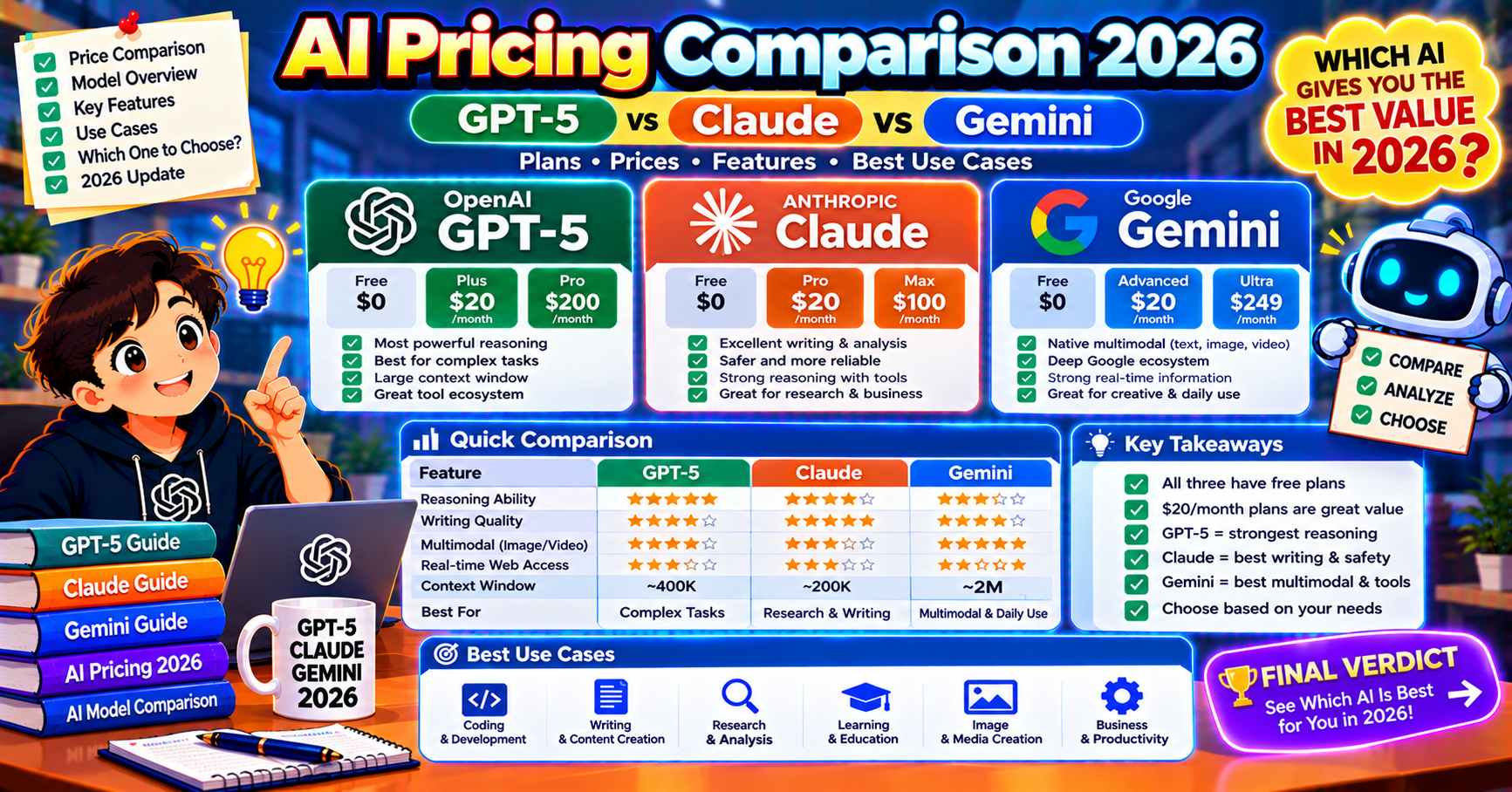
LLM pricing changed dramatically between 2024 and 2026. Models that cost $30 per million tokens in 2023 are $3 in 2026; models that would have been inaccessible are now cheap enough to run in production at scale. Picking the right model for the job depends on current pricing, which is a moving target. This article is a hands-on comparison of the top 2026 models by task type, with real cost math and the tradeoffs between them.
Headline model prices (October 2026)
| Model | Input $/M | Output $/M | Cached input $/M |
|---|---|---|---|
| GPT-5 (OpenAI) | $5.00 | $20.00 | $2.50 |
| GPT-5-mini | $0.25 | $1.00 | $0.125 |
| GPT-4o | $2.50 | $10.00 | $1.25 |
| GPT-4o-mini | $0.15 | $0.60 | $0.075 |
| Claude Opus 5.5 | $15.00 | $75.00 | $1.50 |
| Claude Sonnet 5.5 | $3.00 | $15.00 | $0.30 |
| Claude Haiku 5.5 | $0.80 | $4.00 | $0.08 |
| Gemini 2.5 Pro | $1.25 | $5.00 | $0.3125 |
| Gemini 2.5 Flash | $0.075 | $0.30 | $0.01875 |
| DeepSeek-V3 | $0.27 | $1.10 | $0.07 |
| Llama 3.3 70B (via Groq) | $0.59 | $0.79 | N/A |
Prices shown as of early October 2026. Expect them to drop; expect provider-specific features (web search, structured outputs, caching) to differentiate choices as pricing converges.
Cost per task: real-world math
Headline $/M prices do not tell you what a task actually costs. Here are five common tasks priced across models.
Classify a 400-token support ticket into one of 5 categories (output: 10 tokens):
- GPT-4o-mini: $0.0001 ($0.10 per 1000 tickets)
- Claude Haiku 5.5: $0.00036 ($0.36 per 1000 tickets)
- Gemini 2.5 Flash: $0.00003 ($0.03 per 1000 tickets)
- DeepSeek-V3: $0.00012 ($0.12 per 1000 tickets)
Gemini 2.5 Flash wins on raw cost. For high-volume classification (100K tickets/month), that is $3 vs $10 to $36 across the others.
Generate a 500-word blog section with 2K-token context:
- GPT-4o: $0.012 per section
- Claude Sonnet 5.5: $0.016 per section
- Gemini 2.5 Pro: $0.006 per section
- DeepSeek-V3: $0.0013 per section
Quality differs enough on long-form writing that cost is not the deciding factor; benchmark the output.
Code review on a 5K-token diff with 15K-token context:
- GPT-5: $0.11 per review
- Claude Opus 5.5: $0.30 per review
- Claude Sonnet 5.5: $0.063 per review
- Gemini 2.5 Pro: $0.028 per review
Claude Sonnet 5.5 is the sweet spot for code; Opus is marginally better and 5x the price. Gemini 2.5 Pro is cheapest but code review benchmarks have Claude slightly ahead.
RAG over a 50K-token document, 500-token answer:
- Claude Sonnet 5.5 fresh: $0.158 per query
- Claude Sonnet 5.5 cached: $0.023 per query (with 1-hour cache tier)
- Gemini 2.5 Pro cached: $0.019 per query
- GPT-4o cached: $0.068 per query
Caching changes the math completely. For RAG with document reuse, enable caching before anything else.
Agent step with 3K-token context, 200-token tool call:
- Claude Sonnet 5.5: $0.012 per step
- GPT-4o: $0.009 per step
- Gemini 2.5 Pro: $0.005 per step
- DeepSeek-V3: $0.001 per step
For a 10-step agent, that is $0.01 to $0.12 per full run. Costs add up with high-volume agents; pick based on tool-use accuracy and cost together.
When to pick which model (task-based guide)
- Classification, extraction, tagging: Gemini 2.5 Flash or GPT-4o-mini. Cheap, fast, good enough quality.
- Customer-facing chat: Claude Sonnet 5.5 for quality, GPT-4o-mini for cost-sensitive.
- Code generation and review: Claude Sonnet 5.5 primary, Opus 5.5 for the hardest reviews.
- Long-document Q&A / RAG: Gemini 2.5 Pro (1M-token context) or Claude Sonnet 5.5 (200K context with caching).
- Agents with lots of tool use: Claude Sonnet 5.5 wins on tool-use benchmarks.
- Writing: marketing copy, blog, outreach: Claude Sonnet 5.5 or Opus 5.5 for quality; expensive but worth it on polish-sensitive output.
- Experimental, high-volume batch: DeepSeek-V3 or Llama 3.3 via Groq. 5-10x cheaper than frontier closed models at 90% of the quality.
- Vision tasks (OCR, image Q&A): GPT-4o or Gemini 2.5 Pro. Both are strong; benchmark on your actual images.
- Reasoning / math / science: GPT-5, Claude Opus 5.5, or Gemini 2.5 Pro. Significant accuracy gap between frontier reasoning models and cheaper siblings on this.
Open-source and self-hosted economics
Running Llama 3.3 70B or Qwen3 72B on your own GPU is cheap at scale: Lambda Labs H100 at $2.49/hour serves roughly 100 to 150 requests per minute of a 500-token response. At that rate, cost per request is $0.0003, roughly 10x cheaper than DeepSeek-V3 API and 100x cheaper than GPT-4o.
The catch: you need enough traffic to keep the GPU busy. A GPU running at 20% utilization costs the same as one running at 100%. For bursty workloads, API is cheaper. For sustained high-volume (10M+ requests/month), self-hosted wins. See our vLLM vs TGI vs llama.cpp comparison for the hosting side.
Pricing is not the whole picture
Three non-price factors that often decide the model:
- Rate limits: a cheaper model you cannot actually scale on is worthless. Check tier limits before committing.
- Latency: Groq’s Llama is 10x faster than frontier APIs. For UX-sensitive apps that matters more than cost per token.
- Reliability: provider outages happen. Multi-provider setups (OpenAI + Anthropic fallback) are worth the complexity for revenue-critical apps.
The right default stack for a new build
A reasonable default in 2026:
- Start with Claude Sonnet 5.5 (good at everything, well-priced)
- Route cheap-token workloads (classification, extraction) to Claude Haiku 5.5 or Gemini 2.5 Flash
- Route hard reasoning to GPT-5 or Claude Opus 5.5
- Enable prompt caching everywhere
- Benchmark on your actual data; swap providers if a competitor beats on cost at equal quality
Hidden costs the headline price does not include
Monthly bills are rarely just input-output tokens. Four line items that catch teams by surprise:
- Image and vision tokens: images get tokenized into hundreds or thousands of tokens each. A single 1024×1024 image on GPT-4o counts as roughly 765 tokens. For OCR workloads, this dominates cost.
- Tool-use overhead: every tool call and tool result lives in the conversation. A 10-step agent accumulates 5K to 20K tokens of tool chatter on top of the user prompt and system message.
- Reasoning tokens on o-series / thinking models: OpenAI o-series and Claude extended thinking charge for reasoning tokens the user never sees. On a hard question, hidden reasoning can be 10x the visible output.
- Failed requests and retries: a 429 rate-limit response is free, but your retry doubles the token spend if the retry succeeds. Timeouts and partial completions count too.
How to monitor spend in production
Three monitoring pieces that pay off within the first week of any new LLM app:
- Per-tenant token tracking: log input_tokens, output_tokens, and model for every call keyed by customer or feature. A single misbehaving customer should not quietly consume 80% of your spend.
- Daily spend alert: wire a Slack notification if yesterday’s token spend was more than 2x the trailing 7-day average. Catches runaway loops, botnet attacks, and new feature spikes early.
- Model-mix dashboard: show the share of calls going to each model and the cost contribution of each. When a routing bug sends everything to Opus instead of Sonnet, this spots it in hours instead of at month-end billing.
Frequently Asked Questions
Official documentation
How often does pricing change?
Every 3 to 6 months. OpenAI dropped prices three times in 2024, twice in 2025, once so far in 2026. Anthropic has held Opus pricing steady but added caching tiers and Haiku price cuts. Expect further drops as GPU efficiency improves and competition intensifies.
What is the fastest way to compare models for my task?
Pick 50 representative examples. Run them through 3 candidate models (one from each major provider). Score outputs manually or with LLM-as-judge. Multiply cost per example by expected monthly volume. Pick the cheapest model that passes your quality threshold.
Should I ever pay for Opus 5.5?
Yes for tasks where the quality gap matters: legal, medical, high-stakes code review, hard reasoning. For most app code and user chat, Sonnet 5.5 is good enough and 5x cheaper. Reserve Opus for the 5-10% of calls that need the top model.
How does fine-tuned model pricing work?
Fine-tuned models typically cost 2 to 3x the base model price. OpenAI gpt-4o-mini fine-tuned is $0.30 input vs $0.15 base. Factor fine-tune training cost ($10 to $100 depending on data size) and ongoing hosting into the economics.
What about Azure OpenAI pricing?
Azure matches OpenAI direct pricing within 5-10%. Enterprise customers often use Azure for compliance (BAA for HIPAA, data residency). Not cheaper on raw cost; the value is in the enterprise plumbing.
Does batch API pricing apply to all workloads?
No. Batch API gives you 50% off on both input and output but delays results up to 24 hours. Useful for overnight pipelines, embedding generation, large eval runs. Not useful for anything user-facing.

Joken E. Villanueva
Founder & Lead Developer at PIES IT Solution
Founder of PIES Information Technology Solutions, a software company building production-grade applications for institutions across the Philippines. Over 8 years of hands-on full-stack development experience, currently leading the development of ClinicAI, an AI-powered clinic management platform.
Expertise: PHP · MySQL · JavaScript · AI Integration · SaaS Architecture · VB.NET · Database Design · Capstone Documentation · Java · View all posts by Joken E. Villanueva →