
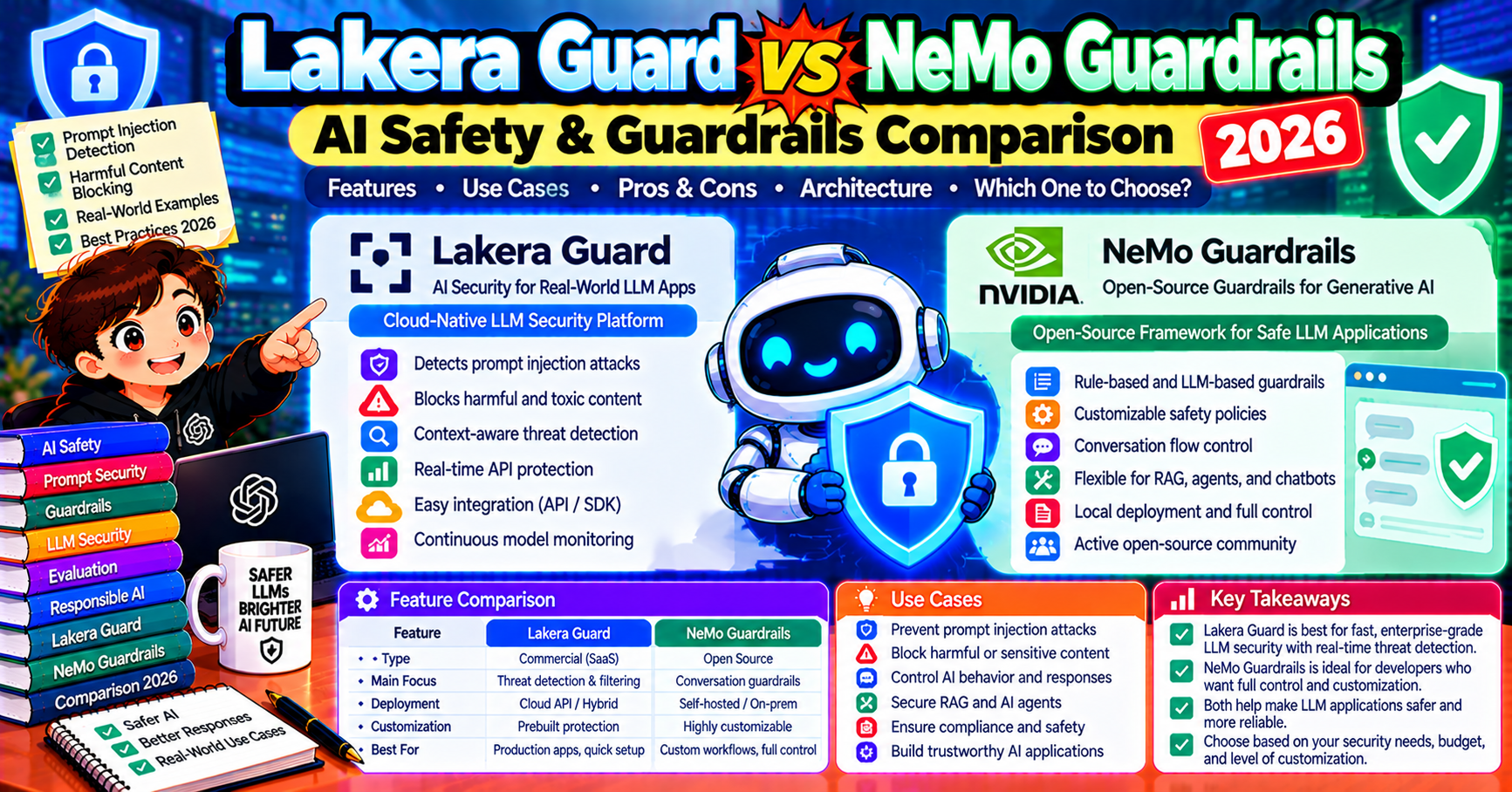
Lakera Guard and NVIDIA NeMo Guardrails are the two serious AI safety frameworks that production teams reach for when “add some guardrails” becomes a shipping requirement in 2026. They solve the same problem differently: Lakera is a hosted API service specialized in prompt injection and content classification; NeMo is an open-source framework for defining complex rail flows with Colang. This article compares them on setup, coverage, latency, cost, and the specific use cases that make one the right pick.
What each product is
Lakera Guard: hosted guardrails API. Call Lakera from your app before and after your LLM call, Lakera classifies the input/output as safe or unsafe. Specialized in prompt injection detection (their flagship capability), with secondary coverage of toxicity, PII, and off-topic content. Pay per request to Lakera’s API.
NeMo Guardrails: open-source Python framework by NVIDIA. Define rail flows in Colang (a declarative DSL), compile them into runtime that intercepts every LLM call. Supports input rails, output rails, dialog rails, and action rails in one framework. Free; self-hosted.
Setup comparison
Lakera Guard (API call):
import requests

def check_input(user_text):
    r = requests.post(
        "https://api.lakera.ai/v2/guard",
        headers={"Authorization": f"Bearer {LAKERA_KEY}"},
        json={
            "messages": [{"content": user_text}],
            "payload": True,  # also check for prompt injection payload patterns
        },
    )
    return r.json()["flagged"]  # True if unsafe

if check_input(user_message):
    return "I cannot help with that."
# ... else proceed to LLM call
Call before every LLM request. Returns a flag + category + confidence score. Latency ~50-150ms per check. Zero infrastructure overhead.
NeMo Guardrails (Colang + Python):
# config/rails.co
define user ask about competitor
  "What do you think of Acme Corp"
  "Should I use Globex instead"

define bot refuse to discuss competitors
  "I focus on our products and cannot discuss competitors."

define flow discuss competitors
  user ask about competitor
  bot refuse to discuss competitors
from nemoguardrails import LLMRails, RailsConfig

config = RailsConfig.from_path("./config")
rails = LLMRails(config)
response = rails.generate(messages=[{"role": "user", "content": user_message}])
Colang declares intents, bot responses, and flows. The framework parses intents at runtime, matches against your defined patterns, and routes to the right flow. Setup takes a day to learn Colang but then adding new rails is fast.
Coverage head-to-head
| Capability | Lakera Guard | NeMo Guardrails |
|---|---|---|
| Prompt injection | best-in-class (their core offering) | self-check pattern, decent |
| PII detection | yes | via Presidio integration |
| Toxicity | yes | yes (self-check output) |
| Off-topic filtering | yes (classifier-based) | yes (dialog rails, more flexible) |
| Multi-turn conversation flow | limited | first-class (dialog rails) |
| Action gating (tool use) | manual | action rails built in |
| Hallucination / fact-check | no | yes (retrieval rail) |
| Jailbreak detection | yes (specialized models) | yes (via LLM self-check) |
Latency and cost
Lakera Guard:
- Latency: 50-150ms per check (hosted API, specialized classifiers)
- Cost: $0.001-0.005 per check depending on tier. At 1M checks/month = $1,000-$5,000
- Pricing: Free tier (10K checks/month), Growth ($1K/month), Enterprise custom
NeMo Guardrails:
- Latency: varies by rail type. Simple keyword/regex rails add ~1ms. LLM-based self-check rails add 500ms-2s per request (because they call an LLM to classify)
- Cost: free framework; underlying LLM calls for self-check cost at your model’s rate
- Infra: self-hosted Python, scales horizontally
Simple math at 1M requests/month:
- Lakera: ~$1,500/month
- NeMo with LLM self-check on both input AND output (2 extra LLM calls per request at $0.002/call avg): ~$4,000/month in LLM costs
- NeMo with just input self-check: ~$2,000/month
Lakera is typically cheaper at scale because its specialized classifiers run faster and cheaper than full-LLM self-check calls.
When Lakera wins
- Prompt injection is your top risk: Lakera’s dedicated attention to prompt injection is unmatched. Their training corpus and classifier updates stay current with new attack patterns in a way DIY-with-LLM self-check cannot match.
- You need low latency guardrails: 50-150ms is a ceiling you can plan around; LLM-based self-check latency varies by model and prompt length.
- You want zero infrastructure: API call, no setup. Good for small teams or when ops bandwidth is tight.
- Enterprise compliance (SOC 2, HIPAA): Lakera carries certifications; building the equivalent audit trail from NeMo logs takes work.
When NeMo wins
- Complex dialog logic: multi-turn conversation flows, state-dependent responses, user intent branching. Lakera is yes/no classification; NeMo is a dialog engine.
- Action-gating for agent tools: NeMo’s action rails can intercept any tool call and apply custom logic. Essential for agents with high-risk tools (payments, data writes).
- You want to add fact-checking: NeMo’s retrieval rails let you verify generated claims against a knowledge source. Lakera does not do fact-checking.
- Open-source + self-hosted required: compliance, air-gapped environments, no third-party data sharing. NeMo runs anywhere.
- Deep customization: Colang gives you fine-grained control over rail logic. Lakera is a black-box classifier.
Running them together
Both-and is a common 2026 pattern for high-stakes production LLMs:
- Lakera for the fast first-pass: catches prompt injection and obvious attacks before they consume LLM tokens
- NeMo for dialog + action rails: handles the business-logic enforcement (do not discuss competitors, do not quote prices, do not call the delete-account tool without explicit confirmation)
def handle_user_message(msg):
    # First-pass: Lakera (fast, specialized)
    if lakera_guard.check(msg)["flagged"]:
        return "I cannot help with that request."

    # Second-pass: NeMo (dialog + business logic)
    return nemo_rails.generate(messages=[{"role": "user", "content": msg}])
Added latency: Lakera (~100ms) + NeMo input rail (~500ms if using LLM self-check) = ~600ms total guardrail overhead. Acceptable for user-facing chat; tune based on your SLO.
Common operational pitfalls
- Firing guardrails on legitimate content: Lakera and NeMo both have false positive rates (1-5% typical). Monitor flagged requests, update exceptions for your domain. Lakera supports custom allow-lists; NeMo lets you refine the Colang definitions.
- Not caching Lakera results: identical inputs within a short window produce identical results. Cache for 1-5 minutes to cut cost on repeat traffic.
- NeMo cold start: compiling Colang configs takes 1-5 seconds. In serverless deployments, keep instances warm or pre-compile at container build time.
- Logging guardrail triggers: both tools log when they fire. Store these logs; they are the signal for how your attack surface is evolving over time.
Frequently Asked Questions
Is Lakera Guard worth the API cost vs rolling my own?
For prompt injection specifically, yes. Building an equivalent classifier in-house takes 6-12 months and ongoing training as new attack patterns emerge. For simpler guardrails (toxicity, PII), the open-source alternatives (Presidio for PII, Detoxify for toxicity) are good enough.
Can NeMo Guardrails handle multiple LLM providers?
Yes. Configure the primary LLM in NeMo’s config to any OpenAI/Anthropic/Google/local model. Self-check rails can use a different judge model from the main LLM. Multi-provider setups work cleanly.
How do these compare to Guardrails AI (the Python library)?
Guardrails AI is a lighter-weight alternative with pre-built validators (PII, toxicity, URL check, etc). Think of it as a middle ground: more opinionated than NeMo, less specialized than Lakera. Pick Guardrails AI for a Python-first stack with simple rail needs.
Can Lakera protect downstream agents with tool access?
Partially. Lakera classifies the input (user message) and output (LLM response), but does not intercept tool calls. For action-gating on agents, pair Lakera with NeMo action rails or LangGraph’s interrupt_before.
What about response-level content moderation?
Both check outputs. Lakera’s output check uses the same API; pass response text as the input, get a flag. NeMo output rails fire after the LLM generates but before you return to the user, letting you rewrite or block.
Do these replace OpenAI’s own moderation endpoint?
No. OpenAI’s moderation covers mandatory categories (hate, violence, self-harm) and is free to call. Use it as a baseline. Lakera + NeMo add protection for the business-specific risks that OpenAI’s generic moderation misses.
Official documentation

Mary Grace G. Patulada
Programmer & Technical Writer at PIES IT Solution
Mary Grace G. Patulada (pen name 'Nym') is a programmer and writer at PIES IT Solution with a BSIT background from Carlos Hilado Memorial State College, Binalbagan Campus. Authored 370+ UML diagram tutorials and capstone documentation guides at itsourcecode.com. Specializes in UML (class, use case, activity, sequence, component, deployment), DFD, and ER diagrams for BSIT capstone projects.
Expertise: UML Diagrams · DFD · ER Diagrams · Use Case Diagrams · Activity Diagrams · Capstone Documentation · PHP · View all posts by Mary Grace G. Patulada →