
The short answer
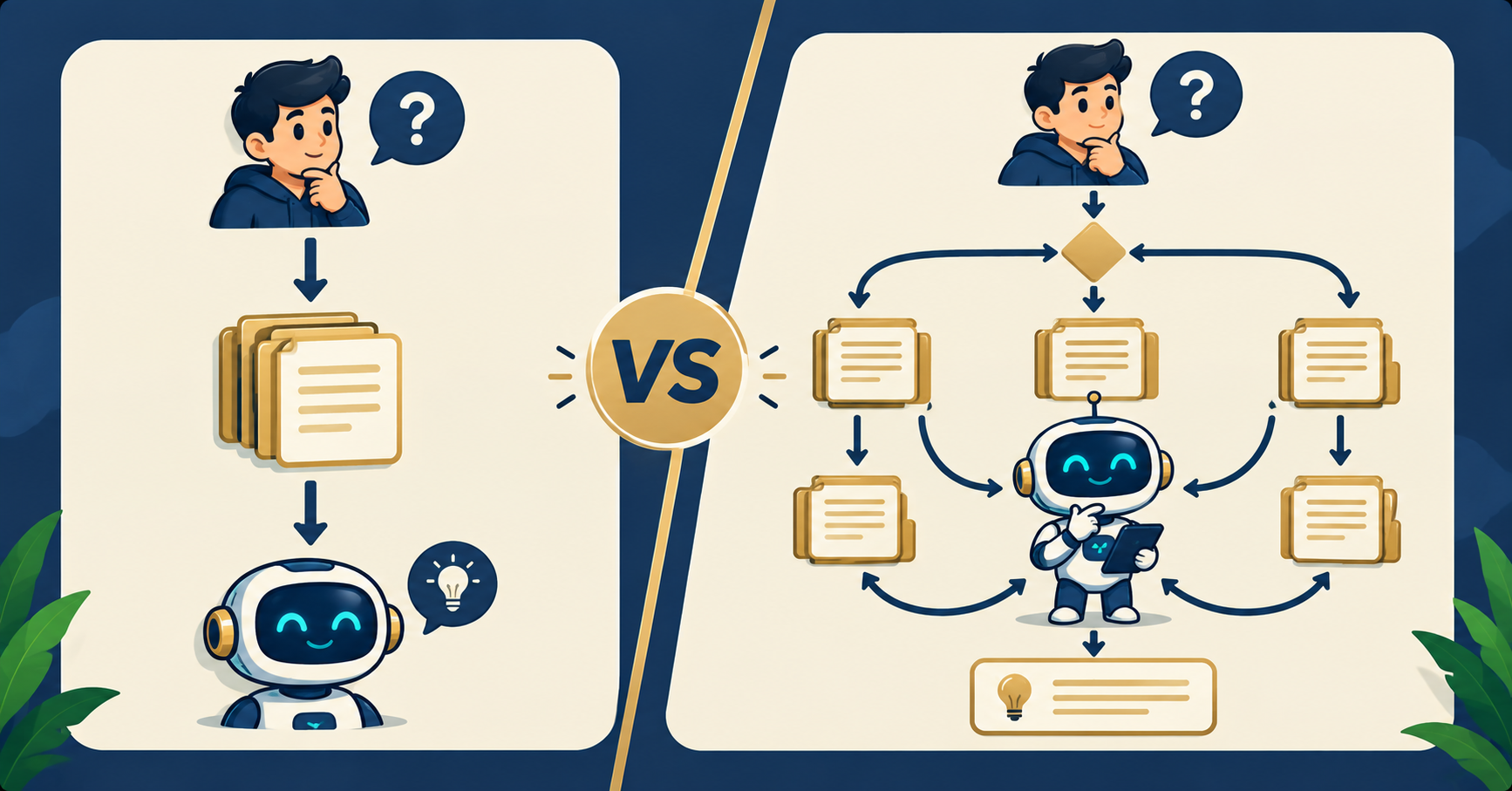
Traditional RAG runs a single retrieval step before the LLM answers. Agentic RAG lets the LLM decide when to retrieve, what to retrieve, and whether to retrieve again. Agentic RAG is more accurate on multi-hop questions and ambiguous queries but costs 3 to 5 times more per request and adds latency. Stick with traditional RAG for high-volume Q&A, switch to agentic when accuracy on complex queries matters more than cost.
Everyone is building RAG systems. By my count, a third of the production LLM pipelines I audit are RAG. In 2026 the question is no longer “should I use RAG” but “should I use traditional single-shot RAG or agentic multi-step RAG.” I have shipped both. Here is how I decide between them.
What traditional RAG looks like
Traditional RAG is one retrieval followed by one LLM call.
User query
   -> Embed the query
   -> Vector search returns top-k chunks
   -> LLM sees query + chunks
   -> LLM answers
This has been the default pattern since LangChain popularized it in 2023. It is simple, fast, and cheap. A single query costs about $0.002 on Claude Sonnet 5.5 with 4K context. Response time is around 2 seconds.
What agentic RAG looks like
Agentic RAG puts the LLM in charge of the retrieval loop.
User query
   -> LLM decides: do I need to retrieve? What do I need?
   -> LLM calls a retrieval tool with its own query
   -> LLM evaluates the retrieved chunks
   -> LLM decides: do I need more? Different query? Different corpus?
   -> LLM loops until it has enough context
   -> LLM answers
The LLM becomes an agent that uses retrieval as a tool, same way it would use a calculator or a shell. Costs more because you pay for multiple LLM turns. Takes longer for the same reason. But handles questions that traditional RAG cannot.
Where traditional RAG wins
Traditional RAG is the right call when your users ask single-focus questions and your corpus is well-indexed. Think “What is the return policy for enterprise customers?” against a 200-page support knowledge base. One retrieval, one answer, under 3 seconds.
If you are doing high-volume customer support, product search, or FAQ bots, traditional RAG wins on cost and latency. Scale to 100,000 queries per day for a few dollars.
Where agentic RAG wins
Agentic RAG is worth the extra cost when the question requires reasoning across multiple retrievals. Three concrete patterns where it dominates:
Multi-hop questions: “What did the CEO say about AI in the earnings call that happened in the quarter when revenue grew 20 percent.” That needs two retrievals: first to find the quarter, then to find the earnings call content. Traditional RAG fails because the first retrieval does not surface earnings call transcripts.
Ambiguous queries: “How do I reset my password” is simple. “The thing I set up last week is not working” requires the agent to narrow down “thing” by asking questions or searching your account history. Agentic RAG handles that elegantly.
Multi-corpus retrieval: If you have docs, a support database, a code repo, and user analytics, an agent can pick which corpus to search for each sub-question. Traditional RAG would need to concatenate everything upfront or pick one.
Cost comparison on real workloads
I benchmarked both on 500 real support queries from a SaaS client:
                 Traditional     Agentic
Avg cost/query   $0.004          $0.019    (4.75x)
Avg latency      2.1 sec         6.8 sec
Accuracy (judge) 71%             89%
Cost per 1000    $4              $19
Agentic RAG was 4.75x more expensive and 3x slower. The accuracy gain was 18 percentage points, which is enormous. For a $29/month SaaS product with 100 queries per user per month, that is a difference of $0.40 vs $1.90 in LLM cost per user per month, hitting gross margin by 3 to 5 percentage points.
When the cost delta does not matter
If your product charges $100+ per user per month, or if your users submit low-volume high-value queries (legal research, financial analysis, medical literature review), the 4.75x cost multiplier disappears into the pricing. Agentic RAG is the obvious choice for enterprise use cases.
If your product is a free or near-free consumer tool processing millions of queries per day, traditional RAG is the only economic option. Reserve agentic RAG for the tiny percentage of queries that truly need it.
Hybrid patterns that work well
Many of our production systems use a hybrid approach.
Confidence-gated agentic RAG: Start with traditional RAG. If the first LLM response contains “I do not have enough information” or a similar signal, fall back to agentic RAG. This covers 90% of queries at traditional cost and the remaining 10% at agentic cost.
Query classification routing: Use a small cheap model (Claude Haiku) to classify incoming queries as simple or complex. Route simple to traditional RAG, complex to agentic. Classification cost is negligible.
Budget-capped agentic: Let agentic RAG loop but cap it at 3 retrieval turns max. Prevents runaway costs on degenerate queries while still giving the agent room for multi-hop reasoning.
Common pitfalls
Teams that switch to agentic RAG without thinking usually hit one of these:
- Cost explodes because they removed the per-query budget cap.
- Latency becomes unacceptable because they did not stream intermediate results to the user.
- Users think the system is broken because they see no response for 8 seconds. Add a loading state that says “thinking”.
- Tracing was not instrumented, so when agentic RAG fails they cannot tell which retrieval step went wrong.
My decision framework
I apply these questions in order to pick:
- Are more than 20% of your queries multi-hop or ambiguous? If yes, agentic. If no, consider traditional.
- Does your product price support a $0.02 per query cost? If yes, agentic is viable. If no, hybrid.
- Are your users willing to wait 5 to 10 seconds for better answers? If yes, agentic. If no, traditional with a confidence-gated fallback.
- Do you have observability in place to debug multi-turn agent runs? If no, build it first before shipping agentic RAG.
Which to start with on a greenfield project
Start with traditional RAG. It is faster to build, cheaper to run, and good enough for most use cases. Measure real user queries for two weeks. Identify which queries traditional RAG fails on. Then add agentic RAG as a fallback for just those queries.
Building agentic from day one is an over-engineering trap I have seen several teams fall into. The complexity cost is real, and most users never trigger it.
Pick the simpler pattern first. Measure. Only add agents when the data shows your users are hitting the ceiling of traditional RAG. Agentic RAG is a tool, not an upgrade. I hope this decision framework saves you the three-month rewrite cycle most teams go through when they jump to agentic too early. Feel free to comment below with your workload specifics and I will share what I would do.
Official documentation
Frequently asked questions
What is the simplest way to add agentic behavior to existing traditional RAG?
Wrap the retrieval function as a tool and give it to an LLM with a loop budget. Use the Claude Code SDK or LangGraph for the agent loop. Takes about 2 hours to convert a traditional RAG pipeline.
Does agentic RAG replace traditional RAG entirely?
No. Most production systems run both and route between them based on query complexity. Pure-agentic deployments are rare and usually expensive.
Which vector database works best for agentic RAG?
Any of the mainstream options work: Pinecone, Weaviate, Qdrant, Chroma. More important than the DB is the quality of your embeddings and chunking strategy.
How do I measure accuracy on both?
Use an LLM judge (RAGAS, TruLens, or a custom Claude-as-judge prompt) to score responses against ground truth. Run the same evaluation set on both pipelines and compare.
Does agentic RAG help with hallucination?
Somewhat. The agent can self-verify by re-querying when confidence is low. But hallucination risk does not go to zero. Add a final-answer verification step for high-stakes use cases.
Which frameworks support agentic RAG out of the box?
LangGraph, LlamaIndex, CrewAI, and the Claude Code SDK all have agentic RAG patterns built in. LangGraph is the most popular in 2026 for complex multi-step pipelines.

Joken E. Villanueva
Founder & Lead Developer at PIES IT Solution
Founder of PIES Information Technology Solutions, a software company building production-grade applications for institutions across the Philippines. Over 8 years of hands-on full-stack development experience, currently leading the development of ClinicAI, an AI-powered clinic management platform.
Expertise: PHP · MySQL · JavaScript · AI Integration · SaaS Architecture · VB.NET · Database Design · Capstone Documentation · Java · View all posts by Joken E. Villanueva →