
Vector databases have crossed the chasm from research tool to production infrastructure in 2026. Pinecone, Weaviate, and Qdrant now serve billions of vectors in production for every category of AI application, from retrieval-augmented generation to recommendation systems to multimodal search. This article compares the three on the dimensions that drive real buying decisions: cost at scale, operational complexity, feature set, and the practical differences you only notice six months in.
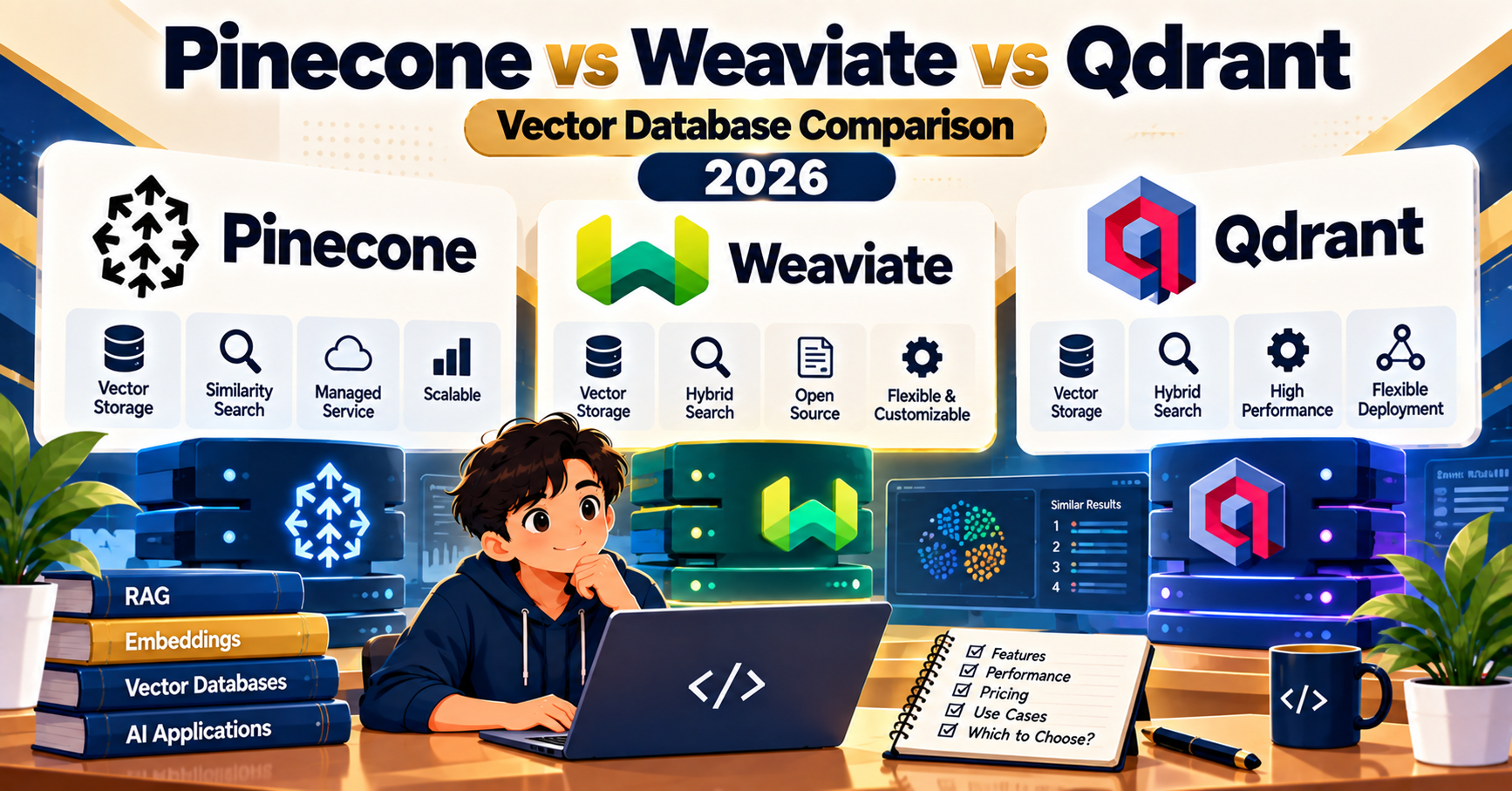
The three databases at a glance
Pinecone is fully managed and serverless-first in 2026. You never think about nodes, replicas, or capacity planning. The tradeoff: no self-hosted option exists, and your cost scales directly with your usage. Pinecone’s serverless pricing is granular enough that small projects pay almost nothing, which is the opposite of the enterprise-first positioning Pinecone had in 2023.
Weaviate gives you both: a managed cloud offering (Weaviate Cloud Services) and a strong open-source core you can self-host on Kubernetes. The database’s standout feature in 2026 is native multi-tenancy, meaning one Weaviate cluster can isolate thousands of customer tenants with per-tenant encryption, backup, and quota. For B2B AI products this is a massive operational win.
Qdrant is open-source first and the most lightweight of the three. The Rust codebase is fast and memory-efficient, and self-hosting is genuinely easy; a single container runs locally for development and in production. Qdrant Cloud (managed) exists but roughly half of production deployments in 2026 are self-hosted.
Pricing comparison (September 2026)
Pinecone Serverless
- $0.33 per million read units
- $2.00 per million write units
- $0.33 per GB stored per month
- Free tier: 2 GB storage, 2 million read units, 1 million write units per month
Weaviate Cloud Services (Serverless)
- $25 per month minimum (includes 1 million objects)
- Scales to $0.095 per million objects per month at volume
- Self-hosted is free
Qdrant Cloud
- $0.014 per hour per GB of RAM used by indexes
- Free tier: 1 GB cluster
- Self-hosted is free
Pinecone’s pricing is the cleanest for projects where you cannot predict scale. The read/write/storage unit model is close to how you think about queries. Weaviate’s pricing is attractive for mid-size workloads but the $25 floor rules out tiny projects on managed. Qdrant Cloud bills per GB of RAM, which rewards efficient indexes and penalizes bloat; the self-hosted path is zero marginal cost beyond the server.
Performance benchmarks
Public September 2026 benchmarks on 1 million vectors (1536 dimensions, OpenAI ada-002 size), top-10 recall at 95%:
- Qdrant self-hosted: 2500 to 3200 QPS, p99 latency 15 ms
- Weaviate self-hosted: 1800 to 2400 QPS, p99 latency 22 ms
- Pinecone Serverless: 1200 to 1600 QPS, p99 latency 45 ms
Qdrant’s Rust implementation wins on raw throughput and latency when both are self-hosted on the same hardware. Pinecone’s managed numbers include the cost of multi-tenant isolation and cross-AZ replication, which real production needs. Benchmark results on a developer laptop are not what you actually ship against. For most workloads under 10M vectors, all three are fast enough that the choice should come down to operations, not throughput.
Feature coverage
- Metadata filtering: All three support it. Qdrant has the most expressive filter language (nested conditions, geo filters, text matching). Pinecone’s filter language is simpler and covers most cases.
- Hybrid search (dense + sparse): All three now support BM25 fused with dense retrieval. Weaviate’s hybrid search in a single query call is the most ergonomic for developers.
- Multi-tenancy: Weaviate leads. Native tenant isolation with per-tenant indexes is a major production win. Pinecone and Qdrant require you to simulate tenancy with namespaces or collections.
- GraphQL: Only Weaviate ships a GraphQL API, which is useful if your product already uses GraphQL.
- Vector quantization: All three support product quantization and scalar quantization in 2026. Qdrant and Weaviate also support binary quantization, which cuts memory usage by 32x with a small recall hit.
- Sparse vectors (SPLADE): Supported in all three, but Qdrant’s implementation is the most tested.
Code example: upsert and query
The same minimal task in each client:
Pinecone
from pinecone import Pinecone, ServerlessSpec
pc = Pinecone(api_key="pcsk_...")
pc.create_index(
    name="docs",
    dimension=1536,
    metric="cosine",
    spec=ServerlessSpec(cloud="aws", region="us-east-1"),
)
index = pc.Index("docs")
index.upsert([("doc1", [0.1] * 1536, {"source": "handbook"})])
res = index.query(vector=[0.1] * 1536, top_k=3, include_metadata=True)
Weaviate
import weaviate
client = weaviate.connect_to_local()
docs = client.collections.create(
    name="Docs",
    properties=[
        weaviate.classes.config.Property(name="source", data_type=weaviate.classes.config.DataType.TEXT),
    ],
)
docs.data.insert({"source": "handbook"}, vector=[0.1] * 1536)
res = docs.query.near_vector(near_vector=[0.1] * 1536, limit=3)
Qdrant
from qdrant_client import QdrantClient
from qdrant_client.models import Distance, VectorParams, PointStruct

client = QdrantClient(url="http://localhost:6333")
client.create_collection(
    collection_name="docs",
    vectors_config=VectorParams(size=1536, distance=Distance.COSINE),
)
client.upsert(
    collection_name="docs",
    points=[PointStruct(id=1, vector=[0.1] * 1536, payload={"source": "handbook"})],
)
res = client.search(collection_name="docs", query_vector=[0.1] * 1536, limit=3)
The three SDKs follow similar shapes. Qdrant’s typed point structures are the most Rust-idiomatic. Weaviate’s property-based model is explicit about schema. Pinecone’s is the most minimal.
Operational complexity
Pinecone Serverless has zero operational burden. No capacity planning, no scaling events, no index rebuilds. You pay more per query than self-hosted alternatives, and the tradeoff is engineer time saved.
Weaviate self-hosted on Kubernetes is manageable but not trivial. Backups, index rebuilds, and horizontal scaling all need thought. Weaviate Cloud removes most of that; the per-tenant quota features are a real advantage for B2B products.
Qdrant self-hosted is the simplest to operate at single-node scale. A Docker container, a persistent volume, a backup script. Horizontal scaling with sharding is well documented but still a learning curve. Qdrant Cloud removes those concerns.
Which to pick for your use case
- Hackathon or prototype, no infrastructure team: Pinecone Serverless free tier. Working in five minutes.
- B2B SaaS with per-customer tenancy: Weaviate. Native multi-tenancy is the right tool.
- Self-host first, cost control critical: Qdrant. Fastest self-hosted performance, cleanest Docker experience.
- Over 100M vectors, enterprise contracts: Any of the three. Benchmark on your workload, negotiate price.
- GraphQL-first codebase: Weaviate.
- You need expressive metadata filters: Qdrant.
Frequently Asked Questions
Which vector database is easiest for beginners in 2026?
Pinecone Serverless. The free tier covers typical learning projects, the SDK has one obvious way to do each task, and there are no servers to manage. Qdrant is a close second if you prefer to run everything locally with Docker.
Can I migrate from Pinecone to Weaviate or Qdrant later?
Yes. All three databases store vectors with optional metadata, and standard migration patterns exist. The actual work is rewriting your SDK calls (a few hundred lines in most apps) and re-upserting your vectors. Plan a weekend for a mid-size migration.
Is Pinecone still free for small projects in 2026?
Yes. The free tier covers 2 GB storage, 2 million read units, and 1 million write units per month on Pinecone Serverless. Small side projects and personal apps rarely exceed this. Paid tiers kick in only when you cross those thresholds.
Which vector database has the best performance?
Qdrant on the same hardware, by about 30% QPS on standard benchmarks. In production the difference matters less than operations, cost, and features. Over 10M vectors, benchmark on your actual workload with your actual hardware before deciding.
Do I need a vector database to use RAG?
No. For under 10K documents you can use a Python library like FAISS, sklearn, or Chroma without running a separate database. Vector databases become worthwhile when you need persistence, concurrent writes, metadata filtering, or multi-tenancy. Many production RAG apps start with Chroma and migrate to Pinecone, Weaviate, or Qdrant around the 100K-document mark.
Which supports hybrid search (dense plus sparse)?
All three support hybrid search in 2026, but Weaviate’s hybrid query API is the most ergonomic (one call fuses dense and sparse scores with a tunable alpha). Qdrant supports hybrid search through its sparse vector feature. Pinecone added hybrid support in late 2025.
Official documentation

Adrian Mercurio
Full-Stack Developer at PIES IT Solution
Specializes in building complete capstone projects with full documentation. Strong background in PHP/MySQL development and database design. Has personally built and tested over 30 capstone-ready projects with ER diagrams, DFDs, and chapter-by-chapter thesis documentation.
Expertise: PHP, Laravel, Database Design, Capstone Projects, C#, C, C++, Python, AI Projects · View all posts by Adrian Mercurio →