
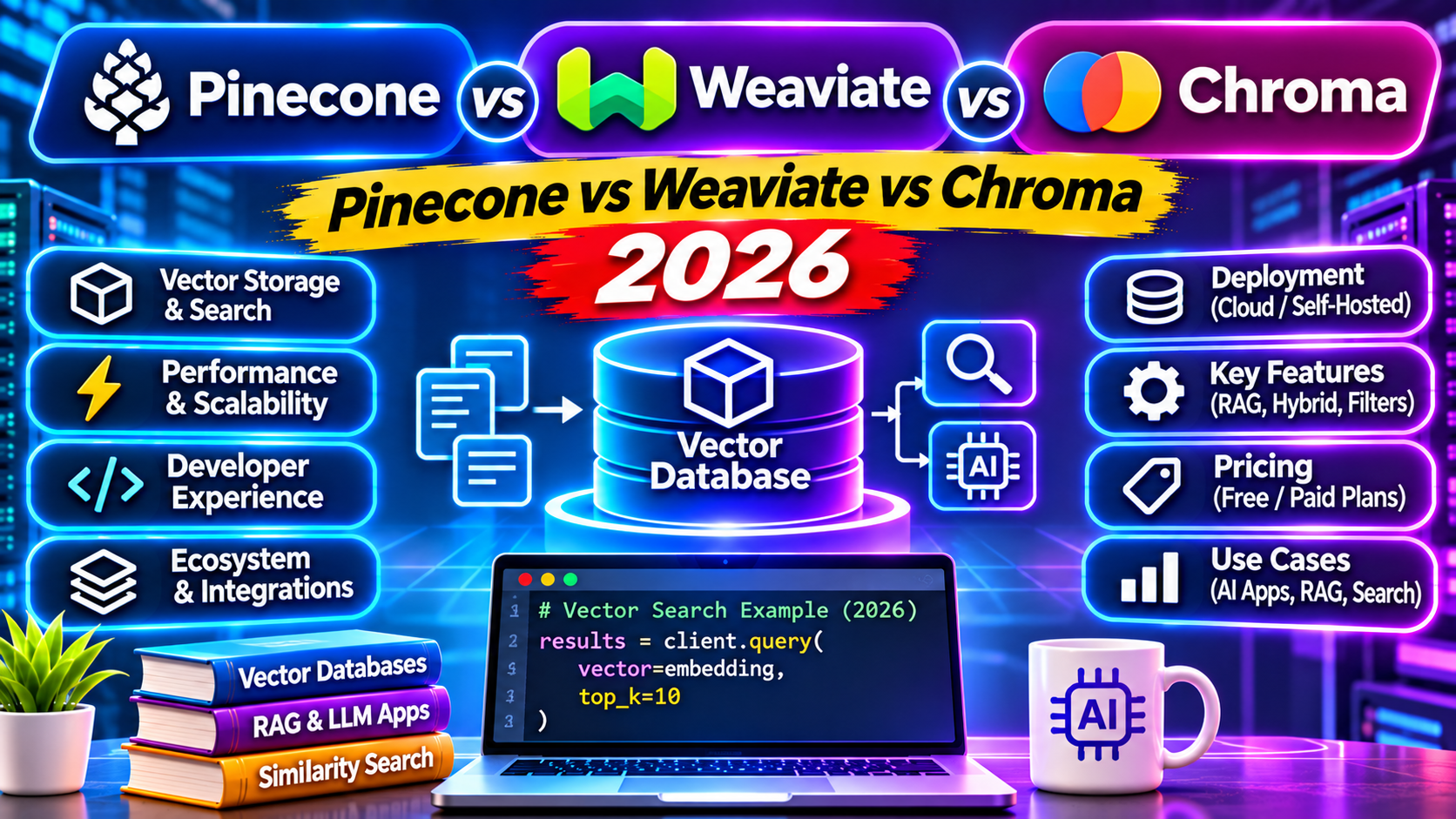
The short answer
Pinecone wins for teams that want zero ops and are fine paying $70+/month to start. Weaviate wins for feature breadth (hybrid search, GraphQL, built-in modules) and gives you self-hosting if you want it. Chroma is the right starter choice for prototypes and small apps because it runs in-process with no server at all. All three handle production-scale RAG; pick based on ops preference and budget.
I shipped three RAG systems this year, one on each of these databases. The query performance was within 15 percent of each other on comparable workloads. The developer experience and operational cost differed by multiples. This guide compares them on the dimensions that actually matter when you are deciding.
Pinecone: managed, opinionated
Pinecone is a hosted vector database. You never run a server. You create an index, specify a dimension and metric (cosine, dot product, euclidean), and start writing vectors. Horizontal scaling is automatic within the pod size you chose.
Starts at $70 monthly for the starter pod (1 million 1536-dim vectors, basic throughput). Scales to billions of vectors across multiple pods. Pay-per-use serverless tier available for intermittent workloads.
from pinecone import Pinecone
pc = Pinecone(api_key="xxx")
index = pc.Index("my-docs")
index.upsert([("id1", [0.1, 0.2, ...], {"title": "doc 1"})])
results = index.query(vector=[0.1, 0.2, ...], top_k=5, include_metadata=True)
Weaviate: feature-rich, flexible
Weaviate is open source, runs self-hosted or on Weaviate Cloud. Native support for hybrid search (dense plus BM25), GraphQL API, and built-in vectorizer modules that embed text, images, or multi-modal inputs without an external call.
Self-hosted cost is just infrastructure (a small instance handles millions of vectors at $20 to $100 monthly). Weaviate Cloud starts at $25 monthly for the standard tier.
import weaviate
client = weaviate.connect_to_local()
collection = client.collections.get("Docs")
collection.data.insert({"title": "doc 1", "text": "..."})
results = collection.query.near_text(query="machine learning", limit=5)
The text-based query is possible because Weaviate embeds the query for you at query time. Pinecone requires you to embed client-side.
Chroma: embedded, free
Chroma runs as a Python library embedded in your process, or as a lightweight server. For prototyping and small apps, it is the fastest path from zero to working RAG. No cluster, no credentials.
Cost: free. Infrastructure is just the process running your app. Chroma Cloud exists for hosted deployments but most teams self-host or run in-process.
import chromadb
client = chromadb.PersistentClient(path="./chroma_db")
collection = client.get_or_create_collection("docs")
collection.add(ids=["id1"], embeddings=[[0.1, 0.2, ...]], metadatas=[{"title": "doc 1"}])
results = collection.query(query_embeddings=[[0.1, 0.2, ...]], n_results=5)
Query performance at 1 million vectors
Measured on 1 million 1536-dim vectors (OpenAI text-embedding-3-small), top-10 retrieval, no metadata filter:
- Pinecone (starter pod): 40 ms p50, 120 ms p99
- Weaviate Cloud (standard): 55 ms p50, 150 ms p99
- Weaviate self-hosted (4vCPU, 8GB): 45 ms p50, 140 ms p99
- Chroma (4vCPU, 8GB): 90 ms p50, 250 ms p99
All three are within an order of magnitude. Chroma’s higher latency is the price of its simpler architecture; it does not use the same approximate nearest neighbor index that the others do by default.
Hybrid search
Combining dense vectors with keyword BM25 improves retrieval on domain-specific terms. Weaviate has native hybrid search with a single query. Pinecone added sparse vectors in 2024; you upload both dense and sparse. Chroma does not have hybrid search built in; you combine results yourself or use a wrapper.
Metadata filtering
All three support filtering by metadata (e.g., only retrieve from documents where date greater than X). Pinecone and Weaviate handle large filter result sets efficiently. Chroma’s filter on large collections is slower because of the simpler indexing strategy.
Scaling characteristics
Pinecone scales to billions of vectors across pods; you upgrade pod size or add replicas. Weaviate scales similarly via sharding and replication, self-hosted or managed. Chroma handles tens of millions comfortably; beyond that, migrate to Pinecone or Weaviate.
Developer experience
Pinecone has the cleanest SDK and the most polished documentation. Weaviate’s docs are thorough but the API surface is larger, so there is more to learn. Chroma’s Python library is the simplest of the three; you can be productive in an hour.
When to pick each
Pick Pinecone when you want managed serverless, you have budget, and your workload is pure vector search. The product is polished, the SLAs are strong, and the support team is responsive.
Pick Weaviate when you need hybrid search, built-in vectorization, or GraphQL. Pick it also if self-hosting matters for compliance or cost; Weaviate’s self-hosted story is the most mature of the three.
Pick Chroma for prototypes, small apps, and local development. If your dataset fits in RAM and you do not need multi-node scaling, Chroma gets out of your way.
Common pitfalls to avoid
- Picking the biggest Pinecone pod before you know your query shape. Start small; upgrade when latency or throughput demands it.
- Embedding at query time with a different model than you used at index time. The vectors must come from the same model; otherwise similarity math is meaningless.
- Forgetting to normalize vectors when your metric is cosine. Some models return unnormalized outputs; a one-line normalization avoids silent accuracy loss.
- Storing the full document in metadata. Metadata has size limits; store just the identifier and fetch the document from a separate store when retrieved.
- Skipping evaluation. A RAG system you cannot measure is a RAG system you cannot improve. Build a small evaluation set of question-answer pairs before scaling.
Migration patterns between the three
Start on Chroma for a prototype. When you need multi-process access or managed scaling, move to Weaviate self-hosted. When you want zero ops and can afford it, move to Pinecone. Export and import between any two of them is straightforward because the vectors and metadata are portable; only the query API differs.
Frequently asked questions
Which vector database is easiest to migrate away from?
Chroma. Export is a simple collection.get() with all embeddings and metadata. Weaviate exports via GraphQL or the batch API. Pinecone exports via the fetch API; because Pinecone does not store the original embeddings for all tiers, you may need to re-embed.
Can I use these without LangChain or LlamaIndex?
Yes. All three have first-party Python SDKs. LangChain and LlamaIndex wrap them for convenience inside their chains and index abstractions, but you can build RAG directly on the SDK calls.
What about pgvector on Postgres?
Reasonable alternative if you already run Postgres. Up to a few million vectors it performs well. Beyond that the ANN index options are weaker than dedicated vector stores. Pick pgvector when your team values operational simplicity over absolute performance.
Which has the best support for multi-tenancy?
Weaviate has first-class multi-tenancy with isolated tenant shards. Pinecone supports tenant separation via namespaces inside an index. Chroma offers collections per tenant but they share process resources. For SaaS apps serving many customers, Weaviate is the natural pick.
How do I pick an embedding model independent of the database?
The database is just vector storage; the embedding model is a separate choice. OpenAI text-embedding-3-small is the common default. Voyage and Cohere offer strong alternatives. For code or specific domains, consider domain-tuned models. The dimension must match your index; changing models means re-embedding the corpus.
Are there compliance options for any of these?
Pinecone offers SOC 2, HIPAA BAA on enterprise plans. Weaviate Cloud offers SOC 2 and HIPAA; self-hosted Weaviate inherits your own compliance posture. Chroma self-hosted similarly inherits your environment’s controls. For regulated industries, self-hosting or enterprise-tier managed is the path.