
Retrieval-augmented generation has settled into three main frameworks for Python developers in 2026: LangChain, LlamaIndex, and Haystack. If you are starting a project this week, the question is less about which has the best features (they all cover the basics well) and more about which fits your team, your deployment target, and the long tail of maintenance work after the demo. This article walks through each one on the dimensions that matter in production.
What each framework is actually for
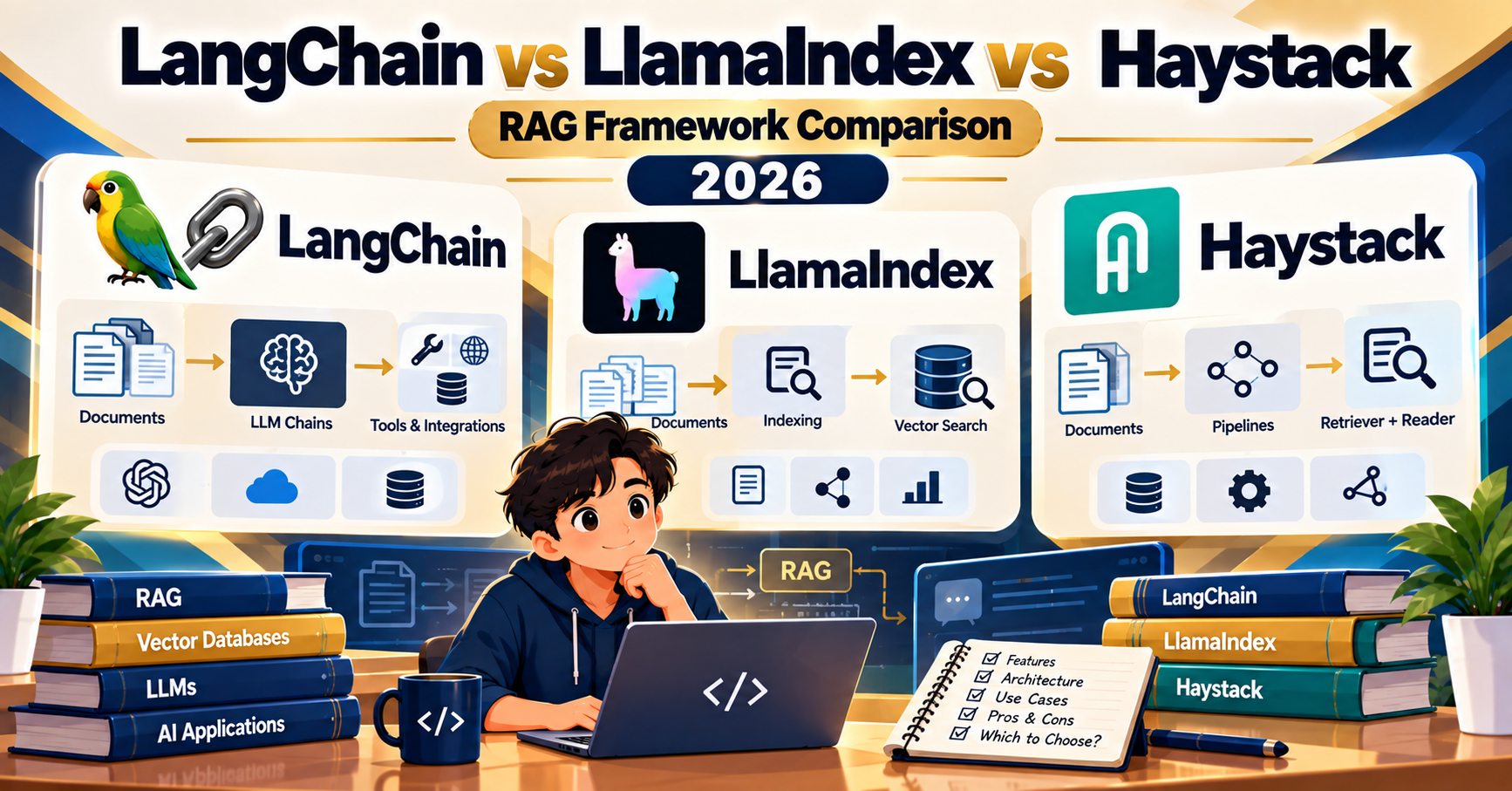
LangChain is the general-purpose LLM orchestration framework. It gives you abstractions for chains, agents, tools, memory, and retrievers. Its scope is wide, which is both its strength (do almost anything) and its weakness (lots of layers to learn). As of September 2026 the main package has split into LangChain Core, LangChain Community, and provider-specific packages (langchain-openai, langchain-anthropic, langchain-google-genai) to keep dependencies clean.
LlamaIndex is retrieval-first. The framework was built around indexing, embedding, and retrieval, with LLM calls bolted on as consumers of retrieved context. If your product is dominantly RAG (search over documents, answer questions, cite sources) and you want a framework that treats retrieval as the main event rather than a plug-in, LlamaIndex feels purpose-built for the job.
Haystack is production-first. Developed by deepset, it treats pipelines as first-class citizens with YAML-driven configuration, structured components, and strong typing. It is the most opinionated of the three about shape and the most comfortable one to hand to a platform team that wants to review your RAG system like any other microservice.
Learning curve and first-week experience
The first-day developer experience is the clearest difference between these three.
LlamaIndex is the fastest to a working demo. Three lines of code load documents, index them, and expose a query engine. The default settings pick reasonable chunk sizes and a decent embedding model. A new developer can show their manager a working RAG prototype in under 20 minutes.
LangChain takes longer because it exposes more concepts. You pick a loader, a splitter, an embedder, a vector store, a retriever, a prompt template, and a chain. All of those are explicit. The payoff is flexibility, but a first-day developer sees more code and more imports.
Haystack sits in the middle. The pipeline abstraction forces you to think about components and their connections before you run anything, which slows the first demo but gives you a mental model that holds up better as the system grows.
Feature coverage in 2026
- Document loaders: LangChain has the most (over 160 built-in loaders). LlamaIndex has around 100 but covers the common cases. Haystack has about 40 but each is well-tested.
- Vector stores: All three support Pinecone, Weaviate, Qdrant, Chroma, and pgvector. LangChain supports the longest tail of niche stores.
- Agents: LangChain’s agent abstractions are the most developed, with LangGraph as the production framework. LlamaIndex ships ReAct agents and workflow agents. Haystack added agents in 2.x but they still feel like an addition rather than a core concept.
- Observability: LangChain integrates with LangSmith (its own paid product) and OpenTelemetry. LlamaIndex integrates with Arize, LangFuse, and OpenTelemetry. Haystack integrates with the deepset Cloud and OpenTelemetry.
- Streaming: All three support streaming for standard LLM calls. LangGraph has the richest streaming primitives for multi-step agent flows.
Code comparison: load, index, query
The same minimal RAG task in each framework, using an OpenAI embedding model and GPT-4o:
LlamaIndex
from llama_index.core import VectorStoreIndex, SimpleDirectoryReader

docs = SimpleDirectoryReader("./docs").load_data()
index = VectorStoreIndex.from_documents(docs)
query_engine = index.as_query_engine()
response = query_engine.query("What is our refund policy?")
print(response)
LangChain
from langchain_community.document_loaders import DirectoryLoader
from langchain_openai import OpenAIEmbeddings, ChatOpenAI
from langchain_community.vectorstores import FAISS
from langchain.chains import RetrievalQA

loader = DirectoryLoader("./docs")
docs = loader.load()
vector_store = FAISS.from_documents(docs, OpenAIEmbeddings())
qa = RetrievalQA.from_chain_type(
    llm=ChatOpenAI(model="gpt-4o"),
    retriever=vector_store.as_retriever(),
)
print(qa.invoke("What is our refund policy?"))
Haystack
from haystack import Pipeline
from haystack.components.converters import TextFileToDocument
from haystack.components.embedders import OpenAIDocumentEmbedder, OpenAITextEmbedder
from haystack.components.retrievers import InMemoryEmbeddingRetriever
from haystack.components.generators import OpenAIGenerator
from haystack.document_stores.in_memory import InMemoryDocumentStore

store = InMemoryDocumentStore()
pipeline = Pipeline()
pipeline.add_component("embedder", OpenAITextEmbedder())
pipeline.add_component("retriever", InMemoryEmbeddingRetriever(document_store=store))
pipeline.add_component("generator", OpenAIGenerator(model="gpt-4o"))
pipeline.connect("embedder.embedding", "retriever.query_embedding")
pipeline.connect("retriever.documents", "generator.documents")
result = pipeline.run({"embedder": {"text": "What is our refund policy?"}})
print(result["generator"]["replies"][0])
LlamaIndex gets you to a working query in six lines. LangChain is roughly double. Haystack is longer still because it is building a reusable pipeline you can serialize to YAML and deploy.
Production deployment considerations
LangChain ships LangGraph for production agents and LangServe for FastAPI deployment. LangSmith (paid) handles tracing and evaluation. The split-package architecture introduced in 2024 and matured in 2025 keeps your production dependency tree small as long as you install only the provider packages you need.
LlamaIndex ships workflows for structured multi-step logic, and LlamaCloud (paid) for managed indexing. Observability integrations are solid. The weakness is that LlamaIndex’s abstractions can feel loose in a large codebase; nothing stops a team member from mixing styles across files.
Haystack deployments feel the most like regular backend services. Pipelines serialize to YAML, components have strict input and output types, and deepset Cloud offers one-click deployment. If your organization treats machine learning like any other software (linters, PR reviews, SLOs), Haystack fits that culture most naturally.
Community and ecosystem
GitHub star counts in September 2026:
- LangChain: approximately 110K stars
- LlamaIndex: approximately 40K stars
- Haystack: approximately 20K stars
Stack Overflow and tutorial volume follow a similar ordering. If your team will Google problems, LangChain gives you the deepest well. LlamaIndex has caught up fast on retrieval topics specifically. Haystack has a smaller but very active forum tied to deepset.
Which to pick for your use case
- Fast RAG prototype or hackathon project: LlamaIndex. Working demo in 20 minutes.
- Multi-step agent system: LangChain plus LangGraph. The agent abstractions are the most developed in 2026.
- Enterprise RAG with platform team review: Haystack. YAML pipelines and strict typing survive code review.
- You need every exotic data source: LangChain’s loader catalog is still unbeaten.
- Your team already knows one of them: stay. Switching frameworks mid-project costs a week of refactoring and buys little.
Frequently Asked Questions
Which RAG framework is best for beginners in 2026?
LlamaIndex. Three lines of code load documents, build an index, and run queries. Beginners see a working result fast, which keeps motivation high. LangChain’s extra concepts (loaders, splitters, retrievers, chains) make it slower to the first demo.
Can I use LangChain and LlamaIndex together?
Yes. The two frameworks interoperate well in 2026. A common pattern is LlamaIndex for the retrieval layer (indexing, embedding, vector store) and LangChain for the orchestration layer (chains, agents, tool calls). Both maintain documented integration helpers.
Which framework has the best agent support?
LangChain with LangGraph in September 2026. LangGraph treats agents as state machines, which makes multi-step flows debuggable in a way that LlamaIndex’s workflows and Haystack’s agent pipelines are still catching up to.
Is Haystack still maintained in 2026?
Yes, actively. deepset ships regular updates and the 2.x architecture introduced in 2024 is the production path forward. Haystack has a smaller community than LangChain but strong institutional backing from deepset’s enterprise business.
Which framework works best with LangSmith?
LangChain, obviously, since both are from the same company. LangSmith integrates with LlamaIndex and Haystack through OpenTelemetry but the first-class experience is reserved for LangChain and LangGraph pipelines.
How much do these frameworks cost?
All three are open source and free to use. Paid tiers exist for managed services: LangSmith for LangChain observability, LlamaCloud for managed indexing, and deepset Cloud for Haystack deployment. You can run any of them in production without paying the framework vendor.
Official documentation

Adones Evangelista
Programmer & Technical Writer at PIES IT Solution
Adones Evangelista is a programmer and writer at PIES IT Solution, author of over 900 tutorials and error-fix guides at itsourcecode.com. Specializes in JavaScript, Django, Laravel, and Python error debugging covering ValueError, TypeError, AttributeError, ModuleNotFoundError, and RuntimeError, plus C/C++ and PHP capstone projects for BSIT students.
Expertise: JavaScript, Python, Django, Laravel, Error Debugging, C/C++ · View all posts by Adones Evangelista →