
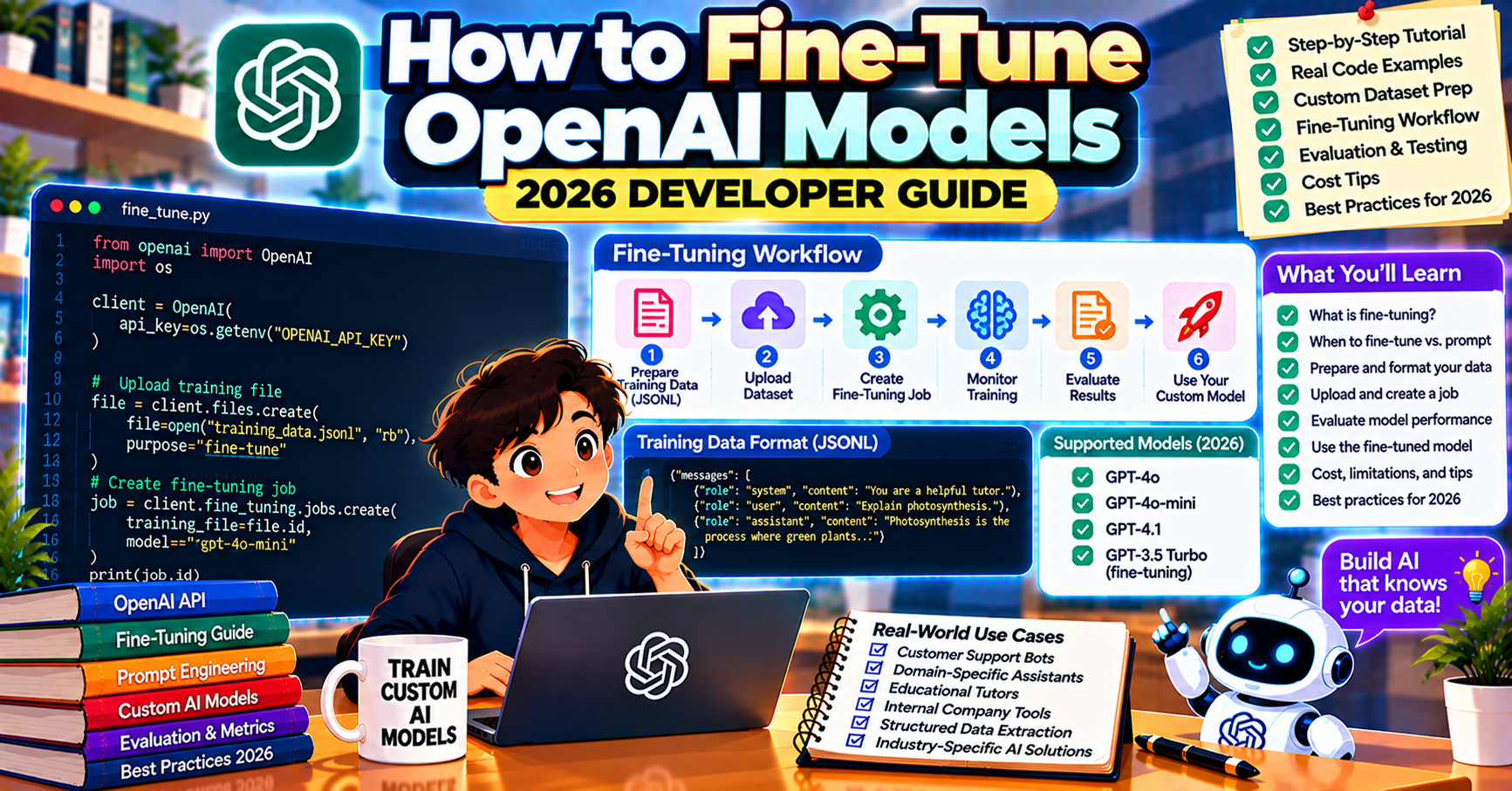
Fine-tuning OpenAI models used to be exotic. In 2026 it has become a standard part of the production AI stack when prompt engineering runs out of runway. This guide walks through what fine-tuning actually does, when it beats a long prompt, what it costs in 2026, and how to run your first fine-tune in under an hour using the OpenAI API.
What fine-tuning actually does
Fine-tuning takes a base model (GPT-4o, GPT-4o-mini, GPT-5-mini) and continues its training on your examples. The result is a new model that behaves more like your examples. You keep the base model’s general capability and layer your pattern on top.
Three concrete things fine-tuning gives you that prompting cannot:
- Consistent output format: the model emits exactly the structure you need, every time, without needing few-shot examples in every prompt.
- Lower per-call latency: no long few-shot block to process. Fine-tuned prompts can be 10% to 25% of the token count of the equivalent few-shot prompt.
- Internalized domain style: medical, legal, support ticket, or brand voice patterns stick in the model instead of being re-explained per call.
When to fine-tune vs when to prompt
Default to prompting. Fine-tune only when one of these is true:
- Your prompt has 5+ examples that eat context on every call
- You run 100K+ calls per month and token cost matters
- You need output in a very specific format that keeps drifting with prompting alone
- Your use case has a specialized vocabulary (medical codes, legal citations, internal jargon) the base model does not know well
- Latency matters and you cannot afford the few-shot prompt time
Fine-tuning is NOT the right tool for:
- Adding new factual knowledge (use RAG for that)
- One-off experiments (prompting is faster)
- Tasks where you need the model’s full reasoning capability (fine-tuning can narrow it)
Cost in 2026
OpenAI pricing for fine-tuned models (September 2026):
- Training: $25 per million tokens of training data (gpt-4o-mini), $90 per million (gpt-4o)
- Inference: $0.30 input / $1.20 output per million tokens for fine-tuned gpt-4o-mini (2x base price)
- Hosting: $0 (OpenAI hosts the fine-tuned model for you)
A typical fine-tune with 500 training examples (around 500K tokens total) on gpt-4o-mini costs around $12.50 to train. Inference costs 2x the base model but is still cheap on gpt-4o-mini scale. If you run 100K requests per month at 500 input tokens and 200 output tokens each, your monthly inference bill is around $39 on the fine-tuned mini vs $19 on the base mini. For most production workloads the 2x premium is worth it for the quality gain.
Prepare your training data
Fine-tuning data is a JSONL file. Each line is one conversation example in the chat format:
{"messages": [{"role": "system", "content": "You are a technical support classifier."}, {"role": "user", "content": "The app crashes when I try to export."}, {"role": "assistant", "content": "{\"category\": \"bug\", \"severity\": \"high\", \"product_area\": \"export\"}"}]}
{"messages": [{"role": "system", "content": "You are a technical support classifier."}, {"role": "user", "content": "How do I change my password?"}, {"role": "assistant", "content": "{\"category\": \"how_to\", \"severity\": \"low\", \"product_area\": \"account\"}"}]}
Rules of thumb for the dataset:
- Minimum: 50 examples (OpenAI requires at least 10). Below 50, the fine-tune usually does not improve meaningfully over few-shot.
- Sweet spot: 200 to 500 examples.
- More is not always better: 2000 examples with the same pattern is no better than 500 and costs 4x to train.
- Keep the system prompt in every example and keep it short. Fine-tuned models work with the same system prompt at inference time.
- Hold back 10% of examples for a validation set.
Run the fine-tune
from openai import OpenAI
client = OpenAI()

# Upload training file
training_file = client.files.create(
    file=open("tickets_train.jsonl", "rb"),
    purpose="fine-tune",
)

validation_file = client.files.create(
    file=open("tickets_val.jsonl", "rb"),
    purpose="fine-tune",
)

# Start the fine-tune job
job = client.fine_tuning.jobs.create(
    training_file=training_file.id,
    validation_file=validation_file.id,
    model="gpt-4o-mini-2024-07-18",
    hyperparameters={"n_epochs": "auto"},
    suffix="support-classifier-v1",
)
print(f"Fine-tune job started: {job.id}")
# Poll with client.fine_tuning.jobs.retrieve(job.id) or watch the dashboard
Fine-tunes typically finish in 10 minutes to 2 hours depending on dataset size and queue. When the job succeeds, OpenAI emails you and the fine-tuned model id (something like ft:gpt-4o-mini-2024-07-18:your-org:support-classifier-v1:A1B2C3D4) appears in your dashboard.
Use the fine-tuned model
response = client.chat.completions.create(
    model="ft:gpt-4o-mini-2024-07-18:your-org:support-classifier-v1:A1B2C3D4",
    messages=[
        {"role": "system", "content": "You are a technical support classifier."},
        {"role": "user", "content": "My invoice total looks wrong this month."},
    ],
)
print(response.choices[0].message.content)
# {"category": "billing", "severity": "medium", "product_area": "invoicing"}
Same API, different model id. Your application code barely changes.
Evaluate the fine-tuned model against the base
Fine-tuning is not automatically better. You MUST compare the fine-tuned model against the base model with a few-shot prompt on the same test set. Run both on your validation set and measure accuracy, F1, format compliance, or whatever metric matters.
Rule of thumb: if the fine-tuned model is not at least 10% better than the base on your metric, keep prompting. The complexity cost of maintaining a fine-tuned model (retraining as data drifts, versioning, A/B testing) is not worth less than 10% improvement.
Common gotchas
- System prompt mismatch: if you train with one system prompt and infer with a different one, output quality drops. Keep them identical.
- Data leakage: do not include your test examples in training data. Hold a strict holdout set.
- Overfitting to format: if all 500 training examples use the same 3 categories, the fine-tune will refuse to predict a new category. Include edge cases in training if you want the model to handle them.
- Base model drift: when OpenAI updates the base gpt-4o-mini, your fine-tuned model stays on the old base. Plan to re-fine-tune every 6 to 12 months to pick up base-model improvements.
Frequently Asked Questions
Can I fine-tune GPT-5 or Claude Opus 5.5?
Fine-tuning for GPT-5 was announced in late 2025 and is in limited preview as of September 2026. Claude fine-tuning is available through AWS Bedrock for Claude Sonnet 5 (not Opus). For most teams in 2026, fine-tuning GPT-4o or gpt-4o-mini is the production-ready path; frontier model fine-tuning is still gated behind applications.
How many examples do I actually need?
50 is the floor where fine-tuning starts to beat few-shot prompting. 200 to 500 is the sweet spot where quality is strong without wasting training budget. Beyond 1000 examples, improvement is incremental and training cost doubles.
Can I fine-tune on my proprietary data without OpenAI training on it?
Yes. OpenAI’s fine-tuning explicitly does not use your data to train base models. Your fine-tuned model is private to your organization. For regulated industries, OpenAI Enterprise also offers zero-retention fine-tuning where training data is not stored after the job completes.
How do I version my fine-tuned models?
Use the suffix parameter at job creation to version the model (support-classifier-v1, support-classifier-v2). Keep each version live for 2 to 4 weeks in parallel so you can A/B test and roll back if the new one regresses on production traffic.
Will fine-tuning make the model worse at other tasks?
It can. If you fine-tune heavily on one narrow task, the model becomes less flexible for other tasks. If your application only uses the model for that one task, this is fine. If the same model needs to handle other tasks too, keep the base model and fine-tune only for the narrow task.
Can I use fine-tuning instead of RAG?
No. Fine-tuning teaches patterns and formats; it does not add factual knowledge the model can retrieve on demand. For current information, product catalogs, legal citations, or anything that changes over time, use RAG. For style, voice, and output format, use fine-tuning. Many production systems use both.