
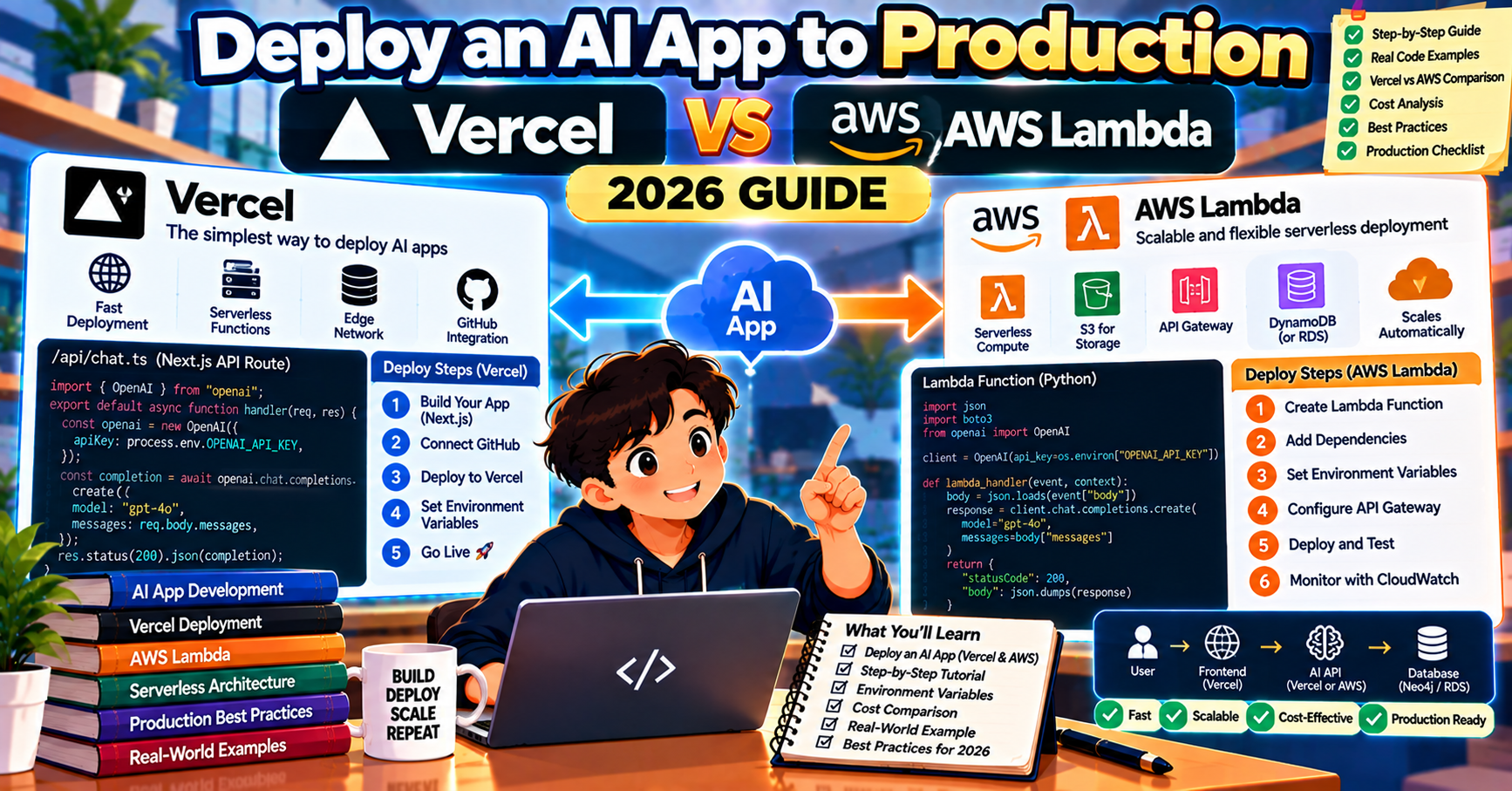
You have a working AI prototype. Now it needs to live on the internet. The two most common serverless deployment targets for AI applications in 2026 are Vercel and AWS Lambda. They solve the same problem (run your code without managing servers) but they are optimized for different shapes of workload. This article compares them on the dimensions that matter for AI apps: cold starts, LLM streaming, timeouts, costs at scale, and operational burden.
What each platform is for
Vercel is a frontend-first platform that has grown into a full application runtime for Next.js, SvelteKit, and other modern web frameworks. In 2026 it ships three runtimes: Edge Functions (V8 isolates, very fast cold starts, 25 ms CPU limit per invocation), Serverless Functions (Node.js and Python, 10-second default timeout), and Fluid Compute (a 2025 release that keeps a warm process alive between invocations, cutting cold starts to near zero at low cost).
AWS Lambda is the general-purpose serverless compute from AWS. Supports every major language, deep integration with the rest of AWS (S3, DynamoDB, SQS, Step Functions), 15-minute max timeout, and sophisticated controls over memory, concurrency, and provisioned concurrency for cold-start mitigation. Response Streaming (added 2023, matured through 2024-2025) is now the standard for LLM-backed Lambda functions.
Cold starts
LLM API calls are expensive and users tolerate seconds of waiting. Cold start is still worth caring about because the first user to hit your endpoint after a quiet period gets the worst experience.
- Vercel Edge: 50 to 150 ms cold start. Fast enough that users do not notice.
- Vercel Fluid Compute: effectively zero cold start under normal traffic. First invocation after extended idle is around 500 ms.
- Vercel Serverless (Node.js): 300 to 800 ms cold start.
- AWS Lambda (Node.js, 512 MB): 400 ms to 1.5 s cold start. Provisioned concurrency eliminates this at a flat hourly cost.
- AWS Lambda (Python, 1 GB): 1 to 3 s cold start for heavier dependencies (torch, transformers). Dependency size dominates.
For LLM apps where the first-token latency from the LLM provider is already 400 ms to 1.5 s, a 1-second cold start is noticeable but survivable. Vercel wins on frontend-latency-sensitive user flows; Lambda with provisioned concurrency wins when you can predict load.
Streaming support
LLM responses stream over tens of seconds. Your deployment target needs to pass that stream through to the browser without buffering.
Vercel supports streaming natively in all three runtimes. The Next.js App Router has first-class streaming support built in. If your frontend is Next.js, you can wire a streamed LLM response to the browser in a few lines of code using the Vercel AI SDK.
AWS Lambda supports streaming through Response Streaming, which uses chunked transfer encoding over Lambda Function URLs or API Gateway WebSocket. The setup is more work than Vercel’s defaults but it is fully supported in 2026. The Lambda Web Adapter extension makes it easier if you already have an Express or FastAPI app.
Timeouts
Long LLM calls (chain-of-thought, agent loops) can take minutes. Timeouts matter.
- Vercel Edge: 25 ms CPU limit (streams can last longer, CPU-bound work cannot)
- Vercel Serverless (Hobby): 10 seconds default, 60 seconds max
- Vercel Serverless (Pro): 60 seconds default, 300 seconds max
- Vercel Fluid Compute: 800 seconds max on paid plans
- AWS Lambda: 15-minute max timeout, configurable per function
For single LLM calls, Vercel Pro or Fluid Compute is enough. For multi-step agents or long RAG pipelines, AWS Lambda’s 15-minute ceiling buys more headroom. Beyond 15 minutes, both platforms want you to use a workflow service (Vercel Workflow in 2026, AWS Step Functions since launch).
Pricing comparison
For a typical AI chat endpoint handling 100,000 requests per month, 2 seconds average duration, 512 MB memory, with 100 KB request and 20 KB response:
- Vercel Pro: around $20 per month base, usage typically covered under the pro plan allowance until well past 100K requests
- AWS Lambda: approximately $4.17 per month in compute, plus $0.02 for requests, plus data transfer
Lambda is cheaper on raw compute. Vercel wins on developer time saved. For most startups, the Vercel premium is paid back on the first day you did not spend configuring API Gateway, CloudFront, and IAM roles.
Code example: streaming LLM response
Vercel (Next.js App Router)
// app/api/chat/route.ts
import { streamText } from "ai";
import { openai } from "@ai-sdk/openai";

export async function POST(req: Request) {
  const { messages } = await req.json();
  const result = streamText({
    model: openai("gpt-4o"),
    messages,
  });
  return result.toDataStreamResponse();
}
AWS Lambda (Python with Response Streaming)
from openai import OpenAI

client = OpenAI()

def handler(event, context):
    stream = client.chat.completions.create(
        model="gpt-4o",
        messages=event["messages"],
        stream=True,
    )
    for chunk in stream:
        if chunk.choices[0].delta.content:
            yield chunk.choices[0].delta.content
Both are short, both work. Vercel’s wrapper (streamText from the AI SDK) handles the data-stream protocol the Next.js frontend expects. Lambda returns the raw stream and your frontend consumes it directly.
Which to pick for your use case
- Next.js frontend: Vercel. Zero friction, fastest to production.
- Python-heavy AI stack (LangChain, LlamaIndex) with team on AWS: Lambda. The AWS ecosystem fit outweighs Vercel’s convenience.
- Chat endpoint with light compute: Vercel Edge or Fluid Compute. Cold start is near zero.
- Multi-minute agent runs: Lambda. The 15-minute timeout headroom matters.
- Multi-tenant SaaS with existing AWS infra: Lambda. Compliance and data-residency usually push toward AWS.
- Side project, prototype, or startup MVP: Vercel. One command deploy, no config.
Frequently Asked Questions
Can I deploy Python AI apps to Vercel?
Yes. Vercel supports Python Serverless Functions in 2026. For a Python-first AI app, keep the business logic in Python and the web layer in Next.js, deployed together on Vercel. The alternative is Vercel’s Python runtime hosting a FastAPI app directly.
Does Vercel Fluid Compute replace AWS Lambda?
For many web-facing AI apps, yes. Fluid Compute keeps a process warm between invocations, which eliminates most cold starts and reduces per-request cost on bursty traffic. It does not replace Lambda for batch processing, event-driven backend work, or anything that needs the broader AWS ecosystem.
What about Cloudflare Workers for AI apps?
Cloudflare Workers are an excellent third option in 2026, especially for edge-latency-sensitive apps and global distribution. The 128 MB memory limit on Workers (lifted to 512 MB on paid plans) and 30-second CPU time cap make them less suited for heavy Python ML workloads but perfect for lightweight LLM API proxying.
Which has better observability?
AWS Lambda plus CloudWatch is the industry standard; the data is granular and integrates with every observability tool. Vercel’s observability improved significantly in 2025 and 2026 with Vercel Observability and the Vercel integration for Datadog, Sentry, and OpenTelemetry. For a startup, Vercel is enough. For a regulated enterprise, Lambda’s auditability wins.
How do I handle long-running AI workflows beyond 15 minutes?
Use a workflow service. AWS Step Functions is mature and well-documented. Vercel Workflow (2026 release) targets the same pattern with first-class Next.js integration. Both let you decompose a long task into checkpoints that run as separate function invocations with durable state in between.
Can I deploy LangGraph or CrewAI agents to these platforms?
Yes to both. LangGraph has official deployment guides for Vercel (via Next.js) and AWS Lambda (via Lambda Web Adapter). CrewAI deploys the same way as any Python application. For agents that run longer than the serverless timeout, use workflow decomposition or move to a container service (Vercel Fluid, AWS Fargate).