
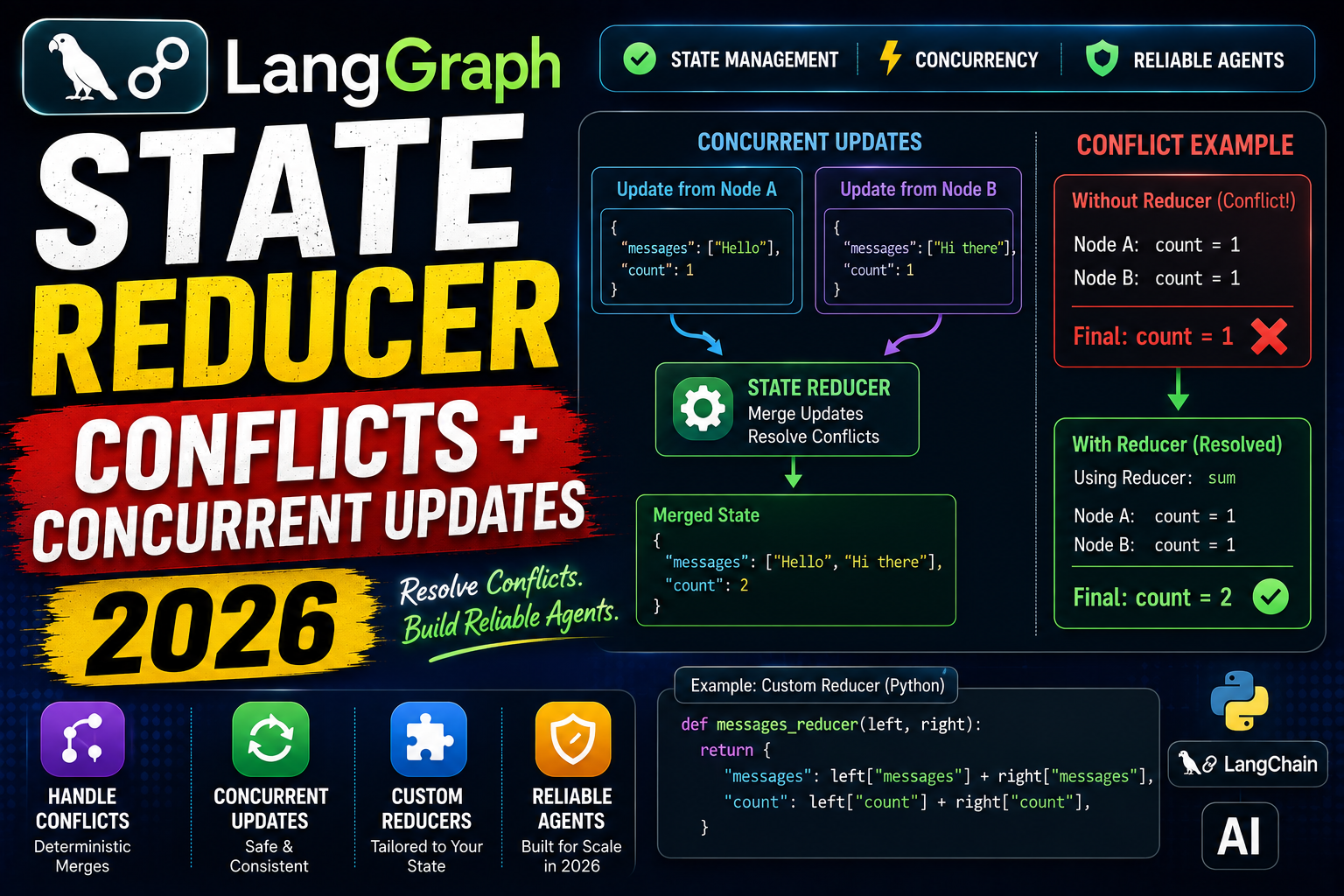
LangGraph tracks agent state through a typed dict updated by nodes. When two parallel nodes both update the same field, the default reducer replaces the value causing lost updates. Symptoms include disappearing messages, empty tool_calls arrays, and inconsistent state after fan-out. The fix is picking the correct reducer per field. Here is the complete 2026 guide.
Why reducer conflicts happen
Every field in your LangGraph state has an implicit or explicit reducer function. Default: last-write-wins (the value replaces the previous). This is fine for single-writer graphs but breaks under fan-out. For any field where two parallel nodes might contribute, you MUST annotate with a merge reducer.
Fix 1: use add_messages for chat history
from typing import TypedDict, Annotated
from langgraph.graph import StateGraph, END
from langgraph.graph.message import add_messages
from langchain_core.messages import HumanMessage, AIMessage

class State(TypedDict):
    # WRONG: default reducer replaces the full list each turn
    # messages: list

    # CORRECT: add_messages APPENDS new messages
    messages: Annotated[list, add_messages]

def node_a(state: State):
    return {"messages": [AIMessage(content="from A")]}

def node_b(state: State):
    return {"messages": [AIMessage(content="from B")]}

# Both nodes' messages preserved when running in parallel
builder = StateGraph(State)
builder.add_node("a", node_a)
builder.add_node("b", node_b)
builder.add_edge("__start__", "a")
builder.add_edge("__start__", "b")
builder.add_edge("a", END)
builder.add_edge("b", END)
graph = builder.compile()
Fix 2: operator.add for list accumulation
from operator import add
from typing import TypedDict, Annotated

class State(TypedDict):
    query: str
    # Any list where multiple nodes append works with operator.add
    search_results: Annotated[list, add]
    citations: Annotated[list, add]

def search_google(state: State):
    return {"search_results": [{"source": "google", "snippet": "..."}]}

def search_bing(state: State):
    return {"search_results": [{"source": "bing", "snippet": "..."}]}

# Both search_results preserved after parallel fan-out
Fix 3: custom reducer for dict merging
from typing import TypedDict, Annotated

def merge_dicts(left: dict, right: dict) -> dict:
    """Deep-ish merge: right overrides left on conflict."""
    return {**left, **right}

class State(TypedDict):
    query: str
    # Each parallel node contributes different keys to metadata
    metadata: Annotated[dict, merge_dicts]

def get_user_metadata(state: State):
    return {"metadata": {"user_id": "u_42", "tier": "pro"}}

def get_source_metadata(state: State):
    return {"metadata": {"source_count": 3, "query_ms": 120}}

# Metadata will have all 4 keys after parallel execution
Fix 4: last-write-wins is correct for single fields
from typing import TypedDict, Annotated
from operator import add

class State(TypedDict):
    # Fine with default: user query only set once
    query: str

    # Fine with default: iteration counter overwritten each turn
    turn_count: int

    # Needs reducer: messages accumulate across turns
    messages: Annotated[list, add]

    # Needs reducer: findings from multiple parallel researchers
    findings: Annotated[list, add]
Debugging checklist
- List every field in your State TypedDict. For each, ask “can two parallel nodes update this?” If yes, add a reducer.
- For messages: always use
add_messages. It handles append + dedup by ID. - For lists:
operator.addconcatenates. Fine when you want all values. - For dicts: write a custom reducer (deep merge, or key-wise merge with conflict rules).
- For scalars: default replace is usually fine unless you need a “max seen” or similar aggregation.
Common mistakes with state reducers
- Assuming lists append by default. They do not. Annotate with
operator.addoradd_messages. - Using
add_messageson non-message lists. add_messages expects LangChain Message objects and does message-specific dedup. Useoperator.addfor arbitrary lists. - Custom reducer that has side effects. Reducers must be pure functions. Side effects break checkpointing and resume.
- Not testing parallel execution. Reducer bugs only surface under fan-out. Add tests that trigger parallel branches.
Debugging checklist for the SDK/library error
Before diving into fixes, run through this diagnostic checklist. Nine times out of ten the answer surfaces here.
- Read the full traceback, not just the error message. The stack trace shows exactly which line and which call chain triggered the error. The last line names the immediate cause; earlier lines show how you got there.
- Add print or debug statements just before the failing line. Print the variable, its type, and its value. Nine out of ten error surprises come from the value being different from what you assumed.
- Check Python version compatibility. Errors sometimes result from APIs that changed between versions. Run your interpreter version check and compare against the library documentation for that version.
- Isolate the failing call in a minimal reproducer. Copy the failing line into a small standalone script with hardcoded inputs. If it fails there too, the bug is in your code. If not, something in your surrounding context is contributing.
- Search the exact error message. Include the class name and the specific text in your search. Chances are someone else hit the same issue and the fix is documented on Stack Overflow or the library’s GitHub issues.
Common causes for the SDK/library error
Most instances of this error trace back to one of these root causes:
- Uninitialized or missing input. A variable was not populated before use, or the input source (file, API response, database row) did not contain the expected key or value.
- Type mismatch. The code expected a specific type (dict, list, string) but received something different. Python’s dynamic typing means this often surfaces at runtime, not at compile time.
- Version drift. The library API changed and your code assumes the old signature. Check the library’s changelog for breaking changes since the version you last used.
- Race condition or ordering issue. Async or concurrent code sometimes tries to access data before it is ready. Add awaits, locks, or explicit ordering to fix.
- Copy-paste from stale tutorial. Older tutorials may use APIs that no longer exist. Always check the official docs for the current version.
Testing and prevention
Preventing this class of error from recurring is more valuable than fixing it once. Build these habits into your workflow:
- Write tests that trigger the error path. If your test suite hits the error scenario, catch and assert it. A well-written test prevents the same bug from returning.
- Validate inputs at API boundaries. When data enters your code from external sources (HTTP requests, file uploads, database queries), validate structure and types immediately.
- Use type hints and static analysis. Tools like mypy for Python or TypeScript for JavaScript catch many type mismatches before you run the code.
- Log important state. Structured logging with context helps you debug production issues faster. Include enough context to reconstruct what happened.
- Read the library changelog. Before upgrading a dependency, skim the changelog for breaking changes. Two minutes of reading saves an hour of debugging.
When to ask for help
Some errors are worth solving yourself for the learning. Others are worth asking about early. Ask for help when: the error blocks a customer-facing feature, you have spent an hour without progress, the error involves security or data integrity, or you are unsure whether your fix will introduce new bugs. Post to Stack Overflow with a minimal reproducer, or ask a senior developer on your team. Time boxes are your friend.
Official documentation
Frequently Asked Questions
Do reducers need to be pure functions?
Yes. LangGraph relies on determinism for checkpointing and resume. Side effects in reducers cause state corruption on resume.
Can I have per-node reducers?
No. Reducers are per-field, not per-node. If two nodes need different merge semantics on the same field, split into two fields.
Does add_messages dedup by ID?
Yes. If you emit the same message ID twice, only one is kept. This matches OpenAI/Anthropic message ID semantics.
Can I use immutable data structures?
Yes and encouraged. Return new lists and dicts from nodes rather than mutating. LangGraph’s checkpointer preserves immutable snapshots.
What about scalar fields with race conditions?
Last-write-wins may be wrong. Write a custom reducer like max or min. Or move the field to per-node state so no cross-write occurs.

Adrian Mercurio
Full-Stack Developer at PIES IT Solution
Specializes in building complete capstone projects with full documentation. Strong background in PHP/MySQL development and database design.
Expertise: PHP · Laravel · Database Design · Capstone Projects · C# · C · View all posts by Adrian Mercurio →