
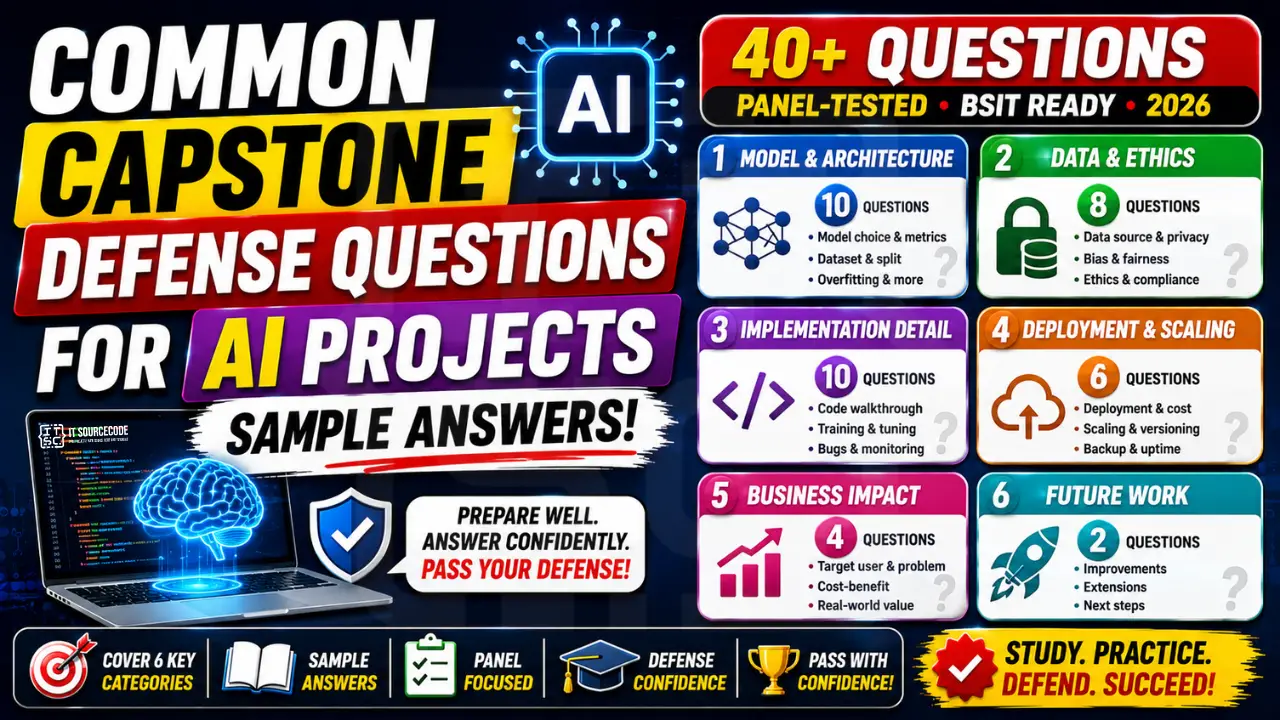
AI capstone defense panels in 2026 ask harder questions than they did in 2022, because they have seen 4 years of AI projects and learned which student demos are “real” vs “GPT wrapper.” This guide is 40+ panel-tested questions across 6 categories, each with a sample answer template you can adapt.
If you can answer all 40 confidently, you will pass. If you stumble on 5+, study those before defense day.
📌 Defense-prep strategy: Print this page. Highlight every question you cannot answer in 1 minute without notes. Practice those out loud 3x. The panel will pick from these 40, and the ones you cannot smoothly answer are the ones they will dig into.
Category 1: Model & Architecture (10 questions)
- Why did you choose this specific model (e.g. YOLOv8, BERT, GPT-4o-mini)?
Sample answer: “We evaluated 3 candidates (X, Y, Z) on our test set. Model A scored 89% accuracy vs Y at 84% and Z at 80%. A also had the smallest model size (45MB) for our mobile deployment constraint. Trade-off: slower inference (180ms vs 90ms) which is acceptable for our use case.” - What is the accuracy of your model?
Sample: Quote precision, recall, F1 separately. NEVER just “accuracy.” Panels know that imbalanced datasets make accuracy misleading. - What is your dataset size and source?
Sample: “1,247 images, 70% training (873), 15% validation (187), 15% test (187). Sourced from Kaggle dataset X (open license), supplemented with 200 locally captured samples for domain matching.” - How did you split train/validation/test?
- What loss function and optimizer did you use? Why?
- What is your model’s F1 score? Precision? Recall?
- How did you handle class imbalance?
- Why this architecture instead of a simpler one (logistic regression baseline)?
Sample: “Our baseline logistic regression achieved 71% F1. CNN reached 89%. The 18 percentage point gain justifies the added complexity for our use case.” - What is overfitting? How did you detect and prevent it?
- Could you defend the result without your computer?
Category 2: Data & Ethics (8 questions)
- Where did your training data come from?
- What consent / data privacy considerations apply? (Data Privacy Act of 2012 if you collected PH data)
- What biases might exist in your dataset?
Sample: “Our face dataset is 85% lighter-skinned. We expect lower accuracy on darker skin tones, a known fairness issue in face recognition. For deployment we would need to collect additional samples and re-train.” - How did you handle missing or noisy data?
- Did you anonymize personal data?
- What happens if your model makes a mistake in production?
- How do you ensure your model isn’t harmful or discriminatory?
- Are you compliant with Republic Act 10173 (Data Privacy Act)?
Category 3: Implementation Detail (10 questions)
- Walk us through your code on this slide. (Have your repo open, highlight the 20-line core function)
- How long does inference take per query?
- How much memory / GPU does your model need?
- What framework did you use (PyTorch, TensorFlow, scikit-learn) and why?
- How do you handle API rate limits / OpenAI costs?
- Show us your model training loop.
- How did you tune hyperparameters?
- What was the hardest bug you fixed? (Memorize a real story; panels love this)
- How do you log and monitor production errors?
- What happens if your training data and production data drift apart?
Category 4: Deployment & Scaling (6 questions)
- Where will this be deployed (cloud, on-prem, mobile)?
- What is the cost per inference at scale?
- How does the model update when new data comes in?
- What happens if 1000 users hit the API simultaneously?
- How do you handle versioning of the model in production?
- What’s your backup plan if the model service goes down?
Category 5: Business / Real-World Impact (4 questions)
- Who is your target user and what problem does this solve?
- Do you have a real client / endorsement letter?
- What is the cost-benefit analysis? (“System saves 4 hours/day of manual work, paying for itself in 3 months”)
- How is this different from existing commercial solutions?
Category 6: Future Work (2 questions)
- What would you improve given another semester?
- How would you extend this to multi-language / multi-domain / mobile?
Related Guides
- Capstone Title Defense Tips + Sample Slides
- Capstone Defense Mistakes to Avoid
- 40 ChatGPT Capstone Ideas
- 150 Best Capstone Ideas
Capstone defense preparation checklist
The defense is 30% presentation, 70% preparation. Do these things in the 2 weeks before defense day.
- Rehearse the 15-minute presentation 10+ times. Time each rehearsal — cut anything over target.
- Practice with a mock panel. Have classmates or friends ask hard questions.
- Prepare a backup video of the working system in case the live demo fails.
- Prepare 20+ anticipated questions with rehearsed answers.
- Bring printed slides + backup laptop. Do not depend on venue equipment.
- Dress business formal or business casual. Matches panel expectations.
- Arrive 30 minutes early. Set up the demo environment before the panel arrives.
Common capstone mistakes to avoid
- Copying without attribution. Panels use Turnitin. Cite everything you did not write yourself.
- Over-scoping the project. A well-executed simple system beats a poorly-executed ambitious one.
- Deferring documentation. Documentation quality is a big part of the grade.
- Skipping user testing. Panels ask about user feedback. Have real data.
- Ignoring adviser feedback. Advisers know what the panel will ask.
Recommended free tools for capstone projects
- draw.io / diagrams.net. UML diagrams for Chapter 3.
- Google Docs. Collaboration + version history + adviser comments.
- Zotero or Mendeley. Reference management + auto-formatted citations.
- GitHub. Version control for the source code (also earns E-E-A-T signal on your CV).
- Grammarly. Language + tone check on the documentation.
- Turnitin. Plagiarism check before submission (some schools provide access).
- ChatGPT or Claude. For outline scaffolding — not for writing the actual content.
Where to get more capstone resources
- Capstone project ideas. Browse itsourcecode.com/topics/fyp/ for 140+ tested capstone concepts.
- Working source code. itsourcecode.com/topics/free-projects/ has 1,000+ downloadable projects.
- UML diagrams. itsourcecode.com/uml/ has 300+ free UML examples for Chapter 3.
- ER diagrams. itsourcecode.com/topics/uml/erd/ for database schemas.
Official references
Frequently Asked Questions
How long should my answer be for each defense question?
30-90 seconds. Long enough to show depth, short enough that the panel doesn’t lose patience. Practice with a timer; if your answer goes over 2 minutes, cut it down.
What if I get a question I genuinely don’t know the answer to?
Say so honestly: ‘I’m not 100% sure but my best understanding is…’ or ‘That’s a great question, I’d need to verify, but my initial thought is…’. Never bluff. Panels respect honesty far more than guesses presented as facts.
How can I prepare if my AI capstone uses a third-party API (OpenAI, Anthropic)?
Be ready to defend: (1) Why this provider not the others, (2) Cost projection at scale, (3) What happens if the API changes or shuts down, (4) Data privacy implications of sending data to a third party. These are the most common gotcha questions for API-based AI capstones.
Do I need to show the code during defense?
Have it ready and open in case the panel asks. Most panels don’t read code line-by-line but may ask you to walk through the core function. Pre-select 2-3 ‘showcase’ functions to walk through if asked.
What evaluation metrics should I report for an AI capstone?
Always include: accuracy, precision, recall, F1 (for classification) or MAE/RMSE (for regression) or BLEU/ROUGE (for NLG). Show a confusion matrix and a few qualitative examples of correct vs incorrect predictions. Avoid reporting only training accuracy without test accuracy.
What’s the most common reason capstones fail defense?
Inability to explain WHY a design choice was made. Panels can tell when a student copy-pasted code without understanding it. Practice articulating the reasoning behind every architecture decision, even if the answer is ‘I chose X because the tutorial used X.’

Caren Bautista
Technical Writer at PIES IT Solution
Responsible for crafting clear, well-structured, and beginner-friendly content across the platform. Handles the writing, proofreading, and editorial review of tutorials, guides, and documentation to ensure every article is accurate, readable, and easy to follow.
Expertise: Technical Writing · Content Creation · Documentation · Editorial Writing · JavaScript · TypeScript · Python · Python Errors · HTTP Errors · MS Excel
· View all posts by Caren Bautista →