
Laravel Property Management System Project with Source Code
This Property Management System Project in Laravel is created in Laravel Framework.
This project aims to improve property management transactions by implementing a content management system that could easily update information on the company’s website.
To give their consumers the information they require, the organization now uses a static website.
The difficulty with a static website is that you have to change and update the code base or source code every time you add or amend material.
This method can only be used by people who are familiar with coding and programming. With this type of situation, the organization opted to upgrade its current system.
General Objectives: Property Management System Project in Laravel
The main goal of this project is to convert a static website into a Content Management System so that anyone with no prior programming experience may quickly edit the website’s content.
Specifically:
- Develop a web-based system for property administration that is simple to use in terms of maintaining and managing all properties.
- To create a web-based system that will reduce the time it takes to generate property records.
| ABOUT PROJECT | PROJECT DETAILS |
|---|---|
| Project Name : | Property Management System |
| Project Platform : | Php |
| Programming Language Used: | Laravel Language |
| Developer Name : | itsourcecode.com |
| IDE Tool (Recommended): | Sublime |
| Project Type : | Web Application |
| Database: | MySQL |
| Upload Date and Time: | October 13, 2021 – 4:42pm |
Laravel Property Management System Steps On How To Run The Project
Time needed: 5 minutes
Here are the steps on how to run a Laravel Property Management System Project with Source Code.
- Step 1: Extract file
Next, after you finish downloading the source code, extract the zip file.

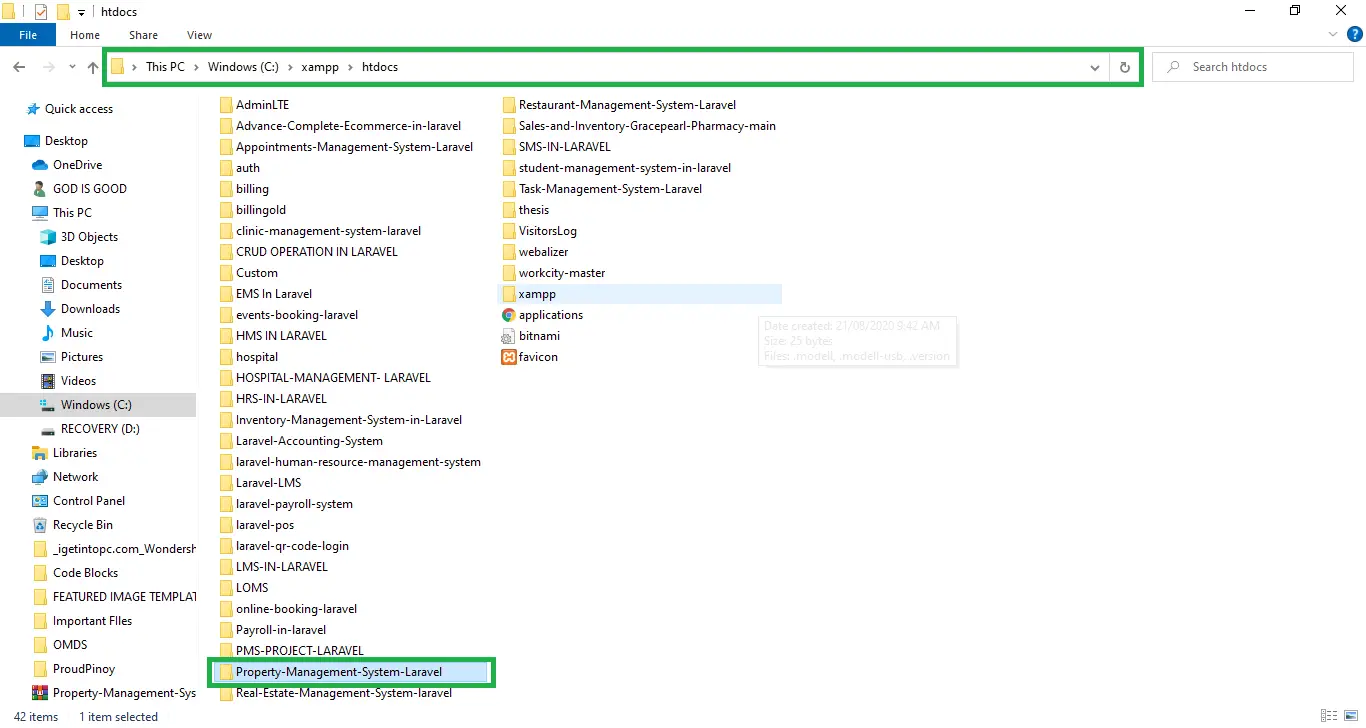
- Step 2: Copy Project Folder
Next, Copy the destination folder to the xampp/htdocs folder.
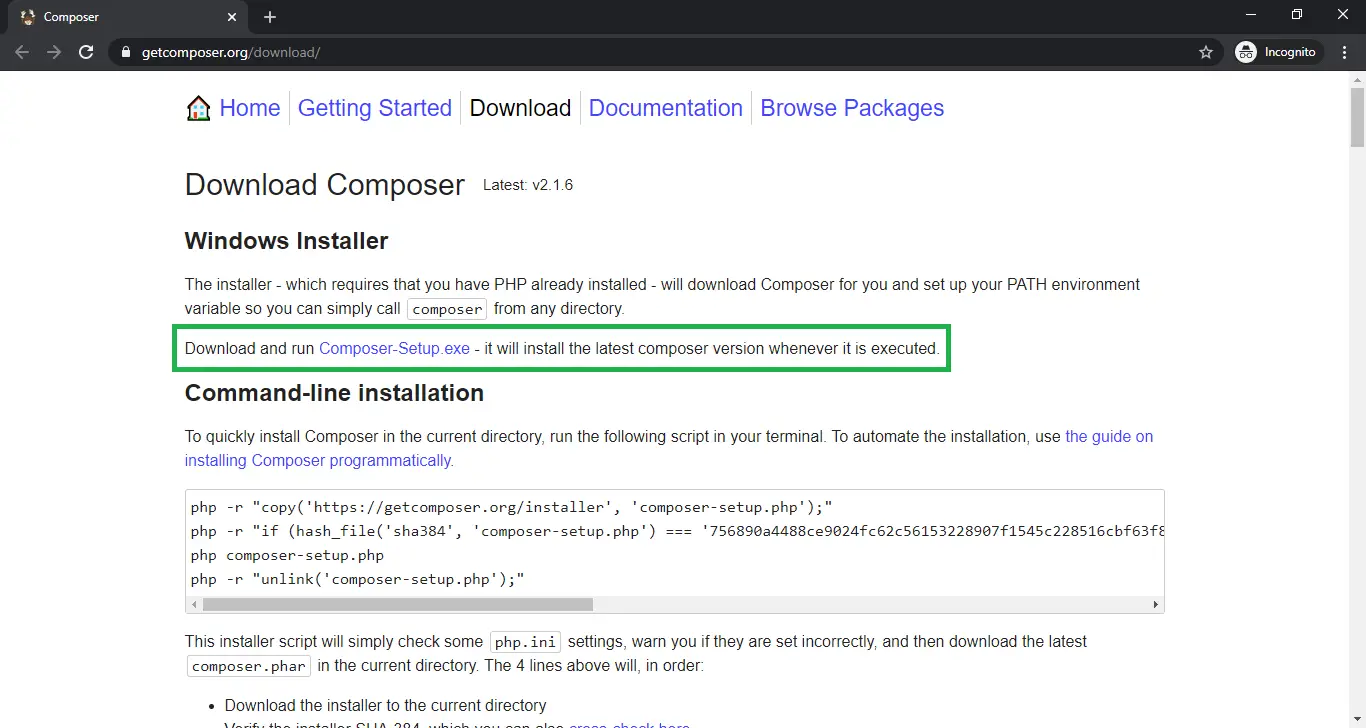
- Step 3: Installed the composer and the Laravel dependencies
Next, You need to install first the Composer and the Laravel libraries.
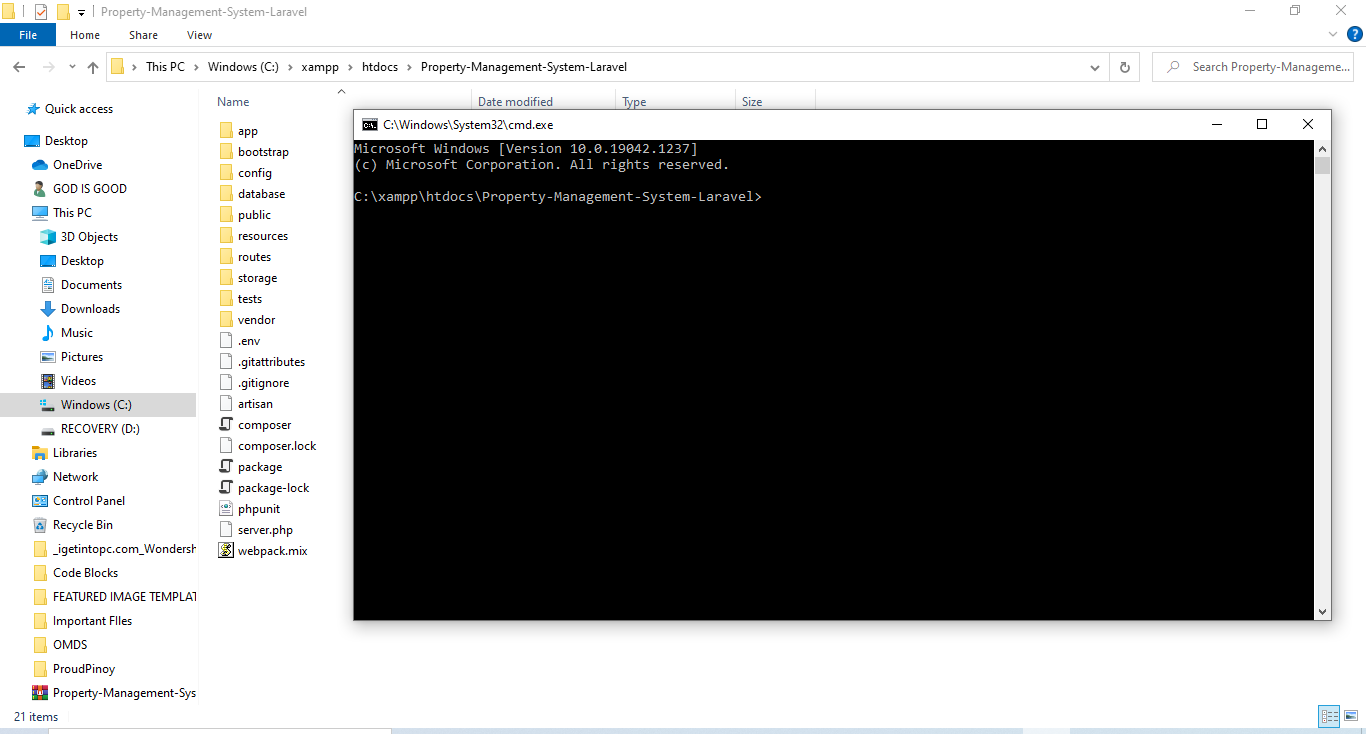
- Step 4: Open Command Prompt
Next, go to the project folder directory then type CMD to open the command prompt.

- Step 5: Composer Install
Next, After you finish installing the composer and the Laravel. now type “composer install” in your command prompt to install the composer dependencies.

- Step 6: php artisan key:generate
Next, then type “php artisan key:generate ” in your command prompt. A command that sets the APP_KEY value in your . env file. By default, Run the following command to have the database tables migrated for you so that you can begin using the system.
- Step 7: Create Database
To install and run the application correctly. Simply go to phpmyadmin and make a new database.
After that, “Be” and rename it to “.env“, then go to connection and modify the default database connection name, only database connection, database username, and password.
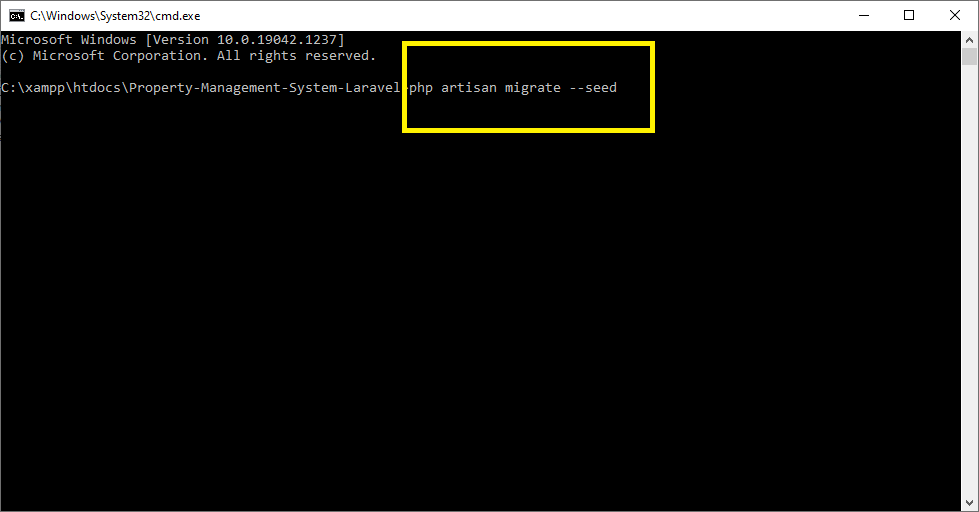
- Step 8: php artisan migrate
After you’ve set up the environment, you’ll need to establish a database configuration for it. Use the following command to create database tables: “php artisan migrate“.
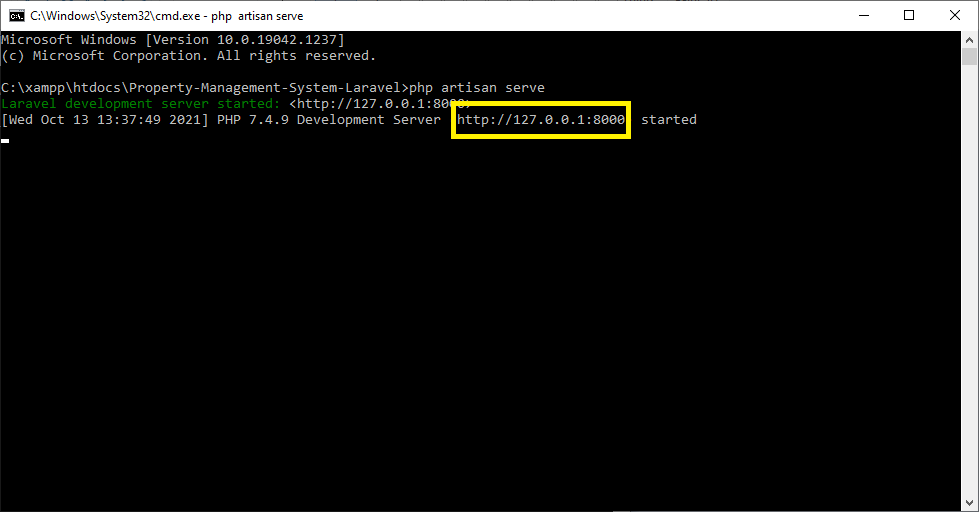
- Step 9: php artisan serve
Lastly, type “php artisan serve” in your command prompt. The purpose of using PHP artisan serve (PHP built-in server) is just for testing and easy starting your project it should not be used in real website deployment.
- Step 10: Copy “http://127.0.0.1:8000/”
In your browser, type the following code to access your project dashboard.
- Step 11: Download the Source Code.
Finally, You are free to download the downloadable source code given below.




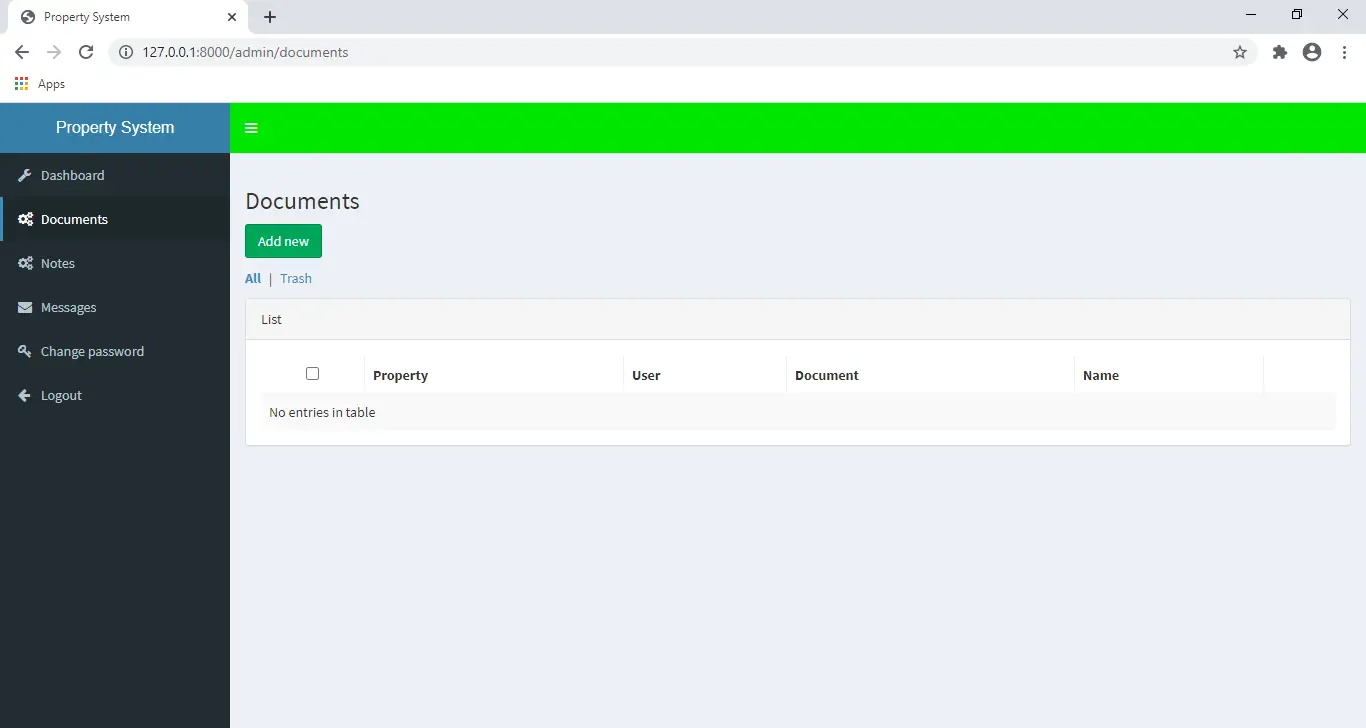
Here are some output images of the system:
Download the Source Code below
Summary
This Laravel Property Management System Project with Source Code is strictly for educational purposes only.
You can use it as a reference and learn more about how to build a system by downloading it. You have complete freedom to change it as you see fit.
Anyway, if you want to level up your programming knowledge, especially Laravel PHP, try this new article I’ve made for you Awesome Laravel Projects With Source Code Free Download.
Technology stack and requirements
To run this PHP project, you need these tools on your development machine:
- XAMPP or WAMP server. Bundles Apache, MySQL, and PHP so you can run PHP on Windows without individual installs. Free from apachefriends.org.
- PHP 8.0 or higher. Included with XAMPP. Older versions (5.x, 7.x) may work but modern PHP features improve security and performance.
- MySQL or MariaDB. Comes with XAMPP. phpMyAdmin manages the database through a browser UI.
- VS Code or PhpStorm. Free code editor with PHP syntax highlighting, IntelliSense, and debugging support.
- Web browser. Chrome, Firefox, or Edge for testing the running app.
Installing the source code
- Download the archive. Get the ZIP file from the download link on this page and extract it.
- Move to htdocs. Place the extracted folder inside C:\xampp\htdocs\ so Apache can serve it.
- Import the database. Open http://localhost/phpmyadmin, click Import, and select the .sql file included in the archive.
- Update database credentials. Open the config.php or connection.php file and set the correct database name, username, and password (default XAMPP: root / empty password).
- Run the project. Start Apache + MySQL in XAMPP, then visit http://localhost/your-project-folder/ in a browser.
Using this project for your BSIT capstone
This PHP project maps cleanly to standard BSIT capstone documentation. Suggested chapter alignment:
- Chapter 1 (Introduction). Discuss the problem the system solves in real-world context. Cite Philippine business or academic use cases where a manual process could be replaced.
- Chapter 2 (Review of Related Literature). Compare this system’s features against 5-10 similar published projects. Cite journals like IJERT or IEEE Access for academic-standard sources.
- Chapter 3 (Methodology). Include Use Case Diagram, Data Flow Diagram, Entity Relationship Diagram, and Activity Diagram covering all major workflows.
- Chapter 4 (Results and Discussion). Screenshot each module of the running system with a caption explaining what data it processes and which user role interacts with it.
- Chapter 5 (Conclusion and Recommendations). Identify features that could be added in a Version 2, such as mobile app, REST API export, or AI-powered analytics.
Modules typical of Laravel Property Management System Project
- Master data. CRUD forms for the primary entities with search and filter.
- Transaction processing. Data entry forms for day-to-day operations the system automates.
- Reports. Formatted printable output summarizing activity per day, user, or category.
- User management. Login with role-based permissions (Admin, Encoder, Viewer).
- Backup and restore. Export database to a .sql file and restore when needed.
Common enhancements for capstone review
- Modernize the UI. Add Bootstrap 5 or Tailwind CSS for a polished appearance.
- Add printable receipts. Use TCPDF or FPDF to generate PDF reports.
- Multi-user concurrency. Ensure database handles simultaneous writes without lost-update errors.
- Rewrite in Laravel. Migrate to Laravel for maintainability and modern development patterns.
Official documentation
Frequently Asked Questions
How does this Laravel property management system work?
Property master (units, owners, tenants), lease agreements, rent collection, maintenance requests, utility billing, expense tracking, owner statements. Foundation for real-estate or condo-corporation management capstone.
What Laravel and PHP versions does this project require?
Most projects in this batch run on Laravel 9 or 10 with PHP 8.1+. A few older projects need Laravel 7-8 with PHP 7.4. Check the project’s composer.json for the exact requirement. To run any of them: install Composer, run composer install, copy .env.example to .env, generate the app key with php artisan key:generate, migrate the database with php artisan migrate, then php artisan serve.
How do I set up the database for this Laravel project?
Open phpMyAdmin (or your MySQL client), create a new empty database (typical names: laravel_school, laravel_pos, etc.). Edit your .env file: set DB_DATABASE to the new database name, DB_USERNAME and DB_PASSWORD to your local MySQL credentials. Run php artisan migrate –seed to create tables and (if seeders are included) sample data.
Can I use this Laravel project for a BSIT capstone or thesis?
Yes, but extend it. A bare CRUD app is too narrow for full capstone scope. Add: user roles (Spatie Permission), reports/dashboards (Laravel Charts), PDF exports (Laravel Snappy or DomPDF), email notifications (Laravel Mail), and a real domain extension (analytics, audit log, multi-branch support). Pair with Chapter 1-5 documentation matching your panel’s rubric.
Why am I getting ‘Class not found’ or ‘No application encryption key’ errors?
Three common Laravel startup issues: (1) Run composer install to pull dependencies into vendor/. (2) Run php artisan key:generate to create the APP_KEY in .env (required for cookies, sessions, and encrypted fields). (3) Run composer dump-autoload after adding new classes manually. If migrations fail with ‘Specified key was too long’: add Schema::defaultStringLength(191) to AppServiceProvider::boot().
Where can I find more Laravel projects with source code?
Browse the Laravel Projects hub for the full library. For broader PHP capstones see PHP Projects (300+ vanilla PHP + MySQL systems). For Python full-stack alternatives see Django Projects. For BSIT-focused capstone idea lists see 150 Best Capstone Project Ideas.
Related PHP Projects
- Laravel Restaurant Management System With Source Code
- Library Management System Project In Laravel With Source Code
- Payroll Management System Project In Laravel With Source Code
- Hotel Management System Project In Laravel With Source Code
- Clinic Management System Project In Laravel With Source Code
- School Management System Project In Laravel With Source Code
Inquiries
If you have any questions or suggestions about the Laravel Property Management System Project with Source Code, please feel free to leave a comment below.

Adones Evangelista
Programmer & Technical Writer at PIES IT Solution
Adones Evangelista is a programmer and writer at PIES IT Solution, author of over 900 tutorials and error-fix guides at itsourcecode.com. Specializes in JavaScript, Django, Laravel, and Python error debugging covering ValueError, TypeError, AttributeError, ModuleNotFoundError, and RuntimeError, plus C/C++ and PHP capstone projects for BSIT students.
Expertise: JavaScript · Python · Django · Laravel · Error Debugging · C/C++
· View all posts by Adones Evangelista →
Hello Thanks for the projects, it will help me learn more on Laravel.
i have this error
“Undefined variable: permissionArray”
where do I get the admin password for Property Management System Project
To run the admin password you need to type this command: php artisan db:seed
and you may look the password in folder of database/seeds
good day sir!
WHY my zip asking for password?
Zip File Password: itsourcecode
pwede ko po bang makuha ang password ng admin account ?
to get the admin password you need to run this after you type the php artisan migrate. Then type this command: php artisan db:seed. Then after you run that command go to the folder of database/seeder dyan mo makikita ang email at password.
Is there anyway to install this to a hosted webserver
thats not work is there any other way
What do you mean not work? Which part?