
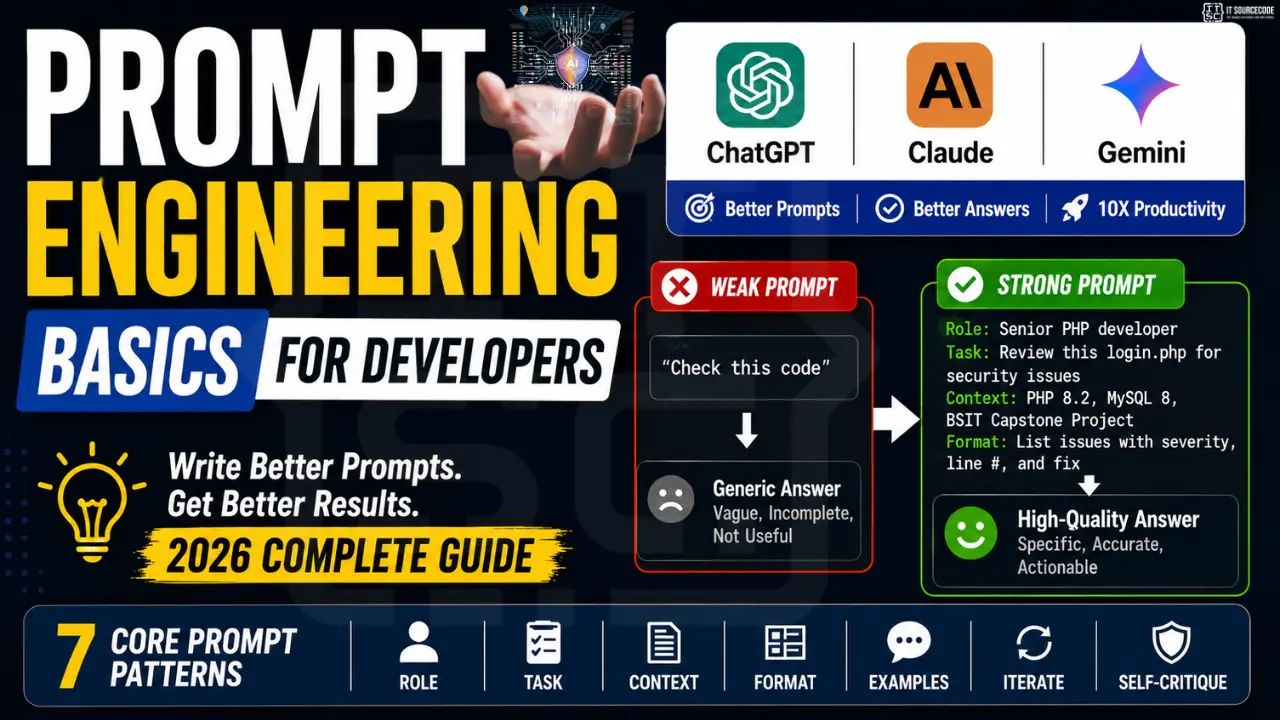
“My AI gives generic answers”, the most common complaint from BSIT students using ChatGPT, Claude, or Gemini. The problem usually isn’t the AI; it’s the prompt. Prompt engineering is the discipline of getting useful, specific, accurate output from large language models. Master 5-7 prompt patterns and you’ll 10x your productivity with AI.
📌 Bottom line: Generic prompts produce generic output. Specific prompts produce useful output. This isn’t art, it’s a set of repeatable patterns you can learn in 1-2 hours and apply forever.
Why Prompt Engineering Matters in 2026
Two developers using the same AI model can get wildly different results. Why? Prompt quality. A poorly-prompted Claude gives generic, hallucination-prone output. A well-prompted Claude generates production-quality code. The model is the same, the prompt makes the difference.
Filipino tech companies in 2026 increasingly assess prompt engineering skills during hiring. A developer who can extract excellent results from AI tools ships 2-3x more than one who can’t. It’s the new “Googling skills.”
The 7 Core Prompt Patterns Every Developer Should Master
Pattern 1: Role + Task + Context + Format
The foundation. Every serious prompt should have these 4 elements:
- Role: Who should the AI act as? (“Senior PHP developer”)
- Task: What should it do? (“Review this code for security issues”)
- Context: What does it need to know? (“This is for a BSIT capstone using PHP 8.2 + MySQL”)
- Format: How should the answer be structured? (“List issues numbered, each with: severity, location, fix”)
Weak prompt: “Check this code”
Strong prompt:
Role: Act as a senior PHP security auditor reviewing a BSIT capstone.

Task: Review this login.php code for SQL injection, XSS,
and password hashing vulnerabilities.

Context: This is for a Library Management System using
PHP 8.2, MySQL 8, plain PHP (no framework). The students
are 4th-year BSIT.

Format: Output as a numbered list. For each finding:
- Severity (Critical/High/Medium/Low)
- Specific line number
- Code example showing the fix

Here is the code:
[paste code]
Pattern 2: Show Examples (Few-Shot Learning)
When you need consistent output format, give 2-3 examples first.
Convert these natural language queries to SQL.

Example 1:
Input: "Show me the top 5 customers by total purchase amount"
SQL: SELECT customer_id, SUM(total) as total_purchases
     FROM orders
     GROUP BY customer_id
     ORDER BY total_purchases DESC
     LIMIT 5;

Example 2:
Input: "Find products that haven't been ordered in 30 days"
SQL: SELECT p.* FROM products p
     LEFT JOIN orders o ON p.id = o.product_id
       AND o.created_at >= DATE_SUB(NOW(), INTERVAL 30 DAY)
     WHERE o.id IS NULL;

Now convert this:
Input: "Show employees who joined in 2025 and earn more than 50,000"
SQL:
Few-shot prompts produce more predictable, consistent output than zero-shot prompts.
Pattern 3: Step-by-Step (Chain of Thought)
For complex tasks, ask the AI to think step-by-step BEFORE giving the final answer.
I need to design a database schema for a payroll system
that handles Philippine tax computations (BIR, SSS, PhilHealth, Pag-IBIG).

Think step-by-step:
1. First, list all the entities involved (employees, payslips, etc.)
2. Identify the relationships between them
3. Then propose the schema with tables, columns, types, foreign keys
4. Finally, suggest 3 indexes for performance

Output each step clearly labeled.
Chain-of-thought prompts produce more accurate complex outputs. The AI essentially “shows its work”, easier for you to verify.
Pattern 4: Constraints (Tell It What NOT to Do)
Sometimes constraints matter more than instructions.
Generate a Python function to validate Philippine phone numbers.

Constraints:
- Use only Python standard library (no external packages)
- Must handle: +63, 63, 09 prefixes
- Reject numbers with non-digit characters (except + and -)
- Return tuple (is_valid, normalized_format)
- Add docstring with examples
- NO regex patterns longer than 50 characters
- Function name: validate_ph_number
Pattern 5: Persona-Based Q&A
Give the AI a specific persona for context-aware responses.
You are a strict BSIT capstone defense panelist with 15 years
of experience. You've reviewed 500+ capstones. You ask sharp,
specific technical questions that students often fail.

I'm presenting my capstone titled: "Inventory Management System
for Sari-Sari Stores using PHP + MySQL with SMS Alerts."

Ask me 10 hard questions you'd ask during my defense. For each:
- The question
- What you're testing (depth, security, scalability, etc.)
- What a strong answer would include
This is the SECRET WEAPON for capstone defense prep. Practice with AI panel before the real one.
Pattern 6: Iterate (Don’t Settle for First Response)
The first response is rarely the best. Follow up with:
- “Make it more concise” (cuts wordiness)
- “Explain why you chose X over Y” (reveals reasoning)
- “What edge cases does this miss?” (surfaces bugs)
- “Show me 3 alternative approaches” (broadens options)
- “Rewrite this for a junior developer” (simplifies)
- “What would break this in production?” (stress test)
Each iteration gets closer to what you actually need.
Pattern 7: Self-Critique
Ask the AI to critique its own output.
You just generated this React component. Now act as a senior
code reviewer and find 5 issues with it:
- Performance problems
- Accessibility issues
- Potential bugs
- Code smell
- Maintainability concerns

After listing issues, provide the corrected version.
[paste code]
Models are surprisingly good at critiquing their own work. This catches 70% of issues that would otherwise go to production.
Specific Prompts for BSIT Tasks
Capstone Chapter Writing
You are helping a BSIT student in the Philippines write
Chapter 1 of their capstone documentation.

The capstone: [your topic]
Target users: [specific user description]
Real problem identified: [problem]

I'll give you key facts. You produce a Chapter 1 outline
with these sections:
1. Background of the Study (3 paragraphs)
2. Statement of the Problem (specific list)
3. Objectives - General + Specific
4. Scope and Limitations
5. Significance of the Study (to: students, schools, industry)

Use formal academic tone but stay accessible. Include
quotes from "user interviews" as placeholders I'll fill in.
UML Diagram Generation
Generate a Mermaid syntax class diagram for an Inventory
Management System with these requirements:
- 4 user roles: Admin, Manager, Cashier, Supplier
- 5 main entities: Product, Stock, Sale, Purchase, Customer
- Include relationships with cardinality
- Show 5-10 key methods per class
- Output as ```mermaid code block ready to paste into
mermaid.live for visualization
Debugging Help
You are an expert PHP + MySQL debugger.

I have this error: [paste exact error message]

My code: [paste relevant code]

Environment: PHP 8.2, MySQL 8, XAMPP on Windows 11

Walk me through:
1. What this error means in plain English
2. The 3 most likely root causes (ranked by probability)
3. How to verify which one applies
4. The fix for each cause

Do NOT just give me the code fix :  I want to understand
the problem first.
Code Review
Review this [language] code as a senior developer at a
Philippine fintech company would. Focus on:

1. Security: SQL injection, XSS, CSRF, password handling
2. Performance: N+1 queries, unnecessary loops, missed caching
3. Readability: naming, comments, structure
4. Best practices for [framework/language] in 2026
5. Specific Filipino concerns (BIR/SSS data privacy)

For each issue:
- Severity (Blocker/High/Medium/Low)
- Specific line
- Why it's a problem
- Concrete fix
[paste code]
Prompts to Avoid
- “Make my code better”: vague, generic improvements
- “Write me a Library Management System”: too broad, gets generic code
- “Is this good?”: AI tends to say yes; ask “what’s wrong with this” instead
- “Just give me the answer”: without context, answers are guesses
- “You are the smartest AI”: flattery doesn’t improve outputs
- “Be creative”: usually produces forced, weird output
- “Step by step think carefully step by step really think”: repetition annoys models
Building Your Prompt Library
Don’t write prompts from scratch every time. Build a personal library of templates for recurring tasks:
- Code review template
- Capstone chapter outliner
- SQL query generator
- Bug debugger
- UML diagram generator
- Defense Q&A simulator
- Resume reviewer (when you start job hunting)
Store them in a Notion database, GitHub gist, or even a TXT file. Copy → modify → paste. After 2-3 months you’ll have 20+ reusable prompts saving you 5+ hours per week.
Advanced Techniques (When Basics Aren’t Enough)
XML Tags (works best with Claude)
<role>Senior Python developer reviewing Filipino BSIT capstone code</role>

<task>
Review the code for production-readiness.
</task>

<code>
[paste your code here]
</code> <output_format> – Issues (numbered list) – Refactored version </output_format>
Temperature Tuning (via API)
When using APIs (not chat UI), set temperature based on task:
- 0.0-0.2: For factual/code tasks, deterministic, repeatable
- 0.7-0.9: For creative tasks, varied output
- 1.0+: Maximum creativity but high hallucination risk
System Prompts vs User Prompts
In API usage, put PERSISTENT instructions in the system prompt (role, format, constraints) and TASK-SPECIFIC content in user prompts. This keeps your role consistent across conversations.
FAQ
Is prompt engineering a real skill or just hype?
Does prompt engineering work the same with Claude, ChatGPT, and Gemini?
How long should my prompts be?
Should I use AI to write prompts FOR AI?
Are there prompt patterns specifically for the BSIT capstone defense?
How do I get better at prompt engineering over time?
Final Thoughts
Prompt engineering separates productive AI users from frustrated ones. The good news: the patterns are simple, learnable in 1-2 hours, and immediately applicable. Start with Pattern 1 (Role + Task + Context + Format) and add others over time. Build your personal template library. By month 3 of consistent practice, you’ll get 2-3x better results from the same AI models your classmates are using.
🎯 Your next steps:
- Try Pattern 1 (Role + Task + Context + Format) on your next 3 AI questions
- Build a personal prompt library in Notion or GitHub gist
- Use Pattern 5 (Persona-Based Q&A) for capstone defense practice
- Read our AI for capstone ethics guide
- Build your first AI-powered project, step-by-step Python guide

Angel Jude Suarez
Full-Stack Developer at PIES IT Solution
Focuses on Python development, machine learning, and AI integration. Has built production AI systems including OpenAI Whisper integration for medical transcription and GPT-4o-powered diagnosis assistance. Strong background in pandas, scikit-learn, and TensorFlow.
Expertise: Python · PHP · Java · VB.NET · ASP.NET · Machine Learning · AI Integration · OpenCV · Django · CodeIgniter · View all posts by Angel Jude Suarez →