
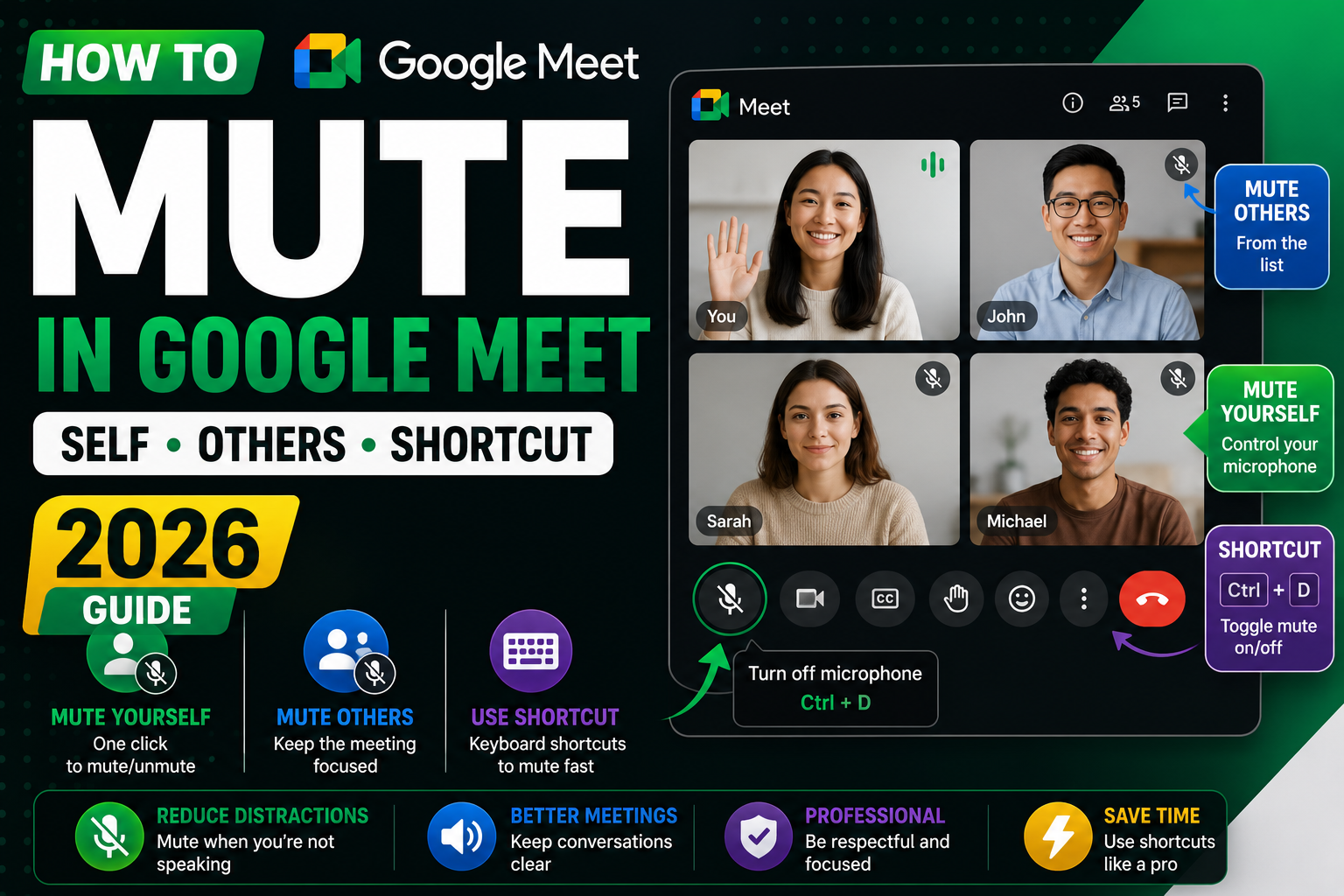
Muting in Google Meet controls background noise, prevents feedback, and creates professional meeting hygiene. Any guest can mute themselves. Hosts can mute other participants and prevent unmute. This 2026 tutorial covers self-mute, muting others as host, keyboard shortcuts, and best practices.
Mute yourself
- In an active Meet, click the microphone icon at the bottom of the screen.
- Icon turns red when muted.
- Click again to unmute.
Keyboard shortcut for mute
Mute/unmute microphone:
Windows/Chromebook: Ctrl+D
Mac: Cmd+D

Turn camera on/off:
Windows/Chromebook: Ctrl+E
Mac: Cmd+E
Keyboard shortcuts work even when Meet isn’t the focused window.
Mute a specific participant (host)
- Only the meeting host can do this.
- Click the People icon (top-right).
- Hover over the participant.
- Click the three-dot menu next to their name.
- Click Mute.
- Confirm the mute.
Note: hosts can mute but cannot unmute others (privacy protection). Participant must unmute themselves.
Mute all participants (Workspace only)
- Available in Workspace Business Standard+ plans.
- Click the shield/security icon (top-right).
- Click Host controls.
- Toggle Mute all.
- All participants muted at once.
Prevent participants from unmuting (Workspace)
- Host controls > toggle Send audio OFF for guests.
- Participants cannot unmute themselves.
- Useful for lectures, presentations, webinars.
- Toggle back on when Q&A time.
Push-to-talk feature
Meet supports push-to-talk: hold spacebar to temporarily unmute:
- Ensure you’re muted.
- Press and hold Spacebar.
- Mic activates while held.
- Release Spacebar to mute again.
Perfect for large meetings where you want to speak briefly without permanently unmuting.
Auto-mute on join
Meet automatically mutes you when joining large meetings (5+ people). To override:
- Before joining, unmute in the preview screen.
- Or unmute after joining.
Mute notifications and chime
- Settings gear (during meeting) > Audio.
- Toggle Play join and leave sounds off.
- No more chime when someone joins/leaves.
Reduces distraction in large meetings with many joiners.
Mute on Google Meet mobile
- Tap the microphone icon (bottom center of screen).
- Icon turns red when muted.
- Tap again to unmute.
- To mute others (host): tap Participants icon > tap the person > Mute.
Noise cancellation (auto-mute background)
Meet has AI noise cancellation for keyboard, dogs, traffic:
- Settings > Audio > Noise cancellation.
- Toggle on.
- Meet filters most background noise automatically.
Requires Workspace Business Standard or higher.
Best practices for muting
- Mute when not speaking, especially in meetings with 5+ people.
- Use push-to-talk in large meetings.
- Enable noise cancellation if you have Workspace plan.
- Use headphones to prevent audio feedback.
- Test your mic quality before critical meetings (Settings > Audio > pick correct input).
- Announce yourself before speaking after being muted for a while (“Just unmuting to add…”).
Common mute issues
- Mic still transmitting after mute: browser/app mute might be lagging. Refresh browser or click mic icon again.
- Cannot unmute: host may have disabled unmuting. Ask host to enable.
- Others can hear me even muted: check that OS system audio isn’t feeding into mic. Check speaker isn’t near mic.
- Cannot mute a participant: only host can. If you’re not host, ask them.
- Push-to-talk not working: keyboard shortcut is Chrome-specific. Use Chrome browser.
- Noise cancellation not filtering enough: strong background noise (loud music, construction) exceeds AI capability. Move to quieter environment.
Common Google Meet mistakes to avoid
- Not testing camera and mic before the meeting. Meet has a preview page at meet.google.com/hangouts/preview where you can test devices before joining any meeting.
- Joining from mobile when you need to share screen. Screen sharing works on mobile but is limited. Use desktop when you need to share content in detail.
- Forgetting to mute when not speaking. Background noise disrupts everyone. Press Ctrl+D (Cmd+D on Mac) to toggle mute.
- Assuming recordings are automatic. Meet only records when the host clicks Record. Enable at the start; you cannot recover an unrecorded meeting.
- Ignoring the noise cancellation feature. Workspace tiers include background noise cancellation. Enable in Settings > Audio.
Power-user tips for Google Meet
- Use keyboard shortcuts. Ctrl+D to mute, Ctrl+E for camera, Ctrl+Alt+H to raise hand, Ctrl+Alt+M for the chat panel. All work on Windows and Mac (swap Ctrl for Cmd on Mac).
- Add captions. Turn on live captions at the bottom-right menu. Useful for accessibility and noisy environments.
- Enable Q&A for large meetings. Attendees can submit written questions without interrupting. Available on Workspace tiers.
- Use polls to gather feedback. Quick pulse checks during long meetings keep attention.
- Share a specific tab, not the whole desktop. Prevents accidentally sharing notifications or personal information.
When to use Meet vs alternatives
Meet works best when your organization is already on Google Workspace, calls are 3-10 participants, and simplicity matters more than advanced features. It integrates seamlessly with Calendar and Gmail, which is unbeatable for Google-first teams.
For large webinars (100+ attendees), Zoom or Webex offer better host controls. For persistent team chat with video, Slack Huddles or Microsoft Teams work better. For high-quality recorded content, tools like Riverside or Descript produce cleaner output.
For BSIT capstone defenses and student meetings, Meet is the right choice on any campus with Google Workspace for Education. Free tier supports up to 100 participants for 60 minutes.
Best practices summary
- Test devices 5 minutes before start. Camera, mic, network. Nothing worse than the “can you hear me?” opening.
- Share agenda in Calendar description. Attendees arrive knowing what to discuss.
- Assign a note-taker at start. Distributes cognitive load and produces action items.
- End on time or early. Respect people’s calendars. Reschedule if content overflows.
- Follow up with meeting notes within 24 hours. Consolidates decisions and prevents forgotten action items.
Recording and transcription options
Meet recordings save to Google Drive automatically. A few tips for reliable recording:
- Host controls recording. Non-host participants cannot record in Meet. Ensure the host is comfortable clicking Record.
- Recording notification. Meet notifies all participants when recording starts. Legal in most jurisdictions but consent is a courtesy.
- Storage in Drive. Recordings save to the host’s Google Drive in the “Meet Recordings” folder. Share the link with participants after.
- Transcription is separate. Meet transcription (available on higher Workspace tiers) generates a text transcript. Enable when recording for searchable notes.
- Storage quota matters. Recordings can be several hundred MB per hour. Monitor Drive storage.
Google Meet security and privacy
- Use the Waiting Room. Meet’s “quick access” toggle lets you review guests before admitting them.
- Password-protect sensitive meetings. Add a code that only invited attendees receive.
- Restrict screen sharing. Settings before or during meeting: only the host can share.
- Kick disruptive attendees. Host can remove anyone with a right-click.
- End-to-end encryption. Meet uses TLS in transit and AES-128 at rest. Sufficient for most business use.
Making virtual meetings feel real
Video meetings tire people out. A few practices reduce Zoom fatigue and keep energy high:
- Cameras on for smaller meetings. Non-verbal cues matter in 3-8 person conversations. Cameras off is fine for large all-hands.
- Stand-up option. Some meetings work better standing. Increases energy and shortens duration.
- Written pre-reads. Distribute a one-pager 24 hours before. Meeting time becomes discussion, not information transfer.
- Async by default. Ask: does this need to be synchronous? Loom videos or Docs collaboration replace many meetings.
- Time boxes. Set a hard end time. Discipline extends to next meeting on time and respects everyone’s calendar.
Official documentation
Recommended audio gear for meetings
The links below are affiliate links. We may earn a commission at no extra cost to you when you buy or sign up. See our affiliate disclosure.
Frequently Asked Questions
Can the host force-unmute me?
No. Host can only mute you. You must click your own mic icon to unmute. Google keeps this privacy control in your hands.
Does mute apply to system sound too?
No. Mute only affects your microphone. You can still hear other participants. To stop hearing, adjust speaker volume or leave the meeting.
Is push-to-talk in Meet mobile?
Yes. Long-press the mic icon to temporarily unmute. Release to mute. Great for large meetings with quick questions.
How to mute keyboard sounds?
Enable Noise cancellation in Meet Settings > Audio (Workspace only). Or physically type more quietly, use a mechanical keyboard silencer.
Can I set default to mute on join?
Meet auto-mutes for large meetings (5+ people). For consistent auto-mute, always join with mic off from preview screen, Meet remembers your last setting.

Caren Bautista
Technical Writer at PIES IT Solution
Responsible for crafting clear, well-structured, and beginner-friendly content across the platform. Handles the writing, proofreading, and editorial review of tutorials, guides, and documentation to ensure every article is accurate, readable, and easy to follow.
Expertise: Technical Writing · Content Creation · Documentation · Editorial Writing · JavaScript · TypeScript · View all posts by Caren Bautista →