
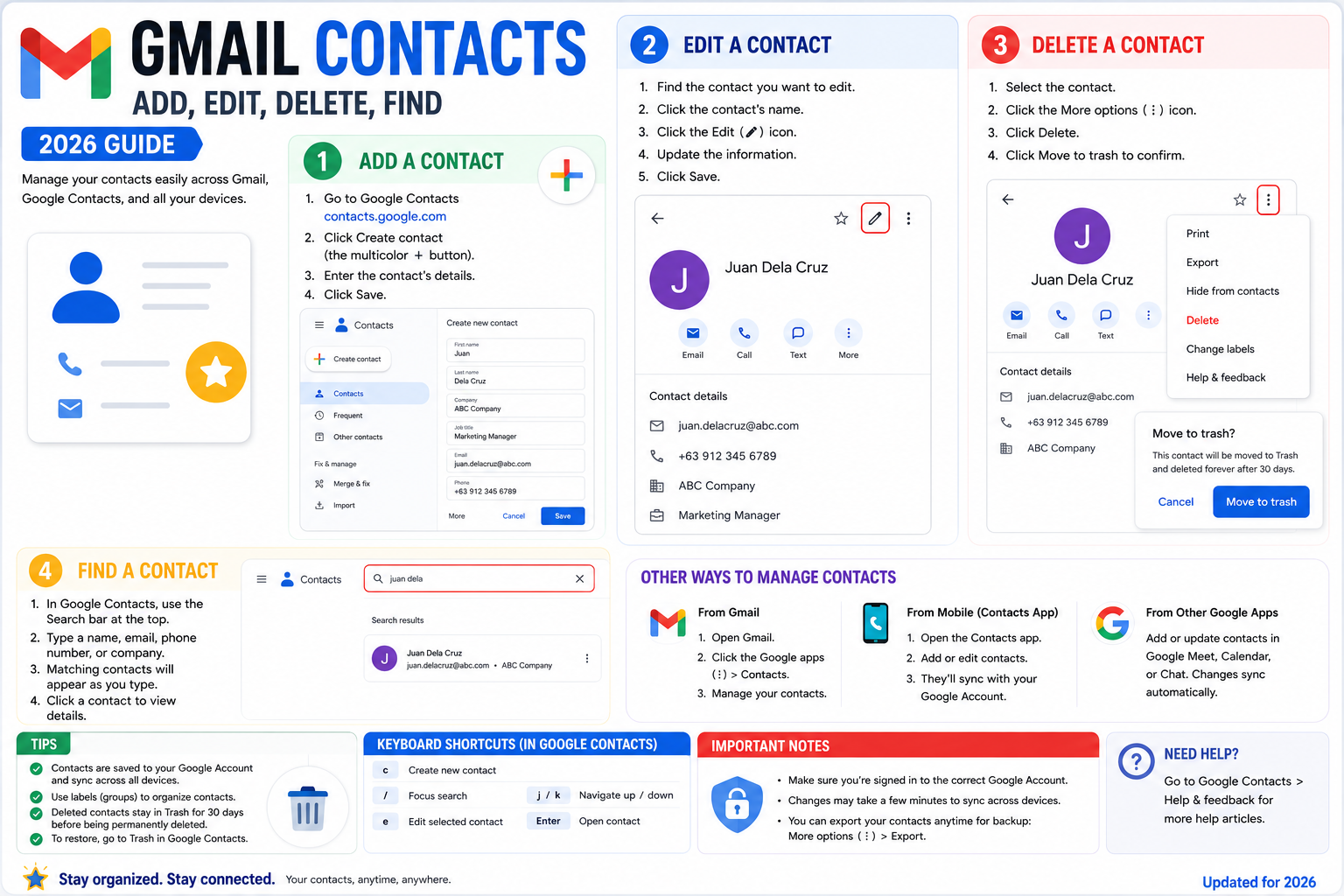
Gmail uses Google Contacts as its address book. Every contact you add, edit, or delete lives at contacts.google.com, which Gmail reads for autocomplete when you type an address in the To field. This 2026 guide covers every common contact task: add, edit, delete, find, merge duplicates, import from CSV, and sync to your phone.
The Google Contacts interface is separate from Gmail itself. Once you learn the click path once, everything else follows.
Where Gmail contacts actually live
Understanding the plumbing prevents wasted time searching Gmail settings for contact controls that do not exist there.
- All contacts are stored in Google Contacts, not Gmail. Gmail queries Contacts for autocomplete suggestions when composing.
- Contacts are tied to your Google Account, so they sync across every device and service (Android phones, Google Chat, Google Meet, Google Calendar) automatically.
- You can access Contacts at
contacts.google.com, from the Google Apps waffle menu, or through the Contacts sidebar icon inside Gmail. - Free Google Contacts supports up to 25,000 contacts per account, more than enough for personal or small business use.
Add a new contact from Google Contacts
The primary path for building your address book from scratch.
- Open
contacts.google.comin any browser. - Sign in with your Gmail account if prompted.
- Click the Create contact button in the top left of the screen.
- Choose Create a contact (or Create multiple contacts if you have a batch).
- Fill in name, email, phone, company, and any notes.
- Click Save at the bottom of the dialog.
- The contact appears in your list and is instantly available for Gmail autocomplete.
Add a contact directly from a Gmail email
Faster than opening Contacts separately when you get an email from someone new.
- Open the email from the person you want to add.
- Hover over the sender’s name at the top of the email.
- A contact card pops up with their photo, name, and email.
- Click Add to contacts in the card.
- Gmail creates a basic contact with the email and name. Fill in more details from Google Contacts later if needed.
Edit or update an existing contact
Contact info changes often. Keep your list current so autocomplete stays accurate.
- Open Google Contacts and search for the contact by name.
- Click the contact to open their detail card.
- Click the edit pencil icon in the top right of the card.
- Update whatever fields have changed: email, phone, address, company, notes.
- Click Save. Changes sync across all your Google services within seconds.
Delete a contact or merge duplicates
Cleaning up your contact list keeps autocomplete useful and prevents wrong-recipient sends.
- To delete: open Google Contacts, right-click the contact, choose Delete.
- To bulk delete: check multiple contacts, click the trash icon at the top of the list.
- To merge duplicates: click Merge and fix in the left sidebar of Google Contacts.
- Google finds likely duplicates (same email or name variations) and shows them side by side.
- Click Merge to combine, or Dismiss to keep them separate.
Import contacts from CSV or vCard
Moving from Outlook, Yahoo, or another provider? Contacts supports CSV and vCard file imports.
- Export contacts from your old provider as CSV or vCard (VCF) format.
- Open
contacts.google.comand click Import in the left sidebar. - Click Select file and choose your CSV or VCF file.
- Click Import. Google processes the file and shows a summary of contacts added.
- Review the imported contacts to catch any formatting errors, then Merge and fix if duplicates surfaced.
Sync Google Contacts to your phone
Contacts sync automatically on Android and can be added on iPhone.
- Android: sync is automatic if you added your Google account to the device. Verify at Settings > Accounts > Google > Contacts (should be toggled on).
- iPhone: open Settings > Contacts > Accounts > Add Account > Google. Sign in and toggle Contacts on.
- New contacts you add on Contacts.google.com appear on your phone within minutes.
- Contacts added on the phone also sync up to Google Contacts (bi-directional).
- The phone’s native address book uses the same contact data as Gmail autocomplete.
Common Gmail contacts mistakes
- Adding contacts from spam or phishing emails. Only add contacts from people you know. Auto-add features can pollute your list with attackers.
- Ignoring the Merge and fix suggestions. Duplicates pile up over years and slow autocomplete. Run Merge and fix monthly.
- Losing contact history when switching providers. Always export as CSV or vCard before switching. Google Contacts imports both formats.
- Sharing a contact list with someone else. Google Contacts is per-account. To share, use a Google Group or Workspace shared contacts (Workspace admin only).
- Deleting contacts you might need later. Contacts moves deleted entries to Trash for 30 days. After that, they are permanently gone. Restore from Trash if you catch it early.
When Gmail contacts management matters most
For personal use, a clean contact list makes composing emails faster because autocomplete surfaces the right person on the first letter. Merge duplicates once and enjoy clean autocomplete for months.
For business use, contacts are your Rolodex. Organizing by labels (Clients, Vendors, Team, Prospects) makes bulk emails and follow-ups much easier. Combine labels with Contacts search to find the right people fast.
For Google Workspace teams, admin can create shared Directory contacts that every team member sees automatically. This is far cleaner than everyone maintaining their own copy of the same list.
Power-user tips for Gmail contacts
- Use labels as folders. Create labels like Clients, Vendors, Team, Family. Assign contacts to labels for bulk email or organization.
- Add photos from search. Right-click a contact and use Change photo to pull from Google Photos, upload, or use Gmail’s suggested photo from linked services.
- Keep notes on each contact. The Notes field is searchable. Add context like “met at conference 2025” or “prefers phone over email” for quick reference.
- Star VIP contacts. The Starred label appears at the top of Contacts. Use it for people you email daily.
- Export before major changes. Contacts > Export before large imports or bulk edits. Provides an easy rollback if something goes wrong.
Official documentation
Recommended email productivity resources
The links below are affiliate links. We may earn a commission at no extra cost to you when you buy or sign up. See our affiliate disclosure.
Frequently Asked Questions
Where is my Gmail contact list stored?
In Google Contacts (contacts.google.com), which is tied to your Google Account. Gmail queries this list for autocomplete but does not store contacts internally.
Can I import contacts from Outlook or CSV?
Yes. Open Google Contacts > Import > choose your CSV or vCard file. Google processes the file and adds all contacts. Run Merge and fix afterward to catch any duplicates.
Do Gmail auto-added contacts count toward my contact limit?
Yes. Google Contacts limits free accounts to 25,000 contacts total, including any auto-added from emails. In practice, most users never hit this limit.
Can I sync Google Contacts to my phone?
Yes. Android syncs automatically if your Google account is added to the device. On iPhone, add the Google account under Settings > Contacts > Add Account > Google.
How do I delete duplicate contacts?
Use Merge and fix in Google Contacts (left sidebar). Google finds likely duplicates by matching name or email variations and lets you merge them in one click.
What happens to contacts I delete?
Deleted contacts move to Trash for 30 days, where you can restore them. After 30 days, contacts are permanently removed and cannot be recovered.

Adones Evangelista
Programmer & Technical Writer at PIES IT Solution
Adones Evangelista is a programmer and writer at PIES IT Solution, author of over 900 tutorials and error-fix guides at itsourcecode.com. Specializes in JavaScript, Django, Laravel, and Python error debugging covering ValueError, TypeError, AttributeError, ModuleNotFoundError, and RuntimeError, plus C/C++ and PHP capstone projects for BSIT students.
Expertise: JavaScript · Python · Django · Laravel · Error Debugging · C/C++ · View all posts by Adones Evangelista →