
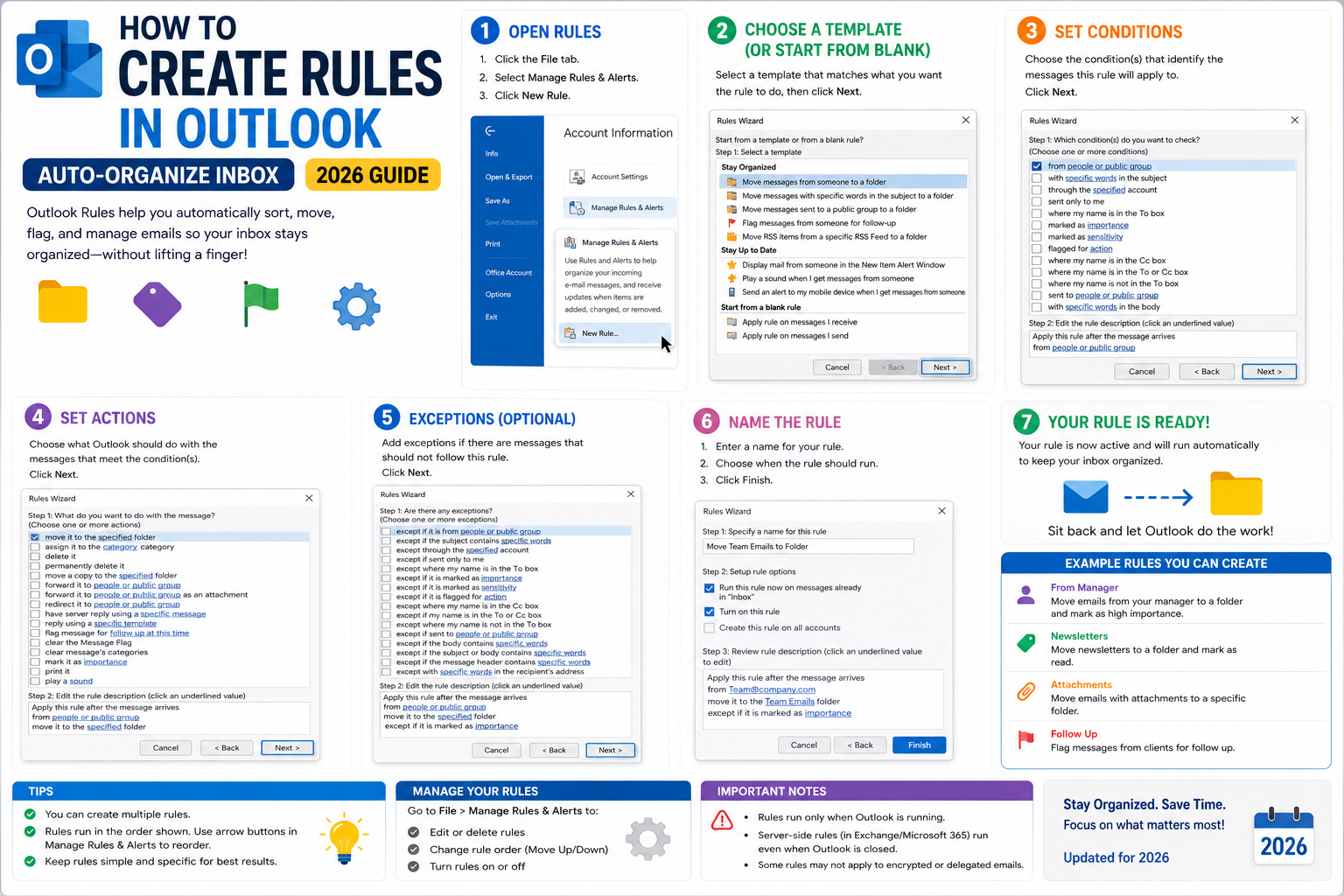
Rules in Outlook automatically process incoming emails based on criteria you set. Move emails to specific folders, forward to a colleague, mark as read, flag as important, or delete unwanted senders. Well-crafted rules can save hours per week by keeping your inbox organized without manual sorting. Here is how to create Outlook rules in 2026 with 10 practical examples you can copy.
Create a rule in Outlook desktop (classic Windows)
- Open Outlook and click on any email that matches the pattern you want to filter.
- Right-click the email and choose Rules → Create Rule.
- In the Create Rule dialog, check the conditions to apply (From, Subject, Sent to).
- Under “Do the following”, check where the email should go (New Folder, Play sound, Display alert).
- Click OK.
- Optional: check “Run this rule now on messages already in the current folder” to apply retroactively.
Create advanced rule via Rules Wizard
- Click File → Manage Rules and Alerts.
- Click New Rule.
- Choose a template: “Apply rule on messages I receive”, “Apply rule on messages I send”, or start from blank.
- Click Next.
- Select conditions (from specific senders, with specific words in subject, sent to a distribution list, with attachments, etc.).
- Click Next.
- Select actions (move to folder, mark as read, forward to, delete, flag for follow-up).
- Click Next.
- Optional: add exceptions.
- Click Next. Name the rule.
- Check “Turn on this rule” and optionally “Run this rule now on messages already in Inbox”.
- Click Finish.
Create rule in Outlook Web App (outlook.office.com)
- Sign in to outlook.office.com.
- Click the gear icon in the top-right.
- Click View all Outlook settings.
- Go to Mail → Rules.
- Click Add new rule.
- Name the rule.
- Set condition (from a specific person, subject contains, etc.).
- Set action (move to folder, mark as read, etc.).
- Toggle “Stop processing more rules” if this should be the last rule to apply.
- Click Save.
10 practical Outlook rule recipes to copy
- Newsletter organizer: from any address containing “newsletter” OR “digest” → move to Newsletters folder + mark as read.
- Invoice auto-file: subject contains “invoice” OR “receipt” → move to Invoices folder + flag for follow-up.
- VIP inbox: from CEO’s email → mark as important + play sound + keep in Inbox.
- Automated meeting emails: from Zoom OR Teams noreply → move to Meetings folder + mark as read.
- Recruiter filter: subject contains “opportunity” OR “hiring” OR “position” → move to Recruiters folder + skip Inbox.
- Order confirmations: from Amazon OR Shopify OR Lazada OR Shopee → move to Orders folder.
- Auto-delete promotions: from marketing@ OR promo@ senders → delete (skip Trash if you never want to see them).
- Distribution list segregation: sent to “all-staff@company.com” → move to Company Wide folder.
- Support tickets: subject contains “[Ticket #” → move to Support folder + flag urgent.
- Personal filter: from any address containing “@gmail.com” OR “@yahoo.com” → move to Personal folder.
Manage existing Outlook rules
To edit, delete, or reorder rules:
- Click File → Manage Rules and Alerts (classic desktop) or Settings → View all Outlook settings → Mail → Rules (web).
- Check or uncheck a rule to enable/disable it.
- Click Change Rule to edit conditions and actions.
- Click Delete to remove a rule.
- Use up/down arrows to reorder. Rules are processed top to bottom.
Server-side vs client-side Outlook rules
- Server-side rules: run on Microsoft’s Exchange server. Fire even when Outlook is closed. Faster and more reliable. Most rule types are server-side by default.
- Client-side rules: run only when Outlook desktop is open on your PC. Marked with a small computer icon in the Rules list. Includes rules with actions like “play a sound” or “display alert”.
- Recommendation: use server-side rules when possible for reliability. Client-side only for local notifications.
Common Outlook rules problems
- Rules stopped working suddenly: check that Outlook was updated. Some Windows updates reset rules. Recreate if needed.
- Rule not firing on new emails: check the rule condition matches exactly. Test by sending yourself an email that matches.
- Rule fires but on wrong emails: refine conditions with more specific text. “From address contains ana” catches too much; “From address is ana@company.com” is exact.
- Duplicate emails after enabling forwarding rule: forwarding rules can cause loops. Set the forwarding rule to “stop processing more rules” and avoid two-way forwards.
- Rule limit reached: Exchange has a soft limit of ~256 KB total rule storage per mailbox. Simplify or delete old rules if you hit the limit.
Common Outlook mistakes to avoid
- Not using folders and rules. An Outlook inbox with 5,000 unread emails is unmanageable. Set up folders per project and rules to auto-file routine mail.
- Forgetting the Signature preview before sending. Signatures render differently across clients. Send yourself a test to catch layout issues before external recipients see them.
- Ignoring Focus Inbox. Outlook’s Focus Inbox auto-filters non-priority mail. Not perfect but a huge time saver once trained.
- Overusing Reply All. The workplace curse. Reply only to the sender unless everyone truly needs the response.
- Not linking Outlook to Teams/OneNote. Microsoft 365 integrations turn Outlook into a hub. Enable calendar-to-Teams and email-to-OneNote linking.
Power-user tips for Outlook
- Use Quick Steps. One-click multi-action shortcuts. Common Quick Step: “File to Project X + mark as read + reply with template”.
- Master search operators. from:name, subject:keyword, hasattachments:yes, received:this-week. Combine for laser-focused inbox search.
- Delay all sends by 60 seconds. File > Options > Mail > Delivery. Prevents accidental sends. Set to 1 minute; retract by editing outgoing.
- Set up conditional formatting for VIPs. Emails from your boss appear in red. Instant priority visibility.
- Use categories, not folders, for tagging. Categories work across folders. A “Follow-up” category surfaces across your entire mailbox.
Outlook desktop vs web vs mobile
Outlook desktop (Windows/Mac) has the most features: full rules engine, advanced search, offline access. Best for heavy email users.
Outlook Web App (OWA) works from any browser. Rules and rules editor slightly limited compared to desktop. Search is fast because it hits the server directly.
Outlook mobile (iOS/Android) is streamlined for on-the-go. Swipe gestures customizable. Good for triage; not ideal for composing long emails.
For most professionals, desktop for morning triage, mobile for meetings, web for occasional access from unfamiliar computers. Sync happens instantly across all three.
Best practices summary
- Zero-inbox mindset. Every email gets a decision: reply, defer, delegate, or delete. No email stays “read but not decided”.
- Rules for routine mail. Newsletter to Reading folder. Reports to Reports folder. Approvals to Approvals folder. Never manually file the same type twice.
- Categorize actively. Follow-up, waiting-for, this-week. Categories cross folder boundaries.
- Schedule email review windows. Not constant checking. Two focused sessions per day beat 40 distracted glances.
- Archive, do not delete. Storage is cheap. Full-text search is powerful. Archive lets you find anything years later.
Official documentation
Recommended Outlook power-user resources
The links below are affiliate links. We may earn a commission at no extra cost to you when you buy or sign up. See our affiliate disclosure.
Quick step-by-step summary (click to expand)
- Open Outlook Rules. Click File then Manage Rules & Alerts. On Outlook web, click Settings then Mail then Rules.
- Click New Rule. Choose a template or start from blank. Common templates: Move messages from someone, Move messages with specific words.
- Set conditions. Pick who the rule applies to: from a specific sender, contains a subject word, has an attachment, etc.
- Set actions. Pick what happens: move to folder, forward, mark as read, delete, flag. You can combine multiple actions.
- Save and test. Send yourself a test email that matches the rule. Verify it triggers correctly before running on your full inbox.
Frequently Asked Questions
Do Outlook rules sync across devices?
Server-side rules sync across all devices via your Exchange or Microsoft 365 account. Client-side rules stay local to the device you created them on.
Can I export and import Outlook rules?
Yes in classic desktop Outlook. File → Manage Rules and Alerts → Options → Export Rules saves to a .rwz file. Import Rules loads them back on another PC.
How many rules can I have?
No hard number limit but total rule storage is capped at ~256 KB per mailbox on Exchange. Simple text-only rules use very little space. Complex ones with long lists of addresses can approach the limit.
Can rules process email attachments?
Rules can filter based on whether an email has attachments and by attachment name. They cannot open or process the attachment content itself.
Do Outlook rules work in the mobile app?
Server-side rules apply automatically to all your devices including mobile. Creating new rules from mobile is more limited; use Web or desktop for advanced rule editing.

Caren Bautista
Technical Writer at PIES IT Solution
Responsible for crafting clear, well-structured, and beginner-friendly content across the platform. Handles the writing, proofreading, and editorial review of tutorials, guides, and documentation to ensure every article is accurate, readable, and easy to follow.
Expertise: Technical Writing · Content Creation · Documentation · Editorial Writing · JavaScript · TypeScript · View all posts by Caren Bautista →