
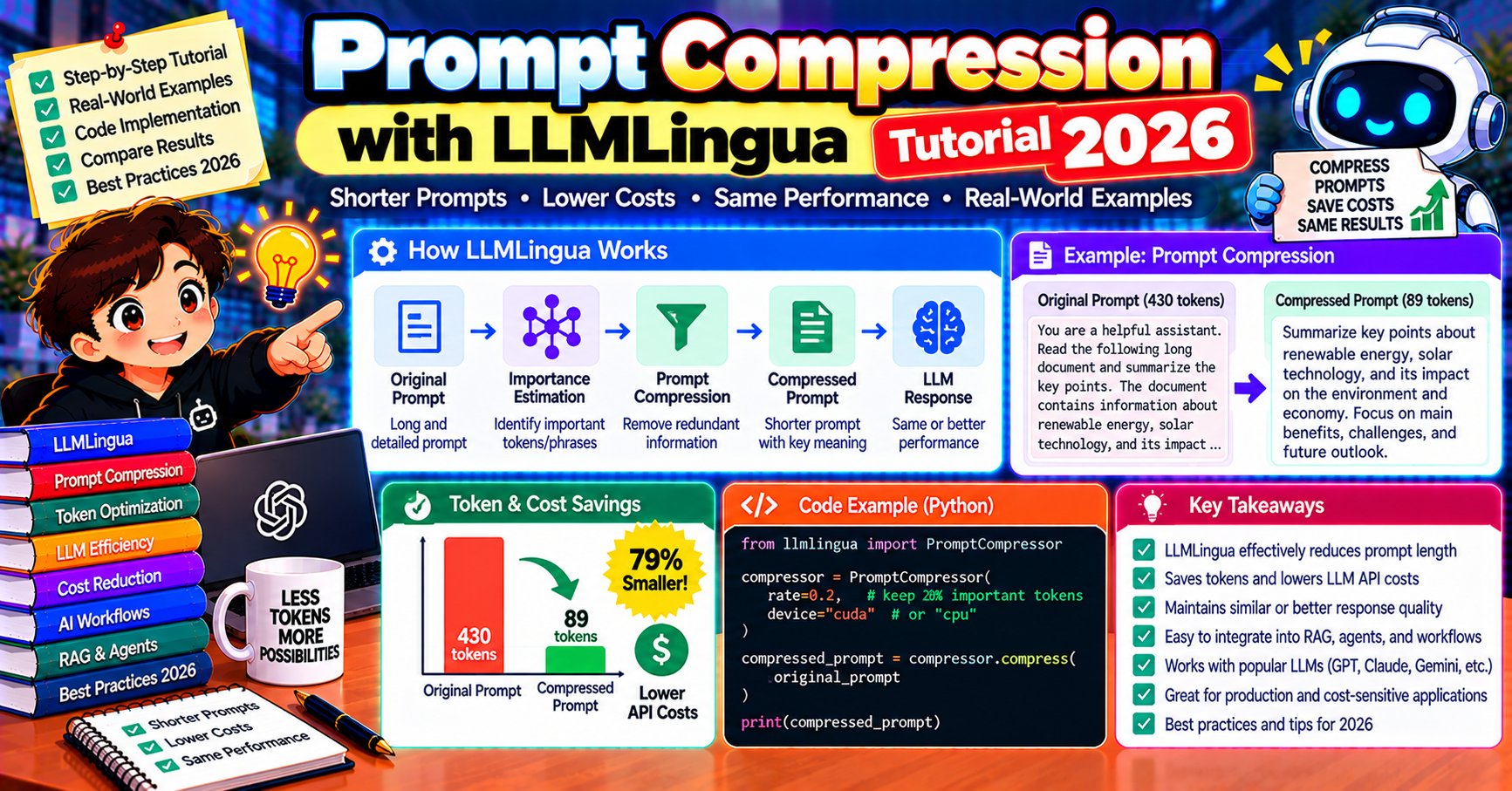
Long prompts are expensive. A 50,000-token RAG prompt sent 100,000 times a month costs $12,500 at Claude Sonnet 5.5 input pricing. Microsoft Research shipped LLMLingua (and the sequel LongLLMLingua + LLMLingua-2) specifically to shrink prompts without losing information the downstream model needs. In 2026 it is the standard open-source prompt compression library and routinely cuts prompt token count by 2-20x. This article walks through how LLMLingua works, when it is the right fix for your cost problem, and how to wire it into a production RAG or long-context pipeline.
What LLMLingua does
LLMLingua uses a small language model (default: Llama 2 7B or GPT-2) to score the information density of each token in your prompt. Low-information tokens get dropped. The downstream LLM receives a shorter prompt that preserves the semantic content but trims filler words, redundant phrasing, and low-signal context.
Three versions worth knowing:
- LLMLingua (original, 2023): targets 2-5x compression. Works well on structured prompts (few-shot examples, instructions).
- LongLLMLingua (2024): optimized for long-context RAG. Up to 20x compression on 100K+ token contexts.
- LLMLingua-2 (2024): task-aware compression using a trained classifier. Faster than the original, slightly less aggressive.
Install and basic compression
pip install llmlingua

from llmlingua import PromptCompressor

compressor = PromptCompressor(
    model_name="NousResearch/Llama-2-7b-hf",
    device_map="cuda",  # or "cpu" for CPU-only
)

original_prompt = """
You are a helpful customer support assistant. Please answer the user's
question based on the following context.

Context: Our company offers refunds within 30 days of purchase. The item
must be unopened and in its original packaging. Shipping costs are not
refundable. For damaged items, we offer immediate replacement. Our hours
are Monday to Friday 9am to 5pm PST. Call 1-800-555-0100 for support.

Question: How long do I have to return a product?
"""

result = compressor.compress_prompt(
    context=[original_prompt],
    ratio=0.5,  # Keep 50% of tokens
)
print(result["compressed_prompt"])
print(f"Original: {result['origin_tokens']} tokens")
print(f"Compressed: {result['compressed_tokens']} tokens")
print(f"Rate: {result['rate']}")
Typical result: 150-token prompt compresses to 60-80 tokens, saving 40-60% of input cost while preserving the answer-relevant information.
LongLLMLingua for RAG pipelines
RAG prompts are the canonical use case: you retrieve 10 chunks of 500 tokens each (5,000 total context tokens), the user question is 50 tokens, system prompt 200 tokens. Total: 5,250 tokens per request. LongLLMLingua can cut the RAG context 10-15x while preserving answer accuracy on standard benchmarks.
compressor = PromptCompressor()

retrieved_chunks = [chunk1_text, chunk2_text, chunk3_text, ...]
question = "What is our refund policy?"

compressed = compressor.compress_prompt(
    context=retrieved_chunks,
    instruction="Answer the question based on the context.",
    question=question,
    target_token=500,  # compress context to 500 tokens
    rank_method="longllmlingua",
    condition_in_question="after",  # question-aware compression
    reorder_context="sort",  # reorder chunks by relevance
)

# compressed["compressed_prompt"] is now ~500 tokens instead of 5000
response = openai_call(compressed["compressed_prompt"])
The condition_in_question parameter is the key difference from the base version: compression keeps tokens most relevant to the specific question, not just high-information tokens generically. Preserves answer accuracy at aggressive compression ratios.
LLMLingua-2: faster, classifier-based
LLMLingua-2 trains a small BERT-style classifier to score each token for “preservation worthy”. Runs 3-6x faster than the original (which uses a 7B LLM for scoring). Less aggressive compression but much lower overhead per request.
from llmlingua import PromptCompressor

compressor = PromptCompressor(
    model_name="microsoft/llmlingua-2-xlm-roberta-large-meetingbank",
    use_llmlingua2=True,
    device_map="cuda",
)

compressed = compressor.compress_prompt(
    original_prompt,
    rate=0.4,
    force_tokens=["\n", ".", "!", "?", ","],
)
Latency: 10-50ms on GPU, 100-300ms on CPU. LLMLingua-2 is practical for request-time compression in a hot path; the original LLMLingua is usually better suited for offline/pre-compute pipelines.
Economic math: when it is worth it
Rough breakeven analysis:
- GPU rental for LLMLingua: ~$0.50/hour for a modest GPU (A10 or T4) handling the compressor
- Compute per request: 50-200ms on GPU, call it $0.00003 per request amortized
- Token savings per request: 2-10x reduction on a 5K-token prompt = $0.015-$0.045 saved at GPT-4o pricing
At 100K requests/month:
- Infrastructure: $360/month GPU + $3 compute = $363
- Savings: 100K * $0.025 avg = $2,500/month
- Net: $2,137/month saved
At under 10K requests/month, the GPU rental usually swamps the token savings. Use LLMLingua-2 on CPU (free) or just skip compression and let shorter prompts pass through.
Where compression hurts accuracy
Not every prompt tolerates compression well:
- Structured data (JSON, tables, code): dropping tokens corrupts structure. Compression breaks parse. Skip compression on structured inputs.
- Precise facts (numbers, dates, names): compression may drop a specific number or name the answer depends on. Fine for RAG context, less fine for financial or medical data.
- Few-shot examples with specific format: compression can strip format cues, making the model’s output format drift. Mark few-shot examples with
force_tokensto preserve them. - Short prompts (under 500 tokens): compression overhead exceeds the savings. Skip under 500 tokens; apply only on long contexts.
Always measure accuracy before/after compression on your evaluation set. Expect 2-5% quality drop at 50% compression on well-structured prompts; up to 10% drop at 90% compression. If quality hit is unacceptable, lower the compression ratio.
Combining with other cost tactics
Prompt compression stacks with other cost optimizations:
- + Semantic caching: cache the UNcompressed input-to-output mapping. Serve cached responses when similar questions come in. Compression only kicks in on cache misses.
- + Prompt caching (OpenAI/Anthropic native): compress once, cache the compressed version in the model provider’s cache. First call pays compression + full input cost, subsequent calls get cached-input pricing.
- + Model routing: compress for the expensive model (GPT-5, Opus 5.5), skip compression for cheap models (Haiku 5.5, GPT-4o-mini) where cost savings do not justify quality risk.
- + Batch API: compress + batch for maximum savings on offline processing. 50% off from Batch + 60% token reduction from compression = ~80% total cost cut.
Production deployment patterns
Three common shapes:
- Request-time compression: LLMLingua-2 as a middleware in your API handler. Adds 10-50ms latency, immediate savings. Best for user-facing chat.
- Offline pre-compression: compress your RAG document chunks once at ingestion, store the compressed versions in the vector DB. Zero per-request latency. Best for stable RAG corpora.
- Hybrid: pre-compressed static context (docs, system prompt) + request-time compression for the user’s dynamic input. Covers both axes.
Frequently Asked Questions
Does compression work on non-English prompts?
Yes with the multilingual LLMLingua-2 model (microsoft/llmlingua-2-xlm-roberta-large). Covers 100+ languages but accuracy varies. Test on your target language before deploying globally.
Can I compress prompts that will be routed to multiple different models?
Yes. Compression is model-agnostic; the compressed prompt works with any downstream LLM. Benchmark accuracy per target model though; a prompt that compresses well for GPT-4o may degrade more for a smaller model like Haiku.
What about streaming responses?
Compression happens before the LLM call, so streaming of the output is unaffected. Users still see the response stream in real time. The compression step adds a small delay to time-to-first-token but is usually not noticeable.
Does LLMLingua work with function calling / tool use?
Compress the prompt text; do not compress tool definitions or function schemas. These are structured and compression breaks them. Pass tool definitions separately to the model after compression of the message content.
How does this compare to summarization?
Summarization replaces the original with a shorter paraphrase. Compression keeps the original tokens but drops low-signal ones. Summarization produces more fluent output but loses more detail; compression preserves exact facts but reads choppier. For RAG context, compression preserves answer accuracy better.
Is LLMLingua used in production by big companies?
Yes. Microsoft uses it internally for GitHub Copilot context management, and the original paper claims deployments at major tech companies. Open-source so adoption is hard to measure, but the GitHub repo has 10K+ stars and active maintenance in 2026.
Official documentation

Angel Jude Suarez
Full-Stack Developer at PIES IT Solution
Focuses on Python development, machine learning, and AI integration. Has built production AI systems including OpenAI Whisper integration for medical transcription and GPT-4o-powered diagnosis assistance. Strong background in pandas, scikit-learn, and TensorFlow.
Expertise: Python · PHP · Java · VB.NET · ASP.NET · Machine Learning · AI Integration · OpenCV · Django · CodeIgniter · View all posts by Angel Jude Suarez →