
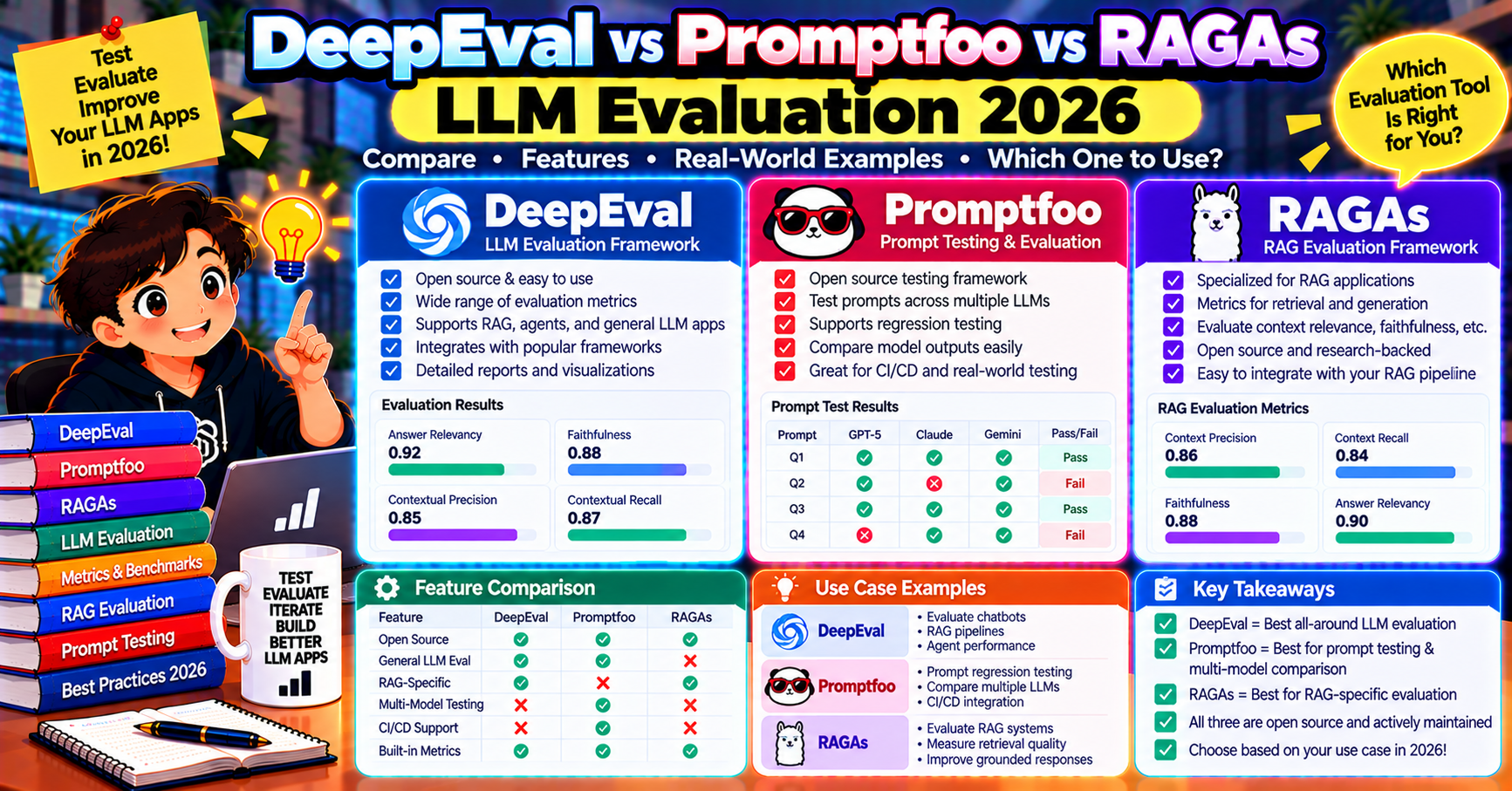
LLM evaluation moved from “nice to have” to “ship-blocker” in 2026 for any team running production AI. Three frameworks dominate the Python ecosystem for this: DeepEval, Promptfoo, and RAGAs. Each one solves evaluation slightly differently and the right pick depends on whether you are testing RAG pipelines, prompt variations, or agent behavior. This article compares all three side by side on setup, test authoring, metrics, CI integration, and when each one is the right choice.
What each framework does
DeepEval (by Confident AI): pytest-style LLM evaluation framework. Write test cases that look like regular pytest tests but assert on LLM output quality metrics (faithfulness, hallucination, relevance). Shipped first in 2023, actively developed through 2026.
Promptfoo: YAML-first eval framework focused on prompt iteration. Write a config file listing prompts, test inputs, and assertions; run the eval to see pass/fail across every prompt variant. Opinionated toward prompt engineering workflows.
RAGAs: RAG-specialized evaluation library. Metrics (faithfulness, answer relevance, context precision, context recall) built specifically for retrieval-augmented generation pipelines. Best when the thing you are testing is a RAG system, not a general LLM.
Setup comparison
DeepEval (pytest integration):
pip install deepeval

# test_pipeline.py
from deepeval import assert_test
from deepeval.metrics import HallucinationMetric, AnswerRelevancyMetric
from deepeval.test_case import LLMTestCase

def test_support_bot():
    test_case = LLMTestCase(
        input="What is our refund policy?",
        actual_output=my_pipeline("What is our refund policy?"),
        context=["Refunds within 30 days of purchase"],
    )
    assert_test(test_case, [
        HallucinationMetric(threshold=0.3),
        AnswerRelevancyMetric(threshold=0.7),
    ])
Run with pytest test_pipeline.py. Fails on metric threshold miss, exactly like a regular pytest test. CI integration is zero config.
Promptfoo (YAML-first):
npm install -g promptfoo

# promptfooconfig.yaml
prompts:
  - "Classify the following ticket: {{ticket}}"
  - "Please categorize this support ticket: {{ticket}}"
providers:
  - openai:gpt-4o-mini
  - anthropic:claude-sonnet-5-5
tests:
  - vars:
      ticket: "My card was charged twice"
    assert:
      - type: contains
        value: "billing"
  - vars:
      ticket: "The app crashes on login"
    assert:
      - type: contains
        value: "bug"
Run promptfoo eval. Promptfoo runs every prompt against every provider against every test, produces a matrix result page. Best for prompt iteration where you want to A/B test wording.
RAGAs (dataframe-based):
pip install ragas datasets

from datasets import Dataset
from ragas import evaluate
from ragas.metrics import faithfulness, context_precision, context_recall

samples = [
    {
        "question": "What is our refund policy?",
        "contexts": ["Refunds within 30 days..."],
        "answer": "You can get a refund within 30 days of purchase.",
        "ground_truth": "Full refunds within 30 days.",
    },
    # ... more samples
]

dataset = Dataset.from_list(samples)
result = evaluate(dataset, metrics=[faithfulness, context_precision, context_recall])
print(result)
Run from a notebook or script. Output is a Pandas-friendly dict of metric scores. Best when the thing you measure IS a RAG pipeline and you want retrieval-specific metrics (context precision, context recall) that DeepEval and Promptfoo do not have out of the box.
Metrics coverage head-to-head
| Metric | DeepEval | Promptfoo | RAGAs |
|---|---|---|---|
| Faithfulness (hallucination) | yes | plugin | yes (native) |
| Answer relevance | yes | yes | yes |
| Context precision/recall | partial | plugin | yes (native) |
| Toxicity | yes | yes | no |
| PII detection | yes | yes | no |
| Prompt injection | yes | yes | no |
| Custom metrics | yes (G-Eval) | yes (JS) | yes |
CI integration patterns
All three work in CI but the shape differs.
DeepEval: runs under pytest, inherits any pytest CI config. Fails the build on threshold miss. Confident AI (DeepEval’s hosted platform) adds dashboards and run history on top.
# .github/workflows/eval.yml
- run: pip install deepeval pytest
- run: pytest test_eval.py -v
Promptfoo: runs promptfoo eval -j report.json and inspects JSON output. Threshold checks via shell:
- run: promptfoo eval --output report.json
- run: |
    pass_rate=$(jq '.results.stats.passes / (.results.stats.passes + .results.stats.failures)' report.json)
    [ $(echo "$pass_rate >= 0.9" | bc) -eq 1 ] || exit 1
RAGAs: no built-in CI runner. Write a Python script, print the metric score, exit 1 if below threshold:
# eval.py
import sys
from ragas import evaluate
result = evaluate(dataset, metrics=[faithfulness])
if result["faithfulness"] < 0.85:
    sys.exit(1)
Which one wins by use case
- You want pytest-native LLM tests: DeepEval. Written like regular unit tests, inherits the whole pytest ecosystem (fixtures, parametrize, markers, parallel).
- You iterate on prompts heavily: Promptfoo. YAML config + matrix output makes "which wording works best" a 2-minute test, not a 2-hour notebook session.
- You run a RAG pipeline: RAGAs. Context precision + context recall are RAG-native and the two metrics the others cover weakly.
- You evaluate agent behavior: DeepEval (G-Eval metric for arbitrary graders) or Promptfoo (custom JS assertion functions). RAGAs is not designed for agents.
- Your team is JS/TS not Python: Promptfoo. The others are Python-first.
Combining them in a real stack
Most teams end up using more than one. A common pattern in 2026:
- DeepEval in CI: catches regressions on every PR, pass/fail gate
- Promptfoo for prompt experiments: A/B test wording changes locally before committing
- RAGAs for RAG-specific QA: run on the retrieval pipeline weekly, chart drift
They do not conflict; each catches a different class of problem. Shared infrastructure cost: the LLM-as-judge calls. Budget $5-20/month in evaluation LLM spend for a moderate test suite running on every PR.
Judge model selection matters
All three frameworks use an LLM to score outputs. Picking the right judge model changes cost and accuracy:
- GPT-4o: default choice in 2026 docs. Good balance of accuracy and cost ($5/M input).
- Claude Opus 5.5: most accurate judge for nuanced quality metrics but 15x more expensive than GPT-4o.
- GPT-4o-mini or Claude Haiku 5.5: 10x cheaper than full-size judges. Accuracy drops noticeably on edge cases; fine for bulk eval but not critical paths.
- Local Llama 3.3 70B: free (self-hosted) but requires GPU infrastructure. Accuracy acceptable with careful prompt tuning.
Pin the judge model version. All three frameworks let you specify this. Changing judge models mid-benchmark invalidates historical comparisons.
Benchmarking the judges themselves
LLM-as-judge is the hidden infrastructure under all three frameworks. The judge model's accuracy caps your eval's accuracy. If GPT-4o scores a correct answer as hallucinated 15% of the time, your eval reports noise, not signal. Teams in 2026 benchmark their judges before trusting the eval results:
- Build a human-labeled gold set. 50-100 examples where a human has already labeled "faithful vs. hallucinated" or "relevant vs. not." Treat this as the judge-of-the-judge.
- Run each candidate judge model against the gold set. Measure precision, recall, and inter-judge agreement when you use multiple models.
- Pick the judge with the best cost-accuracy tradeoff. Not always the biggest model: for simple binary classification (yes/no faithful), gpt-4o-mini can match gpt-4o at 10x less cost.
- Re-benchmark on every judge-model version bump. OpenAI shipping a new gpt-4o snapshot can shift your eval baseline silently.
DeepEval, Promptfoo, and RAGAs all let you plug in a custom judge. Spend an afternoon benchmarking before committing. The alternative is debugging eval noise for months.
Frequently Asked Questions
Which one should a brand-new project pick?
DeepEval if your team is Python and comfortable with pytest. Promptfoo if your work is primarily prompt iteration or your team is JS/TS. RAGAs if you are building a RAG system and want RAG-specific metrics on day one.
Can I migrate from DeepEval to Promptfoo later?
Yes, but the test authoring style is different. DeepEval tests are Python functions; Promptfoo tests are YAML. Expect to rewrite test authoring but your dataset of input-output pairs transfers directly.
How expensive are these to run on every PR?
For a 50-example test suite with GPT-4o as judge, expect $0.20-$0.50 per full run. At 100 PRs/month that is $20-$50. Switching the judge to GPT-4o-mini cuts this 10x. Caching eval results for unchanged test cases cuts it further.
Does any of them handle multimodal eval (image + text)?
DeepEval added multimodal metrics in late 2024 and matured them through 2026. Promptfoo supports image inputs via custom providers. RAGAs is text-only. For vision-heavy pipelines, DeepEval is the clearest pick.
Can I use these with non-OpenAI providers?
Yes. All three support Anthropic, Google, local Ollama models, and anything OpenAI-compatible. Judge model and target model can be different providers.
Which has the best offline / no-LLM metrics?
Promptfoo has the strongest heuristic assertions (contains, regex, JSON schema, cost-under, latency-under) that run without any LLM call. Use these for format-level checks; reserve LLM-as-judge for quality scoring where no heuristic exists.
Official documentation

Angel Jude Suarez
Full-Stack Developer at PIES IT Solution
Focuses on Python development, machine learning, and AI integration. Has built production AI systems including OpenAI Whisper integration for medical transcription and GPT-4o-powered diagnosis assistance. Strong background in pandas, scikit-learn, and TensorFlow.
Expertise: Python · PHP · Java · VB.NET · ASP.NET · Machine Learning · AI Integration · OpenCV · Django · CodeIgniter · View all posts by Angel Jude Suarez →