
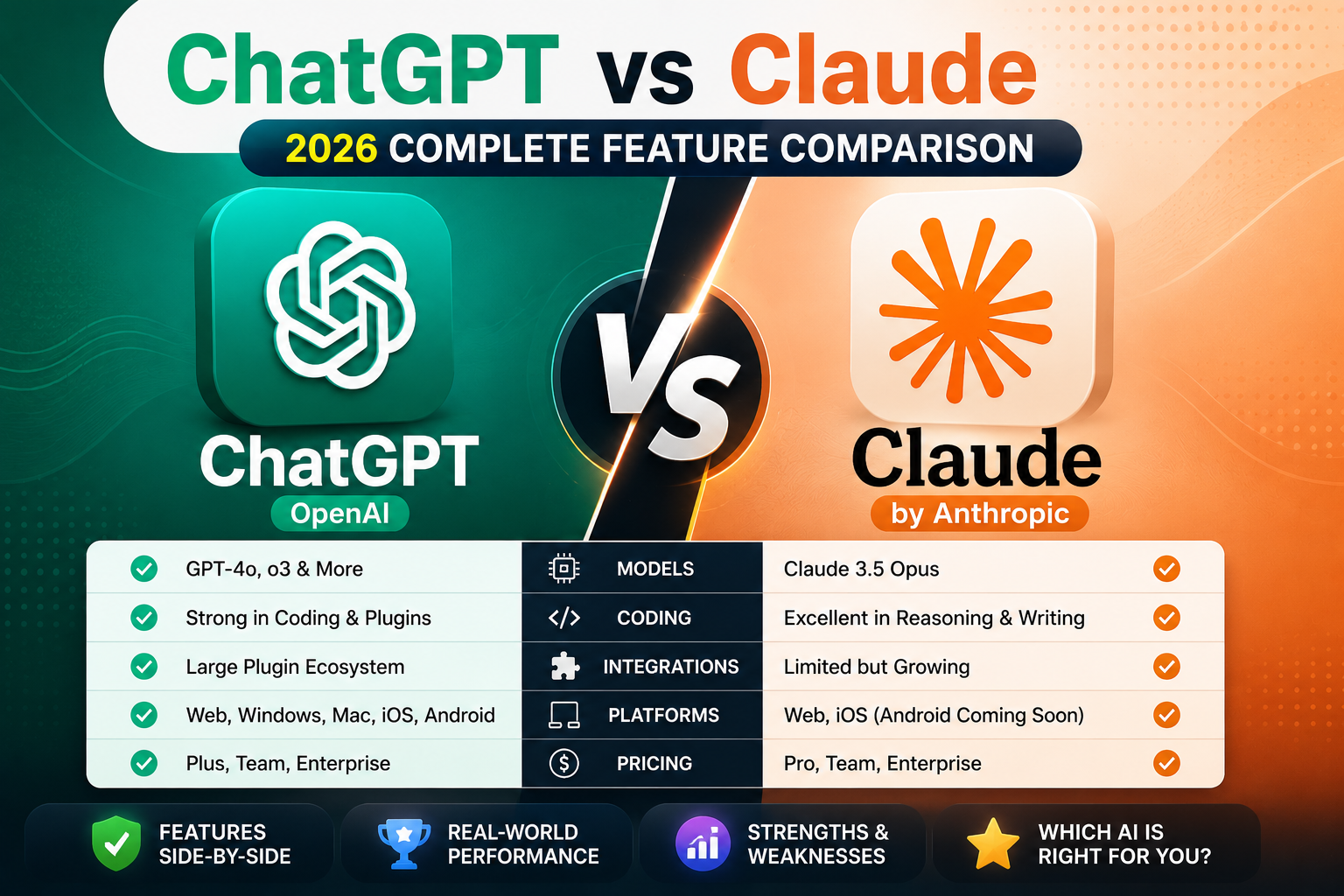
ChatGPT vs Claude: the two most-used AI assistants in 2026. Both cost $20/month for their Pro tiers, but they excel at different tasks. As a developer who uses both daily on production AI systems, I’ll break down where each wins, and why most professionals subscribe to both.
Quick verdict
- Pick ChatGPT if: you need image generation, voice conversations, largest ecosystem, or Custom GPTs.
- Pick Claude if: you code daily, review long documents, need natural writing tone, or care most about reasoning quality.
- Get both if: your work is diverse. $40/month total. Most professional users I know have both subscriptions.
Pricing comparison
| Plan | ChatGPT | Claude |
|---|---|---|
| Free | Yes (limited GPT-4o) | Yes (limited Sonnet) |
| Pro | $20/mo | $20/mo |
| Team | $25/user/mo | $30/user/mo |
| Enterprise | Custom | Custom |
Model quality (2026)
| Task | ChatGPT (GPT-4o + o1) | Claude (Opus 4.8) |
|---|---|---|
| General reasoning | Excellent (o1) | Excellent (Opus) |
| Coding | Very good | Best in class |
| Long documents | 128K context | 200K+ context |
| Writing tone | Sometimes stiff | More natural |
| Following instructions | Good | Excellent |
| Uncertainty acknowledgment | Overconfident | More honest |
Feature comparison
| Feature | ChatGPT | Claude |
|---|---|---|
| Image generation | Yes (DALL-E) | No |
| Voice mode | Yes | No (yet) |
| Web browsing | Yes | Yes (limited) |
| File upload | Yes | Yes |
| Memory across chats | Yes (Plus) | Via Projects |
| Custom instructions | Yes | Yes (Projects) |
| Custom GPTs / Skills | Custom GPTs | Skills (2026) |
| Artifacts (side panel) | Canvas | Artifacts |
| MCP integration | Limited | Native |
Best for coding
Winner: Claude Opus.
- Longer context = paste entire modules for review.
- Fewer library API hallucinations.
- Better at maintaining consistency across long refactors.
- Artifacts render code with preview immediately.
- My daily driver for production code review.
Best for writing
Winner: Claude.
- Natural tone, less “AI-generated” feel.
- Better at matching requested voice.
- Handles nuanced editing (tone adjustment, tightening).
- Longer context = edit entire drafts at once.
Best for creative work
Winner: ChatGPT.
- DALL-E for image generation.
- Voice mode for brainstorming.
- Fable model on Claude is creative but no image support.
Best for research
Tie, depends on task.
- ChatGPT: better web browsing, integrates with Bing search.
- Claude: better at synthesizing large documents (long context wins).
- Both good for summarization.
Best for business
Winner: Claude (barely).
- Better privacy story (never trained on your data).
- Team plan enterprise features.
- Favored in healthcare, legal, finance sectors.
- ChatGPT Team is great but has training-data-opt-in messiness historically.
Best for students
Winner: ChatGPT (barely).
- Larger user community = more tutorials, guides.
- Voice mode for language learning.
- DALL-E for creative projects.
- Both offer discounts to student email addresses.
Verdict: which should you get?
- Budget-limited student: pick Free tiers of both. Use for different tasks.
- Developer with $40/mo budget: get both. Claude Pro for coding, ChatGPT Plus for images + voice.
- Business user, one subscription: Claude Pro. Reasoning + writing quality wins.
- Creative professional: ChatGPT Plus. Image gen is unmatched.
- Enterprise team: probably Claude Team. Privacy story wins.
My workflow (both subscribed)
- Code review, debugging, architecture: Claude Opus.
- Writing drafts, editing content: Claude Sonnet or Opus.
- Image generation for presentations: ChatGPT DALL-E.
- Voice brainstorming: ChatGPT Plus voice mode.
- Real-time news, current events: ChatGPT (web browsing).
- Long document analysis (100+ pages): Claude (200K context).
Comparison at a glance
- General-purpose chat: ChatGPT Plus ($20/mo), Claude Pro ($20/mo), Gemini Advanced ($20/mo). All similar quality; personality differs.
- Coding assistance: GitHub Copilot ($10/mo), Cursor ($20/mo), Codeium (free tier). Copilot integrates deepest with VS Code.
- Search + citation: Perplexity ($20/mo Pro) is search-first with source citations.
- Free tiers: All major tools have free tiers good enough for casual use. Start free, upgrade when limits become blockers.
Common mistakes when adopting AI tools
- Trusting first-draft output blindly. Every AI hallucinates. Verify facts, test code, check dates. Treat AI output as strong first draft.
- Paying for multiple overlapping tools. Do not subscribe to ChatGPT Team, Claude Pro, and Gemini Advanced simultaneously. Pick one primary, use free tiers for others.
- Ignoring privacy. Free tier prompts may be used for training. Use paid tiers with data-usage guarantees for sensitive work.
- Overusing AI for simple tasks. Sometimes Google Search or docs are faster than prompt engineering.
- Not learning prompt engineering. The gap between beginner and expert AI users is prompt quality.
Practical adoption path
Week 1: Pick one general-purpose chat tool. Use free tier for 5-10 real tasks. Track which tasks it accelerates vs slows down.
Week 2: Add a coding tool if you code. Evaluate the same way.
Week 3: Decide. If a tool saves 30+ minutes daily, subscribe. If it only helps occasionally, stay on free tier.
Ongoing: Reassess quarterly. AI moves fast. What was best in Q1 may be surpassed by Q3.
Best practices for AI-assisted work
- Verify before shipping. Test code, fact-check claims, review generated content.
- Version your prompts. Keep a library of prompts that work. Reuse and iterate.
- Combine tools. Different tools have different strengths. Use each where it excels.
- Learn continuously. Follow one credible newsletter (Ben’s Bites, TLDR AI, The Batch) to stay current.
- Set boundaries. AI is a tool, not a replacement for thinking. Some tasks deserve human focus.
Building AI tools into your daily workflow
Beyond one-off uses, integrating AI into your daily workflow multiplies productivity gains. Common integration patterns:
- Morning briefing. Ask your AI to summarize overnight news, emails, or Slack messages while you have coffee.
- Meeting prep. Feed context documents to AI 5 minutes before meetings for a quick brief on what to discuss.
- Draft-and-refine writing. AI generates the first draft; you edit for accuracy, voice, and specificity.
- Code review companion. Ask AI to spot bugs, suggest improvements, or explain unfamiliar code before your human reviewer sees it.
- Learning accelerator. AI explains concepts, generates practice problems, and grades your work. Great for self-directed learning.
Prompt engineering fundamentals
The gap between beginner and expert AI users is prompt quality. Master these fundamentals:
- Provide context. “I am a junior developer working on…” is far better than just “write code”.
- Specify format. “Return the output as a JSON object with keys X, Y, Z” produces cleaner output.
- Give examples. Show the AI what good output looks like. It matches your examples.
- Break complex tasks into steps. Chain of thought prompting improves accuracy on hard problems.
- Iterate. First response is rarely perfect. Refine your prompt based on what came back.
Ethical considerations for AI tools
AI tools raise real ethical questions worth thinking through. Some guidelines:
- Attribution and transparency. If you use AI to write content, disclose when appropriate. Academic and journalistic contexts often require it.
- Privacy of prompts. Do not paste sensitive company data, personal identification, or confidential client information into public AI tools.
- Bias awareness. AI reflects the biases of its training data. Review outputs for gender, race, cultural, or political biases before publishing.
- Copyright and originality. AI-generated content sits in legal gray areas. Consult with your organization’s legal or compliance team for commercial use.
- Skill atrophy. Over-relying on AI can dull your own skills. Balance AI usage with human practice on core competencies.
Official documentation
Recommended AI mastery resources
The links below are affiliate links. We may earn a commission at no extra cost to you when you buy or sign up. See our affiliate disclosure.
Frequently Asked Questions
Which is more accurate?
Claude Opus wins for coding and reasoning. GPT-4o wins for creative tasks. Both hallucinate, always verify facts. Neither is safe to trust blindly for critical information.
Should I switch from ChatGPT to Claude?
Don’t switch, add. Both are $20/mo. Most professionals I know have both. Use each for its strengths. If budget forces choosing one, Claude for developers, ChatGPT for creatives.
Is Claude more private?
Yes. Anthropic doesn’t train on your chats by default. OpenAI does unless you opt out. For sensitive work (medical, legal, financial), Claude is safer.
Which is faster?
Both are fast. GPT-4o mini and Claude Haiku are the fastest. For simple tasks, either. For complex tasks, both take similar time.
Can Claude replace ChatGPT?
For text-only work, yes. For image generation, voice mode, and Custom GPT ecosystem, no. Claude complements ChatGPT rather than replacing it.

Angel Jude Suarez
Full-Stack Developer at PIES IT Solution
Focuses on Python development, machine learning, and AI integration. Has built production AI systems including OpenAI Whisper integration for medical transcription and GPT-4o-powered diagnosis assistance. Strong background in pandas, scikit-learn, and TensorFlow.
Expertise: Python · PHP · Java · VB.NET · ASP.NET · Machine Learning · AI Integration · OpenCV · Django · CodeIgniter · View all posts by Angel Jude Suarez →