
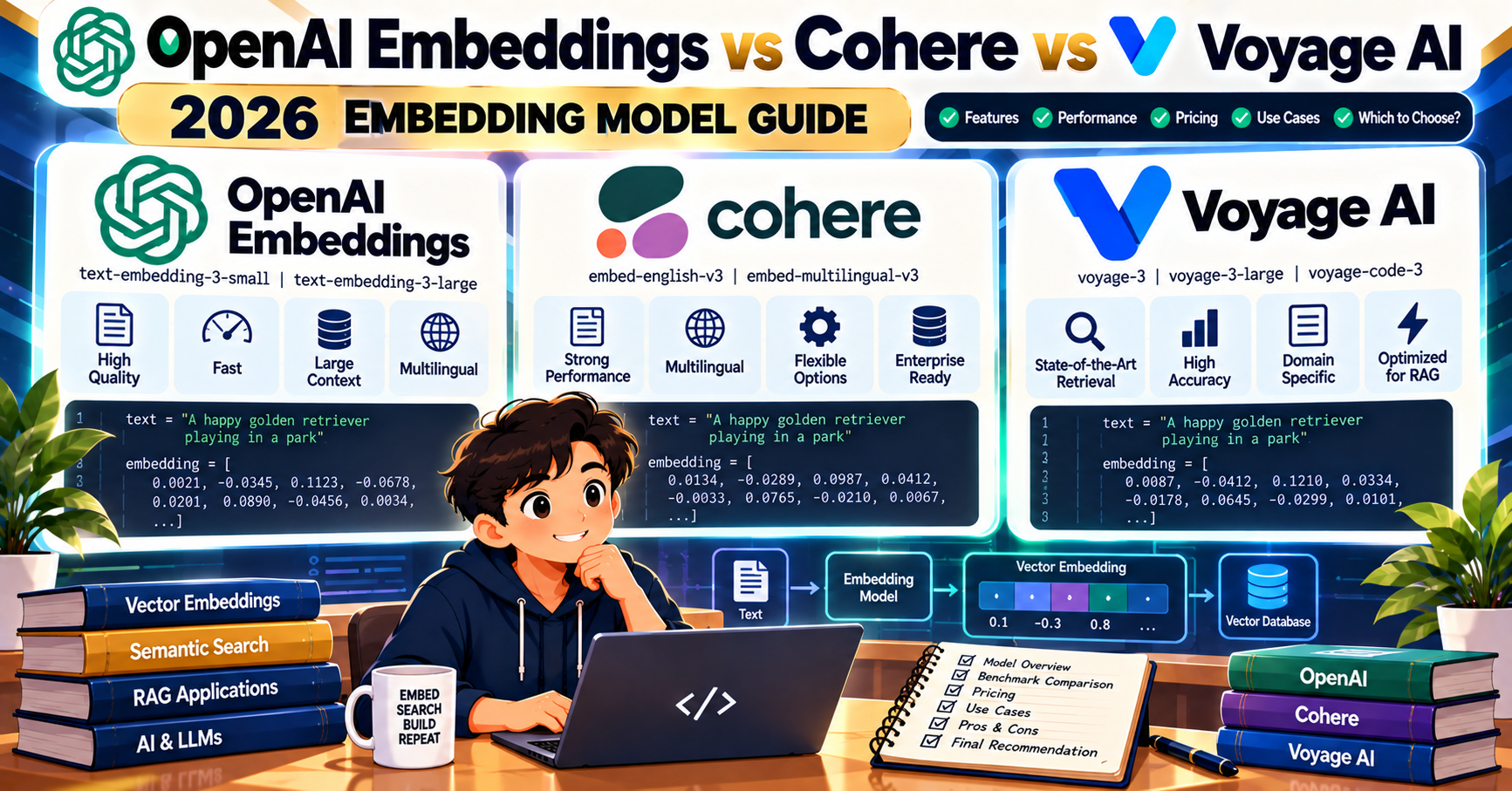
Picking an embedding model is one of those decisions that feels small but compounds. A good embedding model gives your RAG system better recall, cheaper queries, and smaller indexes. A mediocre one buries you in debugging downstream. This article compares the three serious contenders in 2026: OpenAI’s text-embedding-3 family, Cohere’s embed-v4, and Voyage AI’s voyage-3 series. The verdict depends more on your use case than on any single benchmark, so this breaks the choice down by what you are actually building.
The three embedding families at a glance
OpenAI ships two models under the text-embedding-3 banner. The small variant produces 1536-dimensional vectors and the large variant produces 3072. Both support dimension truncation (Matryoshka) so you can store shorter vectors for cheaper indexes without re-embedding. These are the general-purpose default most teams start with because the SDK is familiar and the pricing is clear.
Cohere ships embed-v4, which is multimodal (text and image in the same vector space) and multilingual with first-class support for over 100 languages. Dimensions are configurable from 256 up to 1536. Cohere’s unique angle in 2026 is that its embeddings have been fine-tuned specifically for RAG workloads, which shows up in retrieval accuracy on long-document benchmarks.
Voyage AI ships voyage-3, voyage-3-large, and domain-specific variants (voyage-code-3 for code, voyage-finance-2 for financial documents, voyage-law-2 for legal). The headline is domain specialization. If your corpus is code, financial filings, or legal contracts, voyage’s specialized models consistently beat general models on retrieval accuracy by meaningful margins.
Pricing comparison (September 2026)
- OpenAI text-embedding-3-small: $0.02 per million tokens
- OpenAI text-embedding-3-large: $0.13 per million tokens
- Cohere embed-v4: $0.10 per million tokens (text), $0.0001 per image
- Voyage voyage-3: $0.06 per million tokens
- Voyage voyage-3-large: $0.18 per million tokens
- Voyage voyage-code-3: $0.12 per million tokens
OpenAI’s text-embedding-3-small is the cheapest serious option. For most RAG applications the quality is adequate and the price is irresistible. The larger models cost 5 to 10x more and only pay back if your corpus is complex enough to need the extra fidelity.
Retrieval quality benchmarks
MTEB (Massive Text Embedding Benchmark) is the standard. September 2026 scores on the retrieval task average:
- Voyage voyage-3-large: 68.3
- OpenAI text-embedding-3-large: 64.6
- Cohere embed-v4: 64.1
- Voyage voyage-3: 63.9
- OpenAI text-embedding-3-small: 62.3
Treat these as directional. On your actual corpus the ranking can flip entirely. Voyage’s domain-specific models beat the general leaders by 3 to 6 points when the corpus matches their training domain. If you process code, finance, or legal documents, benchmark the specialized voyage model against the general leaders on your own data before committing.
Dimension and index cost
Vector dimension drives storage cost and query latency in your vector database. Here is what you get across the family:
- OpenAI text-embedding-3-small: 1536 (truncatable to 512)
- OpenAI text-embedding-3-large: 3072 (truncatable to 256)
- Cohere embed-v4: 256 to 1536 (configurable at request time)
- Voyage voyage-3: 1024
- Voyage voyage-3-large: 1024
- Voyage voyage-code-3: 1024
Smaller dimensions mean cheaper storage and faster retrieval. OpenAI’s Matryoshka truncation is useful: you can embed with the 3072-dim large model and store 512-dim vectors in production, retaining most of the quality for a fifth of the storage cost. Voyage’s standard 1024 dim is a reasonable sweet spot for most applications. Cohere’s configurable dimension gives the finest-grained control.
Multilingual and multimodal support
If your corpus is English-only, this does not apply. For anyone handling multilingual content:
- Cohere embed-v4 is multilingual by design, with high quality across over 100 languages. This is Cohere’s biggest advantage in 2026.
- OpenAI text-embedding-3 handles major languages (Spanish, French, German, Chinese, Japanese) competently but was not trained with multilingual retrieval as the primary objective. Quality drops on less common languages.
- Voyage is primarily English-focused. voyage-multilingual-2 exists for multilingual workloads but is a different product line, not the voyage-3 flagship.
Cohere embed-v4 is also multimodal: text and images share one vector space. For products that let users search by uploading a picture or by combining text and image queries, Cohere is the only serious choice among the three.
Code example: embed the same text with all three
from openai import OpenAI
import cohere
import voyageai

TEXT = "What is retrieval-augmented generation?"

openai_client = OpenAI()
openai_vec = openai_client.embeddings.create(
    model="text-embedding-3-small",
    input=TEXT,
).data[0].embedding
print(f"OpenAI: {len(openai_vec)} dims")

cohere_client = cohere.Client()
cohere_vec = cohere_client.embed(
    texts=[TEXT],
    model="embed-v4.0",
    input_type="search_query",
).embeddings[0]
print(f"Cohere: {len(cohere_vec)} dims")

voyage_client = voyageai.Client()
voyage_vec = voyage_client.embed(
    texts=[TEXT],
    model="voyage-3",
    input_type="query",
).embeddings[0]
print(f"Voyage: {len(voyage_vec)} dims")
Note how Cohere and Voyage both accept an input_type parameter that tells the model whether this text is a query or a document. This is a quality feature: the embedding model slightly adjusts the vector depending on which side of a retrieval pair it is. OpenAI does not expose this; the same model is used for both and typically produces results within 2 points of models that do split.
Which to pick for your use case
- English RAG, cost-sensitive: OpenAI text-embedding-3-small. Cheapest, familiar SDK, quality is fine for 90% of use cases.
- Multilingual content: Cohere embed-v4. Nothing else in this list is tuned for it.
- Multimodal (text + image search): Cohere embed-v4. Only serious option here.
- Code search or developer tools: Voyage voyage-code-3. Measurable gain on code retrieval benchmarks.
- Financial or legal documents: Voyage voyage-finance-2 or voyage-law-2. Same story: specialized model beats general on domain data.
- Top retrieval quality, cost is not a constraint: Voyage voyage-3-large. Highest MTEB retrieval score as of September 2026.
Frequently Asked Questions
Can I change embedding models later without rebuilding my index?
No. Different embedding models produce vectors in different coordinate spaces. If you change models, you must re-embed every document and rebuild the index. Plan for this: run embedding as a separate pipeline so you can swap models by regenerating vectors overnight.
Which embedding model is the fastest to call?
Latency is similar across all three (100 to 300 ms for a typical query embedding). Throughput for batch indexing differs: OpenAI accepts up to 2048 inputs per API call, Cohere accepts 96, Voyage accepts 128. For large indexing jobs OpenAI has an edge on batching efficiency.
Do I need to normalize embeddings before storing them?
Not for cosine similarity (the default in most vector databases). All three providers return unit-normalized vectors in 2026. For dot-product indexes you also do not need to normalize; the math works out the same when vectors are already unit length.
How do I evaluate embedding quality on my own corpus?
Build a small evaluation set: 50 to 100 questions you know the answer to, with the known-correct document chunks labeled. Run each embedding model and measure how often the correct chunk appears in the top 5 retrievals. Precision at 5 is the simplest metric that correlates well with real-world quality.
Can I combine embeddings from multiple models?
Yes, through hybrid search. Store two vectors per document (one from each model) and query both, then fuse the scores. In 2026 this is called ensemble retrieval and some RAG systems use it to squeeze out an extra few points of recall. The cost is double the storage and double the embedding spend.
Which embedding model is best for a startup prototype?
OpenAI text-embedding-3-small. Three reasons: lowest cost, most tutorial content and example repos online, and quality is adequate for the questions a prototype needs to answer. Switch to a specialized model only when you have evidence that quality is holding you back.