

Sales and Inventory System Thesis Documentation Chapter 3
This chapter about Sales and inventory System thesis document is a continuation of our previous sales and inventory system document chapter 2. In this material, we will focus on design and methodology and Project Development.
Design and Methodology
The process used to collect information and data for the purpose of making a business settlement.
The methodology can include disclosure of the research, interviews, surveys and the other research study techniques, and could include the same present and historical information.
Project Development
The project development started after conducting the interview and research about our proposed system.
The grouped decided to use the Waterfall model for our proposed system development Life Cycle (SDLC) because the proponents really believe that using this model.
The following process of this model for the development of this project is a step by step procedure to identify what the researchers are doing to develop the proposed system.

Project Development Steps
- Planning
The group conducted an interview in TH Garments Center at Tayum, Street Kabankalan City to gather data information. We have noticed that by updating their products they have to write manual in the record books and checking of the remaining items.
For our proposed system, this will help to make it faster and accurate to control the inventory of their products by updating and adding using this computerized sales and inventory system.
- Analysis
Doing the computerized sales and inventory system takes several risks, first the submission of the letter to the company, and also prepare to the problem that the system might encounter especially with regards to the security, unauthorized access and or problem to the operator’s computer system, this includes viruses that might pop in the system.
- Design
The software design is the development that matches the environment of the TH garments center for them to have easy system. The proposed system will be a major change for the establishment.
All the transactions will be computerized. With the use of the new system, it will be much easier to modify information because the database of the system holds all the messages and a user-friendly interface is provided to customizing the data.
- Implementation
After completing all the documents about the system, conducted test, and training on how to use the system and finally complete ready to be delivered in the to be used for their business work.
- Software Development
The development of the system and the programming style or way that the developers do their work.
- Testing
The group conducted some tests to make sure that the system is free of bugs and errors, this include performance and other testing procedures. It turned out good because the expected result came out to be actual results of the program.
The testing is done every time .after adding some code in the system. There are times that the expected result happens.
- Maintenance
The maintenance will be conducted once the unit delivered and deployed to the client to make sure that our system having a better performance.
If the company suggested updating some feature or adding some function for the system to make it more efficient and reliable to them they just need to contact the maintenance.
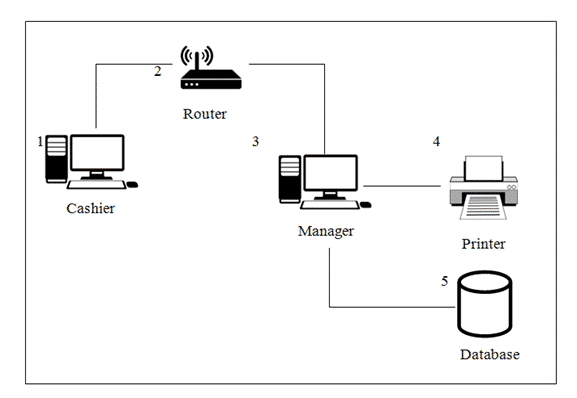
Architectural Diagram interface of hardware
The figure: 2 Architectural diagrams of TH garments center. The manager will be the admin that will manage to add staff and products, update and delete records for the database after adding the staff.
The cashier will manage his unit for the sales; he will record all the sales report and store it in the database to generate a report to the manager for the printing.
System Testing and Implementation
In order to prove that the system is ready to deploy, the client of the project and to test the system to produce reliable information that makes the project more efficient and effective system testing and implementation is very important for the client to see the effects for the difference of the manual to computerize.
System Testing
To create this project successfully, we let our BSIT-3 classmates to test our TH Garments Sales and Inventory System in order for our group to receive a message or feedbacks from the testers in order to improve our system and to make it effective and functional.
TH Garments Sales and Inventory System is a customized system was created to improve the manual system of TH Garments in order for them to have an easy process of ordering and cashiering.
System Implementation
Once the builders assured that the system is ready to be deployed after the training, the implementation plan was executed. Everything went to the plan.
The requirements for the hardware and the software were reached. The implementation was in its effective because the user of the system was easily adapting to the new system.
TH Garments Sales and Inventory System Features
- Inventory Management
- User, a customer staff, accounts management
- Report Generator
- Secure database for transaction records
Recommended hardware/Software/Network
Software Requirement:
- windows 7 ultimate/ professional
- Visual Basic 2008
- PHP, MYSQL, APACHE
- MYSQL Database and MYSQ utilities
- Crystal report
Recommended Hardware Requirement:
- Intel (R) Core(TM) i3-4170 CPU 3.70GHz
- Use memory ram 2.00GB
- Canon ip277
- Optic Mouse
- Keyboard
- Monitor
Related Capstone Resources
- Sales And Inventory System Chapter 1 Thesis Documentation
- Point Sales And Inventory System Documentation Chapter 5
- Computerized Sales And Inventory System Thesis Chapter 4
- Computerized Sales And Inventory System Thesis Chapter 2
- Sales And Inventory System Thesis Chapter 5 Concept Of Operation
- Sales And Inventory System Chapter 1 Introduction 2019 Doc
If you have any questions or suggestion about the sales and inventory system thesis document chapter 3, please feel to contact us or just leave a comment below.
Capstone chapter writing checklist
Structuring a BSIT capstone chapter correctly saves rework and eases the defense. Follow this checklist for consistent quality across all 5 chapters.
- Draft the outline first. Every section header first, then fill in the content.
- Write the methodology before the introduction. Chapter 3 (methodology) forces you to think through the system; Chapter 1 becomes easier after.
- Include diagrams early. UML diagrams in Chapter 3 clarify what you’re building.
- Cite sources as you write. Do not defer citations. Use Zotero or Mendeley to track sources.
- Get adviser feedback per chapter. Do not write all 5 chapters then ask for review.
- Number figures and tables. Figure 3.1, Table 4.2, etc. Panels reference these numbers.
- Follow the school template exactly. Font, margins, spacing — do not deviate.
Common capstone mistakes to avoid
- Copying without attribution. Panels use Turnitin. Cite everything you did not write yourself.
- Over-scoping the project. A well-executed simple system beats a poorly-executed ambitious one.
- Deferring documentation. Documentation quality is a big part of the grade.
- Skipping user testing. Panels ask about user feedback. Have real data.
- Ignoring adviser feedback. Advisers know what the panel will ask.
Recommended free tools for capstone projects
- draw.io / diagrams.net. UML diagrams for Chapter 3.
- Google Docs. Collaboration + version history + adviser comments.
- Zotero or Mendeley. Reference management + auto-formatted citations.
- GitHub. Version control for the source code (also earns E-E-A-T signal on your CV).
- Grammarly. Language + tone check on the documentation.
- Turnitin. Plagiarism check before submission (some schools provide access).
- ChatGPT or Claude. For outline scaffolding — not for writing the actual content.
Where to get more capstone resources
- Capstone project ideas. Browse itsourcecode.com/topics/fyp/ for 140+ tested capstone concepts.
- Working source code. itsourcecode.com/topics/free-projects/ has 1,000+ downloadable projects.
- UML diagrams. itsourcecode.com/uml/ has 300+ free UML examples for Chapter 3.
- ER diagrams. itsourcecode.com/topics/uml/erd/ for database schemas.
Official references
Frequently asked questions
How many pages should a BSIT capstone chapter be?
Chapter 1 (Introduction) is typically 8-12 pages. Chapter 2 (RRL) is 15-25 pages. Chapter 3 (Methodology and System Design) is 15-30 pages depending on diagram count. Chapter 4 (Results) is 10-20 pages. Chapter 5 (Conclusions) is 5-10 pages. Total: 60-100 pages for the whole capstone.
What order should I write the chapters in?
Recommended order: Chapter 3 first (system design and methodology — most concrete), then Chapter 1 (introduction with the problem statement), then Chapter 2 (RRL to justify Chapter 1), then Chapter 4 (results — after implementation), then Chapter 5 (conclusions). This avoids rewrites and speeds up defense readiness.
What formatting style should I use for the capstone documentation?
Most Philippine BSIT programs require IEEE or APA 7th edition. Confirm with your adviser first. Use Times New Roman 12pt, double-spaced, 1-inch margins, and page numbers. Reference all sources properly and use consistent citation style throughout.
How many references do I need per chapter?
Chapter 1: 5-10 references. Chapter 2 (RRL): 20-40 references. Chapter 3: 10-15 references. Chapter 4-5: minimal, mostly self-referential. Recent sources (last 5 years) are strongly preferred over older ones.
What tools help write the capstone chapters?
Zotero or Mendeley for reference management, Grammarly for language check, Turnitin for plagiarism scan, Google Docs for collaboration with adviser, LaTeX (Overleaf) for advanced formatting, and ChatGPT or Claude for outline scaffolding (not for writing the actual content).

Adrian Mercurio
Full-Stack Developer at PIES IT Solution
Specializes in building complete capstone projects with full documentation. Strong background in PHP/MySQL development and database design. Has personally built and tested over 30 capstone-ready projects with ER diagrams, DFDs, and chapter-by-chapter thesis documentation.
Expertise: PHP, Laravel, Database Design, Capstone Projects, C#, C, C++, Python, AI Projects · View all posts by Adrian Mercurio →