

Computerized sales and inventory system thesis Chapter 4
The Computerized sales and inventory system thesis chapter 4 will focus on the existing system, term and reference, Scope of the study, Scope of the existing system, the concept of operation, and the activity diagram.
The Existing System
The TH garments center is still using the current manual system for their business work staff still writes all the transactions for their business process.
Term and Reference
Objective
This section pertains to the identified objectives, which you can see the major end-results desired by this undertaking. This should be broken down into the statement of the:
General Objective
To develop a system that will enhance the monitoring of the sales and inventory of TH Garment.
Specific Objective
- To develop a module that can generate monthly sales and inventory report.
- To develop security in terms of keeping the records of the inventory
- To develop a system that can monitor the stocks inventory in a fast and efficient manner.
- To accurately record, compute and produce a report of sales.
Scope of the Study
A statement indicating the functional or application areas that will be covered by the study.
Scope of the existing System
The study only revolves in the scope of proposal sales and inventory control. The study of sales and inventory is only within TH GARMENTS. The proponents will also incorporate data reporting by producing hard copies.
The system has four distinct types of level access. First, is the authority or Admin account, second is the Inventory account, third is the Cashier account and the fourth is Sale clerk account.
Concept of Operation
The administrators gain access to and perform high-level arrangement of the features of the system. The administrators were allowed to create new user accounts, reset user password, activate or disband user accounts, and monitor all system processes.
The administrators can view and edit sales, inventory and dealers reports as well as their stock levels. The cashiers (front liners) input the actual sales transactions of the customer. They provide product descriptions and unit prices that are stored in the Sales and Inventory System databases.
This function allows maximal complaisance, security, and centralization at different levels. The cashier is responsible for the preparing of daily, weekly, monthly and annual sales reports of the TH garment Staff Clerk. The Staff/
The clerk will handle the day-to-day parts of inventory control and expenditure that serves the TH Garments.
The Activity Diagram
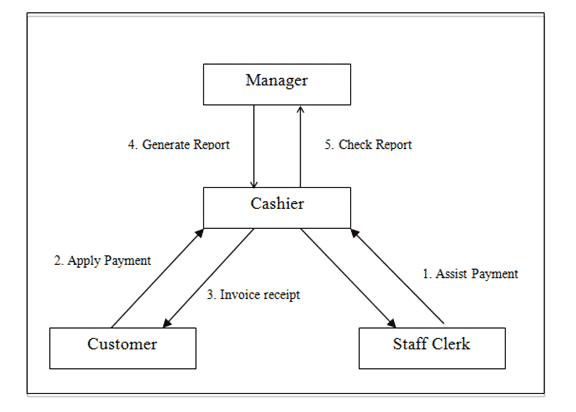
Figure 3: Existing activity diagram of TH garments show the process of their business work the first process the customer will be assisted by the customer for the item they want to purchase the second process the customer will pay the item in the cashier the third process the customer will write all the item.
Related Capstone Resources
- Sales and Inventory System Documentation Chapter 1
- Sales and Inventory System Documentation Chapter 2
- Sales and Inventory System Documentation Chapter 3
- Sales and Inventory System Documentation Chapter 5
- Sales And Inventory System Thesis Chapter 5 Concept Of Operation
- Point Sales And Inventory System Documentation Chapter 5
- Sales And Inventory System Chapter 1 Introduction Doc
Capstone chapter writing checklist
Structuring a BSIT capstone chapter correctly saves rework and eases the defense. Follow this checklist for consistent quality across all 5 chapters.
- Draft the outline first. Every section header first, then fill in the content.
- Write the methodology before the introduction. Chapter 3 (methodology) forces you to think through the system; Chapter 1 becomes easier after.
- Include diagrams early. UML diagrams in Chapter 3 clarify what you’re building.
- Cite sources as you write. Do not defer citations. Use Zotero or Mendeley to track sources.
- Get adviser feedback per chapter. Do not write all 5 chapters then ask for review.
- Number figures and tables. Figure 3.1, Table 4.2, etc. Panels reference these numbers.
- Follow the school template exactly. Font, margins, spacing — do not deviate.
Common capstone mistakes to avoid
- Copying without attribution. Panels use Turnitin. Cite everything you did not write yourself.
- Over-scoping the project. A well-executed simple system beats a poorly-executed ambitious one.
- Deferring documentation. Documentation quality is a big part of the grade.
- Skipping user testing. Panels ask about user feedback. Have real data.
- Ignoring adviser feedback. Advisers know what the panel will ask.
Recommended free tools for capstone projects
- draw.io / diagrams.net. UML diagrams for Chapter 3.
- Google Docs. Collaboration + version history + adviser comments.
- Zotero or Mendeley. Reference management + auto-formatted citations.
- GitHub. Version control for the source code (also earns E-E-A-T signal on your CV).
- Grammarly. Language + tone check on the documentation.
- Turnitin. Plagiarism check before submission (some schools provide access).
- ChatGPT or Claude. For outline scaffolding — not for writing the actual content.
Where to get more capstone resources
- Capstone project ideas. Browse itsourcecode.com/topics/fyp/ for 140+ tested capstone concepts.
- Working source code. itsourcecode.com/topics/free-projects/ has 1,000+ downloadable projects.
- UML diagrams. itsourcecode.com/uml/ has 300+ free UML examples for Chapter 3.
- ER diagrams. itsourcecode.com/topics/uml/erd/ for database schemas.
Official references
Frequently asked questions
How many pages should a BSIT capstone chapter be?
Chapter 1 (Introduction) is typically 8-12 pages. Chapter 2 (RRL) is 15-25 pages. Chapter 3 (Methodology and System Design) is 15-30 pages depending on diagram count. Chapter 4 (Results) is 10-20 pages. Chapter 5 (Conclusions) is 5-10 pages. Total: 60-100 pages for the whole capstone.
What order should I write the chapters in?
Recommended order: Chapter 3 first (system design and methodology — most concrete), then Chapter 1 (introduction with the problem statement), then Chapter 2 (RRL to justify Chapter 1), then Chapter 4 (results — after implementation), then Chapter 5 (conclusions). This avoids rewrites and speeds up defense readiness.
What formatting style should I use for the capstone documentation?
Most Philippine BSIT programs require IEEE or APA 7th edition. Confirm with your adviser first. Use Times New Roman 12pt, double-spaced, 1-inch margins, and page numbers. Reference all sources properly and use consistent citation style throughout.
How many references do I need per chapter?
Chapter 1: 5-10 references. Chapter 2 (RRL): 20-40 references. Chapter 3: 10-15 references. Chapter 4-5: minimal, mostly self-referential. Recent sources (last 5 years) are strongly preferred over older ones.
What tools help write the capstone chapters?
Zotero or Mendeley for reference management, Grammarly for language check, Turnitin for plagiarism scan, Google Docs for collaboration with adviser, LaTeX (Overleaf) for advanced formatting, and ChatGPT or Claude for outline scaffolding (not for writing the actual content).

Adrian Mercurio
Full-Stack Developer at PIES IT Solution
Specializes in building complete capstone projects with full documentation. Strong background in PHP/MySQL development and database design. Has personally built and tested over 30 capstone-ready projects with ER diagrams, DFDs, and chapter-by-chapter thesis documentation.
Expertise: PHP, Laravel, Database Design, Capstone Projects, C#, C, C++, Python, AI Projects · View all posts by Adrian Mercurio →