
You picked collections.defaultdict specifically to avoid KeyError, then it still raised one. The most common 2026 causes: you used .get() or **unpacking (which bypasses the default factory), you serialized it to JSON and back (loses the factory), or you passed the wrong callable to the constructor.
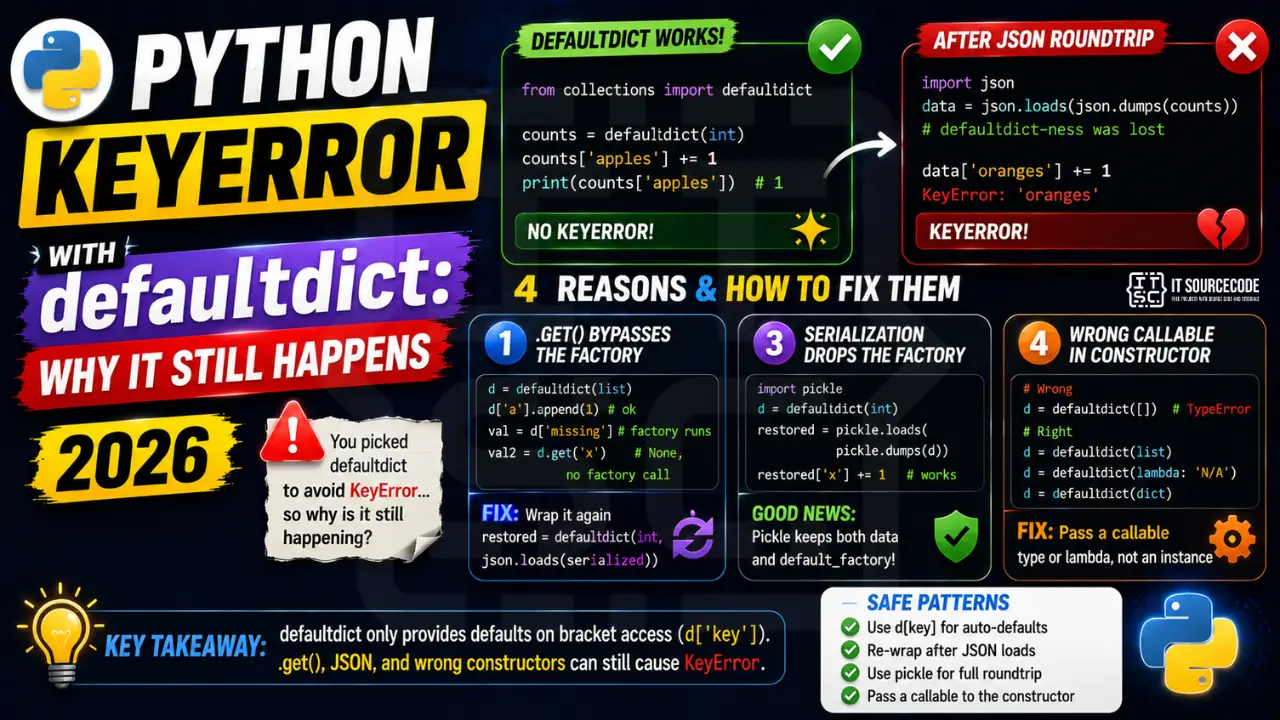
The minimal reproducer
from collections import defaultdict
counts = defaultdict(int)
counts['apples'] += 1  # works, returns 1

# Now from JSON
import json
data = json.loads(json.dumps(counts))
data['oranges'] += 1  # TypeError or KeyError, defaultdict-ness was lost
Cause 1: .get() bypasses the default factory
d = defaultdict(list)
d['a'].append(1)        # default factory runs: d['a'] = []
val = d['missing']      # default factory runs: d['missing'] = []
val2 = d.get('also_missing')  # returns None, no factory call

# .get() is just dict.get(), it doesn't know about default_factory
If you want both behaviors, call the key with bracket access first or pass an explicit default to .get().
Cause 2: Serialization drops the factory
# Wrong: defaultdict becomes plain dict after JSON roundtrip
import json
counts = defaultdict(int)
counts['apples'] = 5
serialized = json.dumps(counts)
restored = json.loads(serialized)  # restored is a plain dict
restored['oranges'] += 1  # KeyError

# Right: wrap in defaultdict after restore
restored = defaultdict(int, json.loads(serialized))
restored['oranges'] += 1  # works, returns 1
Cause 3: Pickle preserves the factory if you pickle correctly
import pickle
counts = defaultdict(int)
counts['apples'] = 5

# Pickle preserves defaultdict-ness AND the factory
restored = pickle.loads(pickle.dumps(counts))
restored['oranges'] += 1  # works, factory survives
Cause 4: Wrong callable in constructor
# Wrong: passing an instance instead of a callable
d = defaultdict([])  # TypeError: first argument must be callable

# Right: pass the type or a lambda
d = defaultdict(list)        # callable: list, calls list() = []
d = defaultdict(lambda: 'N/A')
d = defaultdict(dict)        # for nested defaultdict
When NOT to use defaultdict
| Need | Better choice |
|---|---|
| Count occurrences | collections.Counter (cleaner API) |
| Strict schema | TypedDict or Pydantic |
| JSON-friendly storage | Plain dict + setdefault() |
| Group by key | itertools.groupby or defaultdict(list) |
Why defaultdict can still raise KeyError
defaultdict only inserts the default value when you use attribute-style or subscript access. Any method that does not trigger __missing__ still raises KeyError. The common gotchas: d.pop(key), d[key] after del, and d.__getitem__ called from custom code.
Safe patterns with defaultdict
from collections import defaultdict

counts = defaultdict(int)
counts["a"] += 1
counts["b"]      # inserts 0

# WRONG: pop always raises when key is missing
# counts.pop("z")   # KeyError: z

# CORRECT: pop with default
counts.pop("z", 0)   # returns 0, no exception

# WRONG: reading after del
del counts["a"]
# print(counts["a"])   # inserts 0 again (fine but often unintended)

# CORRECT: check before del if you want to be strict
if "a" in counts:
    del counts["a"]
When to use plain dict.get vs defaultdict
- Use defaultdict when you always want to accumulate (counters, groupings).
- Use dict + .get(key, default) when reads should NOT create keys.
- Use dict + .setdefault(key, default) when the default is expensive to construct.
Real-world example: word count with defaultdict
from collections import defaultdict

text = "the quick brown fox jumps over the lazy dog the end"

counts = defaultdict(int)
for word in text.split():
    counts[word] += 1

print(dict(counts))
# {"the": 3, "quick": 1, ...}

# Now pop safely
top_freq = counts.pop("the", 0)
print(f"the appeared {top_freq} times")
When defaultdict is the wrong choice
defaultdict inserts a key on every read. If you want to check “did this key ever exist” later, defaultdict silently pollutes the dict. Use plain dict.get(key, default) when reads should not create keys.
When NOT to use defaultdict
- Read-heavy code that should NEVER create keys. defaultdict pollutes the dict on every read. Use plain dict +
.get(key, default). - Nested dictionaries built dynamically. Nested defaultdicts get confusing because reads at deep levels create parent keys too. Prefer explicit construction.
- Serialization boundaries. When you serialize the dict, the defaultdict factory is lost. If someone reloads the JSON as a plain dict, they lose the auto-insert behavior.
Quick reference summary
defaultdict is a specialized tool for accumulation patterns. Reach for it when you want write-side auto-insert semantics. Reach for plain dict + .get() for read-heavy code. Reach for .setdefault() when the default is expensive to construct. Every KeyError that survives defaultdict is a method call (pop, __delitem__ after clear) that does not trigger the __missing__ hook.
Interoperability with plain dicts
A defaultdict is a subclass of dict, so it works everywhere a plain dict is expected. When you serialize via json.dumps or pickle, the output is a plain dict. When you deserialize, you get a plain dict back, not a defaultdict. If you need auto-insert behavior on the reloaded data, wrap it: counts = defaultdict(int, loaded_dict).
Python KeyError debugging checklist
- Print the actual keys.
print(list(my_dict.keys()))shows what is available. - Check for case and whitespace. “name” vs “Name” vs ” name ” — all different keys.
- Use dict.get with default. Returns None or a fallback instead of raising.
- Guard with “key in dict”. Explicit check before access.
- Consider defaultdict or Counter. Automatic default values for missing keys.
Safe dict access patterns
# BAD — raises KeyError on missing
d = {"name": "Alice"}
age = d["age"]  # KeyError

# GOOD — several safe alternatives
age = d.get("age")                    # None if missing
age = d.get("age", 0)                 # 0 if missing
age = d.setdefault("age", 0)          # sets AND returns 0

# For nested access with fallback
from collections import defaultdict
counts = defaultdict(int)
counts["apples"] += 1                 # no KeyError, auto-init to 0

# For counting
from collections import Counter
words = Counter(["a", "b", "a", "c"])
print(words["z"])                     # 0, no KeyError
Modern tooling to prevent KeyError
- pydantic v2. Runtime validation with clear error messages.
- TypedDict + mypy. Static checking of dict shape.
- dataclasses. Attribute access is safer than dict lookup.
- pydantic-settings. For environment variables specifically.
Official documentation
Quick step-by-step summary (click to expand)
- Import defaultdict from collections. Add from collections import defaultdict at the top of your file.
- Create defaultdict with a factory function. Use d = defaultdict(list) for auto-empty lists, or defaultdict(int) for counters, or defaultdict(dict) for nested dicts.
- Access missing keys without try/except. d[missing_key] returns the factory default instead of raising KeyError, so no more if key in d guards needed.
- Convert back to regular dict when done. If you need to serialize or return the result, wrap with dict(d) to get a normal dictionary.
Frequently Asked Questions
Why does defaultdict.get() return None instead of the default?
defaultdict inherits .get() from dict, which does not call the default_factory. Bracket access d[key] is the only operation that triggers the factory. To get default-aware get, use d[key] or d.setdefault(key, factory()).
How do I serialize a defaultdict to JSON without losing the factory?
JSON cannot represent the factory. Use json.dumps(dict(my_defaultdict)) to serialize, then re-wrap on load: defaultdict(int, json.loads(text)). For full round-trip preservation, use pickle instead of JSON.
Is defaultdict thread-safe?
No. defaultdict has the same thread-safety properties as dict: individual operations are atomic under GIL but compound operations (check-then-update) are not. For multi-threaded counting, use threading.Lock or use a thread-local Counter.
Should I use defaultdict or Counter for counting?
Counter for pure counting (it has Counter() + Counter() merging, most_common(), and elements()). defaultdict(int) when you only need basic incrementing or you also store other types of values. Counter is a subclass of dict, so both work in most contexts.
Can I nest defaultdict for 2-level grouping?
Yes. Use a lambda or partial: nested = defaultdict(lambda: defaultdict(list)). Now nested[‘key1’][‘key2’].append(‘item’) works without any pre-initialization. Be careful with serialization: lambdas cannot be pickled.

Angel Jude Suarez
Full-Stack Developer at PIES IT Solution
Focuses on Python development, machine learning, and AI integration. Has built production AI systems including OpenAI Whisper integration for medical transcription and GPT-4o-powered diagnosis assistance. Strong background in pandas, scikit-learn, and TensorFlow.
Expertise: Python · PHP · Java · VB.NET · ASP.NET · Machine Learning · AI Integration · OpenCV · Django · CodeIgniter
· View all posts by Angel Jude Suarez →