
You called my_dict.pop("key") and Python crashed with KeyError. The fix is simple: my_dict.pop("key", None) returns None instead of raising. But there are subtleties around when to use which form, and how this differs from list.pop and set.discard.
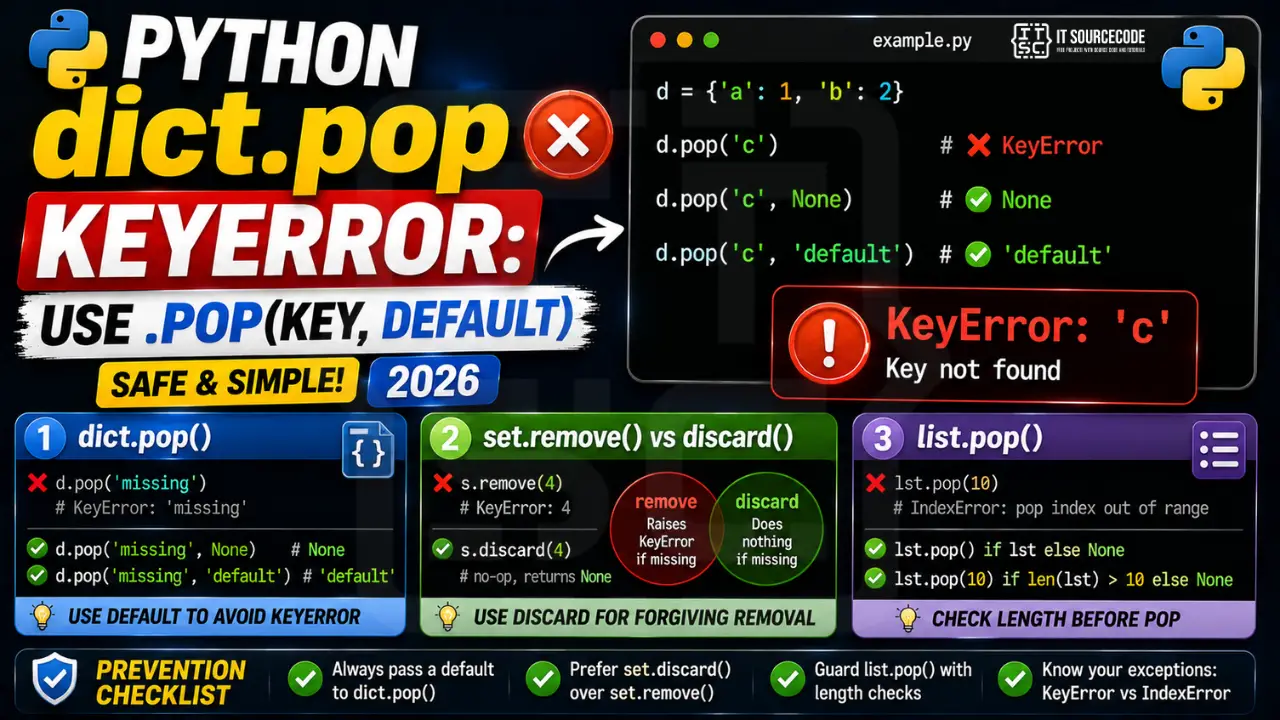
📌 Quick answer: Use my_dict.pop("key", None) for safe removal. The second argument is the default returned when the key is missing. For sets use my_set.discard("item") (no-op if missing) or my_set.remove("item") (raises KeyError if missing).
Cause 1: Bare dict.pop on absent key
Default Python behavior: raises KeyError if the key is missing.
d = {"a": 1, "b": 2}
d.pop("c")    # ❌ KeyError: 'c'
d.pop("c", None)    # ✓ returns None
d.pop("c", "default")    # ✓ returns "default"
Cause 2: set.remove() vs set.discard()
set.remove() raises KeyError if missing (same behavior as dict.pop). set.discard() silently does nothing.
s = {1, 2, 3}
s.remove(4)    # ❌ KeyError: 4
s.discard(4)   # ✓ no-op, returns None
Cause 3: list.pop confusion (different exception)
list.pop raises IndexError, not KeyError, on out-of-range index.
lst = [1, 2, 3]
lst.pop(10)    # ❌ IndexError: pop index out of range

# Safe pattern for lists
lst.pop() if lst else None    # pop last if non-empty
lst.pop(10) if len(lst) > 10 else None    # safe popping at index
Prevention
- Always pass a default to dict.pop unless missing means “fail loudly”
- Prefer set.discard() over set.remove() for forgiving removal
- For lists, guard with
if lstorif len(lst) > ibefore pop
Related Guides
Debugging checklist
- Print the dict right before
.pop(key). Confirm the key exists. - Check for stringified keys.
{"1": "x"}is different from{1: "x"}. - If iterating a dict, do not mutate it. Copy keys first:
for k in list(d.keys()).
Safe pop patterns
# Always pass a default when uncertain
value = d.pop("k", None)
value = d.pop("k", 0)          # numeric default
value = d.pop("k", "unknown")  # string default

# Or guard
if "k" in d:
    value = d.pop("k")
else:
    value = None

# Multi-key clean-up
for k in ["temp1", "temp2", "temp3"]:
    d.pop(k, None)
Real-world example: cleaning up a config dict
def sanitize_config(cfg: dict) -> dict:
    """Remove sensitive keys before logging config."""
    for key in ("password", "api_key", "secret", "token"):
        cfg.pop(key, None)
    return cfg

sample = {"host": "db.corp", "password": "s3cr3t", "port": 5432}
print(sanitize_config(sample))
# {"host": "db.corp", "port": 5432}
Related dict methods that can raise KeyError
- dict[key] read access: raises KeyError if missing. Use
.get(key, default). - dict.pop(key) without default: raises KeyError. Use
.pop(key, None). - del dict[key]: raises KeyError if missing. Guard with
if key in d: del d[key]. - dict.popitem() on empty dict: raises KeyError. Check truthiness first.
- dict[key] = … where value construction raises: the write itself does not, but nested computation might.
When guard vs default is cleaner
- Use
.pop(key, default)when the default is a simple literal. - Use
if key in dguard when you need to do something else if the key is missing (log a warning, raise a custom error). - Use
try/except KeyErrorwhen the missing case is genuinely exceptional and not expected in normal flow.
Testing your fix
import pytest

def sanitize(cfg):
    for k in ("password", "api_key", "secret"):
        cfg.pop(k, None)
    return cfg

def test_removes_password():
    assert sanitize({"host": "x", "password": "y"}) == {"host": "x"}

def test_survives_missing_keys():
    assert sanitize({"host": "x"}) == {"host": "x"}

def test_removes_all_sensitive():
    result = sanitize({"password": "1", "api_key": "2", "secret": "3", "port": 80})
    assert result == {"port": 80}
Quick reference summary
Python’s dict.pop() raises KeyError when the key is missing and no default is provided. This is different from JavaScript’s Object.pop() which silently returns undefined. Passing a default (d.pop("k", None)) makes pop safe for all cases. For one-time cleanup of multiple keys, iterate over a tuple and call pop with default for each.
Migration tips from Python 2 dict semantics
Python 2 dict.pop() raised KeyError just like Python 3, but Python 2 code often relied on has_key() which was removed. If you are porting Python 2 code that used d.has_key("k") and d.pop("k"), replace with d.pop("k", None) as the modern equivalent. Same behavior, one method call instead of two.
Threading and dict pop
Python’s dict is not thread-safe for concurrent mutation. If two threads call pop on the same dict, the outcome depends on GIL scheduling. Use threading.Lock around dict operations, or use queue.Queue which has built-in thread safety. In async code, dict operations under a single event loop are safe because there is no true concurrency at Python level.
Final tip: use type hints for dict methods
Modern Python code should include type hints on dict operations because they document the missing-key contract. Annotate a function that returns a value or None as Optional[str] so callers know to handle None. Type checkers like mypy catch missing None checks at review time, before they become KeyError bugs in production.
Python KeyError debugging checklist
- Print the actual keys.
print(list(my_dict.keys()))shows what is available. - Check for case and whitespace. “name” vs “Name” vs ” name ” — all different keys.
- Use dict.get with default. Returns None or a fallback instead of raising.
- Guard with “key in dict”. Explicit check before access.
- Consider defaultdict or Counter. Automatic default values for missing keys.
Safe dict access patterns
# BAD — raises KeyError on missing
d = {"name": "Alice"}
age = d["age"]  # KeyError

# GOOD — several safe alternatives
age = d.get("age")                    # None if missing
age = d.get("age", 0)                 # 0 if missing
age = d.setdefault("age", 0)          # sets AND returns 0

# For nested access with fallback
from collections import defaultdict
counts = defaultdict(int)
counts["apples"] += 1                 # no KeyError, auto-init to 0

# For counting
from collections import Counter
words = Counter(["a", "b", "a", "c"])
print(words["z"])                     # 0, no KeyError
Modern tooling to prevent KeyError
- pydantic v2. Runtime validation with clear error messages.
- TypedDict + mypy. Static checking of dict shape.
- dataclasses. Attribute access is safer than dict lookup.
- pydantic-settings. For environment variables specifically.
Official documentation
Quick step-by-step summary (click to expand)
- Provide a default value to pop(). Use d.pop(key, None) or d.pop(key, “default”). This returns the default instead of raising KeyError.
- Check membership before pop for conditional logic. When you need different behavior based on whether the key exists, use if key in d: value = d.pop(key).
- Use popitem() for LIFO removal. popitem() removes and returns the last inserted pair. Wrap in try KeyError except for empty dict handling.
- Reserve try/except KeyError for rare cases. The default-value pattern is cleaner. Only use try/except when missing key is truly an exceptional error condition.
Frequently Asked Questions
How do I safely pop a key from a dict in Python?
Use my_dict.pop(‘key’, None). The second argument is the default returned when the key is missing. Without it, dict.pop raises KeyError.
What’s the difference between set.remove() and set.discard()?
set.remove(item) raises KeyError if the item is missing. set.discard(item) silently does nothing. Use discard when you don’t care if the item was there; use remove when you do.
Why does list.pop() raise IndexError instead of KeyError?
Lists use position-based indexing, so out-of-range access is an IndexError, not KeyError. KeyError is for dict-style key lookups.
Can I pop multiple keys from a dict at once?
Not in one call. Use a loop: for k in keys: d.pop(k, None). Or filter into a new dict: d = {k: v for k, v in d.items() if k not in keys_to_remove}.
What does dict.popitem() do?
popitem() removes and returns an arbitrary (key, value) pair as a tuple. In Python 3.7+ it’s last-inserted (LIFO). Raises KeyError if the dict is empty. Use ‘if d: d.popitem()’ to guard.

Angel Jude Suarez
Full-Stack Developer at PIES IT Solution
Focuses on Python development, machine learning, and AI integration. Has built production AI systems including OpenAI Whisper integration for medical transcription and GPT-4o-powered diagnosis assistance. Strong background in pandas, scikit-learn, and TensorFlow.
Expertise: Python · PHP · Java · VB.NET · ASP.NET · Machine Learning · AI Integration · OpenCV · Django · CodeIgniter
· View all posts by Angel Jude Suarez →