
In this article, I will explain to you on how to turn off JavaScript in Tor Browser. By the end of this article, you will learn three easy techniques to disable JavaScript on Tor on browser.
Many Tor Browser users keep JavaScript enabled, but it’s safer to disable it when accessing onion sites (websites on Tor).
In the past, there was a vulnerability that allowed onion websites to reveal the actual IP address of Tor users.
Techniques To Disable the JavaScript on Tor
Here are the following techniques that can disable that JavaScript on Tor:
Technique 1: Edit the about:config settings
This method is the simplest because you don’t need to install anything. We just need to make some changes to the settings of Tor Browser.
Here are the simple steps:
- Open the Tor browser and go to the URL bar.
- Type “about:config” and press Enter.
- A confirmation message will appear. Click the blue button to accept it.
- In the search bar, type “javascript.enabled”.
- Find the entry for “javascript.enabled” and double click on it.
- Change the value from “True” to “False”.
- By doing this, Tor will disable JavaScript.

Technique 2: Use the JavaScript Switcher addon
The second technique is for you if there are times when you want to keep JavaScript enabled.
I’ll show you an add-on that allows you to easily turn JavaScript on and off with a single click.
Here are the three simple steps to use JavaScript Switcher in Tor Browser:
- Install JavaScript Switcher by clicking on “Add to Firefox”.
- After installation, you will notice a small button labeled “JS” on the right side of the URL bar.
- When the button is grayed out, JavaScript is disabled. When it turns green, JavaScript is enabled.
- To toggle between the two states, simply click on the button.
Initially, I was often confused about the colors that shown whether JavaScript was disabled or enabled.
However, once you start using it regularly, you’ll find the JavaScript switcher addon to be very useful.
If you prefer not to install this addon, you should try the final method!
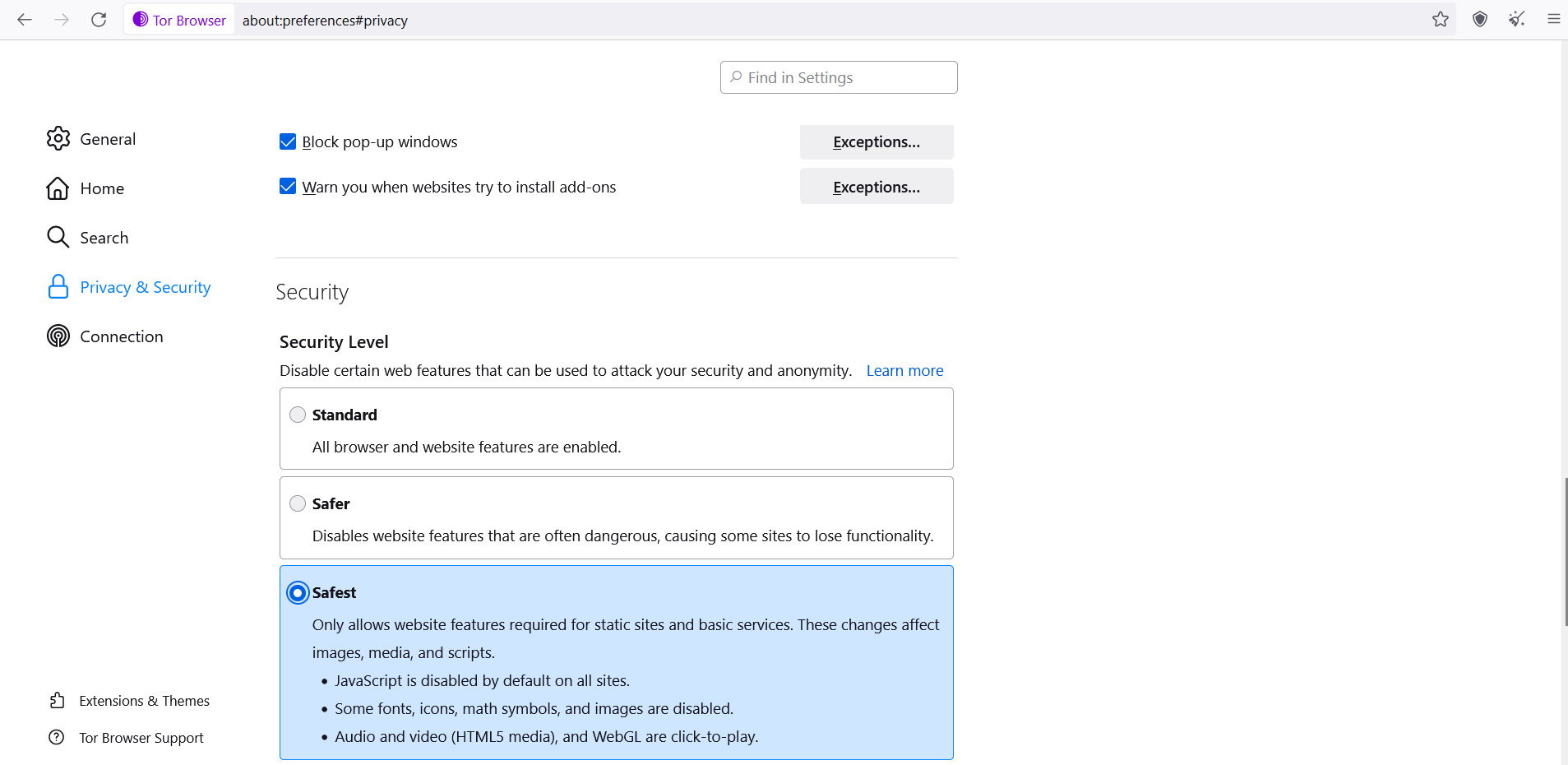
Technique 3: Disable JavaScript in Tor settings
In this final technique, we will adjust Tor’s security settings to disable JavaScript (JS).
- Open the Tor settings menu on the right.
- Choose “Preferences”.
- Click on “Privacy and Security”.
- Scroll down to the security level settings.
- Select “Safest” to disable JavaScript on all sites.
Conclusion
This is the end of the article, and now you can easily disable JavaScript! We have discussed the three techniques of How to disable JavaScript in tor.
Additional Resources
- How to Fix the Issue of $ Not Working in JavaScript?
- How to comment out multiple lines in javascript?
- How to run JavaScript in VsCode?
Common use cases for How to disable javascript in tor?
How to disable javascript in tor? appears in most modern JavaScript codebases. The most frequent patterns:
- Front-end applications. React, Vue, Svelte, and vanilla JS all rely on How to disable javascript in tor? for user interactions and rendering logic.
- Back-end services. Node.js APIs use How to disable javascript in tor? in request handlers, middleware, and data pipelines.
- Utility functions. Small reusable helpers wrap How to disable javascript in tor? to encapsulate common transformations.
- Test suites. Unit tests exercise How to disable javascript in tor? across happy-path and edge-case inputs to lock behavior.
- Configuration handling. Read from environment variables or config files and normalize with How to disable javascript in tor? before use.
Working code example
// A realistic example of How to disable javascript in tor? in production code
function processInput(rawValue) {
  // Guard against unexpected input
  if (rawValue == null) {
    return { ok: false, reason: "empty input" };
  }

  const cleaned = String(rawValue).trim();
  if (cleaned.length === 0) {
    return { ok: false, reason: "whitespace only" };
  }

  return { ok: true, value: cleaned };
}

const result = processInput("  hello world  ");
console.log(result); // { ok: true, value: "hello world" }
Best practices when working with How to disable javascript in tor?
- Use strict mode. Add “use strict” at the top of your files, or use ES modules which are strict by default.
- Prefer const over let. Only use let when you actually reassign. Never use var in new code.
- Add TypeScript. Adopting TypeScript catches many bugs in How to disable javascript in tor? at compile time.
- Write focused functions. Small functions with a single responsibility are easier to test and reason about.
- Add unit tests. Cover the happy path plus edge cases like empty strings, null, undefined, and boundary numbers.
Common pitfalls with How to disable javascript in tor?
- Type coercion surprises. == does implicit conversion. Always use === and !== unless you specifically want coercion.
- Hoisting confusion. Function declarations hoist, but const/let do not. Declare before use.
- this binding. Arrow functions inherit this from the surrounding scope. Regular functions do not. Choose deliberately.
- Silent NaN propagation. Math with a NaN value results in NaN. Guard with Number.isFinite() at boundaries.
Official documentation
Frequently Asked Questions
Is JavaScript still worth learning in 2026?
What is the difference between var, let, and const?
Which JavaScript version should I target in 2026?
What is the best free editor for JavaScript?
How do I run JavaScript locally vs in the browser?
What can I build with JavaScript for my BSIT capstone?

Adones Evangelista
Programmer & Technical Writer at PIES IT Solution
Adones Evangelista is a programmer and writer at PIES IT Solution, author of over 900 tutorials and error-fix guides at itsourcecode.com. Specializes in JavaScript, Django, Laravel, and Python error debugging covering ValueError, TypeError, AttributeError, ModuleNotFoundError, and RuntimeError, plus C/C++ and PHP capstone projects for BSIT students.
Expertise: JavaScript · Python · Django · Laravel · Error Debugging · C/C++
· View all posts by Adones Evangelista →