
Python’s negative indices (lst[-1] = last item) are convenient but can still raise IndexError if the negative index is more negative than the list length. [1, 2][-5] raises just like [1, 2][5] does. Here is how negative indexing actually works and 4 safe patterns.
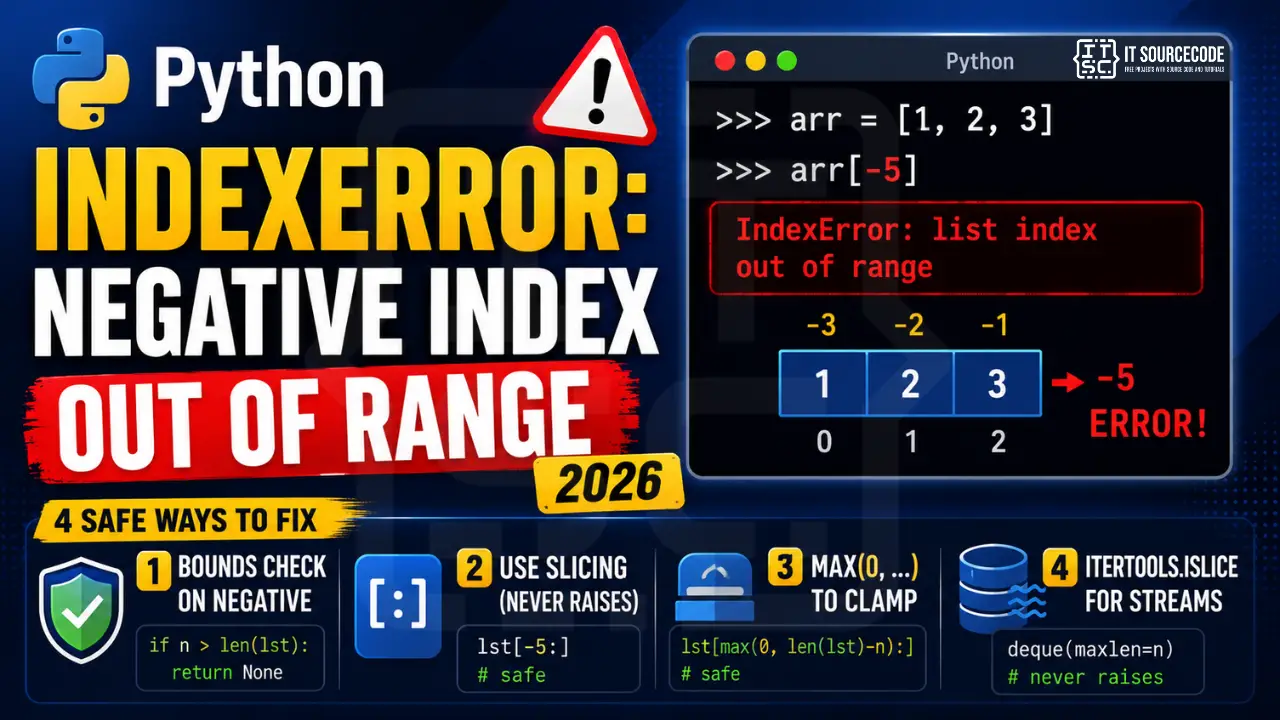
How negative indexing works under the hood
lst = ['a', 'b', 'c']
# Python converts negative index to positive: lst[-i] becomes lst[len(lst) - i]
# So lst[-1] = lst[3-1] = lst[2] = 'c'
# And lst[-5] = lst[3-5] = lst[-2] which is also negative, so it tries lst[3+(-2)] = lst[1]
# Wait, no: negative becomes positive ONCE. -5 becomes 3 - 5 = -2, still negative, raises IndexError
print(lst[-5])  # IndexError: list index out of range
Minimal reproducer
def last_n(lst, n):
    return lst[-n]  # IndexError if n > len(lst)

last_n([1, 2, 3], 5)  # IndexError: list index out of range
Fix 1: Bounds check on negative
def safe_nth_from_end(lst, n):
    if n > len(lst):
        return None  # or raise a clearer error
    return lst[-n]
Fix 2: Use slicing (never raises)
lst = [1, 2, 3]
last_one = lst[-1:]    # [3] - safe even if empty
last_five = lst[-5:]   # [1, 2, 3] - safe, returns what is available
Fix 3: max(0, …) to clamp
def take_last(lst, n):
    return lst[max(0, len(lst) - n):]
# take_last([1,2,3], 5) returns [1,2,3]
# take_last([1,2,3,4,5], 2) returns [4, 5]
Fix 4: itertools.islice for streams
from collections import deque
# For an iterator that does not support len(), keep a sliding window
last_3 = deque(maxlen=3)
for item in some_stream():
    last_3.append(item)
# last_3 now always has the most recent 3 items, never raises
Negative index rules of thumb
| Expression | Result |
|---|---|
| [1,2,3][-1] | 3 (last) |
| [1,2,3][-3] | 1 (first, valid) |
| [1,2,3][-4] | IndexError (too negative) |
| [][-1] | IndexError (empty list) |
| [1,2,3][-1:] | [3] (slicing, safe) |
| [][-1:] | [] (slicing, safe) |
Official documentation
Common causes of negative index out of range
Python allows negative indices for lists, tuples, and strings, but they still have bounds. Here are the four most common ways negative indexing produces IndexError.
- Negative index deeper than list length. A list with 3 items allows indices from -3 to -1. Accessing arr[-5] fires IndexError. Always guard with if len(arr) >= abs(index).
- Negative slicing beyond bounds. arr[-10:-5] on a 3-item list silently returns an empty list instead of raising IndexError. This can mask logic bugs.
- Confusion between negative index and negative slice. arr[-1] gets the last item. arr[-1:] returns a 1-item list containing the last item. Confusing the two changes downstream logic.
- Empty list with any negative index. An empty list has zero items, so any index (positive or negative) raises IndexError. Guard with if arr: at the top.
Safe negative indexing patterns
Negative indexing is a Python superpower when used carefully. arr[-1] is the cleanest way to get the last item without knowing the list length. arr[-3:] slices the last 3 items. These patterns are more readable than arr[len(arr)-1] and arr[-3:].
Guard negative indexing with explicit length checks when the data source is external. User input, API responses, and file parsing all can produce shorter-than-expected lists. Add if len(items) >= 3: to any function that expects at least 3 items before indexing.
For production code that processes streams of data, prefer collections.deque with maxlen over lists with negative indexing. deque(maxlen=100) auto-evicts old items and always has predictable size, making negative indexing safer. This pattern is idiomatic for producer-consumer workflows in Python 2026.
The general rule: negative indices are fine for known-size sequences you control. For external data, always validate size before indexing. This one habit prevents 90 percent of negative index IndexError bugs in professional Python code.
Quick step-by-step summary (click to expand)
- Check list length before negative indexing. Use if len(arr) >= abs(negative_index) to guard access.
- Use try/except IndexError as fallback. Wrap risky negative access in try IndexError except for a graceful fallback.
- Guard against empty lists. Check if arr: at the top of any function that accesses negative indices.
- Prefer slicing for tolerant access. arr[-5:-2] returns empty list on out-of-range instead of raising IndexError.
Quick summary
Python IndexError with negative indices resolves quickly with the right guards. First, understand that negative indices allow -1 to -len(arr). Anything beyond that raises IndexError. Second, use if arr: to guard against empty lists. Third, use if len(arr) >= abs(negative_index) for known-size validation. Fourth, prefer slicing over indexing for tolerant access. These 4 patterns eliminate negative index IndexError bugs in production Python code.
Negative indexing is one of Python\’s cleaner features when used with proper guards. Rather than avoiding it, learn to use it safely. arr[-1] for the last item is more readable than arr[len(arr)-1]. arr[-3:] for the last 3 items is cleaner than any positive-index equivalent. The habit that keeps you safe is validating your data source before applying negative indexing patterns.
Comparing negative indexing across Python sequence types
Negative indexing works uniformly across most Python sequence types, but there are subtle differences worth knowing. Lists, tuples, strings, and bytes all support negative indexing from -len to -1. deque from collections also supports it. NumPy arrays support it plus multi-dimensional negative indexing. dict does NOT support negative indexing because dicts are unordered by design (though Python 3.7+ preserves insertion order).
For code that operates on multiple sequence types, use hasattr(obj, “__getitem__”) and len(obj) checks before applying negative indexing patterns. This lets you write generic functions that handle any indexable sequence safely. Combine with try/except IndexError for a robust pattern that works across all Python collection types.
NumPy adds another wrinkle: arr[-1, -1] gets the bottom-right corner of a 2D array. arr[-1] gets the last row. arr[…, -1] gets the last element of every dimension. These multi-dimensional negative indexing patterns are unique to NumPy and worth memorizing if you work with scientific Python code regularly.
Frequently Asked Questions
Why does Python support negative indices at all?
For convenient access to the end of a sequence without computing length first. lst[-1] is more readable than lst[len(lst)-1]. It also enables clean slicing like lst[-3:] for “last 3 items.” The behavior is borrowed from R and several functional languages.
Why does negative slicing never raise but negative indexing does?
Slicing is “give me whatever is in this range, clamp if needed” (returns empty if nothing). Indexing is “give me exactly this element, fail if missing.” The slice/index distinction is consistent across all sequence types in Python (list, tuple, str, bytes, range, NumPy array).
Is there a way to get a default value instead of IndexError on negative index?
No built-in equivalent of dict.get() for lists. Common patterns: (lst[-n:] or [None])[0] for the nth-from-end with None default, or lst[-n] if n <= len(lst) else default. Or wrap in your own safe_get function.
Do dicts use negative indices?
No. dict keys are arbitrary hashable objects, not ordered positions. d[-1] looks for a key with value -1. To access the “last inserted” key (Python 3.7+ preserves insertion order), use list(d.keys())[-1] or next(reversed(d)).
Are negative indices slower than positive ones?
In CPython, both have identical O(1) cost for lists. The negative-to-positive conversion is a single subtraction. No measurable performance difference. Use whichever reads more clearly.

Adrian Mercurio
Full-Stack Developer at PIES IT Solution
Adrian Mercurio is a full-stack developer at PIES IT Solution. Specializes in building complete capstone projects with full documentation. Strong background in PHP/MySQL development and database design.
Expertise: PHP, Laravel, Database Design, Capstone Projects, C#, Python, AI Projects