
Almost every Filipino I know uses either GCash, Maya, or both. Both are legit, both are safe, both let you pay bills, transfer money, save, invest, and cash out. So the real question is not which one is better in general but which one is better for how YOU use it. In this article I will walk through the honest 2026 comparison, based on how I actually use them and what my friends here in Negros use them for.
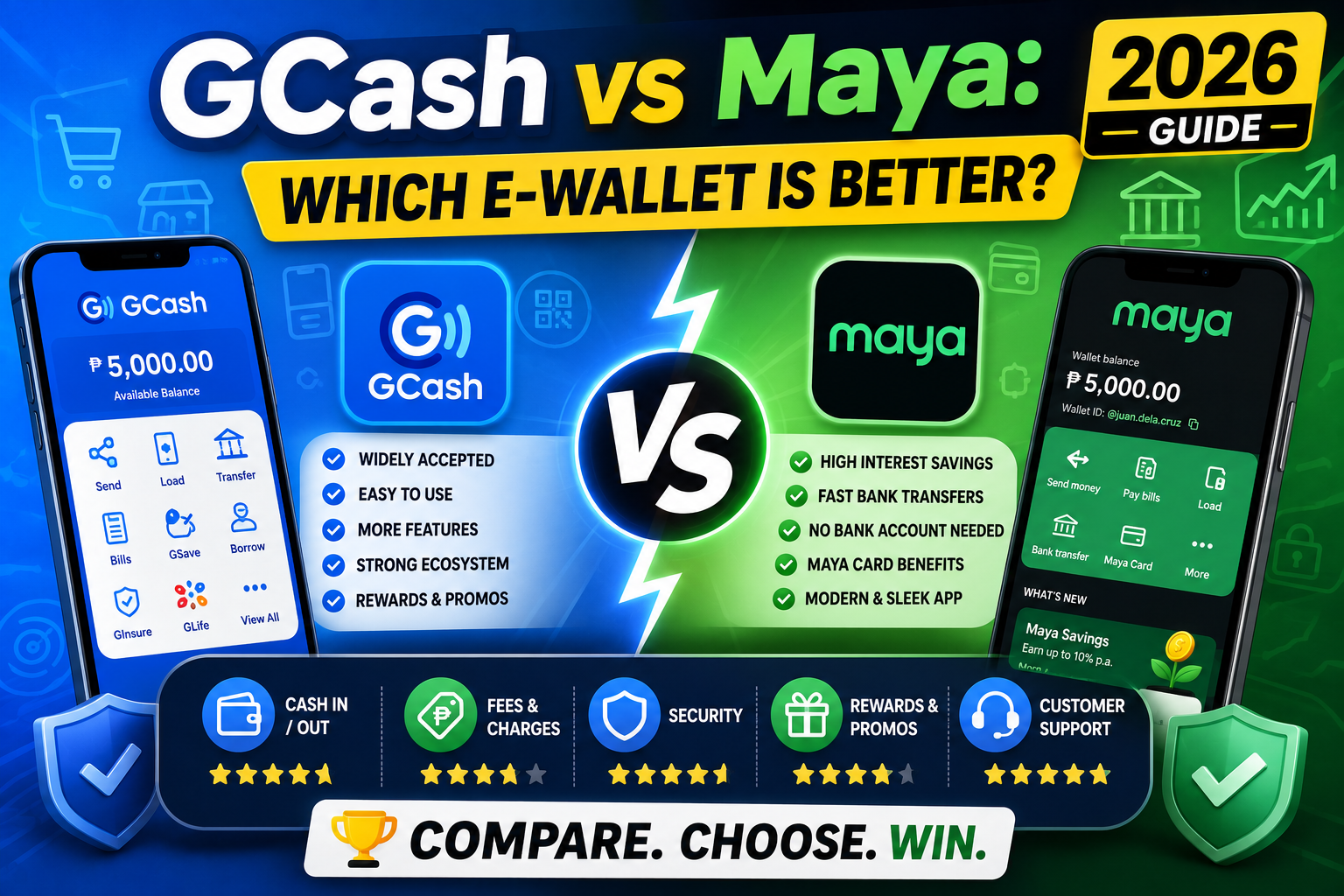
Quick verdict up front
- Pick GCash if you receive money from PayPal, use GCredit for buy-now-pay-later, or want the biggest merchant network for QR payments.
- Pick Maya if you want the best savings interest rate (up to 15% p.a. for eligible users), a debit card that works overseas, or seamless integration with UnionBank.
- Use both if you can afford the mental overhead. Different tools for different jobs.
Now let us go into the details.
User base and adoption
- GCash: Over 90 million users in the Philippines as of 2026. Owned by Mynt (a Globe Telecom + Ant Group + Ayala partnership).
- Maya: Around 40 million users. Owned by Voyager Innovations (a PLDT-backed group). Formerly known as PayMaya.
GCash’s larger user base matters if you send money to random merchants (sari-sari store, jeepney driver, freelance graphic artist) because more of them accept GCash than Maya. For sending to specific people, both work fine.
Fees head-to-head
| Transaction | GCash | Maya |
|---|---|---|
| Send to same-wallet user | Free | Free |
| InstaPay to bank (as of Jul 4, 2026) | PHP 10 | PHP 10 |
| Cash in via 7-Eleven | PHP 20 | PHP 20 |
| Cash in via bank transfer | Free | Free |
| ATM withdrawal (partner banks) | PHP 8-20 | PHP 15 (unlimited free with Maya+ debit card via BancNet) |
| Bills payment (most billers) | Free | Free |
| Cash out at physical partner | PHP 20-40 | PHP 15-30 |
Fees are basically the same for daily transactions. Maya has a slight edge on ATM withdrawals if you have their debit card. GCash has a slight edge in bill payment coverage.
Savings interest rate
This is the biggest difference in 2026:
- GSave (GCash): 2.6% p.a. on regular GSave (via CIMB Bank). Higher tiers via GSave+ at 3.5% p.a. Interest paid daily.
- Maya Savings: Up to 15% p.a. for the first PHP 5,000 if you meet monthly activity requirements (5+ transactions per month). Base rate around 6% p.a. for lower balances.
Maya wins here for small savers. If you park PHP 5,000 in Maya and hit activity requirements, you can earn around PHP 750/year vs PHP 130 on GCash. Not life-changing money but real.
The catch: Maya’s high rate applies only to the first PHP 5,000. Above that, the rate drops sharply. So Maya wins for people saving PHP 100 to PHP 5,000. For larger savings, look at real banks (RCBC High-5, Union Digital 4%, Tonik 6%).
Credit and buy-now-pay-later
- GCredit (GCash): Revolving credit line up to PHP 100,000 (limits depend on GScore). Pay bills, cash out, or use anywhere GCash accepts. Interest around 5% per month if unpaid.
- Maya Credit: Buy-now-pay-later at select merchants. Smaller ecosystem than GCredit. No general-purpose revolving credit like GCredit yet.
GCash wins for credit. GCredit is genuinely useful for emergencies or spreading larger purchases across 2-3 pay cycles.
Investing
- GInvest (GCash): Access to local UITFs (mutual funds) with a PHP 50 minimum. Categories include conservative, moderate, and aggressive.
- Maya Investments: Similar UITF access via ATRAM. PHP 50 minimum.
Both are fine for beginners. GCash has slightly more fund options and better educational content in the app. Neither is a real investment platform for serious investors (use Stocks.PH or COL Financial for that).
International use (debit card and cash outside PH)
- GCash: Offers a virtual card powered by Visa. Works for online purchases in USD and other currencies. No physical card option.
- Maya: Physical Maya+ debit card powered by Visa. Works at ATMs worldwide. Foreign transaction fee around 3.5%.
Maya wins if you travel or shop online in USD frequently. GCash’s virtual card works but not for physical ATM withdrawal abroad.
PayPal integration
GCash has a direct cash-in option for PayPal transfers. Maya does not yet (as of Q3 2026). If you receive USD from clients or family abroad via PayPal, GCash is the direct path. For Maya, you would need to transfer PayPal to a US bank first, then to Maya via SWIFT which takes days.
Merchant acceptance
GCash QR is at more merchants: sari-sari stores, jeepneys (some routes), tricycles, market vendors, most food delivery apps. Maya QR is common at bigger chains (7-Eleven, McDonalds, SM stores) but thinner on the smaller-vendor side.
Practical rule: GCash for everyday small purchases, Maya for planned bigger transactions at chain stores.
Security
Both use 2FA, PIN/biometric login, and transaction alerts. Both have had fraud incidents (GCash lost-fund reports covered by Inquirer in 2024-2025; Maya had smaller-scale issues). Both companies now provide fraud reversal for verified cases.
Best practice regardless of which wallet you use: enable biometric login, never share your MPIN, and be careful with links from SMS or email claiming to be from the wallet. Both wallets have official in-app support if you suspect fraud.
Which one for specific use cases
Freelancer receiving USD from clients: GCash (PayPal integration).
OFW sending money home: Both work. Wise to either wallet is cheapest. Direct sender preference decides.
Small business accepting payments: GCash (larger merchant network + GCash for Business tools).
Student saving allowance: Maya (15% p.a. on first PHP 5,000 is genuinely useful).
Someone who wants a debit card that works abroad: Maya (physical card).
Bill payment center: GCash (broader biller coverage).
Investment beginner: Both equal. Whichever is already installed.
The pragmatic answer: use both
Most people I know have both installed. GCash for daily payments and receiving from PayPal. Maya for savings and the debit card. They complement each other more than compete.
The one time you should stick to just one: if you find yourself confused about which balance is where and forgetting which wallet holds your bill money. In that case, pick one, uninstall the other, and simplify your life.
I hope this article helps. If you have a specific scenario I did not cover, drop a comment on our Contact page or message us on Facebook.
Official documentation
Frequently asked questions
Is GCash safer than Maya or vice versa?
Both are BSP-regulated and use bank-grade security. Both have had fraud incidents. Neither is meaningfully safer than the other. What matters more is your own security habits: use biometric login, never share your MPIN, and report suspicious activity immediately.
Can I transfer money between GCash and Maya?
Yes, via InstaPay. From GCash, tap Send Money > Bank Transfer > select Maya. Same from Maya. Fee is PHP 10 per transfer (dropped from PHP 15 on July 4, 2026). Arrives within 30 seconds most of the time.
Which has better customer service, GCash or Maya?
Both are known for slow customer service. GCash has larger volume so wait times are typically longer (24-72 hours for chat, 3-5 days for complex issues). Maya’s smaller user base means slightly faster response. Neither has a physical office you can walk into.
Does Maya really pay 15% interest per year?
Yes but with conditions. The 15% rate is on the first PHP 5,000 of your Maya Savings balance, and only if you meet monthly activity requirements (usually 5+ transactions per month). Above PHP 5,000, the rate drops. For larger savings, use a real digital bank.
Can I use both GCash and Maya on the same phone number?
Yes. Both apps allow one account per mobile number and both can be installed on the same phone. Log in with the same PH mobile number on each. Verification is done separately per wallet.
Is it worth switching from GCash to Maya (or the other way)?
Usually not worth switching completely. Add the second one alongside the first for use cases where it wins. Only switch entirely if you have a very specific need (like wanting the Maya+ physical card and disliking GCash’s UI). The daily-payment features are nearly identical.

Joken E. Villanueva
Founder & Lead Developer at PIES IT Solution
Founder of PIES Information Technology Solutions, a software company building production-grade applications for institutions across the Philippines. Over 8 years of hands-on full-stack development experience, currently leading the development of ClinicAI, an AI-powered clinic management platform.
Expertise: PHP · MySQL · JavaScript · AI Integration · SaaS Architecture · VB.NET · Database Design · Capstone Documentation · Java · View all posts by Joken E. Villanueva →