
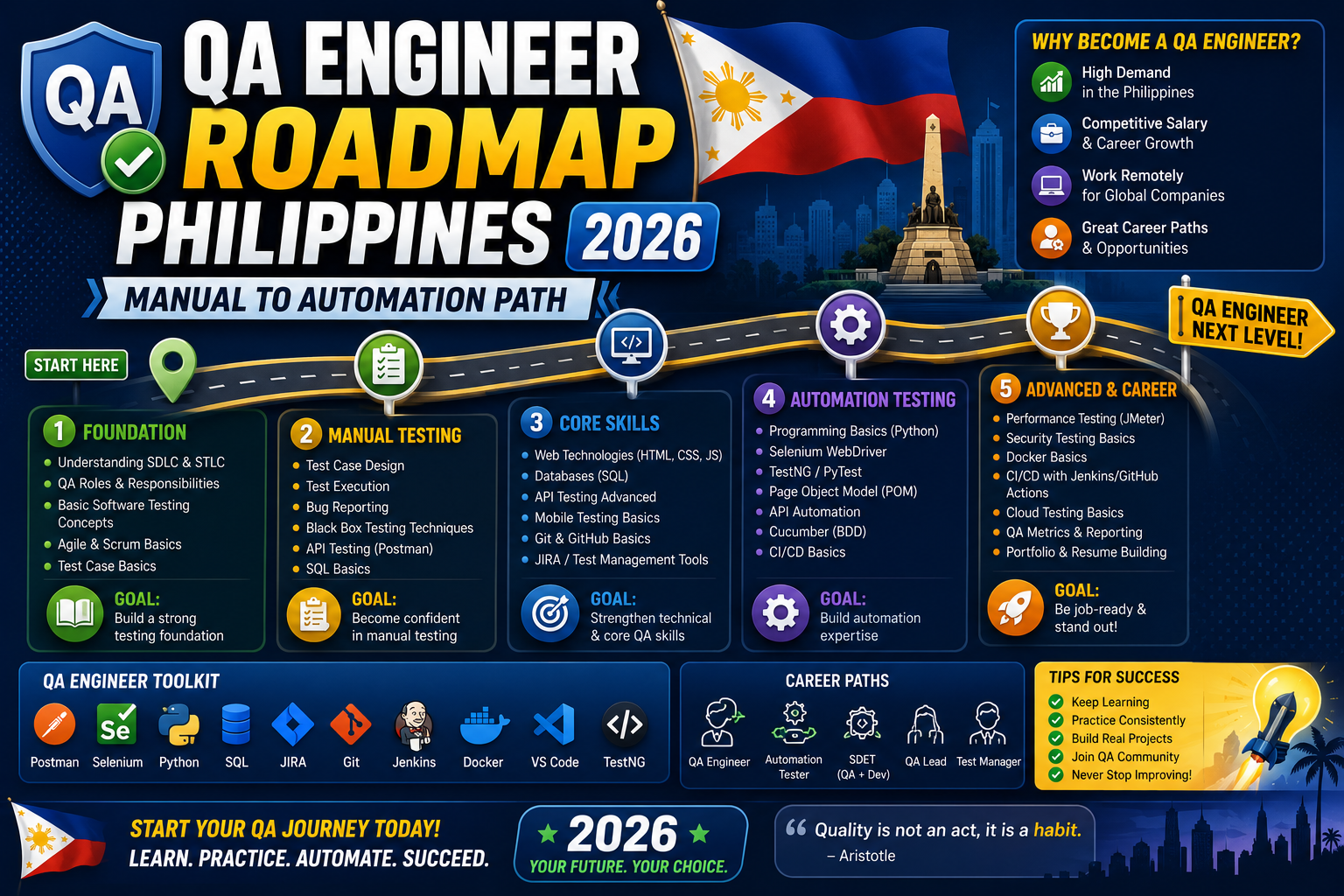
Quality Assurance is one of the steadiest tech career paths in the Philippines. Manual QA has always been in demand at BPOs, but the biggest salary jumps come when you shift into automation (Cypress, Playwright, Selenium, Appium). This 2026 guide covers the roadmap from Manual QA to Senior Automation Engineer, salary ranges at each step, and which tools to invest time in.
Manual QA vs Automation QA vs SDET
Three related but distinct roles:
- Manual QA (also called QA Tester): Tests software by hand. Writes test cases, executes them, reports bugs. No code required.
- Automation QA (Test Automation Engineer): Writes automated tests in a scripting language. Cypress, Playwright, Selenium are typical tools. Salary tier above manual.
- SDET (Software Development Engineer in Test): Blends dev and QA. Writes code that tests code, builds test frameworks, and often contributes to production code. Highest QA-track salaries.
The industry trend: manual QA salaries are stagnant. Automation is where the growth is. Almost every Filipino QA career path today aims at automation within 2-3 years of starting.
Salary ranges in the Philippines (2026)
Manual QA:
- Junior (0-1 year): PHP 20,000 to 35,000 monthly.
- Mid (1-3 years): PHP 35,000 to 55,000.
- Senior (3-5+ years): PHP 55,000 to 85,000. Growth caps here.
Automation QA:
- Junior (0-2 years, transitioning from manual): PHP 40,000 to 65,000.
- Mid (2-4 years automation experience): PHP 70,000 to 110,000.
- Senior (4-7 years): PHP 120,000 to 180,000.
SDET:
- Junior (5+ years total, transitioning from automation): PHP 90,000 to 130,000.
- Mid (7+ years): PHP 140,000 to 200,000.
- Senior (10+ years): PHP 200,000 to 320,000+.
Remote for foreign companies:
- Senior Automation Engineer remote for US: USD 3,500 to 6,500 monthly (PHP 200,000-370,000).
- SDET remote for US mid-size company: USD 5,500 to 9,000 monthly (PHP 310,000-510,000).
Roadmap: Manual QA → Automation QA in 12-18 months
Month 1-3: Learn a scripting language. JavaScript or Python. Focus on syntax, data structures (arrays, objects, dicts), and functions. Free resources: freeCodeCamp for JS, Codecademy Python. Aim for 100 hours of coding practice.
Month 4-6: Learn a test framework. Choose Cypress (JS, browser-based) or Playwright (JS/TS/Python, browser + API). Both are 2026’s dominant tools. Selenium is legacy but still widely used at enterprise/BPO. Playwright is the safer future bet.
Month 7-9: Write real automated tests. Take your current manual test cases and automate them. Build a small test suite of 20-30 tests covering login, forms, and navigation.
Month 10-12: CI/CD integration. Get your tests running in GitHub Actions or GitLab CI. Learn to interpret test failures and diagnose flaky tests.
Month 13-15: API testing. Learn Postman (manual) and either RestAssured (Java), Playwright’s API testing, or Python’s requests library for automation.
Month 16-18: Mobile testing (optional). If you want to work with mobile apps, learn Appium. Otherwise, skip and specialize deeper in web.
By month 18, apply for Junior Automation QA roles. Salary jump of PHP 15,000-30,000 monthly is realistic.
Best test automation tools to learn in 2026
- Playwright: Best all-around for web testing. Fast, reliable, works with JS/TS/Python. Growing fastest in job listings.
- Cypress: Very popular, especially in JS shops. Slightly slower than Playwright for large test suites.
- Selenium: The legacy standard. Still used at big BPOs. Not the future but knowing it is a plus.
- Appium: For mobile app testing (Android and iOS).
- Postman + Newman: API testing standard. Everyone uses Postman for manual API testing.
- k6 or JMeter: Performance and load testing.
- Cucumber (Gherkin): BDD framework used in enterprise. Reads like plain English.
Learn ONE web framework deeply (Playwright or Cypress) plus API testing basics. That combination lands you 80% of Automation QA roles.
SDET path (for senior QA who want the top salary)
To move from Automation Engineer to SDET, you need to:
- Build test frameworks, not just tests. Design page object models, custom assertions, test data factories.
- Contribute to production code (bug fixes, small features). Get comfortable in the dev codebase.
- Own the test infrastructure: CI pipelines, test environments, test data management.
- Advocate for quality practices in engineering (code review, TDD, testability improvements).
SDET salaries top out higher than Senior Backend Developer at the same tenure. The role is harder to reach but the ceiling is much higher.
Best companies hiring QA in the Philippines
- BPOs with software development: Accenture, Cognizant, Wipro, IBM, Infosys. Highest QA hiring volume.
- Local fintechs: GCash, Maya, Union Bank, RCBC. Strong Automation QA demand.
- E-commerce: Lazada, Shopee. Both mobile and web automation.
- Product SaaS: Sprout Solutions, Kumu, Payoneer.
- Foreign remote: Toptal, Turing, and direct US startup hires (LinkedIn, WeWorkRemotely).
Certifications worth the money
- ISTQB Foundation Level: Entry-level QA certification. Cheap (about PHP 8,000) and widely recognized at BPOs. Good for landing your first QA job.
- ISTQB Advanced Level Test Automation Engineer: Higher tier, worth it for senior positions.
- Playwright / Cypress certification: Not offered by official tool vendors, but Test Automation University (free) courses serve the same signaling purpose.
- AWS Cloud Practitioner: Not QA-specific but adds value for QA roles at cloud-heavy shops.
The pattern: certifications are less important than a strong portfolio. A GitHub repo with a well-structured test suite you built is worth more than a paper cert.
Skills matrix by role level
Manual QA: test case writing, bug reporting (Jira/Bugzilla), exploratory testing, basic SQL, cross-browser testing.
Automation QA: above + JavaScript or Python, Playwright/Cypress/Selenium, Git basics, CI/CD (GitHub Actions).
Senior Automation: above + API testing (Postman + code), advanced framework design, test data management, flaky test debugging.
SDET: above + Docker basics, contribute to production code, Kubernetes basics, observability tools (Datadog, Grafana), infrastructure-as-code basics.
Common mistakes on the QA career path
- Staying in manual QA too long. After 2-3 years, salary growth stalls. Move to automation.
- Learning Selenium first in 2026. Selenium is legacy. Learn Playwright or Cypress instead unless you specifically target a Selenium-heavy shop.
- Only learning one language. Being locked into one framework limits opportunities. Learn Playwright with both JS AND Python variants to double your job pool.
- Ignoring CI/CD. Modern QA runs tests in pipelines, not on local machines. Learn GitHub Actions basics; it takes a weekend.
- Skipping API testing. Backend systems increasingly outnumber UI. API tests are faster, more reliable, and demanded at every senior QA role.
- Undervaluing communication. QAs who write clear bug reports, communicate reproducibility, and work well with devs get promoted faster than those who just find bugs.
2026 outlook for Filipino QA Engineers
Manual QA demand is flat or slightly declining as automation absorbs entry-level testing. Automation QA demand is growing 15-25% year-over-year. SDET roles are the growth area with the biggest salary jumps.
AI-assisted testing (like using LLMs to generate test cases) is entering the field. Junior QAs who leverage these tools become more productive. Junior QAs who ignore them get outpaced.
Foreign remote QA roles are the biggest single career unlock: USD-denominated pay for Filipino QA with strong automation portfolios.
Official documentation
Frequently asked questions
Can I become a QA Engineer without a Computer Science degree?
Yes. Most Filipino Manual QAs come from BSIT, non-tech backgrounds, or self-taught paths. What matters is attention to detail, ability to reproduce issues clearly, and (for automation) willingness to learn code. Boot camp grads land QA jobs regularly.
Is Manual QA a dying career?
Not dying but flat. Salary growth in pure Manual QA plateaus after 3-5 years. The path forward is always adding automation skills. If you stay purely manual past 5 years, salary tops out around PHP 70,000-85,000.
Should I learn Playwright or Cypress first?
Playwright. It supports more languages (JS, TS, Python, .NET, Java), is faster than Cypress at large scale, and has stronger enterprise adoption growth in 2026. Cypress is still hireable but Playwright job listings are growing faster.
How long does it take to transition from Manual to Automation QA?
12-18 months of focused learning while working full-time in Manual QA. Faster if you can dedicate 15+ hours per week. The transition requires learning programming (Python or JS) plus one automation framework plus CI/CD basics.
Do QA Engineers get remote jobs paid in USD?
Yes at Automation Engineer and SDET levels. US startups and mid-size companies routinely hire Filipino QA engineers at USD 3,500-9,000 monthly. Portfolio and English communication matter more than degree specifics.
Is ISTQB certification worth it?
Yes for landing your first Manual QA job at BPOs. Many BPO job listings require or prefer ISTQB Foundation. For Automation and SDET roles, ISTQB matters less than a portfolio of real automation work on GitHub.