
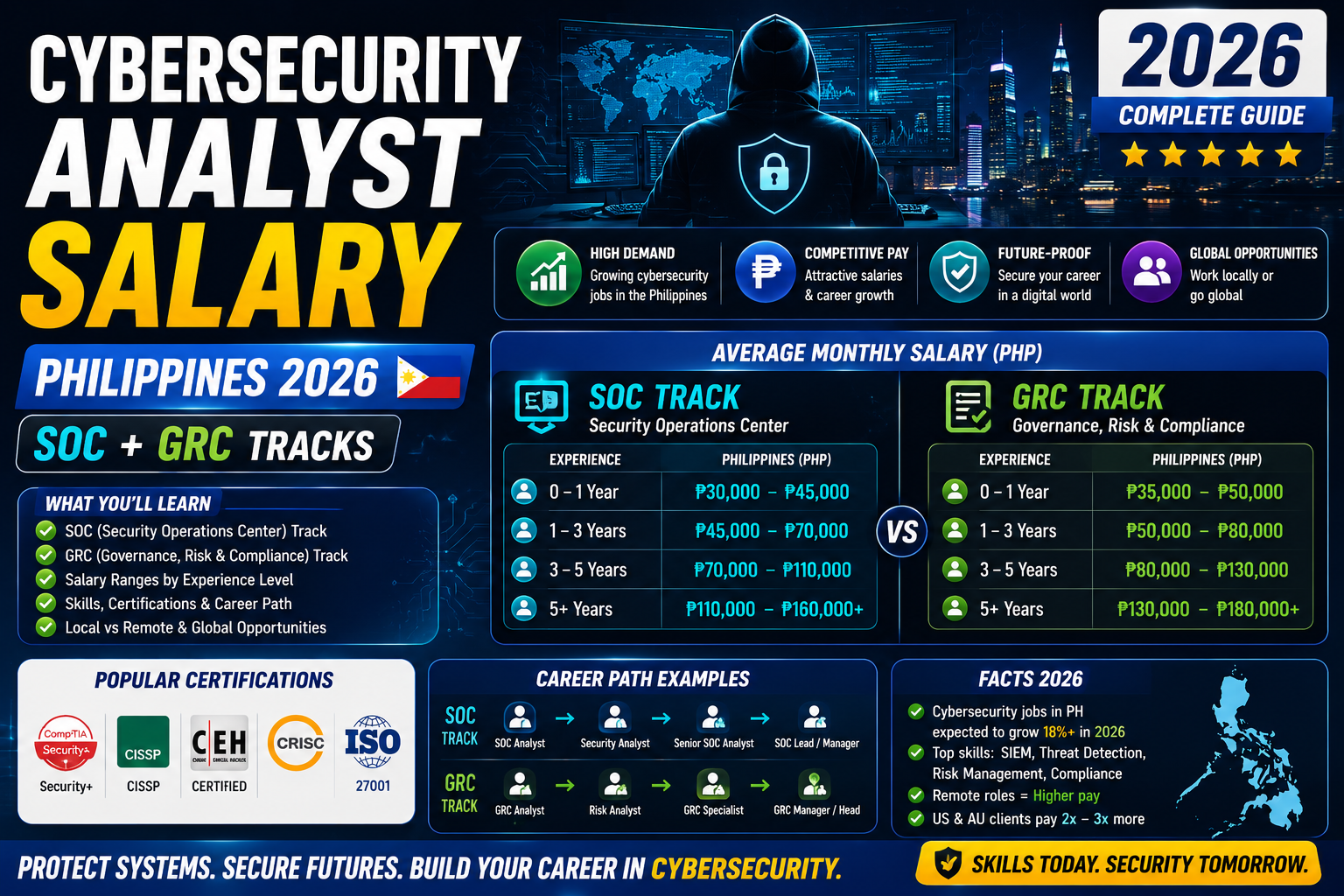
Cybersecurity is one of the fastest-growing tech fields in the Philippines, driven by data privacy regulations (Data Privacy Act, PSA 173), rising cyberattack rates, and BPO demand from foreign clients. Cybersecurity Analyst salaries have grown 20-30% over the past three years. This 2026 guide breaks down the two main career tracks (SOC and GRC), current peso ranges, and the certifications that matter most.
SOC vs GRC: two different careers
Cybersecurity Analyst is a broad title. The two main subtracks in the Philippines:
- SOC (Security Operations Center) Analyst: Technical, monitoring-focused role. Watch security event feeds, investigate alerts, respond to incidents. Uses SIEM tools (Splunk, QRadar, Sentinel), EDR platforms (CrowdStrike, SentinelOne). Requires strong technical skills.
- GRC (Governance, Risk, Compliance) Analyst: Business-focused role. Ensure the organization meets regulations (ISO 27001, NIST, GDPR, Data Privacy Act). Write policies, manage audits, assess vendor risk. Requires strong communication and documentation skills.
SOC pays slightly more early-career; GRC catches up and often surpasses at senior levels because of business impact.
SOC Analyst salary in the Philippines (2026)
- Junior SOC Analyst / Tier 1 (0-2 years): PHP 35,000 to 55,000 monthly. Watches alerts, escalates real incidents to Tier 2.
- Mid-level SOC Analyst / Tier 2 (2-4 years): PHP 60,000 to 100,000 monthly. Investigates escalated alerts, coordinates with IT for response.
- Senior SOC Analyst / Tier 3 (4-7 years): PHP 110,000 to 180,000 monthly. Handles complex incidents, hunts threats proactively, mentors juniors.
- SOC Manager / Team Lead (7+ years): PHP 180,000 to 280,000 monthly. Manages the SOC team, budget, and vendor relationships.
GRC Analyst salary in the Philippines (2026)
- Junior GRC Analyst (0-2 years): PHP 30,000 to 55,000 monthly. Assists with policies, evidence gathering, audit prep.
- Mid-level GRC Analyst (2-5 years): PHP 65,000 to 115,000 monthly. Owns specific compliance domains (like PCI-DSS or ISO 27001).
- Senior GRC Analyst (5-8 years): PHP 120,000 to 200,000 monthly. Leads audits, advises leadership on risk decisions.
- GRC Manager / CISO track (8+ years): PHP 220,000 to 400,000+ monthly. Head of security programs at mid-to-large companies.
Remote roles for foreign companies
Cybersecurity remote is highly competitive but pays well:
- Junior SOC remote for US MSSP: USD 2,500 to 4,500 monthly (PHP 140,000-260,000).
- Senior SOC remote for US enterprise: USD 5,500 to 9,000 monthly (PHP 310,000-510,000).
- Senior GRC remote for US or European company: USD 6,000 to 11,000 monthly (PHP 340,000-620,000).
- Cybersecurity Engineer roles (technical + coding): USD 7,000 to 14,000 monthly (PHP 400,000-800,000).
Time zone can be a barrier for SOC roles requiring 24/7 shift coverage. GRC roles are more flexible for PH-based candidates working with US or European teams asynchronously.
Certifications that boost salary the most
Entry-level (essential first cert):
- CompTIA Security+: The standard entry cert. Cost: about PHP 20,000. Nearly every SOC Tier 1 role requires or prefers it. Adds PHP 8,000-15,000 to your salary.
- Certified in Cybersecurity (CC) by ISC2: Newer entry cert, free for the first 100,000 candidates. Good alternative if Security+ is out of budget.
Mid-level:
- CompTIA CySA+: Cyber security analyst focused. About PHP 25,000. Signal for SOC Tier 2 roles.
- Certified Ethical Hacker (CEH): Very popular in Filipino market. About PHP 40,000. Adds PHP 15,000-30,000 salary boost.
Senior / specialized:
- CISSP: The gold standard for senior security roles. About PHP 40,000. Adds PHP 30,000-60,000 monthly. Requires 5 years documented security experience.
- CISM: Management-focused, complements CISSP. Similar cost and salary impact for GRC/management tracks.
- CISA: Audit-focused, essential for GRC roles in regulated industries (banks, healthcare).
- CCSP: Cloud security, growing in demand as PH companies migrate to AWS/Azure.
Combine one entry (Security+) + one mid (CySA+ or CEH) + one senior (CISSP or CISM) over 5-7 years to command top salaries.
SOC Analyst technical skills to master
- SIEM tools: Splunk (dominant in enterprise), Microsoft Sentinel (fastest growing), IBM QRadar, LogRhythm. Learn one deeply.
- EDR platforms: CrowdStrike Falcon, SentinelOne, Microsoft Defender for Endpoint. Understand how to investigate detections.
- Network security fundamentals: Firewalls, IDS/IPS, VPN, network segmentation. TCP/IP internals.
- Windows and Linux administration: Understand where logs live, what normal looks like, and how attackers hide.
- Threat intelligence: MITRE ATT&CK framework, common threat actors, indicators of compromise.
- Scripting (Python or PowerShell): Automate common investigation tasks. Bonus but growing requirement.
GRC Analyst skills to master
- Regulatory frameworks: Philippine Data Privacy Act (RA 10173), PSA 173, and international ones like ISO 27001, NIST CSF, GDPR, HIPAA (for BPOs supporting healthcare clients).
- Policy writing: Clear, unambiguous documentation of security controls.
- Audit management: How to prepare for and pass external audits (SOC 2, ISO 27001).
- Risk assessment: Quantify and prioritize risks using frameworks like NIST 800-30.
- Vendor risk management: Assess third-party security posture during procurement.
- Communication: Explain security requirements to non-security business leaders in their language.
Best companies hiring Cybersecurity Analysts in the Philippines
- BPOs with security operations: Accenture, Concentrix, TDCX. Steady 24/7 SOC roles.
- Local fintechs: GCash, Maya, Union Bank. Both SOC and GRC roles.
- Local telecoms: Globe, PLDT, Converge. Large in-house SOC teams.
- Multinationals: Google, Microsoft, IBM Security. Higher pay, more technical work.
- Managed Security Service Providers (MSSP): KPMG, Deloitte, Trustwave. Client-facing SOC roles.
- Remote / foreign employers: US MSSPs like Arctic Wolf, Rapid7. UK/EU roles via Toptal Security or LinkedIn.
Career path: entry to senior in 6-8 years
- Year 0-1: Land Junior SOC or GRC role. Get Security+ certification within the first 6 months.
- Year 1-3: Master one SIEM tool (Splunk or Sentinel) if SOC track; master one compliance framework (ISO 27001 or NIST) if GRC. Get CySA+ or CEH.
- Year 3-5: Move to mid-level. Own specific incident types (phishing response, cloud security) or compliance domains (PCI-DSS, HIPAA).
- Year 5-6: Earn CISSP. Move into senior IC or manager track.
- Year 6-8: Senior SOC Analyst / GRC Manager. Salary PHP 150,000+ locally or USD 6,000+ remote.
Common misconceptions
- “You need a Cybersecurity degree.” No. BSIT, BSCS, Computer Engineering, or even non-tech backgrounds all get hired. Certifications matter more than degree specifics.
- “You need to be a hacker.” Most cybersecurity work is defensive: investigating alerts, writing policies, running audits. Offensive security (penetration testing) is a specialized subfield.
- “You need years of IT experience first.” Helpful but not required. Many Filipinos enter cybersecurity directly with a Security+ cert and boot camp experience.
- “AI is going to replace SOC analysts.” AI augments SOC work (alert triage, false positive reduction) but does not replace the human judgment for real incidents. Senior analysts who use AI as a tool become more productive.
- “Cybersecurity jobs are only at big BPOs.” Growing at Filipino fintechs, e-commerce, and remote foreign roles. BPOs are the largest employer but not the only path.
Official documentation
Recommended VPN
The link below is an affiliate link. We may earn a commission at no extra cost to you. See our affiliate disclosure.
Frequently asked questions
How do I start a Cybersecurity career with no experience?
Get CompTIA Security+ (or the free ISC2 CC) as your first cert. Apply for Junior SOC Tier 1 roles at BPOs, MSSPs, or Filipino fintechs. Build a home lab (TryHackMe, HackTheBox) to demonstrate hands-on skill. Most Filipino security careers start at PHP 30,000-45,000 monthly.
Is CISSP worth it in the Philippines?
Yes at Senior level (5+ years experience). CISSP adds PHP 30,000-60,000 monthly to your salary and unlocks senior IC and management roles. Requires 5 years documented security experience to earn. Cost about PHP 40,000. High ROI for career progression.
Do SOC Analysts work night shifts in the Philippines?
Often yes. Many SOC roles are 24/7, so you rotate through shifts. BPOs supporting US clients typically require night shifts (9 PM to 6 AM PH). Night differential pay compensates (usually 10-25% premium). GRC roles are usually daytime only.
Can I do cybersecurity remotely from the Philippines?
Yes, especially GRC roles. SOC roles requiring 24/7 shift coverage can be remote for US-timezone shifts. Foreign US-based MSSPs and enterprises actively hire PH-based security analysts at USD 3,000-9,000 monthly.
Should I choose SOC or GRC as an entry path?
SOC if you enjoy technical work, live incidents, and network/system deep-dives. GRC if you prefer documentation, communication with business leaders, and structured audit work. SOC has slightly higher early salaries; GRC often surpasses at senior levels.
Is cybersecurity a stable career in the Philippines long-term?
Yes. Cyberattack rates are growing 20-30% annually. Philippine data privacy regulations are tightening. Foreign companies increasingly hire PH-based security talent. Demand exceeds supply, especially for senior CISSP-holding candidates. Job stability is high.