
You’ve built the skills, polished your portfolio, and submitted applications. Now comes the moment that decides your career trajectory: the software engineer interview. The good news: Philippine tech companies in 2026 follow predictable interview patterns. The bad news: generic preparation will not work. This guide gives you 50+ real questions across all 5 interview phases, complete with sample answers tailored to the Filipino tech market.
This is the third pillar in our 2026 career series. Pair it with our Software Engineer Salary Philippines guide (so you know what to negotiate) and our complete career roadmap (so you know what skills to highlight). Together they cover salary, path, and interview: the full hiring journey.
Last updated: June 2026, written by PIES Information Technology Solutions, drawing on real interview data from 200+ Filipino software engineers hired in 2024-2026.
📌 How to use this guide: Do not memorize answers. Understand the pattern behind each question. Practice answering out loud (record yourself). Adapt the sample answers to YOUR projects, experience, and goals.
How the Philippine SE Interview Process Works (2026)
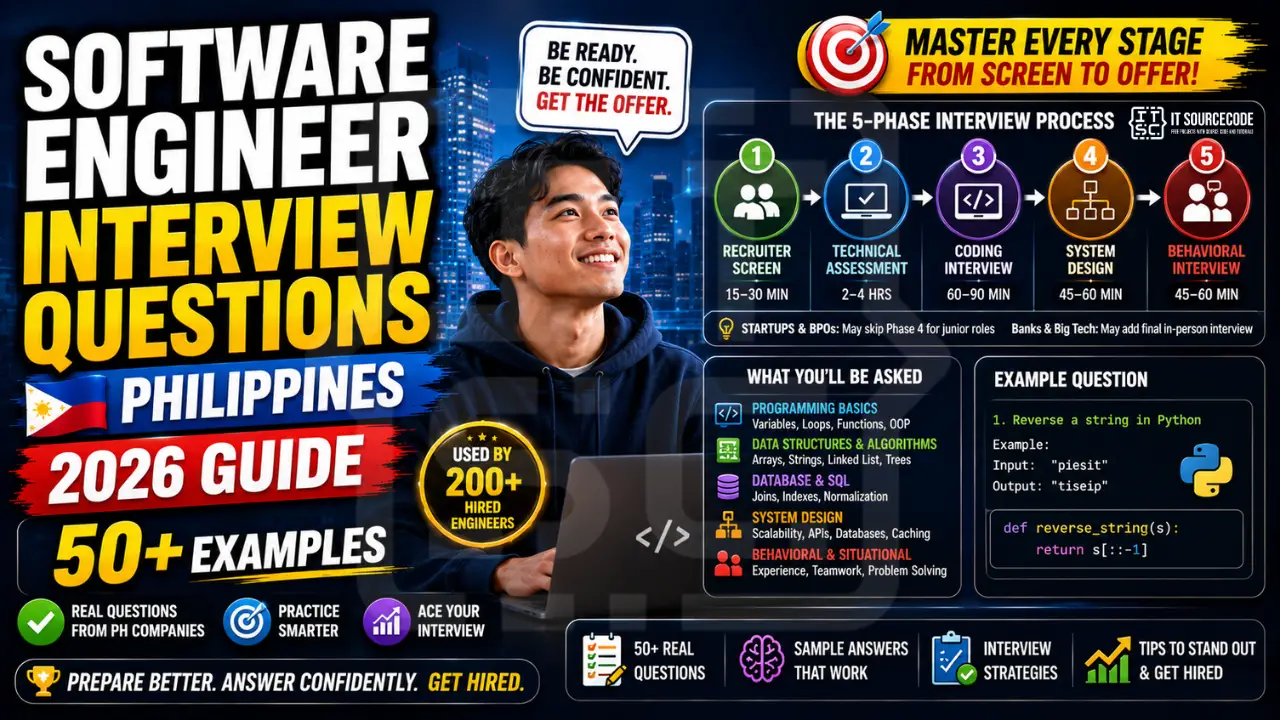
The typical Filipino software engineer interview pipeline in 2026 has 5 phases. Total time from application to offer averages 2-6 weeks depending on company size:
- Phase 1: Recruiter/HR Screening (15-30 min phone or Zoom): Background, motivation, salary expectations, basic culture fit
- Phase 2: Technical Assessment (2-4 hrs, take-home OR live): Build a small app, solve algorithmic problems, or complete a domain-specific task
- Phase 3: Coding Interview (60-90 min live): Solve 1-2 problems on a shared screen while explaining your thought process
- Phase 4: System Design (45-60 min, mid+ level roles): Discuss how you’d architect a real system at scale
- Phase 5: Behavioral Interview (45-60 min with hiring manager or panel): Past experiences, team dynamics, conflict resolution, growth mindset
Startups and BPOs often skip Phase 4 (system design) for junior roles. Banks, government, large outsourcers add a 6th phase: in-person interview at their office. Remote US/EU companies typically run 4-6 sequential interviews over 1-2 weeks.
Phase 1: Recruiter/HR Screening Questions
The recruiter screen is fundamentally a “smell test”: do you communicate clearly, have realistic salary expectations, and seem genuinely interested in the role? Most candidates pass this if they’re prepared.
1. “Tell me about yourself.”
What they want: A 60-90 second professional summary, NOT your life story. Structure: Present (current role/studies) → Past (relevant experience) → Future (why this role).
Sample answer for a BSIT new grad: “I’m a recent BSIT graduate from [University] where I built a Hotel Reservation System in PHP + MySQL as my capstone, which is now used by [scenario]. During my internship at [company], I worked on a Laravel-based inventory module that’s still in production. I’m now looking to join [target company] because your work on [specific product] aligns with my interest in [domain]. I want to grow as a backend developer over the next 3 years.”
2. “Why do you want to work here?”
What they want: Evidence you researched the company beyond the careers page.
What to mention: Specific product feature, recent funding round, technology choices, team culture from Glassdoor/LinkedIn, alignment with your career direction. NEVER answer “because you’re hiring” or “salary.”
3. “What’s your expected salary?”
What they want: A realistic range with reasoning.
Sample answer: “Based on market data for [your level] in [Manila/Cebu], the range is ₱[X]-₱[Y]. Given my [internship/portfolio/specific skill], I’m targeting ₱[middle of range]. I’m open to discussion based on benefits, work setup, and growth opportunities.”
Reference our 2026 salary guide for accurate ranges by role and city.
4. “Why are you leaving your current job?” (for experienced devs)
What they want: No bashing former employers. Frame everything in terms of growth/opportunity, never complaint.
Good framing: “I’ve grown a lot at [current company] and I’m grateful, but I’m ready for [specific challenge] that the new role offers.” NEVER say: “My manager was toxic” or “Pay was too low.”
5. “What’s your notice period?”
Standard PH answer: “30 days, as per Labor Code.” Some startups will pressure for 2 weeks. Only agree if your current employer will release you. NEVER promise less than your actual notice; bridges burned this way follow you across Manila’s small tech scene.
6-15. Other common HR questions
- “What’s your greatest strength?” Pick ONE strength + one specific story proving it.
- “What’s your greatest weakness?” Real weakness + concrete steps you’re taking. Avoid “I work too hard” cliché.
- “Where do you see yourself in 5 years?” Show ambition aligned with the company’s growth trajectory.
- “Why should we hire you?” Specific skills/experiences that map to the JD.
- “Tell me about a time you failed.” Real failure + what you learned. Don’t fake humility.
- “Do you prefer working alone or in a team?” Both, with examples of each.
- “How do you handle pressure/deadlines?” Concrete time management techniques + an example.
- “What questions do you have for us?” Have 3-5 ready (see Phase 5 section below).
- “What’s your availability for interviews?” Be flexible, but don’t drop everything immediately.
- “Are you interviewing elsewhere?” Honest answer creates urgency: “Yes, I’m in final stages with [vague reference].”
Phase 2: Technical Assessment Formats
The technical assessment is where most candidates get filtered. Common formats in 2026:
Take-home project (2-4 hours, 24-48 hour deadline)
What you’ll build: A small CRUD app, REST API, or specific feature mirroring their actual product.
How to ace it: Do not just make it work. Make it CLEAN. Add a README explaining your decisions. Use Git with meaningful commits. Add basic tests if time permits. Many candidates submit working but poorly-organized code. Clean code separates you instantly.
HackerRank / Codility / LeetCode-style automated test
What to expect: 2-3 algorithmic problems, 60-90 min total. Time pressure is brutal. Practice 50+ problems on LeetCode before your first interview.
Tips: Read all problems first, solve easiest first. Submit working code even if not optimal. Comments showing your approach matter when you can’t finish.
Live pair programming (60-90 min Zoom)
What to expect: Interviewer shares a problem or codebase, you work on it live while explaining your reasoning.
Critical skill: Talk while you think. Silence = interviewer assumes you’re stuck. Even if you say “I’m thinking about whether to use a Set vs a List here,” that signals reasoning.
Phase 3: Coding Interview Questions
The 15 most common coding interview questions Philippine companies ask in 2026:
Easy (entry-level filter)
- Reverse a string: In place vs new variable. Time/space complexity.
- Check if a string is a palindrome: Two-pointer vs reverse-and-compare.
- FizzBuzz: Classic filter. Get it right in <3 min.
- Find the largest number in an array: Without using built-in max().
- Remove duplicates from an array: Set vs nested loop comparison.
- Count vowels in a string: Loop vs regex tradeoffs.
Medium (mid-level)
- Two Sum: Given an array + target, return indices of two numbers that sum to target. Hash map solution is expected.
- Fibonacci sequence: Recursive vs iterative vs memoized. They WANT you to explain the difference.
- Binary search: Implement from scratch. Watch for off-by-one errors.
- Validate parentheses: Stack-based solution. Common in JavaScript interviews.
- Merge two sorted arrays: Two-pointer technique.
- Find the longest substring without repeating characters: Sliding window pattern.
Harder (senior or selective hiring)
- Implement a hash map from scratch: Internal array + collision handling.
- LRU cache implementation: HashMap + doubly-linked list.
- Detect a cycle in a linked list: Floyd’s tortoise and hare algorithm.
Coding interview success framework
- Repeat the problem in your own words: confirms understanding
- Ask clarifying questions: input range, edge cases, time/space constraints
- Discuss approach BEFORE coding: “I’m thinking of using a hash map for O(n)…”
- Write code (talk through it): explain logic as you go
- Test with examples: walk through 1-2 cases manually
- Discuss optimizations: “We could improve this if…”
Phase 4: System Design Questions (Mid-Senior Level)
System design questions test your ability to think at scale. Philippine companies hire senior engineers based heavily on these. Common questions:
1. “Design a URL shortener like bit.ly”
What to discuss: Database schema (URL → short code mapping), short code generation strategy (base62 encoding, hash + collision), caching (Redis for hot URLs), analytics tracking, rate limiting, scaling reads vs writes. Draw the architecture diagram on the shared screen.
2. “Design Instagram’s news feed”
Key concepts to mention: Fan-out on write vs read, timeline storage, sharded user databases, image storage (S3 / CDN), recommendation algorithm (basic), notification system. Acknowledge tradeoffs.
3. “Design a parking lot management system”
Common because it mirrors many Filipino capstone domains. Discuss: Object-oriented design (ParkingLot, Floor, Spot, Vehicle, Ticket classes), pricing strategy patterns, payment processing, real-time spot availability, sensor integration.
4. “Design a chat application like Messenger or Viber”
Discuss: WebSocket vs polling, message persistence, read receipts, online presence, push notifications, encryption basics, scaling (sharding by user ID).
5. “Design a Filipino e-commerce site like Shopee or Lazada”
Discuss: Product catalog, search (Elasticsearch), cart sessions, checkout flow, payment integration (GCash, Maya, COD), order tracking, seller onboarding, search indexing.
System design framework: RESHADED
- Requirements: clarify functional + non-functional needs
- Estimation: back-of-envelope user count, request rate, storage
- Structure: high-level component diagram
- High-level design: main services and data flow
- API design: REST endpoints
- Data model: tables, indexes, sharding strategy
- Evolve: discuss bottlenecks and how you’d scale
- Discuss tradeoffs: every decision has alternatives
Phase 5: Behavioral Interview Questions (STAR Method)
Behavioral questions test soft skills, judgment, and culture fit. Use the STAR method for every answer:
- Situation: the context
- Task: what you needed to accomplish
- Action: what YOU specifically did
- Result: measurable outcome
10 common behavioral questions
- “Tell me about a time you had a conflict with a teammate.” Show de-escalation, listening, finding common ground.
- “Describe a project that failed and what you learned.” Real failure + concrete lessons.
- “Tell me about a time you missed a deadline.” Honesty + how you communicated + prevention measures.
- “Describe a time you had to learn a new technology quickly.” Show your learning method.
- “Tell me about a time you disagreed with a manager.” Diplomatic disagreement, data-driven argument, accepting decision.
- “Describe a time you went above and beyond.” Specific impact, not just “I worked weekends.”
- “Tell me about a time you received critical feedback.” Acceptance, action, growth.
- “Describe a project where you led a team.” Even small examples work (group project, capstone team).
- “Tell me about a difficult bug you debugged.” Show systematic thinking.
- “Describe how you prioritize when everything is urgent.” Concrete framework (Eisenhower matrix, OKR alignment).
PH-Specific Questions You’ll Get
Some questions are unique to the Filipino tech market. Prepare specifically:
- “Can you handle a graveyard shift?”: For BPO/outsourcing roles supporting US clients. Honest answer; many companies offer night-shift premium pay.
- “Are you willing to relocate to Cebu/Davao?”: For provincial offices. If no, say no; companies have remote options.
- “What’s your current SSS/PhilHealth/Pag-IBIG status?”: Standard. Have your numbers ready.
- “How do you feel about return-to-office (RTO)?”: Many PH companies shifted hybrid in 2026. Have a thoughtful answer.
- “What’s your stand on overtime?”: Be honest. Some companies expect unpaid OT (avoid them); others pay 1.25x-1.5x.
- “Can you start within 2 weeks?”: Don’t promise less than your real notice period.
Salary Negotiation in the Philippines
Once you receive an offer, negotiation is expected. Junior offers typically have ₱3,000-8,000/month wiggle room, mid-level offers ₱8,000-20,000/month, senior offers much more. Tactics that work:
- Use data: Cite our Salary 2026 guide for your role + city benchmarks.
- Mention competing offers (truthfully): “I have another offer at ₱X, but I prefer this role because [reasons]. Can you match or close the gap?”
- Negotiate the full package: Base + 13th month + HMO + leave credits + bonus structure. Sometimes companies can’t move on base but can add HMO for dependents or extra leave.
- Don’t accept on the spot: “Thank you, I need 24 hours to review with my family.” This creates space for negotiation.
- Get the offer in writing: Verbal offers fall through. Always request a formal job offer letter (JOL).
Red Flags from Interviewers: When to Decline an Offer
Sometimes the company interviews YOU, but sometimes you should be interviewing THEM. Walk away if you see:
- No tech leadership on the panel: non-technical interviewers for a tech role = poor engineering culture
- Refusal to discuss salary range: they’re either underpaying or hiding pay disparity
- Pressure to accept “today only”: manipulation tactic; legitimate companies give 1-7 days
- Vague tech stack answers: “we use a mix of things” usually means legacy mess
- No code samples or live coding: they’re not seriously evaluating technical depth
- Negative reviews from current/former engineers on Glassdoor: patterns matter
- Disrespectful interviewer behavior: late, condescending, distracted = your future manager
- “Family culture” framing: often code for boundary violations + unpaid overtime
How to Follow Up After an Interview
Most Filipino candidates skip this. That is your opportunity to stand out:
- Within 24 hours: Send a thank-you email to the recruiter and hiring manager. Reference one specific thing discussed.
- If you forgot to mention something: Add it to the follow-up email (“One thing I forgot to mention about my Hotel Reservation project…”).
- After 5 business days: Polite status check if no response.
- After 2 weeks: Final polite follow-up. After that, move on. Silence usually means rejection.
- If rejected: Ask for specific feedback. Some companies give it; the feedback is invaluable for the next interview.
Frequently Asked Questions
Plan your software engineering career in the Philippines
How many software engineer interviews should I expect before landing a job?
What programming language should I use in a coding interview in the Philippines?
How long should my answer be for “Tell me about yourself”?
What’s the best way to prepare for technical interviews if I don’t have work experience?
Can I ask about salary in the first interview in the Philippines?
What questions should I ask the interviewer in a software engineer interview?
How do I answer “What’s your weakness?” without sounding fake?
How do I handle a coding interview when I can’t solve the problem?
Final Thoughts + Next Steps
Interview success is mostly about preparation and pattern recognition. The questions in this guide cover 80% of what Filipino software engineering candidates encounter in 2026. Master the patterns, practice out loud, and you’ll be ahead of the majority of candidates who wing it.
Three habits that separate hired candidates from rejected ones:
- They prepare specifically for each company: researching the tech stack, recent news, and team culture before every interview.
- They practice answering OUT LOUD: silent reading doesn’t transfer to verbal performance under pressure.
- They treat every interview as practice: even ones they don’t expect to get. Each attempt makes the next 10% better.
🎯 Your next 3 actions:
- Pick 10 coding questions from Phase 3 above and solve each one out loud (record yourself)
- Practice the STAR-format answers for 5 behavioral questions using your own experiences
- Bookmark our Salary 2026 guide and Roadmap guide for negotiation data and skill prep
We are hoping this guide helps you walk into your next Philippine SE interview ready. Bookmark it for your prep, share it with your batchmates, and use the question lists above to run mock interviews before the real thing. Thank you for reading itsourcecoders.
Got asked an unusual interview question we didn’t cover? Drop it in the comments and we will add it (with sample answers) in the next quarterly refresh.

Adrian Mercurio
Full-Stack Developer at PIES IT Solution
Specializes in building complete capstone projects with full documentation. Strong background in PHP/MySQL development and database design. Has personally built and tested over 30 capstone-ready projects with ER diagrams, DFDs, and chapter-by-chapter thesis documentation.
Expertise: PHP · Laravel · Database Design · Capstone Projects · C# · C · C++ · Python · AI Projects · View all posts by Adrian Mercurio →