
Dynamic Programming (DP) has a reputation as the hardest DSA topic. It is not hard, it is just different: instead of solving a problem directly, you break it into overlapping subproblems and cache their answers. This 2026 guide teaches DP through examples every developer will recognize: Fibonacci, climbing stairs, house robber, coin change, and the 0/1 knapsack. Master the pattern once and every DP problem becomes a variant.
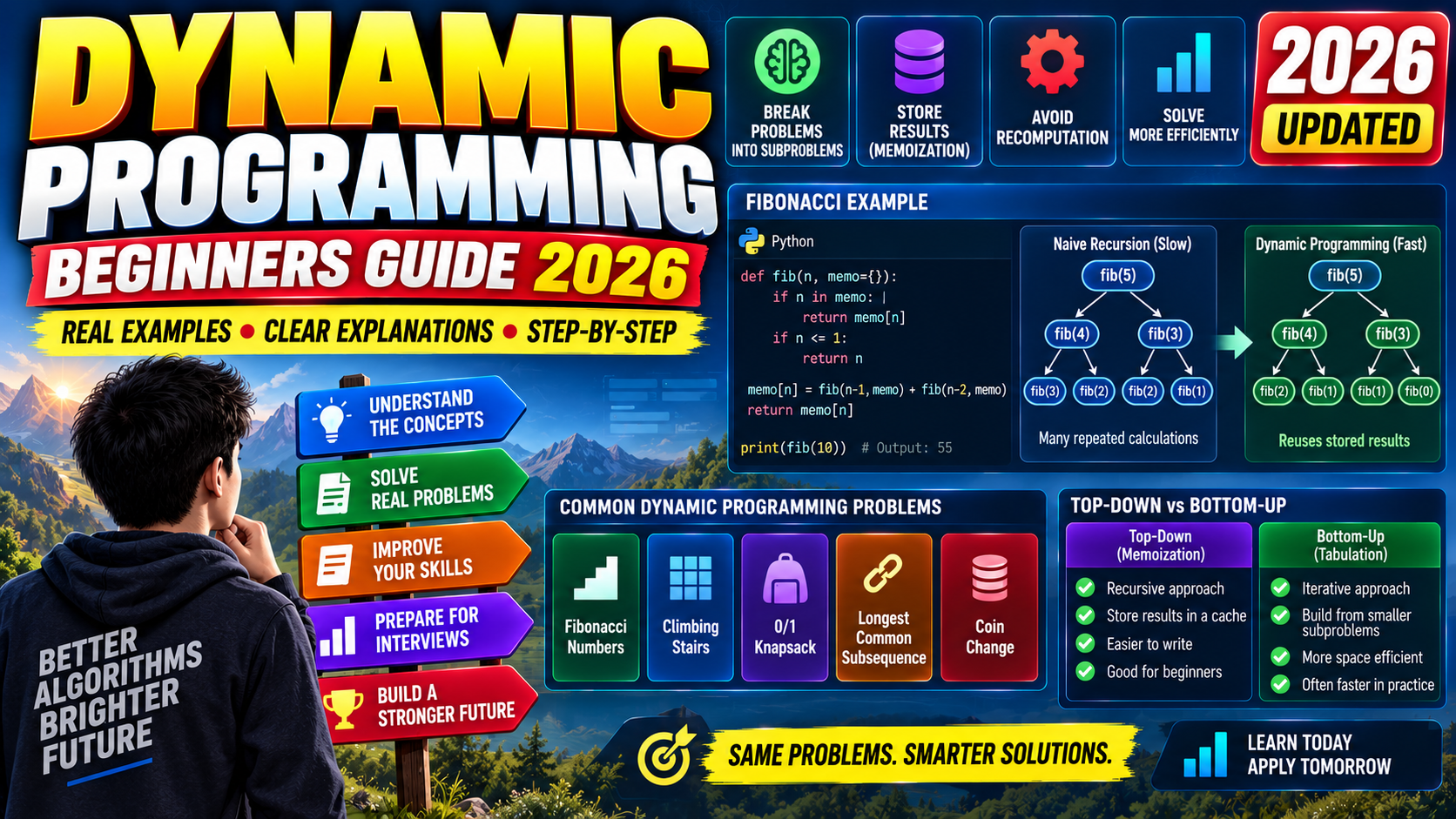
Quick 2026 verdict
DP applies when your problem has: (1) overlapping subproblems (same smaller problem solved multiple times) and (2) optimal substructure (optimal solution builds from optimal subsolutions). Two implementations: memoization (top-down recursion with cache) or tabulation (bottom-up loop filling a table). Both give the same complexity. Memoization reads cleaner; tabulation avoids recursion depth issues. Master 5 canonical problems and you handle 80 percent of interview DP questions.
What is Dynamic Programming actually
DP is a technique for solving problems by combining solutions to smaller subproblems. The two ingredients that make a problem DP-shaped:
- Overlapping subproblems. The naive recursive solution computes the same subproblem many times.
- Optimal substructure. The optimal answer to the whole problem can be built from optimal answers to smaller subproblems.
Fibonacci has both. Naive recursion computes fib(5), fib(4), fib(3), fib(2) many times each. And the optimal fib(n) is just fib(n-1) + fib(n-2). Perfect DP fit.
Divide-and-conquer (merge sort) has optimal substructure but no overlap. Merge sort’s subproblems are all different halves of the array. That is why merge sort is NOT dynamic programming; it is plain recursion + combine.
Two ways to implement DP: memoization vs tabulation
Memoization (top-down): write the natural recursion, cache each unique call.
from functools import lru_cache

@lru_cache(maxsize=None)
def fib(n):
    if n <= 1: return n
    return fib(n - 1) + fib(n - 2)

fib(100)   # instant, correct
Tabulation (bottom-up): loop from smallest subproblem up, filling a table.
def fib(n):
    if n <= 1: return n
    table = [0] * (n + 1)
    table[1] = 1
    for i in range(2, n + 1):
        table[i] = table[i-1] + table[i-2]
    return table[n]
Same complexity: O(n) time, O(n) space. Memoization is easier to write once you know the recursion. Tabulation is more predictable in performance (no recursion overhead, no Python 1,000-depth limit).
Space optimization: since fib(i) only needs fib(i-1) and fib(i-2), you can drop the table entirely and just track two variables. O(n) time, O(1) space. This "space reduction" trick applies to many DP problems.
Canonical Problem 1: Climbing Stairs
Problem: You climb a staircase of n steps. Each turn you can climb 1 or 2 steps. How many distinct ways to reach the top?
Insight: To reach step n you either came from step n-1 (took 1 step) or from step n-2 (took 2 steps). So ways(n) = ways(n-1) + ways(n-2). This is Fibonacci in disguise.
def climb_stairs(n):
    if n <= 2: return n
    prev, curr = 1, 2
    for _ in range(3, n + 1):
        prev, curr = curr, prev + curr
    return curr
O(n) time, O(1) space. First DP problem most students meet on LeetCode.
Canonical Problem 2: House Robber
Problem: A row of houses. You cannot rob two adjacent houses. Maximize money robbed.
Insight: At each house you decide: rob it and skip the previous, OR skip it. So max_money(i) = max(max_money(i-1), max_money(i-2) + money[i]).
def rob(nums):
    if not nums: return 0
    prev, curr = 0, 0
    for money in nums:
        prev, curr = curr, max(curr, prev + money)
    return curr

print(rob([2, 7, 9, 3, 1]))    # 12 (rob 2, 9, 1)
Same "Fibonacci-shaped" recurrence but with a max() decision. Space-optimized to O(1). This is the pattern for many "choose or skip" problems.
Canonical Problem 3: Coin Change (fewest coins)
Problem: Given coins and a target amount, return the fewest coins needed. Return -1 if impossible.
Insight: To make amount A with minimum coins, try each coin c. min_coins(A) = 1 + min(min_coins(A - c) for c in coins if c <= A).
def coin_change(coins, amount):
    INF = amount + 1
    dp = [INF] * (amount + 1)
    dp[0] = 0
    for a in range(1, amount + 1):
        for c in coins:
            if c <= a:
                dp[a] = min(dp[a], dp[a - c] + 1)
    return dp[amount] if dp[amount] != INF else -1

print(coin_change([1, 2, 5], 11))    # 3 (5 + 5 + 1)
O(amount × len(coins)) time, O(amount) space. Bottom-up tabulation because it is easier to write than the memoized version here.
Canonical Problem 4: Longest Increasing Subsequence
Problem: Find the length of the longest strictly increasing subsequence.
def length_of_lis(nums):
    if not nums: return 0
    dp = [1] * len(nums)
    for i in range(1, len(nums)):
        for j in range(i):
            if nums[j] < nums[i]:
                dp[i] = max(dp[i], dp[j] + 1)
    return max(dp)

print(length_of_lis([10, 9, 2, 5, 3, 7, 101, 18]))    # 4 (2, 3, 7, 101)
O(n²) with basic DP. Can be optimized to O(n log n) with patience sort + binary search, but O(n²) usually gets full credit in interviews. The pattern here: dp[i] = longest LIS ending at index i.
Canonical Problem 5: 0/1 Knapsack
Problem: Given items with weights and values, and a max weight capacity, maximize total value.
def knapsack(weights, values, capacity):
    n = len(weights)
    dp = [[0] * (capacity + 1) for _ in range(n + 1)]
    for i in range(1, n + 1):
        for w in range(capacity + 1):
            if weights[i-1] <= w:
                dp[i][w] = max(
                    dp[i-1][w],                            # skip item i
                    dp[i-1][w - weights[i-1]] + values[i-1]  # take item i
                )
            else:
                dp[i][w] = dp[i-1][w]
    return dp[n][capacity]

print(knapsack([1, 3, 4, 5], [1, 4, 5, 7], 7))    # 9
O(n × capacity) time and space. 2D DP: rows = items considered, columns = remaining capacity. Every "take it or leave it" DP problem is a knapsack variant.
The DP problem-solving framework
- Identify the state. What defines "where you are" in the problem? For Fibonacci: n. For coin change: amount. For knapsack: (items considered, capacity remaining).
- Write the recurrence. How does the state at step i relate to states at earlier steps?
- Identify the base case. What is the answer for the smallest input? Usually dp[0] or dp[1].
- Decide top-down or bottom-up. Memoization if the recursion is natural. Tabulation if you can see the fill order.
- Space-optimize. If dp[i] only depends on dp[i-1] and dp[i-2], drop the array and keep two variables.
Common mistakes on DP problems
- Confusing DP with recursion. DP is recursion with caching (or the equivalent iterative version). Plain recursion without overlap is not DP.
- Wrong base case. Off-by-one on dp[0] or dp[1] breaks the whole table.
- Wrong table dimensions. Knapsack needs (n+1) × (capacity+1), not n × capacity. The extra row/column handles the "no items" or "zero capacity" base case cleanly.
- Filling the table in the wrong order. Bottom-up must fill smaller subproblems before they are needed. Watch loop order carefully.
- Not verifying with the brute force answer. On small inputs, compare DP output to naive recursion. If they disagree, your recurrence is wrong.
Official documentation
Frequently Asked Questions
Is memoization always the same as dynamic programming?
Yes, when applied to a problem with overlapping subproblems and optimal substructure. Memoization is one implementation strategy for DP (top-down). Tabulation is the other (bottom-up). Both solve the same problem in the same complexity.
Which is better, memoization or tabulation?
Memoization reads more naturally (write the recursion, add @lru_cache, done). Tabulation avoids Python's recursion depth limit and has slightly less overhead. Both give the same complexity. Personal preference varies; in interviews, memoization gets you to a correct answer faster.
How do I recognize a DP problem in an interview?
Signals: "how many ways", "minimum/maximum X to achieve Y", "given these choices at each step". If the problem asks for a count or optimum and involves choices that build on smaller versions, try DP. Also, if brute force recursion works but is too slow (O(2^n)), memoize it and see if it fits.
Is greedy the same as DP?
No. Greedy makes the locally-best choice at each step and hopes for the global optimum. DP considers ALL choices at each step and picks the best globally. Coin change is a classic case: greedy (always take the biggest coin) fails for [1, 3, 4, 6] making 8 (greedy takes 6+1+1 = 3 coins, DP finds 4+4 = 2 coins).
Why is DP so intimidating to learn?
Because textbooks present DP as a bag of unrelated tricks (knapsack, LCS, edit distance, etc.) rather than a unified pattern. Once you internalize the "identify state, write recurrence, cache or tabulate" framework, most problems fit one of about 6 templates. NeetCode DP section walks through this shift.
How many DP problems should I solve before interviews?
15-25 well-understood problems, covering: 1D DP (climbing stairs, house robber), 2D DP (knapsack, LCS), string DP (edit distance, palindromic substrings), interval DP (matrix chain, burst balloons), tree DP (house robber III). Grinding 100 problems without a framework does not help.
Related DSA + Interview tutorials
- Big-O Notation Complete Guide for Beginners 2026
- Recursion Explained with Real Examples 2026
- HashMap Deep Dive 2026 Python + Java + JavaScript
- Graph Algorithms Complete 2026 Guide (coming later today)
Official documentation
- Python.org: functools.lru_cache decorator
- Wikipedia: Dynamic programming
- NeetCode: Curated DP problem list

Angel Jude Suarez
Full-Stack Developer at PIES IT Solution
Focuses on Python development, machine learning, and AI integration. Has built production AI systems including OpenAI Whisper integration for medical transcription and GPT-4o-powered diagnosis assistance. Strong background in pandas, scikit-learn, and TensorFlow.
Expertise: Python · PHP · Java · VB.NET · ASP.NET · Machine Learning · AI Integration · OpenCV · Django · CodeIgniter · View all posts by Angel Jude Suarez →